
Proponents of Measure B promise voter ID. Here’s the rest of the story.
In addition to voter ID requirements, Measure B would put in place a number of other changes that, like voter ID, are currently illegal in California, including hand-counting and disconnecting Shasta’s voter rolls from those of the state. If passed by voters, the measure would likely result in costly lawsuits that would be paid for by Shasta’s taxpayers.
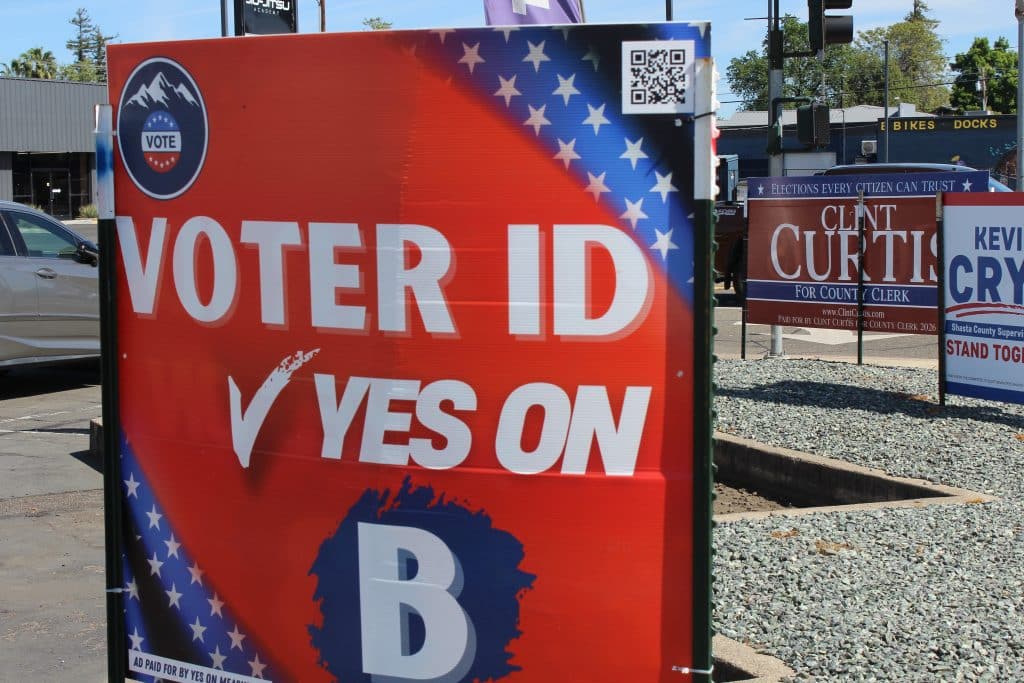
Around town, signs promoting Measure B communicate to the public that a “yes” on the ballot measure will implement voter ID requirements. It’s signage that tells only part of the story.
The wording of the ballot measure also calls for eliminating most early voting, limiting who can cast an absentee ballot, requiring hand-counting of all ballots at the precinct level, and separating local voter rolls from those of the state, all of which appear illegal to implement under current state and federal laws.
Measure B is intended to “secure” local elections. It was championed by a group of election activists, several of whom have since been hired as election staff by current Registrar of Voters Clint Curtis.
Supervisor Chris Kelstrom, is opposing Measure B for legal reasons. At a recent candidate forum, Kelstrom said if the measure is passed, it’s “not if a lawsuit will be initiated, it’s when the lawsuit will be initiated.”
His lack of support is notable because like many Californians, Kelstrom supports the implementation of voter ID laws. He’s also promoting a statewide ballot measure for voter ID brought forward by Assembly member Carl DeMaio. Kelstrom has noted in comments to the public that he supports DeMaio’s ballot measure because election laws set at the state level should be changed by votes at the state level. A state-wide voter ID measure is slated to appear on ballots this fall.
The regional chapter of the American Civil Liberties Union and the League of Women Voters have also released statements in opposition to Measure B, with the ACLU expressing that Measure B plainly violates state law and exposes county taxpayers to significant litigation costs — “all in pursuit of a solution to a problem that doesn’t exist.”
What’s in the fine print?
Looking beyond Measure B’s voter ID headline and its promise that hand-counting can produce “same day results,” the ballot initiative’s text reveals other important details about the proposed process.
Alongside implementing hand-counting of votes, rather than relying on machines, Measure B would also limit who can cast an absentee ballot to the “infirm” and those in the military or living overseas. The measure also requires all ballots to be cast on Election Day, eliminating early voting and greatly restricting voting by mail. In the 2024 vote for president, about 76,400 people in Shasta County voted using their mail-in ballot — 86% of all of those who cast votes in that particular race.
Another major component of Measure B would contain Shasta County’s voter roll to “a computer with open-source software,” disconnected from an internet source that the state could access.
Manual tally method
If passed, Measure B would require Shasta to implement a manual tally, or hand count of all votes, using a format conceived by Linda Rantz. Rantz is an election activist and supporter of 2020 election skeptic Mike Lindell, who wrote the foreword to her guide “Return to Hand Counting: Missouri Method Hand Count Process.”
As reported by local Missouri media in 2023, Nicci Kammerich, the clerk in Missouri’s Osage County, agreed to facilitate an experiment comparing the process of hand-counting to the standard machine count from years prior — at the request of a group of voters. Unlike what proponents of Measure B claim, she found that the hand-count process was more expensive, took longer, and was slightly less accurate than the machines.
Kammerich resigned months after the experiment. In her resignation letter, she wrote that she and her staff were subjected to “threats, harassment, and bullying” that was affecting her physical and mental health. Her resignation came just one year before Shasta’s former and longtime Registrar of Voters Cathy Darling Allen would resign for similar reasons amid ongoing pushback to her work by the same activists who later became the original proponents of Measure B.
While the text of Measure B text states that election workers would hand-count votes in compliance with California election code, that section of the code allows hand counting only under very specific circumstances — such as a recount. In 2023, California banned hand-counting in jurisdictions the size of Shasta in 2023, in response to efforts by Kelstrom and others to implement hand-counting under Darling Allen’s leadership, and against her wishes.
Shasta is not the only place in California where citizens are attempting to implement local laws that contradict state election code. In 2024, the City of Huntington Beach tried to pass an elections-related ballot initiative demanding much less than Shasta’s Measure B. That measure required voter ID requirements, the monitoring of dropboxes, and providing more in-person polling locations.
It was struck down by the Attorney General, given that voter ID requirements contradict current state-wide legislation. In its press release on the matter, the AG stated that no city or county charter in California — like Huntington Beach and Shasta — is above the law. The California Supreme Court has declined to hear Huntington Beach’s argument in favor of the measure.
Do you have a correction to share? Email us: editor@shastascout.org.
Comments (12)
Comments are closed.
Related Articles

Redding outperforms for Ironman athletes, from beautiful yet challenging terrain to overwhelmingly supportive crowds
The Ironman 70.3 Northern California made a mark on athletes, supporters and the broader community. Hear the stories of those who participated, and see more photos from the event.

See a sneak peak of photos from the Redding Ironman triathlon
The Ironman 70.3 Northern California has passed, but it was a moment in Redding’s history to commemorate for athletes, their supporters and the Redding community.
Union representing Shasta’s election staff calls for resignation of ROV Clint Curtis
Election employees represented by Teamsters Local 137 have issued a vote of no confidence in Curtis after he responded to his censure with new allegations against staff. Another union representing election employees is expected to issue a vote of no confidence on Monday.
Please stop calling them “election activists”. They are election deniers who make claims unsubstantiated by any factual reality.
Selah
NorCal Gary: To me, the term election denier does not have a clear meaning. What are they denying?
Anytime an election has an outcome that they don’t like, they deny the election was fair.
Jolly: I’ve certainly seen all political persuasions do that, including people who typically trust the American election process.
Hi Annelise. I disagree with your “election denier” position. An “election denier” is a broadly agreed upon term to describe those who think most all elections are rigged; the most prominent being the belief that Trump won the 2020 election. This term was not born in a vacuum; neither was the term “Activist”. While I greatly appreciate your publication’s mission to be a balanced news source, in this instance, your “ both sides” analogy feels flawed.
You know, all the Measure B signs all over town kinda look like great examples of false advertising: kinda like an ad that says, “Made in USA” when the only thing made in America is the ad.
.
In reality, truth in advertising might require accurate labeling like, “Warning: This product (Measure B) is illegal and has not been approved by a court of law!” But of course, this is politics, and all is fair in war, right?
.
Measure B requires MUCH more than voter ID. It requires illegal actions like:
.
Hand-counting all ballots.
.
One-day voting.
.
Radically limiting vote-by-mail.
.
Creating separate county voter rolls disconnected from the state system.
.
Changing ballot counting procedures.
.
Volunteer ballot counters.
.
Restrictions on DMV and third-party registrations.
.
But some think the law and truth are relative. After all, Hobbs, Curtis, Jones, and Plumb (all ROV Clint Curtis hires) and most of their crew have been pushing their largely debunked, false election-conspiracy-theory lies for a long time, so I guess truth in political advertising is not required…
The law suits would be unnecessary. A preliminary injunction would be sought by the State of California in the Shasta County Superior Court if Prop 50 passes: That injunction would be promptly granted. Those who supported the passage of Prop. 50 could–without taxpayer monies–and would file a petition to contest the injunction. The hearing that followed would be funded from the coffers of the State of California and the non-taxpayer funds of the private entity opposing the injunction. The hearing would be short and the results certain: Prop. 50 could not be utilized. I do not know if the State of California can ask for a Court order to the effect that the challenger of the injunction would have to pay the costs of the State of California for defending the injunction, or if the State would seek those costs if it could do so: Bankruptcy would be a way to avoid paying those costs if they were sought and granted by the Court.
Taxpayers will be on the hook either way if Measure B passes. Proponents will sue if not implemented, opponents will sue if implemented. Only way taxpayers avoid expensive litigation costs will be to vote it down. Otherwise, Measure B is a lose-lose proposition for us taxpayers.
Maybe. I can see Measure B passing, but a reconfigured BOS refusing to allocate funds to defend it on the basis that it’s deader than fried chicken when it goes to q judge given that it violates state law in multiple ways.
.
That would put the onus on Hobbs and her clown colleagues to raise the money themselves, and I don’t think they’d be able to raise more than a couple grand. But that said, pony up, local MAGAs! Light your money on fire and let a judge piss it out! The entertainment value of that would be high for the rest of us.
Measure B is like Prop 50 or hate crimes– symbolic legislation. Want citizens to prove it with an ID before voting? Yes! Want to get sued to prove that point because state election policy has to be approved at the state level? Uh.. what? Gerrymandering is the softcore label for unconstitutional behavior and infects both parties. It is wrong in every scenario, whether you’re applying it to redistricting, victim specific penalty tiers, or local election requirements.
.
We should exchange embarassing Cesar Chavez day for a holiday called Election day. Everyone has it off. Restaurants are closed. You need an ID to vote. The absentee system remains as has worked previously for the infirm and first responders, etc. It should not be a system for rich people on vacation or those too disconnected from the country to obtain an ID.
.
And as for June 2nd, remember this–you’re trading the cult of Maga for the cult of Bethel. It’s different, not better. You can thank the spotted owl and the lack of seriously pursuing a UC campus 50 years ago for every problem we have in Shasta County.
It sucks that many of our town fathers recoiled at the prospect of landing the 10th UC campus. I was a grad student at a UC school at the time and was blown away reading a quote from a Redding politician in a major California newspaper: “We don’t want the liberal element a university would bring to Shasta County.”
.
But it’s cool. Instead, we got Hogwarts Spooky School of Supernatural Scamming.
I thought the supervisors had already decided and announced that they would not defend it in court, if it passed.
Does my memory fail?