
Meet Joanna Francescut for Shasta County’s clerk and registrar of voters
There are two candidates running for Shasta County’s clerk and registrar of voters. Election official Joanna Francescut says she’s running for her children, and to ensure the community knows the truth about elections and has knowledgeable staff running them.
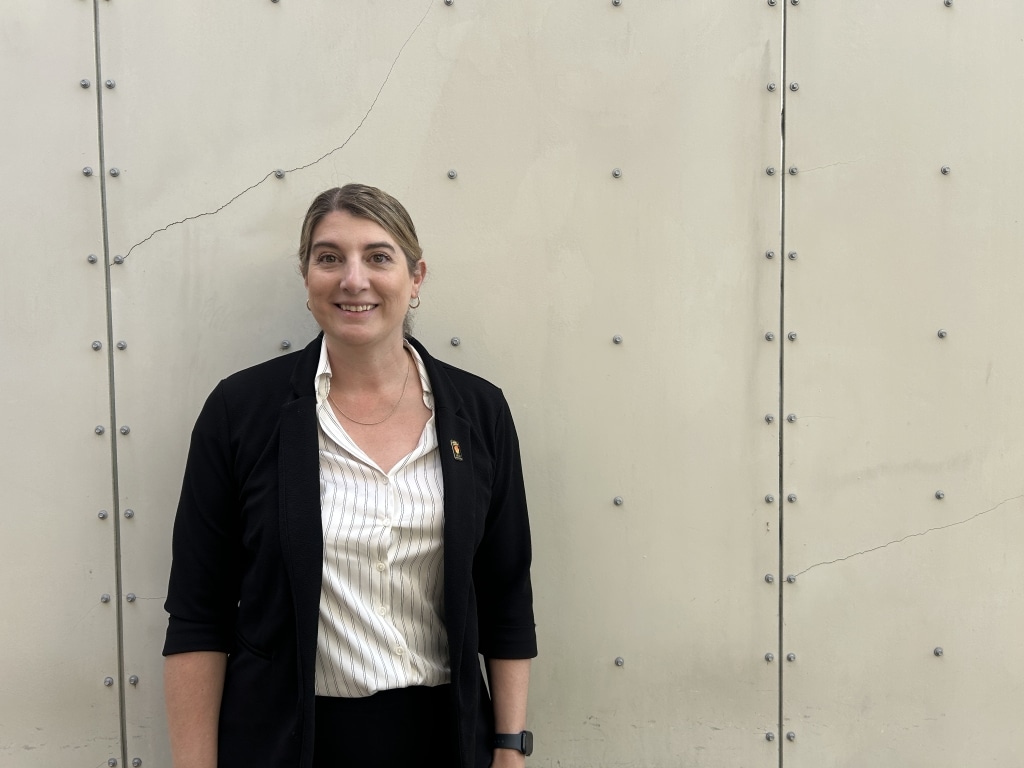
Editorial Note: This story is part of Shasta Scout’s citizen-powered election coverage. We’re conducting long-form, in-person interviews that last about an hour each. Candidate responses have been curated and paraphrased for this format.
Tell us briefly about yourself. What’s your current role? What background experiences or concerns led you to run for county clerk and registrar of voters?
I grew up in Washington, Idaho and Montana. My dad was a forester and had to start his career over when my mom was pregnant with her eighth child. I learned a lot of resilience from living in a large family and from how my parents handled moving. I met my husband in Wyoming, where I played volleyball at a junior college. In 2007 we moved here, where we decided to raise our children.
I took a job at the elections office in 2008, as extra help. My very first job was verifying signatures on petitions. It gave me a sense of purpose and passion. This role, as minor as it was, helped me both become a better mother and serve the community. I quickly fell in love with the work. At the time, we were
“the happy office.” People came in to get passports and marriage licenses and vote. All of those really drew me to the work. At the time, people loved elections, and we were heroes in the community. It was a great feeling and a really great experience for me as I learned the work from the ground up.
For 17 years I worked in the Shasta County Elections Office, until I was terminated last year by the newly appointed county clerk and registrar of voters. Now I’m working at the Trinity County Elections Office as a program manager, helping train their brand-new elections team. I’m helping them understand how the election process works from the ground up. I’m really grateful for the opportunity. It’s helped me remember why elections are fun.
I’ve never wanted to be a politician. I just wanted to stand behind other people and lift them up. I’m running for office for my children, because this is their home and I want them to live here. And for our community because they deserve to know the truth and there’s so much misinformation about elections out there.
If I don’t win this election, the impact on the community is going to be significant. We’ve had strong leaders in the office for the last 60 years. Cathy Darling Allen was in the office for 20 years; before that was Ann Reed, and prior to that, Richard Brennan. It takes four years for one staff member to learn how to do the work of elections from the ground up. If I don’t win this election, it’s going to take at least 16 years for our staff to get back to where they were, to the knowledge base they had. That’s a big deal, and it will be expensive.
Sometimes we forget the role of county clerk and registrar of voters has two halves to it. I think people are pretty familiar with the elections part of it, but what does a county clerk do?
There’s some history there with how the role has changed over time, but in Shasta now, the county clerk role is broken down to very specific duties. One is to be the commissioner of civil marriages. So if someone says, ‘I’m going to go to the courthouse to get married,’ they’re actually going to the county clerk’s office. Any marriage license that’s issued in Shasta County is issued at the county clerk’s office. We also do other professional filings, including notary and unlawful detainer assistant filing processes, passport applications, and fictitious business name filings. And we issue oaths of office to county employees and notaries.
The county clerk’s side of the office has ebbs and flows similar to the election side, and we have to manage staffing around those. People most often come in and get passports in January and February, for example. That seems to be when they’re making their trip plans: spring break, summer break and mission trips. Similarly, October seems to be a very busy time for marriage licenses. And one of our busiest wedding days in Shasta County is April 20, for some reason.
When I first started at the office, there were only 11 staff, but now there are up to 19. More staff has meant we’re able to separate the county clerk side from the elections side a little more, and get more specialization in each, but really everybody has to know many things because during election cycles we are all hands on deck. When you start working in that office, it’s like a fire hose of information coming at you, knowing the different laws and code sections. Almost all the work we do is outlined by state law and we have to follow those laws consistently. We don’t make up any of this, how passports are filled out or how marriage licenses are filled out or how we manage elections. It’s all found in the law, which is something we have to know and understand.
It sounds like the county clerk and elections office is managing details related to a variety of central forms of identification and documentation, not only for voting, but for many parts of life?
Yes. One interesting example is how the process of obtaining a marriage license has changed over time and how that’s impacting people now who are trying to obtain their Real ID now. Prior to 1995, the state required a blood test to obtain a marriage license. The loophole was that you could pay for a confidential marriage license and skip the blood test. A lot of people did that and maybe some of them didn’t really know or didn’t really remember that they did. And now they’re having trouble accessing those confidential marriage licenses, which they need to get their Real IDs.
It’s really detail-oriented work, all the time. You really need to know where to focus and how to follow the code.
As an election official, you have to follow the law while building trust with diverse community members. How would you work to increase transparency and accountability in the ROV process?
Over the six years from when I became the assistant county clerk to when I was no longer the assistant county clerk, I increased transparency every single election. We want people to have access to observe and we also need staff to be able to be focused so we can get the job done as efficiently as possible. That’s always a tricky balance.
What I’m not seeing right now is accountability, and that’s really important to build trust in elections.
Something we’ve noticed as we’ve reported on four different people managing that office over the last few years is that the work of elections always requires a certain amount of trust from the public. No one is ever able to watch the ballots all the time as they move from the printer to the election office and the election office to the post office and then back to ballot drop boxes or poll places before they return to the election office for counting.
The community is actually what builds trust in elections. It takes a community to make elections happen, and it takes a community to keep them secure, and we all need to step up together and do that.
We each have a role in our democracy, this constitutional republic. We have to self-govern, that’s the point of the election process. So we all need to step up and participate. And when it comes to ballots, we all need to do the right thing. That includes checking to make sure your voter information is accurate before election day, so your ballots can be mailed to the right mailing address. It means updating your signature on file, so we can count your ballot as quickly as possible. For some it means serving as a poll worker. It takes hundreds and hundreds of poll workers every election day to keep ballots secure, to be the ambassadors of the office, and to serve the public well.
How would you work to reduce conflict between the public and the election office and also within the election office itself?
When you work as a team, there will always be some conflict. Election work is a particularly intense kind of work, and when it comes to election season, everybody is busy at the same time. It’s a highly stressful environment, even when things are going well. We’re traditionally under-resourced, we have to get the job done with limited staff and limited resources, and those high demands can cause staff to get maxed out easily. So I always made it very clear to my staff that they would be more likely to be written up or advised on how to behave if they were creating drama in the office than they would if they actually made a mistake. Drama and conflict within the office destroy our trust with each other, and it also impact trust with our community, and that’s not fair to the people who are counting on us as they cast their ballots.
The bottom line is that building trust within the office is the best way to also build trust with the community. The people who work in the elections office have passion for their jobs, they really care, they want to show up well and serve the public. The community should feel that when they walk through the doors.
But it also seems like an environment where mistakes, or a lack of clear communication between staffers, could have really big consequences. How do you ensure accuracy and accountability within the office?
Absolutely. Something I would often tell staff within their first week is that they should always tell me if my pants are unzipped. What I meant by that is that they should never fail to provide me with direct communication about what I need to know, whether they think I want to hear it or not. Tell me in a very direct way what’s happening, why it’s happening, and what you think we need to do.
Election administration is complex and requires a very diverse skill set, so I need all my experts in various parts of the election system process to know their jobs well, work together and communicate clearly, promptly and directly with each other and with me. Small choices in the election office can have big impacts, including how we develop the voter information guide and how we design the ballot. So we have to work as a strong team.
Let’s talk a little bit more about poll workers. Why are poll workers important? And how do foundational steps, like poll worker training, increase voter access and security?
Shasta County is very large, so we have more than 50 poll locations, incorporating more than 60 different precincts — some poll places have two precincts at a single site. For each precinct, we need to train five community members to run the poll place. They have to be able to follow directions and do it correctly, otherwise their mistakes could impact the will of the voters. It’s a highly technical process, and poll workers accomplish it while working long days from 6 a.m. to 9 p.m. Along with administering the election, they serve as ambassadors for the county clerk and are a reflection of the office.
Given the demands of the role, building trust with the poll workers is something that is key to being successful in an election. One reason you need to do so is because poll worker retention is imperative. This year there are three elections, and we’ll need poll workers for each one. The June primary is the hardest to recruit poll workers for. That’s because it occurs at the same time as vacations and weddings and isn’t as exciting as a general election, so it’s harder to get poll workers who want to show up for such long days.
When it comes to poll worker training, there’s a lot we need to be keeping in mind and getting right. For one, federal law requires us to ensure every polling place is compliant with the Americans with Disabilities Act. That process starts with how we choose our polling places. The staffer who does our poll place recruitment is trained by both the Department of Rehabilitation and the California Secretary of State to conduct ADA surveys of the space. One thing they have to do is make sure that someone in a wheelchair can get from a bus stop to the parking lot, and from the parking lot to the polling place, and then navigate inside the polling place in their wheelchair. That’s problematic in some of our polling places, so then we have to mitigate the space by adding additional parking spots, making sure the ramp is in place and other things to ensure they’re set up according to ADA law. The way we set up a polling place can have a really big impact on people’s ability to participate in elections. So it’s very important.
Ninety percent of our Shasta County voters still choose to vote at home using a vote-by-mail ballot, but they must have the option to go in and vote independently and privately if they choose. We ensure that with ADA-compliant devices that allow them to, for example, listen to their ballot or make the font larger. If poll workers don’t know how to set that up and use that device correctly, then it can impact the ability of the voters to vote independently and privately which is their right under the law. Poll workers cannot just assist them to mark their ballots, that’s not legally compliant.
The poll workers have to know and understand that, and be able to step up and serve every diverse voter that walks in the door. And we have to train them to do that, because that’s also required by law. The Secretary of state produces requirements for poll training which we have to follow. There’s also the Election Officer’s Digest, and it’s required by law to make sure the poll workers have access to that, because it has all the laws that poll workers are supposed to follow.
What’s your commitment to accessibility for observers? Do you think it matters to the democratic process? And how are you balancing that with security?
There is a tough balance between access and observability and getting the job of elections done. From what I’ve observed of my opponent’s work in the office, access and observability has actually decreased. There’s been less access for observation of signature verification and logic and accuracy testing. And the new observer room is not ADA-compliant when it comes to the path of travel. He’s also claimed he would film every ballot. That’s something he can’t actually do by law. He’s not offering more transparency; he’s offering a different kind of transparency.
It’s important to remember that the point of observation is to observe the process, not to be able to look at the voters’ ballots. It’s very direct in the constitution: voters have the right to a secret ballot. My commitment has always been, first and foremost, to the voter and their right to cast a ballot independently and privately. When it comes to observers, they have the right to observe and look at the process. They don’t have the right to touch ballots and they don’t have a right to direct staff on how to do their work, or impede in the process. That was what was happening over the last number of years, since 2020.
When we have put up boundaries between staff and observers in the past, it was because of how observers’ actions had impacted staff’s ability to get the job done. And as we added boundaries to protect the process, we also added accessibility for observation. For example, we added monitors so people could see what was happening on the tabulation machines without being directly behind staff. We closed some doors at the election office, and that angered people. But they actually had a closer view, and they still had the right to observe the processes, which is what the law requires.
Observers are a great part of the process, and they can be a great truth-teller, but when you come in with your own bias and not an open mind, your observations can be meaningless.
It’s important to note that the Market Street building is a real challenge for access and observation. We’ve been saying that for years. We have had to “play Tetris” every election, adjusting supplies and moving things for each part of the process. We don’t have the space that is needed in the office to do things efficiently. But with the millions of dollars it will take to acquire the right space, it’s going to take a while to get there while balancing the budget.
Does the job of an election official also include safeguarding staff?
Yes, and it’s always tough to balance that with observation. At one point, I had to stop operations because observers were directing my staff in a way that made them cry. We couldn’t do a process we needed to do that day because things were so heated after that interaction. Talk about impeding an election. So there’s a real balance between allowing observers close and providing space for staff.
I like to compare it to when you have your grandmother and your mother both in the kitchen sharing a family recipe that they’ve both modified, so they’re telling you how to do it two different ways.
Something I struggled with in my role was trying to meet everyone’s expectations and wishes. When people asked questions or made suggestions, I would try to adjust our processes to please them. When it got to the point where we had to hold boundaries and say ‘here’s the line you can’t cross,’ people really pushed back. The boundaries were put in place to protect staff, to protect voters, and to protect the ballots.
The current registrar of voters says recording images of voted ballots on livestream during the election process increases transparency for the public. Do you agree? Why or why not?
My biggest concern with filming the ballots is the federal law which requires election officials to seal ballots after the election is certified. I’m also concerned that he’s stating that he’s filming all ballots, which is not true, about 10 to 20% of the ballots were filmed. He also claims that people can use the livestream recordings to look at all the ballots and do their own count but you really can’t do that because they weren’t all recorded on the livestream. It’s also a very costly process. I think he spent $100,000 last election to set the system up, and he’s gonna have to spend that much again this election.
The most important thing that we can do for transparency is to allow our voters to vote to tabulate their own ballots by feeding them into a machine at the polling place. The machine takes a picture of their ballot and makes a noise indicating that the ballot was scanned. It’s secure and, importantly, it also feels secure to the voter. That’s what we used to have before the county cancelled our contract with Dominion.
My opponent likes to talk about writing code to flip voting machine votes. But he’s talking about a system that we haven’t used in California for years. It’s called a direct reporting device. California got rid of that type of voting system in 2007, and we’ve been using a hand-marked paper ballot system with machine counting of votes since then. We test the machine-counting system before the election, and we also confirm the machine count numbers after every election by using a 1% manual tally audit. When that work is done appropriately, voters can trust the results. The truth is that we need machines to help us with the complex work of vote counting in areas as large as Shasta. And we have systems in place to ensure they work and work accurately.
Like many local offices, the role of ROV is nonpartisan in nature. Is your intent to remain nonpartisan? If so, why does this matter to you?
My intention is to always remain nonpartisan, probably for my entire life, whether or not I’m a registrar. The voters need to trust that the person in charge of elections is making sure their vote is counted. One of the ways I can increase that trust is by not sharing my own political beliefs. Like everyone I have my own political beliefs, but I am deeply committed to not sharing them publicly, as a way to maintain trust in the position I wish to hold. This is a ministerial role, not a legislative role. Legislators are the ones that make the laws, and it’s my job to follow them.
Do you have a correction to share? Email us: editor@shastascout.org.
Author

Comments (30)
Comments are closed.
Related Articles
Meet Jack Munns for Redding City Council
There are three council seats on the ballot this November, and nine candidates are running. Munns is a current council member and former police officer.
Meet Lisa Barry for Shasta County Office of Education Trustee
Lisa Barry is running for one of seven seats on SCOE. She has a background of service in the Intermountain area including as a community organizer with Burney Friends and Neighbors.
Meet Joana Rebollar for Redding City Council
There are three open seats on the council, and nine candidates are in the running. Rebollar is a tax preparer and accountant who has a primary focus on the city’s finances.
The ONLY choice.
If Joanna Francescut is elected the controversy will be over. Our votes will be counted behind bars blocking entrance to the elections office and behind locked doors and we will be told who won in due time.
Yep, I hope she wins too. 😁
I’m well-convinced that nobody in Shasta County is more qualified for our ROV position than Joanna Fancecut.
.
That said, I’d vote for a jar of sauerkraut before I’d vote for the grinning, lying, abusive carpetbagger from Florida. Same goes for the smirking, self-serving, grifting BOS incumbent from District 1. Two steaming piles of MAGA ordure.
Why are you people afraid to use your full name or your real name?
Nick Gardner
Oh Rick. Is that the best you got?
.
“Oh noes, people aren’t using their for realz name! But I want to know who they are!”
.
Rick, I post under Jolly Roger because that is who I am. That’s my name. I won’t tell you what my middle name is, because I don’t like my middle name.
.
Just because you don’t know who I am, doesn’t mean there aren’t other people on here who know me.
.
Hope you have a great day, Rick. – Jolly S. Roger
Kinda narcissistic to expect people to know or care who you are, don’t you think?
.
But good on you for really trying to get your name out there and known locally, Nick Gender. You just keep at it, and one day people will know who you are. 😀
I agree with Mike. It’s time to bring back sanity to the voting process and hopefully to our Nation. Voting for Joanna is the only way to go.
One thing apparent in this interview is the absence of vitriol and finger pointing. She explains her positions well, without getting defensive. Seems to be even-tempered and forthcoming. I anticipate that, if elected, the public, combative spectacle we have witnessed recently will quickly disappear.
She really knows her stuff. Every voter skeptic should read this.
Definitely a breath of fresh air. Your wait is almost over Joanna.
Joanna
I am personally sorry for all the BS you have had to put up with.. to have to steel yourself as a candidate and now a politician.. For you have demonstrated yourself as a most qualified and loyal county employee.. One who has provided us with the absolute best of who you are devoted to Shasta County.
I am a staunch conservative… I couldn’t care one iota about your personal beliefs or your political bent.. I care what you have done for this county and all of us.
I voted for you and every person in my orbit voted for you.
Let’s finish strong and send this snake oil salesman political carpetbagger back to Florida.. or New York…or whatever computer program he chooses
I question this election if you don’t wipe the floor with him
I look forward to you being our next election ROV
Go Joanna Go
What a breath of fresh air! Expecting Joanna to win in a landslide.
If transparency is so important, why did she report only 10 wrongly-counted votes in the ~10,000 sampled ballots in the 2024 post election audit when there were actually 511?
Didn’t voters deserve to know that due to staff sometimes accidentally duplicating the wrong unscannable ballots, the original count was wrong enough to definitively alter the results of the Happy Valley contest (and with an 8% error rate, perhaps a dozen other contests as well)?
Is it true she dropped out of junior college without ever getting any formal training in accounting or statistics?
There is not a single case of certified voter fraud in Shasta County that you can point to as evidence of ‘voter fraud’. The local MAGA effort to stop mail in voting, something Curtis supports, is built on the same Big Lie that Crye and team have been pushing since he gained office. Curtis is delusional, and like Trump, nothing he says is reliable.
This wasn’t voter fraud, this was incompetence followed by a fraudulent report covering up the incompetence.
You’ve been humping this same key on the piano for months. People ask you for hard evidence, and you basically just repeat the charges.
.
Maybe you should start by providing info on your own formal education in statistics. Then follow that by explaining why you suspect an 8% error rate across the board, and why that would in turn affect a dozen other contests.
I’ve repeatedly posted proof. All anyone needs to do is look at her report in the statement of vote and the conflicting data tables in the last 100 pages of that report.
There were 6 wrongly-counted votes in the 4,290 audited election day ballots (a mildly high 0.14% error rate) and 505 wrongly-counted votes in the audited 6,553 vote by mail ballots (a completely unacceptable 7.7% error rate). Remember, they had time to replace the blurry election day ballots before the election so those did not need to be duplicated, but the vote by mail ballots had already gone out so those ballots did.
14.0% of 90,162 voted on election day vs 86.0% by mail. With a random sampled audit, we must assume the 0.14% election day error rate and 7.7% VBM error rate affected the entire contest (the point of random sampled audits), resulting in an assumed:
18 wrongly counted election day ballots out of 12,615 cast.
5,971 wrongly counted VBM ballots out of 77,547 cast.
That’s 5,989 wrongly counted ballots out of 90,162 or 6.6% error rate overall (8% – or 7.7 rounded – was the VBM error rate).
The following contests were decided by less than a 6.6% margin:
CA Assembly 1st District 5.04%
Shasta Board of Education Area 1 4.86%
Shasta Board of Education Area 2 Full Term 1.30%
College Trustee Area C 6.28%
College Trustee Area D 5.42%
Fall River USD 3.73%
Cottonwood Elementary 1.75%
Grant Full Term 2.04%
Grant Short Term 6.13%
Happy Valley School Board 0.08%
Junction School Board 3.83%
Anderson Council 1.59%
Redding Council Full Term 1.53%
Redding Council Short Term 3.63%
Shasta Lake City Council 1.39%
Fall River Fire Full Term 2.80%
Mountain Gate CSD 2.19%
Prop 34 6.00%
Measure H 2.56%
Measure K 4.74%
Measure L 3.84%
Measure N 2.32%
Measure O 3.76%
Measure P 0.44%
Yeah…. the court threw that jibberish out on its ass…. Try again.
.
On second thought, don’t bother.
The judge essentially ruled that he did not have the authority to grade the accuracy of her report, only whether she turned in any homework at all.
As you all are learning now with Curtis in office, getting a Shasta County judge to hold the elections office accountable for blatant legal violations is a tall order, especially if the effort is not well funded and organized.
If you don’t want to read through the statement of vote yourself, I posted the relevant screenshots here: https://www.facebook.com/permalink.php?story_fbid=pfbid0Mh1ZzKUnys94eu61BDTEY4jaa6LH4hX2ejVX5YnHPLFpZ2UpTBxbPS4s3GSedSsGl&id=100092837937307
Hey Darwish, lots of allegations but no proof so far. But here are some questions for you. Is it true that there was no evidence that courts or official audits proved widespread fraud in Shasta County’s 2024 elections?
.
Is it true that Kevin Crye, Patrick Jones, Laura Hobbs, and Chris Kelstrom considered contesting the 24 election results, and that Jones even called Hobbs up to the dais to ask her opinion in the middle of a supervisor’s friggen meeting?
.
Is it true that Kevin Crye, Patrick Jones, and Laura Hobbs have all promoted election-fraud claims that election officials, courts, and major news organizations described as unproven, false, or conspiracy-based?
.
Is it true that after losing the March 2024 District 2 supervisor race, Hobbs requested a recount and that Hobbs took her case of “mal-administration” of the election, only to have Judge Stephen Baker throw it out, stating “the lack of evidence was profound” and found that Hobbs had not provided sufficient evidence to support claims of election misconduct or fraud, and that Hobbs’ lawsuit have cost shasta Couty taxpayer about $150,000 to defend against before they were thown out of cort and that the supervisors have not charge her anything for legal costs to this day?
.
Is it true that because of proven false election conspiracy theories promoted by far-right extremists, Shasta County taxpayers have had to spend at least 3 million or more on replacing voting systems, evaluating, or preparing for hand-count procedures, staffing and operational expansion, legal and administrative disputes,
and election-related political conflict since 2023?
.
Is it true that Hobb’s Measure B, requiring local voter ID requirements, restricting vote-by-mail voting, one-day in-person voting, hand-counting ballots, and separating from California’s voter-roll systems, is not legal under California law?
.
Is it true that Hobb’s Measure B could cost Shasta County taxpayers hundreds of thousands of dollars at a minimum, and potentially millions of dollars if the litigation became prolonged or moved through state and federal appeals?
.
Is it true that Shasta County is under substantial financial economic strain, especially in areas involving staffing, litigation costs, health services funding, and budget reductions, and that local media is reporting our county is reviewing approximately $25 million in budget cuts for the 2025–2026 fiscal year?
.
Is it true that Shasta County Taxpayers, where 26% of our children live in poverty, 66,230 more than 1 in 3 are on Medicaid, (Medicare) facing cuts under Trumps HR 1, where many citizens are facing acute rising costs of fuel, rent, and health care, just might, I say just might…. be getting tired of paying for the 5 year circus show and conflict in our government and would just like a Safe and Sane nonparticin Shasta County Government for a change?
.
I guess we’ll find out on June 2, that is, if people come out to vote.
Would anything you just said make okay Francescut feloniously (Penal Code 115) filing a false document with the state concealing a wildly inaccurate election?
Care to comment on that instead?
Boring….
If graduating from college is, at least in your opinion, your requirement to hold elected office, what about Crye, Kelstrom and Harmon? What degrees do they hold?
A basic understanding of accounting and statistics should be required for someone tasked with performing and analyzing random sampled audits (a statutory duty of the ROV). That knowledge doesn’t have to be from college, on the job training should have been enough, but Francescut very clearly doesn’t have a grasp of the basic concepts.
I know this because she claims that there was no problem with the election because she fixed the errors she found in the random sampled audit. This is what happened at Moodys and S&P did when big banks had them rate their mortgage bonds. Top tier analysts worked for Wall Street banks; the bottom of the barrel worked for the much lower paying ratings agencies. And these rubes were convinced to simply remove any bad mortgages they found from their samples until the rehabilitated sample now met the threshold for AAA ratings. Crucially, they did not correct all the mortgages they did not sample in their audit, resulting in AAA ratings on junk bonds.
This would be like taking a sample of river water, finding dangerous contamination, and deciding not to fix the river’s pollution but to instead filter the sample so you could report the river passed your testing.
Everything is going to be okay MD. Just take a chill pill.
Darwish, I see you have a lot to say but completely ignore or side step questions asked of you. It is apparent you don’t care about the truth.
Bravo, Jo!
A vote for Francescut will be a step toward sanity and away from the conspiracy theory driven, divisive atmosphere that has infected Shasta County politics.
Francescut is an experienced, qualified professional and deserves our support at the ballot box.