
A Newly-Formed “Youth Prevention Committee” Will Present Shasta County’s Board with a Rough Plan for $4 million in Opioid Settlement Funds
The informal group is now being referred to in County documents as a “Youth Prevention Committee.” They’ve declined to present a detailed budget to the Board for now, saying more input is needed before spending decisions can be made.
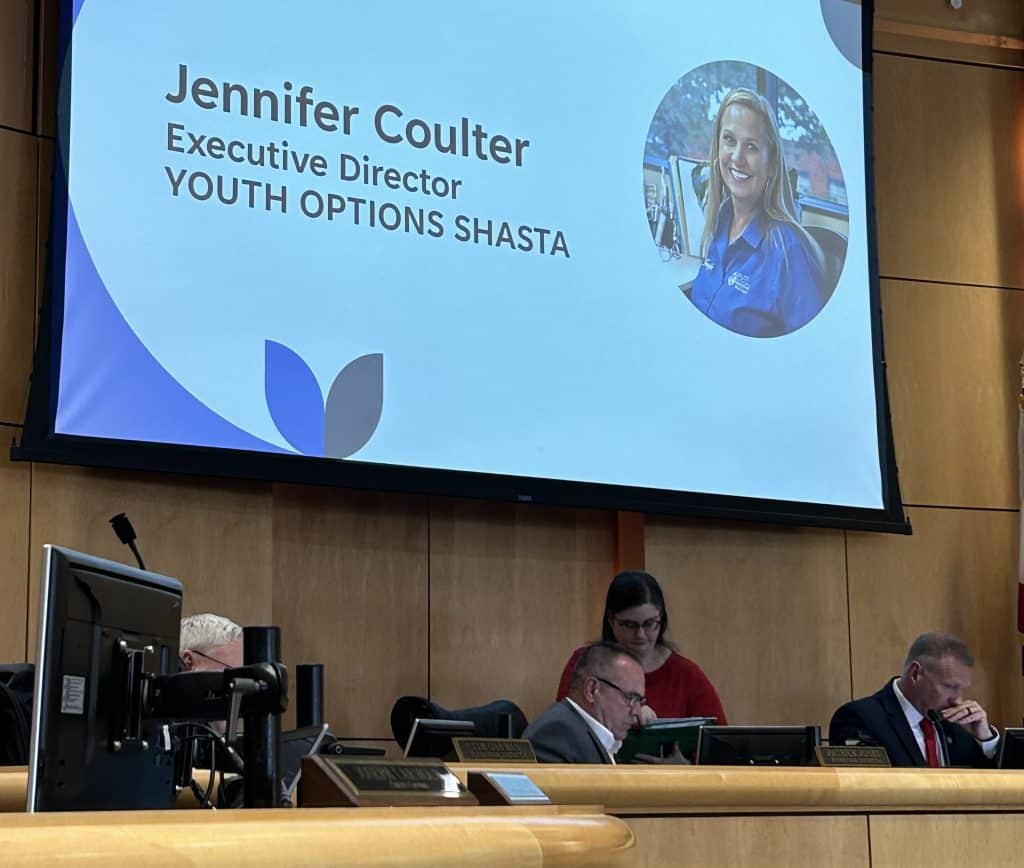
About a month ago, the Shasta County Board of Supervisors held a marathon discussion about opioid settlement fund use that included rapid-fire six-minute pitches by 20 organizations. Now a few select individuals and organizations with an interest in youth prevention will present before the Board tonight, December 19.
The informal group, which is now being referred to in public documents as a “Youth Prevention Committee” includes Jennifer Coulter of the Youth Violence Prevention Council (Youth Options Shasta), Jenna Berry of Raising Shasta, Clay Ross the Superintendent of the Columbia Elementary School District, and Amanda Faith, a Shasta County mother and motivational speaker who lost her 13-year old son to fentanyl poisoning in 2020.
The working group was spontaneously formed by Board Chair Kevin Crye towards the end of the special opioid settlement funds meeting on November 12 as part of a motion in which he first said he’d like to give the group “$3 million dollars over the next two or three years”, then later, “$4” million. Minutes from that meeting show the Board’s vote is formally recorded as a request for the group to present on how they would use “$3-4 million” over two years. They’re now presenting a rough outline of a plan for how to use $4 million over 4 years. That amount equals about 10% of Shasta’s known settlement funds.
Crye formed the informal working group without including Shasta Chemical People, another organization which also presented on youth substance use prevention during the November 12 meeting, but did include Superintendent Ross and parent Faith, neither of whom submitted a presentation for that meeting.
Crye also explicitly excluded the Shasta County Office of Education (SCOE), which had issued a letter just days before the November 12 meeting, sent on behalf of Shasta County’s school districts, including Columbia, which working group member Superintendent Ross represents. SCOE’s letter requested that the Board set aside 10% of the County’s opioid settlement funds for school-based prevention and intervention projects to expand on existing programs, a roughly similar amount to what the working group has created a rough proposal for.
On November 13, after specifically excluding SCOE from the working group on youth substance use prevention, Crye showed up to SCOE’s monthly Board meeting, where he shared public comment alleging that SCOE leadership has been non-responsive to his emails about prevention initiatives, something SCOE’s Superintendent Mike Freeman and Associate Superintendent of Administrative Services Austin Preller both refuted.
In an interview with Shasta Scout several weeks ago, SCOE representatives said that the letter soliciting opioid funds for schools was ‘sent on behalf of the signatories’. She said SCOE itself has not asked for any percentage of Shasta County opioid settlement funds itself.
According to the federal Substance Abuse and Mental Health Services Administration (SAMHSA), while substance use among adolescents decreased in 2021, the rate of overdoses increased dramatically from 2019 to 2021. According to UCLA Center for Health Policy Research in 2021, mental health distress is prevalent among teens in California, and is compounded by poverty rates, gender and race–based discrimination, and immigration status.
On a more local level, SCOE student surveys found that the motivation for Shasta County teens to experiment with drugs has shifted since the pandemic began. Pre-COVID, students tended to cite “peer pressure” as a motivating factor while after, more answered “depression and anxiety.”
According to a statement shared in the introduction of its presentation, the Youth Prevention working group was given only three weeks, until December 5, to submit plan to direct $3-4 million in substance use prevention spending over the coming years. The group met four times between November 12 and December 5.
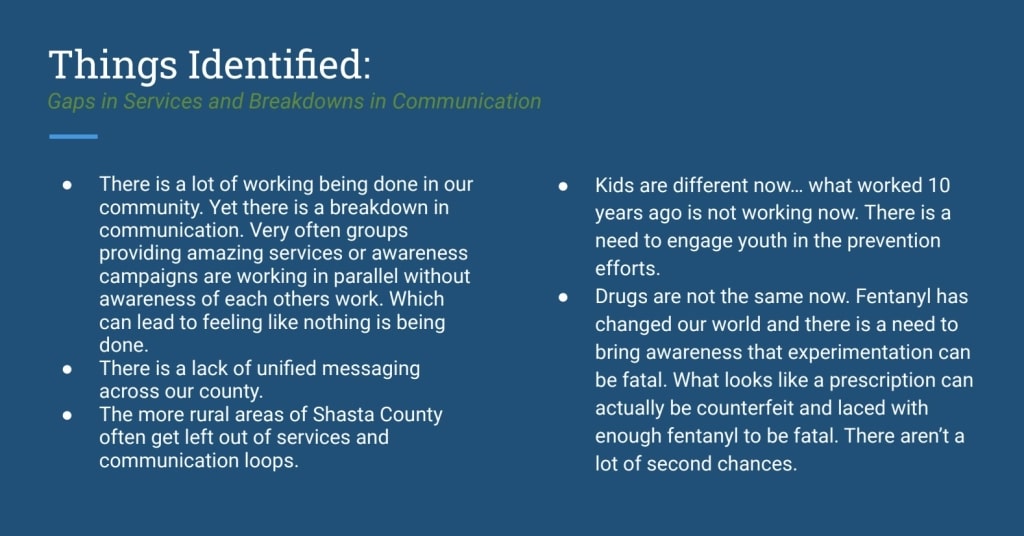
Key themes of the presentation include the idea that prevention methods must adapt to the shifting needs of new generations, that rural areas of Shasta County are often neglected by prevention efforts, and that fentanyl contamination makes experimenting with drugs far more lethal than in the past.
The committee’s proposed initiatives include collaborating with other organizations to create uniform substance use prevention messaging across the County, facilitating prevention programming and naloxone trainings in schools, supporting parents and children who face challenges related to substance use, and eliminating the “school to prison pipeline” through the use of restorative justice practices.
According to the presentation, members of the working group spoke with representatives from school districts, Shasta County Probation, Shasta County First 5, Shasta County Health and Human Services Child Welfare and Public Health departments, the Shasta County Youth Substance Use Coalition and Girls Inc. They also contacted a number of individuals who work in the youth prevention space including Rocky Herron, Hal Zawacki, Jennifer Epstein and Ed Ternan, Courtney Chase, Laura Garett, Jennifer Volbrecht, and Paula Young.
The working group hopes to roll out programming in July 2025. Before that, they’ve proposed holding three County-wide summits on the topic of youth substance use prevention to improve communication, centralize information and resource-sharing and identify a singular community message that can be used in a unified awareness and engagement campaign.
The group did not include a budget in their proposal saying they hope to come back to the Board of Supervisors in March with a detailed financial plan created in collaboration with Deputy Shasta County CEO Erin Bertain.
Shasta Scout attempted to interview the two organizations in the committee to learn more about their approaches to prevention. Raising Shasta did not respond to multiple requests for comment, and Youth Options Shasta declined to comment.
Do you have a correction to share? Email us: editor@shastascout.org.
Authors

Comments (12)
Comments are closed.
Related Articles
Shasta County must hold off on placing voter ID measure on ballots, judge says
The decision came in response to a petition filed earlier this month by an anonymous plaintiff. If approved by voters in June, the ballot measure would amend local law to allow for changes to elections, including hand counting and voter ID.

Riverside’s Sheriff is investigating alleged election ‘irregularities.’ Shasta’s election official was the one to break the news
Shasta ROV Clint Curtis told county supervisors during Tuesday’s public board meeting that the Riverside department was “confiscating all of the records in Riverside.” Riverside officials have confirmed the news of an investigation.

Supervisor Kevin Crye hospitalized due to ‘cardiac episode’
A statement posted on Facebook today said he’s been given an “excellent prognosis” for recovery. He’s also being treated for colon cancer.
How about giving the funding to someone who is experienced and already working on these problems? Supporting an agency that doesn’t have to research how to do everything and start from scratch would be a more efficient use of this money, resulting in a more timely outcome. This could save lives, rather than postponing action.
Annelise – looks like you are putting on weight.
Mindy, what’s that rude BS about ? What does your snarkyness have to do with the article ?
Hi Mindy! Maybe introduce yourself next time you see me in person. Sounds like you have important things to share. 🙂
Sounds very much like a quickly thrown together group of people that probably should WAIT and come up with an actual plan before being handed 4 MILLION DOLLARS. I’m sure there might be some good intentions in there somewhere but I bet there are far more organized plans out there and this is more sketchy than not sketchy. We NEED secular medically based treatment facilities and safe sober housing. A concept of a plan is NOT a plan, I hope they can wait until the next time around.
I smell something rotten in Copenhagen, or however that old saying goes…especially if Kevin Crye and Chriss Street are the authors of another money grabbing scheme. Please, new BoS members, pay attention to the sly fox on the BoS, aka Foxy Crye.
Let’s see how Chris Kelstron handles the gavel as chairperson. Remember voters and citizens, Kevin Crye signed his name to the Shasta County Ballot Measure P & Q, and guess what…they lost.
Yes, Crye’s going to figure out a grift on this. Remember when he met with the SCOE superintendent, supposedly about a different matter. The superintendent stopped the meeting because he was uncomfortable with the direction it was going; Crye pitching his grift.
With proposition 36 kicking in, hopefully a lot of of these drug dealers will be ushered into prison. I would like to see a measurable goal from any group. Many times, it costs more an administration than it does to help the cause.
“Youth Prevention Committee”… so, they prevent youth?
Maybe work on the name as well as the budget.
As a federal grant specialist I wouldn’t ever fund an agency that has a completely new staff, quickly thrown together plan of operation or no history of handling grant funds. It’s a proven waste of grant funds. Choosing a proven agency with stable staff and positive outcomes, is a win, win.
Patrich, Let’s hope your wise words resonate with Kelstrom & Harmon…Crye obviously won’t oppose his own recommendation. Perhaps you could email or phone Kelstrom and Harmon and help them understand your premise.
So….we’re preventing… youth? No one’s allowed to be young anymore? People really need to be more clear with their committee names.