
After presentation from nonprofit Amity Foundation, county moves towards plan to develop an alternative custody facility
If a hoped-for reentry project comes to fruition, those served will be mostly people convicted in Shasta County and currently incarcerated in state prison. The Amity facility would be a place for them to “come home” to serve the remainder of their sentences before being released.
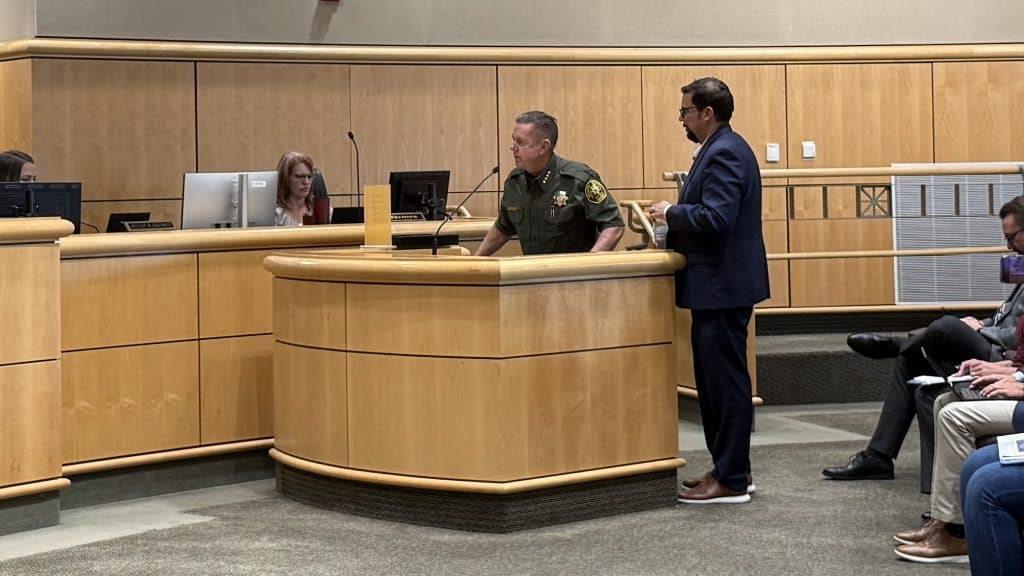
For months, some county supervisors have vaguely floated the idea of establishing a reentry facility run by the nonprofit Amity Foundation. On Tuesday Sept. 9, more details came to light during a presentation from Amity Foundation CEO Doug Bond. Amity’s reentry programs, Bond told the board, are currently operated in six locations, mostly in southern California, and serve about 600 incarcerated individuals.
“These are semi-secure facilities focused on public safety and public health,” Bond told the board. He said they would include a residential component where program participants would have access to job training and GED classes and receive physical and mental health services, and substance use treatment.
Following his presentation, the board unanimously voted to direct county staff to bring back information that could guide a request for proposal (RFP) for a facility operated on land newly leased by the county off Eastside Road in Redding. The board also directed staff to review possible funding sources.
Supervisors did not address whether the RFP referred to the cost of building or just operating such a facility, how large it would be, or whether it would include housing – all details that remain to be discussed publicly by the board. Supervisor Matt Plummer told Shasta Scout today that his understanding is that public officials are currently envisioning a total of 100 beds at a future reentry facility on Eastside Road, with 50 reserved for people sent from the county jail and another 50 for those convicted in Shasta who would be returning from state prisons. For state prisoners, California would foot the bill.
The Amity Foundation is one organization that the board hopes to partner with to run a justice facility on the county’s newly-leased land, but others could apply if an RFP is put out in future.
Supervisors first considered leasing the Eastside land from the city in January of this year, when Sheriff Michael Johnson suggested the location as the site of a new alternative custody facility, where those convicted of certain low level crimes in Shasta would be diverted from incarceration to live at home and report to a day program to provide community service. Sheriff Johnson has said that roughly a third of the county jail’s prison population would be eligible to participate in such a program in lieu of incarceration.
The Amity Foundation program discussed by the board this week is something different. It would provide a secure housing facility for incarcerated people preparing to reenter the Shasta County community either from state prison or the county jail. If built, the Amity facility could sit adjacent to the alternative custody facility described by Johnson earlier this year, if the project moves forward.
Amity’s program rules excludes sex offenders, gang members, and those who have had “significant behavioral health issues” within the past 24 months.
“We do not create institutional environments. We want people to be in a rehabilitative environment,” Bond said, as he flipped through photos of the organization’s other facilities – communal spaces with vaulted ceilings and exposed brick walls, and a Buddha statue in a garden. Participants will wear ankle monitors and under supervision by correctional officers from the county.
Attempted escapes from an Amity facility are rare, Bond said, noting, “there’s not a person that would rather be in prison or in jail than in one of these beautiful community reentry programs, getting those services that they need.”
Information shared by the California Legislative Analyst’s Office indicates that in 2025, the taxpayer cost of incarceration is $123,000 per person, annually. Bond said Amity’s cost per participant is roughly half of that amount, and that the reentry programs are focused on breaking the cycle of future imprisonment for those selected to participate.
Part of the program, Bond says, emphasizes connecting people with industry sectors in the area as they approach their release dates. Amity facilities, he continued, are an example of the ways that state and local carceral systems can integrate to provide an off-ramp for people released from state prisons, something that can reduce recidivism.
“Right now, a lot of the ways that folks come home from either jail or prison” include Bond said, “a few hundred dollars in gate money, a bus ticket, and then they often cycle back through.” Gate money is a stipend of $200 dollars issued to people upon their release from state prisons.
According to a study into re-entry programs conducted by Stanford University in 2021, reentry programs have a significant positive effect on recidivism rates for those who participate. But, the researchers note, that there hasn’t been other significant studies into the efficacy of such programs despite the state’s investment in them in recent years. The Amity Foundation cites data showing their reentry programs have decreased recidivism, noting a 92% drop in re-arrest rates within one year of completing the program.
The response from public commenters about the potential new facility during this week’s board meeting was almost entirely positive. The main concerns came from people who live near the site on Eastside Road, where the new facility might be built. In response, Supervisor Chris Kelstrom suggested that an increased presence of correctional officers would make the neighborhood safer – and Sheriff Johnson tentatively agreed.
Asked after the meeting if Amity was considering locations other than Shasta to build this facility, Jonathan Underland, a spokesperson for the Amity Foundation, told Shasta Scout “we are exploring any and all opportunities across California to establish successful reentry and habilitation services.”
Do you have a correction to share? Email us: editor@shastascout.org.
Comments (1)
Comments are closed.
Related Articles
Shasta County must hold off on placing voter ID measure on ballots, judge says
The decision came in response to a petition filed earlier this month by an anonymous plaintiff. If approved by voters in June, the ballot measure would amend local law to allow for changes to elections, including hand counting and voter ID.

Riverside’s Sheriff is investigating alleged election ‘irregularities.’ Shasta’s election official was the one to break the news
Shasta ROV Clint Curtis told county supervisors during Tuesday’s public board meeting that the Riverside department was “confiscating all of the records in Riverside.” Riverside officials have confirmed the news of an investigation.

Supervisor Kevin Crye hospitalized due to ‘cardiac episode’
A statement posted on Facebook today said he’s been given an “excellent prognosis” for recovery. He’s also being treated for colon cancer.
Convicts have been released into Shasta County for years and that practice has not improved the quality of life here! Let’s not continue to import convicts! We do not need this in our town, we already have enough growing pains.
A project with this much impact should require a community vote.