
After spate of alleged hate crimes and incidents, California Civil Rights Department holds forum in Shasta
Addressing recent allegedly racially-motivated crimes and incidents, California’s Commission on the State of Hate held a forum with local leadership to discuss the harms of discrimination.
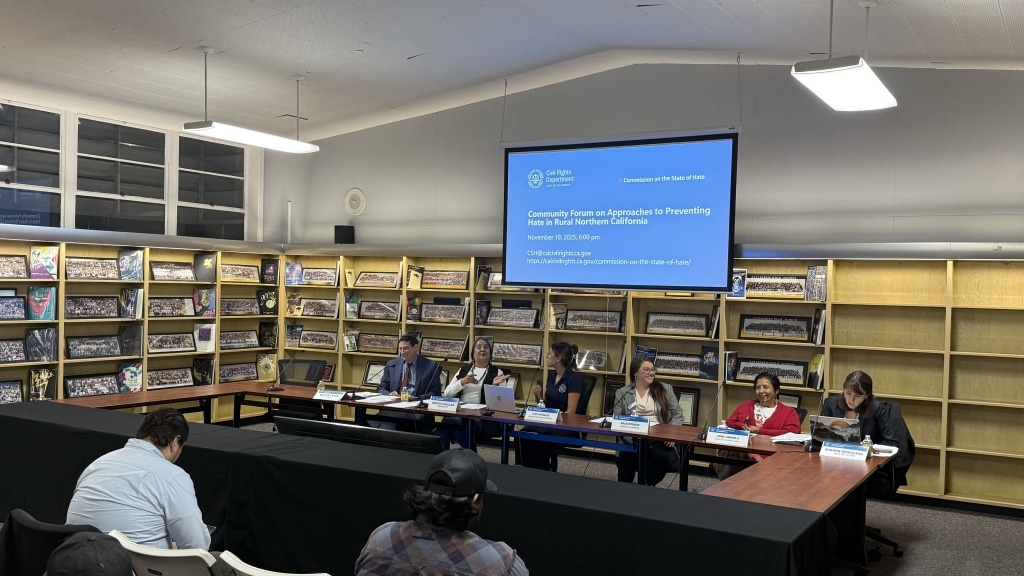
Since the spring, community organizers and law enforcement have been responding to a troubling wave of alleged hate crimes and hate incidents in Shasta and the surrounding counties. The most high-profile incident involved allegations of an unprovoked white motorist shooting toward a neighboring Latino family outside their home in Igo, as he yelled disparagingly about their perceived ethnic background.
Last week local NGOs and educators gathered with representatives from the California Civil Rights Department Commission on the State of Hate (CSH). The statewide group was formed to leverage data on hate crimes and hate incidents across the state.
The Commission on Hate’s most recent report from 2023-2024, reported crimes against trans people, Jewish people, and Black people have all soared in California over recent years. Crimes against Muslims and immigrants have not seen the same sharp rise but the department acknowledges potential blind spots in tracking those crimes due to distrust in law enforcement among those communities.
In an interview with Shasta Scout, the commission’s chair, Brian Levin, and Civil Rights Department Deputy Director of Communications Rishi Khalsa described the nuance with which hate data — which can include both hate crimes and hate incidents — is aggregated by the state.
“A hate crime is an actual criminal event, where law enforcement can respond. A hate incident is a non-criminal event,” Levin explained, noting that while “horrible” statements about racial or religious minorities may be protected by the First Amendment and therefore not illegal, they can still cause harm.
Data on hate crimes is tracked by California’s Department of Justice, the FBI, and the national victimization survey. Numbers of incidents documented throughout California were provided via responses to the California Health Interview Survey — which surveyed about 20,000 households — as well as reports submitted via the CA vs Hate hotline.
For the purposes of the Commission on Hate forum held on the evening of November 19 at Enterprise High School, Levin was joined by his colleagues Alee Gonzalez and Regina Cuellar. Representing the Shasta community were representatives from three primary organizations: the Shasta Equal Justice Coalition (SEJC), the Shasta County Indian Education Consortium, and the United Way of Northern California.
The presentations began with SEJC’s Sharon Brisolara unpacking the organization’s just-released 2024 Shasta County State of Equity report. The findings painted a bleak picture: among other data, people perceived as Black were the most likely to be stopped by police officers in Shasta but were also the least likely of any race to have been found in possession of something illegal.
April Carmelo, the Indian Education Specialist at Shasta Union High School District, spoke next, contextualizing her presentation with an overview of all the anti-Native massacres that occurred in Shasta County — at the behest of state government — over the nineteenth century. Describing state-sponsored genocidal actions, Carmelo noted that “California’s Indian population plunged from 150,000 to 30,000 with the involvement of California state and federal officials and the taxpayer dollars.”
Moving into the present, Carmelo also discussed a growing movement to raise awareness about the alarming number of missing and murdered indigenous people. From the audience, a mother whose daughter was murdered, and a young woman whose cousin is still missing, both shared their accounts of how they believe law enforcement failed to respond adequately to the cases, both in the moment of crisis and later investigations. Upon hearing these stories, Chair Levin made a personal promise that he would make sure their stories are “distributed to every commissioner and to the Civil Rights department.”
The last of the Shasta presenters was the newest CEO of the United Way of Northern California, Kalie Brisbon, whose presentation transitioned from the history and scope of discrimination in Shasta County to how her organization is working to respond.
Brisbon described the United Way’s Building Bridges initiative, which seeks to facilitate safe and open dialogue across a politically divided community. The initiative was in part a response to the increasingly volatile political environment in Shasta County, Brisbon said, noting that “when people check out of civic life, democracy suffers and inequities grow.”
“When was the last time you had a meaningful conversation with someone whose political views are completely different from you?” she queried the audience, explaining that the Building Bridges discussions — which occur in churches, coffee shops, and community centers — are meant to create a nonjudgemental space for anyone on the political spectrum to hash out potentially thorny issues.
Larry Olmstead, former United Way CEO and member of SEJC told Shasta Scout in a follow up interview that everyone has their biases, including those who think of themselves as progressively minded. When triggered, Olmstead noted, anyone can lash out.
Compounding factors that can aggravate the likelihood of hate crimes and incidents, Olmstead suggested, include mental health challenges and addiction — as court documents show appears likely to be the case in the Igo shooting.
Olmstead noted that the words of political leaders can also contribute, creating paranoia that increases individuals’ likelihood of acting out.
“Our elected leaders in Washington saying disparaging things and stoking fear about people of color and our immigrant population, that that trickles down,” he said. He stressed the value of local law enforcement’s words as well, noting that the Sheriff’s strong condemnation of recent hate crimes will help to establish a cultural climate locally.
Challenging the notion that hate crime designations themselves are divisive, Olmstead used the metaphor of a home invasion to illustrate the cascade of fear that hate crimes instill in targeted communities.
“If a house on your street is burglarized, the whole street is like, oh, boy, do I need to make sure I lock my doors and lock my windows? When somebody from a racial a certain ethnic group is impacted [by a hate crime],” he said, “then it makes that whole group feel like, oh, I’m a little insecure here.”
The role of California’s Commission on Hate is advisory in nature: hosting community forums, providing resources for local governments and compiling and reporting out data including in rural areas which according to Levin, are subject to underreporting. In Shasta, the commission’s community forum served as a place for state officials to learn more about conditions in the rural North State and point community members toward the resources available to all Californians, including accessible ways to report a crime, receive potential compensation, find a therapist, or even receive free legal help.
The information gathered at these community forums, including the one in Redding, will help inform the recommendations the commission makes in its annual reports produced for the California Legislature and Governor.
If you need to report a hate incident or hate crime you can do so here.
This story is part of “Aquí Estamos/Here We Stand,” a collaborative reporting project of American Community Media and community news outlets statewide.
11.25.25 10:30 a.m.: This story has been updated to correct a reference to a place of employment.
Do you have information or a correction to share? Email us: editor@shastascout.org.
Comments (11)
Comments are closed.
Related Articles
Shasta County must hold off on placing voter ID measure on ballots, judge says
The decision came in response to a petition filed earlier this month by an anonymous plaintiff. If approved by voters in June, the ballot measure would amend local law to allow for changes to elections, including hand counting and voter ID.

Riverside’s Sheriff is investigating alleged election ‘irregularities.’ Shasta’s election official was the one to break the news
Shasta ROV Clint Curtis told county supervisors during Tuesday’s public board meeting that the Riverside department was “confiscating all of the records in Riverside.” Riverside officials have confirmed the news of an investigation.

Supervisor Kevin Crye hospitalized due to ‘cardiac episode’
A statement posted on Facebook today said he’s been given an “excellent prognosis” for recovery. He’s also being treated for colon cancer.
I just want to speak this once for my own sanity: there is only crime. There is motivation for crime. Just as domestic violence is violence and should be punished as violence upon a stranger, hate crimes are crimes and should be punished as crimes without hate. We are punishing the action not the reason. I dont know when people will be emotionally ready for that.
NC: The way it works is that hate is an aggravating factor that if proven can increase the severity of the crime and how its punished. This is similar to an aggravating factor Tyler McCain is being charged with in his murder case. The charge for McCain is that his motivation was to silence the victim to prevent her testimony against him. This is seen as particularly dangerous by the law and the courts because if true and not punished appropriately it could lead to copycat behavior by other DV abusers. Enhancements to criminal charges based on aggravating factors are not new and they’re not unusual. https://courts.ca.gov/cms/rules/index/four/rule4_421
The article refer to the hate committee, not witness tampering. My comment refers to delineations of motivation and consequent enhancements based on hate (i.e. race and orientation, etc) not witness tampering. We are inventing feel good prosecution but it actually increases division by valuing types of victims and perpetrators. California Penal Code 136.1 addresses silencing victims. We don’t need a new law, just balanced enforcement.
NC: My point is that in both cases alleged perpetrators are facing enhancements to charges. And in both cases the enhancements relate to the perceived vulnerability of the alleged victims.
You are absolutely correct. Furthermore, there is hateful speech, but there is not “hate speech.” Hate speech is a non-existent-in-reality construct by the left-side of the political spectrum. In California, when a person convicted of a felony is facing sentencing, the Court is allowed to consider facts in mitigation of the defendant receiving the maximum penalty and facts in support of the maximum penalty being imposed—as well as whether the crime was found to be a “hate crime” by the trier of facts for adding one to three years to the sentence. Nevertheless, a better choice would be to make the motive the subject of in-prison reformation–rather than a consideration in support of the maximum penalty being imposed with or without extra time in prison–for the defendant. The convict would have to participate in the reformation to receive his or her full good conduct and good work credits which lessen his or her actual time in prison. (As an aside, those credits are ridiculously overly generous)
We have been sold snake oil by the legislature both when it was controlled by the Republican Party and when it was controlled by the Democrat Party during the last one-half century. The result is smoke-and-mirror sentencing and a broken justice system with woefully inadequate efficacy.
Several defendants plead and were convicted of their hate crime.
One was sentenced to 3 yrs in person, another plead guilty and by news account was released and due fot sentencing in Jan. 2026
Please check that out.
Mr. McAllister, will do.
Would he get more or less time if he claims he killed her because: a. she’s Hmong or b. to silence a witness or d. she’s his wife?
NC: I have no idea.
I’d advise my client to select the one that gets the least time.
Thanks for pointing this out Mr. McCallister. Regardging the Igo hate crime we focused on in the article, the suspect Timothy Ray Thompson has denied or plead not guilty to all allegations, and his trial is scheduled to begin in December.
As for the three years in prison sentence you mentioned, we note that Donald Demercurio plead no contest to resisting an executive officer, with a hate crime enhancement due to his threats and use of racial slurs during a DUI arrest.
More information on that here: https://www.redding.com/story/news/crime/2025/08/09/redding-man-sentenced-to-3-years-in-prison-in-dui-hate-crime-plea-deal/85584858007/