
As gray wolves reemerge in Shasta, humans look for ways to address threats to livestock
Long eradicated from Northern California, gray wolves are reappearing — but their new habitat also means new threats for ranchers whose livestock provide easy prey. Efforts are being made at the county, state and federal levels to find solutions that allow for coexistence between people, their livestock and wolves.
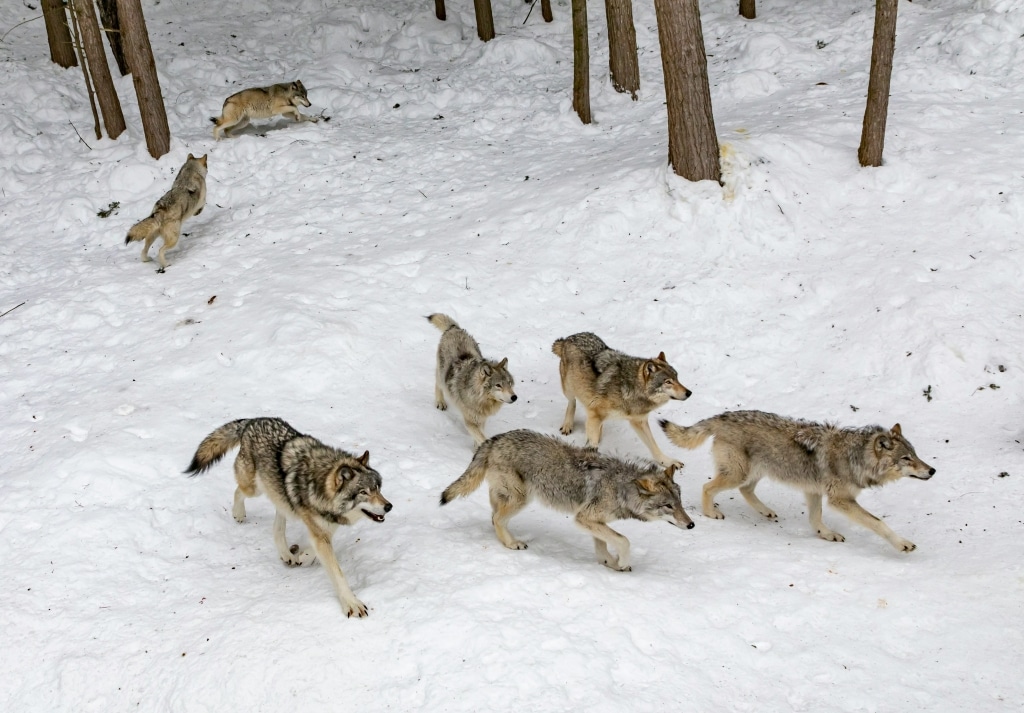
There’s a subject that’s been brought up consistently throughout Shasta County Supervisor Corkey Harmon’s tenure that he said isn’t going away any time soon: wolves.
As gray wolves have reemerged in Northern California over the last several years, livestock kills are becoming more frequent. It’s a cause of concern for several of Harmon’s constituents, he said, who are ranchers that rely on their livestock.
“These families, this is how they make a living. At some point, somebody’s going to say, ‘Hey, we got to protect ourselves.’ I don’t want to see that happen,” he said, referring to the idea that ranchers may try to take matters into their own hands and kill wolves to protect their livestock, something that’s currently illegal.
Gray wolves are protected under the Endangered Species Act, meaning people are restricted from intentionally killing, harassing or harming them or destroying their habitat. They became endangered after westward expansion in the 1800s led to efforts to eradicate them — as agriculture expanded, wolves’ natural prey was wiped out, causing them to target livestock. The first wolf reemerged in California in 2011. Today, most of the gray wolves in the state live in northeastern California, with one confirmed pack fully residing in Shasta County.
“Wolves play essential roles in balancing their environments, influencing forest compositions and the behavior of other species,” the Endangered Species Coalition said in its argument for why gray wolves should remain protected.
But the government-mandated protections for gray wolves are a source of frustration for at least some ranchers in the North State, whose livestock are threatened by the predators. In 2025, there were 196 confirmed wolf attacks on livestock across all of California.
Local, state and federal agencies are working to find solutions to wolf conflicts, but determining which solutions are best has presented a challenge to ranchers, environmentalists and lawmakers alike.
Harmon said the risk of residents in his district taking wolf conflicts into their own hands is becoming more urgent, so he’s been working to figure out how to mitigate the issue. At Tuesday’s board of supervisors meeting, he sponsored an agenda item to add a “Wildlife Liaison” position to the county, which would serve as a point of connection between livestock producers, wildlife agencies and federal, state and local government officials during wildlife-related matters, such as investigating attacks on livestock.
“This role focuses on wildlife monitoring, conflict mitigation, information sharing, and support for ranchers and growers affected by wildlife activity,” the position description says, “while supporting the recovery of wildlife in California through proactive conflict reduction.”
County Senior Administrative Analyst Bryce Ritchie presented the position at Tuesday’s meeting. He told supervisors that while wolves have been the primary focus of discussions involving wildlife activity, the term “Wildlife Liaison” was chosen because it applies to other animals discussed in legislative sessions, including bears and spotted owls.
Staff are looking to have the position funded by the state, Ritchie said, but if the state chooses not to fund it, different funding sources will be researched. He explained that the county had to create the classification for the position in order to apply for funding, and supervisors unanimously passed it after some discussion. No position has been funded yet, but the classification of it opens opportunities for funding.
The state appears to be taking interest in this topic. Earlier this month, the California legislature passed a budget bill that includes $5 million in funding to support ranchers dealing with conflicts with wolves. Half of that funding is meant to compensate livestock owners if their animals are killed by gray wolves, and the other half is designated for activities related to wolf management including wolf attack investigations, collaring wolves or assessing wolf activity.
Harmon said the funding included in this section of the budget bill may be able to help pay for the county’s wildlife liaison position.
Another wolf-related bill, the California Wildlife Coexistence Act, was passed by the legislature and is awaiting Gov. Gavin Newsom’s signature. The bill gives the livestock compensation program a firm legal foundation, according to Sen. Megan Dahle, who supported the bill. She said in a recent press release that the bill also sets guidelines for wolf-livestock coexistence that have been successful in other states where wolves are established.
“What ranchers really need is for wolves to be delisted and to be allowed depredation permits when wolves attack livestock,” Dahle said. “I look forward to that happening, but realistically it will take time. For now, that means we need a consistently funded compensation program and other support for ranchers.”
Dahle’s wishes could become a reality. On Sept. 4, President Donald Trump signed an executive order that directs federal departments to determine whether to remove Endangered Species Act protections from gray and Mexican wolves. If that happens, the wolves would be delisted or downlisted, which means ranchers could potentially be allowed to use lethal force to combat predation.
Removing protections from wolves would likely face pushback from environmental and wildlife advocacy groups. Collette Adkins is the Carnivore Conservation director at the Center for Biological Diversity, and she said in a press release that removing Endangered Species Act protections from wolves would be a “disaster,” adding that the animals are still recovering in population after being nearly eradicated in the 20th century.
She said Trump’s executive order will likely lead to a court decision that reinstates the protections for wolves “while doing nothing to help ranchers,” and that she’s looking forward to challenging delisting attempts in court.
“Smart ranchers coexist with wolves by using commonsense measures like guard dogs and fencing to protect livestock,” she said. “Trump should be funding these tools, not wasting taxpayer money trying to kill or illegally strip wolves of livesaving protections.”
While Harmon supports the president’s efforts to delist or downlist gray wolves, he emphasized that he doesn’t see himself as a “wolf-killer.” But he still sees the threat of gray wolves as a significant problem that needs solving.
“Can they live in places like this valley right here and commingle?” he asked. “No, it’s not functional. There’s places for them, but not right down here in the ranches.”
Do you have a correction to share? Email us: editor@shastascout.org.
Related Articles

Shasta board removes Kerns as planning commissioner amid contentious debate
County Counsel Joseph Larmour said Planning Commissioner Steve Kerns was being removed without cause. Supervisors who attempted to delve into what was behind Kerns’ removal received pushback from the county’s attorney.

Council members make clear: No plans for data center in Redding
After Circle 6 Consulting recommended the council consider a data center project in Redding, council members expressed their disapproval of such a plan. There’s little word yet on how the efficiency study Circle 6 produced will be used by the council to improve city finances.

Shasta elections official in violation of state law for not destroying November 2024 ballots, county attorney says
According to state law, the ballots were supposed to be retained only through Sept. 5, 2026. Litigation filed last week in an attempt to delay the destruction of ballots has failed, the county’s attorney said. Curtis did not respond to a request for comment.
Comments (0)
There are no comments on this article.