
‘Fewer children are able to thrive’: California AmeriCorps programs adapt to funding uncertainty
Nearly a dozen programs for vulnerable students and communities have ended their services through AmeriCorps. Hundreds of tutoring and mentoring positions in schools have also been eliminated, while funding disruptions have made it difficult to recruit and retain staff.
This story was originally published by EdSource. Sign up for their daily newsletter.
For programs across California that rely on federal AmeriCorps funding to provide services such as mentoring and tutoring, it’s been a year of dramatic ups and downs.
In April, California AmeriCorps programs lost millions of dollars in federal funding, which was then restored in late August as a result of a multi-state lawsuit. Programs now face an existential threat with a Trump administration budget proposal to dismantle the agency.
Amid this roller coaster, those who run AmeriCorps programs say they are learning how to adapt. Many have established contingency plans to keep their programs running if funding is pulled again. Others have turned to fundraising. And in some cases, out of fear of losing funding, programs have closed.
“The federal government has infused a high level of chaos that creates a lot of anxiety and uncertainty for our programs,” said Josh Fryday, director of the Governor’s Office of Service and Community Engagement (GO-Serve), which oversees California Volunteers — the state service organization that receives most AmeriCorps grant funding and disburses it to schools, nonprofit organizations and other entities.
AmeriCorps, an independent agency of the U.S. government, supports volunteer and service efforts in California and across the country by addressing issues such as academic support for students, youth mentoring, homelessness, food insecurity, health and other key areas.
PROGRAMS SUPPORT COMMUNITIES
AmeriCorps programs are funded with federal, state and local dollars. Most of that funding goes toward living stipends for AmeriCorps members who may be tutors, mentors or in other roles.
The federal government provides over half the funding for some of California’s AmeriCorps programs. In 2023-24, volunteers supported 17,000 foster youth with education or employment and tutored or mentored 73,833 students, according to California Volunteers.
At the federal level, AmeriCorps has historically had bipartisan support.
But there’s a desire to cut AmeriCorps in some circles. In a May budget recommendation, the Trump administration proposed eliminating AmeriCorps funding to “enhance accountability, reduce waste, and reduce unnecessary governmental entities.”
With the government shutdown, which began Oct. 1, state and local organizations don’t yet know the fate of AmeriCorps funding going forward and won’t know until Congress passes a budget.
For many AmeriCorps programs, they only have to look back a few months to know what disruption feels like. When the federal government, under the Trump administration, slashed hundreds of millions in funding across California and the nation earlier this year, local and statewide programs were forced to either use their own funding to continue services or shutter their doors.
Without AmeriCorps, ‘services are going to go away’
Fryday said program participation in AmeriCorps is down. As of Sept. 26, AmeriCorps California had filled about one-third of its 2,219 openings, including 570 of 1,388 positions focused on education.
“The cascading ripple effects of it mean that fewer children are able to thrive in California,” said Avo Makdessian, executive director of the First 5 Association of California. The statewide organization, funded by the tobacco tax, provides support for early childhood health care and education.
For First 5 programs in places such as Madera, Modoc, Colusa and Sacramento counties, the funding cuts earlier this year led to the elimination of critical staff, according to Makdessian.
Appointments were canceled for kids who were scheduled to be screened for developmental delays. Home visits to check for child health and safety had stopped. Family resource centers that offered free child care and preschool closed.
Although federal funding has been restored, many organizations, including some that provide AmeriCorps members to First 5, have decided not to depend on AmeriCorps dollars, Makdessian said.
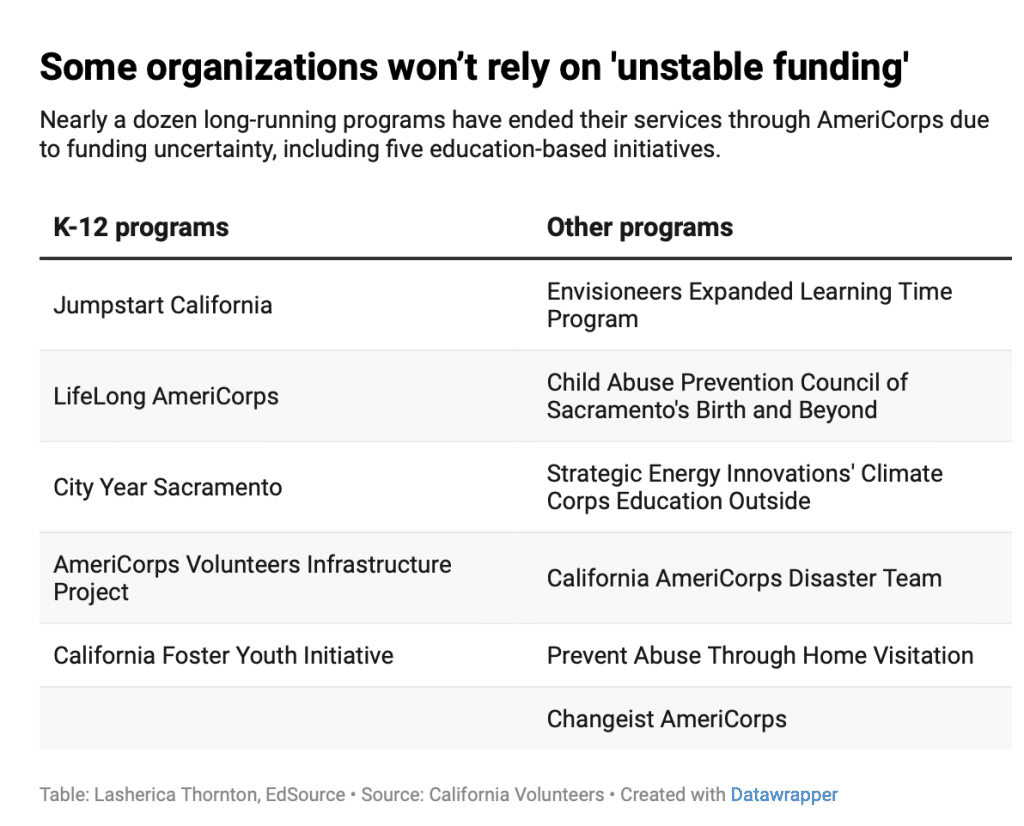
Eleven long-running programs discontinued their services through AmeriCorps due to funding uncertainty, including five that supported struggling students in the K-12 education system.
“Those services are going to go away,” he said.
Uncertainty wreaks havoc
Some community-based organizations are trying to avoid extinction. During the temporary funding cuts, San Francisco-based 826 Valencia restructured and raised additional funds to continue providing individualized writing support to over 7,000 students from under-resourced communities.
To get through the period without funding, Bita Nazarian, the organization’s executive director, said 826 Valencia hired writing tutors as hourly employees rather than AmeriCorps members, costing the organization $250,000 more and depriving the tutors of living stipends and $10,000 awards they receive through AmeriCorps.
“It was more expensive and less beneficial to the participants,” said Nazarian.
When 826 Valencia was paying hourly, it meant less time with students, Nazarian said, because as part-time workers, the tutors worked 29 hours a week, rather than a 40-hour workweek.
Less individualized attention means less support for the neediest students, she said.
In preparing for the current school year, there was — and continues to be — worry that funding could be yanked midyear.
When hiring 14 tutors, 826 Valencia warned that “we don’t know what’s going to happen with AmeriCorps,” Nazarian said. “That’s not a constructive way to run an organization. Hiring people. Telling them they might lose their jobs.”
Sustained by community support

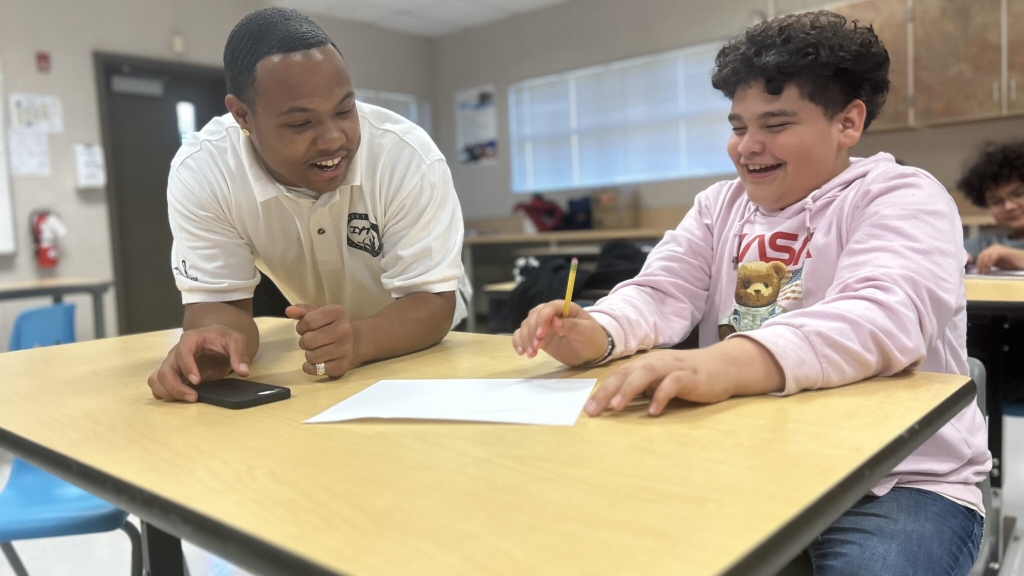
In the Stockton Unified School District, the positive outcomes of the AmeriCorps-funded Improve Your Tomorrow, a mentorship and college access program for young men of color, can be seen at Cesar Chavez High School. Mentor Nicole Davidson worked with a junior who disclosed that he had contemplated suicide every day for at least four months.
To help the student, Davidson, who is a program manager for Improve Your Tomorrow, increased the frequency of their one-on-one sessions and check-ins, leading to an “inspiring transition,” she said. After one school year, the student is now on a leadership committee.
“We want our young men to succeed, but it’s also making sure that they’re OK,” she said. “We want them to be well-rounded students.”
WATCH: Sa’vion Fairley, an eighth grader at Hong-Kingston Elementary School and an Improve Your Tomorrow mentee, leads the brotherhood creed focused on academic excellence and college attainment on Oct. 20, 2025.
When funding was cut, Improve Your Tomorrow was expected to stop offering the mental health resources students needed. But the program used its reserves and turned to community donations to continue paying mentors who provide services to about 1,000 young men in Stockton and 6,000 across California to help them finish the 2024-25 school year.
“It caused a lot of uncertainty within the kids because we just didn’t know if we were going to be here (this school year) or not,” said Tony Vang, a Franklin High School mentor for Improve Your Tomorrow. “They’re like, ‘What are we going to do if you guys aren’t here anymore?’”
“We’re on the ground,” helping with the challenges students must overcome, he said.
In an emergency fundraising campaign, Improve Your Tomorrow raised $300,000 to sustain the program, even if there are cuts this year, according to the organization.
But the effects of AmeriCorps’ roller coaster are being felt across California schools; 650 mentoring and tutoring positions did not return this academic year because of funding uncertainty, according to California Volunteers.
Leaders at the state level hope that continued state funding and advocacy will prevent other AmeriCorps programs from ending their services.
“We understand how incredibly impactful these programs are,” said Fryday, with California Volunteers. “California’s going to continue to fight for these resources because they’re so critical, whether it’s through the legal process or pushing Congress to continue to fund this critical work. I think that’s the most certainty we can provide right now.”
This story was originally published by EdSource and is republished here with permission.
Author

Related Articles
Shasta County must hold off on placing voter ID measure on ballots, judge says
The decision came in response to a petition filed earlier this month by an anonymous plaintiff. If approved by voters in June, the ballot measure would amend local law to allow for changes to elections, including hand counting and voter ID.

Riverside’s Sheriff is investigating alleged election ‘irregularities.’ Shasta’s election official was the one to break the news
Shasta ROV Clint Curtis told county supervisors during Tuesday’s public board meeting that the Riverside department was “confiscating all of the records in Riverside.” Riverside officials have confirmed the news of an investigation.

Supervisor Kevin Crye hospitalized due to ‘cardiac episode’
A statement posted on Facebook today said he’s been given an “excellent prognosis” for recovery. He’s also being treated for colon cancer.