
Good News Rescue Mission Holds Second “Redding Restart” Forum Focused On Housing
We followed up with some simple questions: How much affordable entry-level housing is available and how long is the wait? The news wasn’t good.
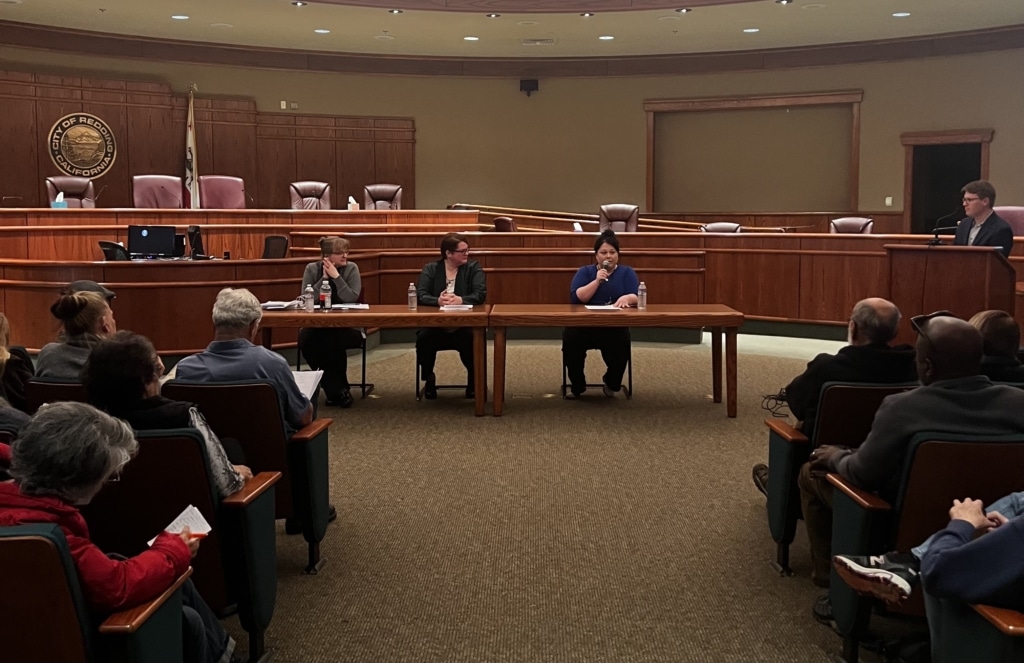
About one hundred people attended the Good News Rescue Mission’s second forum on homelessness, held Friday, April 13 in the Redding City Council Chambers.
The event included the input of panelists representing Shasta County, the City of Redding, and local nonprofit organization Faithworks, which provides housing and supportive services for local families.
Justin Wandro, the Mission’s Community Development Manager, began the event with testimonials and a presentation on the history of homelessness before posing a series of audience questions to panelists.
They responded with information about the need for case management, the challenges of matching funding sources to needs, and how the County’s coordinated data entry system works.
But despite the forum’s focus on addressing housing, no information was offered about how adequate the County’s stock of affordable housing is, or how long people who are motivated to come off the streets are currently waiting to access entry-level affordable housing.
Speaking to Shasta Scout after the forum, Wandro, who facilitated the forum, deferred those questions to panelists Bostain and Smith.Both agreed that the answer is complicated, but acknowledged that the wait list for most Shasta County residents seeking affordable, entry-level housing is long.
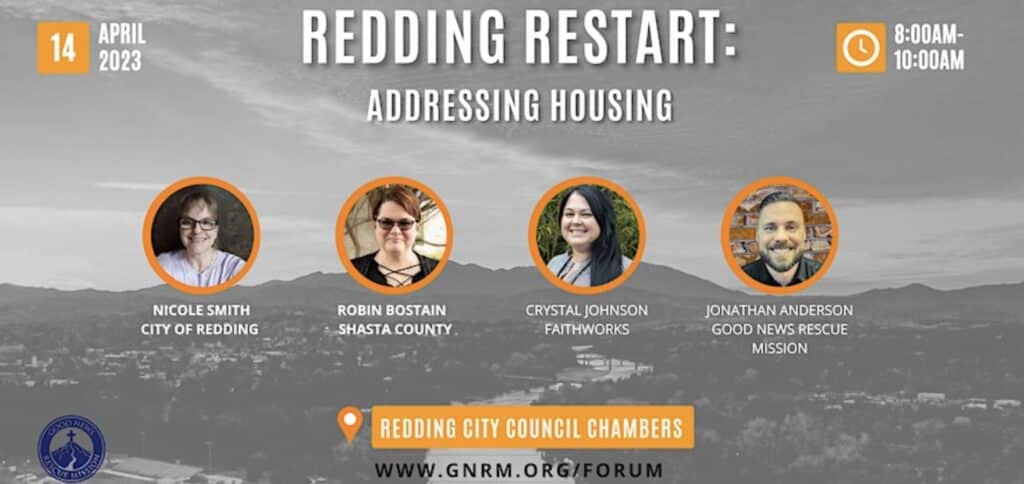
Bostain, who is Shasta County’s Community Development Coordinator, has spent the last nine years working with homeless families to identify and overcome barriers to housing.
Those barriers, she said, include both a lack of social workers to coordinate case management and enough affordable housing. Which is why, she explained, the wait list for permanent housing for unsheltered Shasta County adults coming off the street is currently “very long.” She was unwilling to hazard a guess on how many months that wait might be.
Nicole Smith, Redding’s Community Development Manager, said she too couldn’t say exactly how long people coming off the streets would wait for housing in the City of Redding.
The City receives a total of about 1,800 housing vouchers, most of which are already in use. Smith said about 15-20 become available each month and are distributed to those at the top of the voucher waiting list. That waiting list is currently at 12,000 she said, but first priority is given to the approximately 1,000 City of Redding residents on the list.
Speaking to Shasta Scout after the housing forum Friday, Smith said she believed most people were receiving a voucher after about six months on the housing list but on Monday, April 17, when asked about the data, Smith updated that number to estimate people’s wait times at “over a year to up to two years” saying “as time goes on we’ll have a better idea.”
Simple math shows that if 1,000 people are waiting and only up to 20 receive a voucher each month, their wait will be approximately four years. But regardless of how long people are waiting, even receiving a voucher is no guarantee of housing, as Smith explained.
“The voucher is (good) for four months and they have the ability to go out and (try to) locate housing (during that time),” Smith said. “But I think part of the problem is a lot of folks (who are seeking housing) have credit issues or an unlawful detainer on their record.”
“Helping people really fix some of those problems,” Smith said, “is going to be important for them to be able to actually use a voucher.”
Another reason for the long wait is an ongoing lack affordable housing in the City of Redding. Steve Bade, Redding’s Deputy City Manager, said while the City is doing all it can to respond to the high need for affordable housing, especially in the very-low-income category, Redding still lacks about 3,000-3,500 low-income housing units.
The hope is to have 800 more available by the end of 2024, he said. Assuming the City achieves that goal, that would still leave Redding with a deficit of at least 2,200 units. Bade says the highest housing need is for one- and two-bedroom units for low- and very-low-income populations, particularly the elderly and the disabled.
“The cost of living goes up,” Bade explained, “And those folks are limited on their income and they get hit the hardest. They’re barely able to pay rent and living expenses.”
For those currently waiting for housing they can afford, Bade expects they’re coping by paying a higher percentage of their income than the recommended 30%, perhaps more like 40–50%.
But according to Sarah Fielding, managing attorney for Legal Services of Northern California’s (LSNC) Redding Branch, which provides free legal services to income-qualifying clients in California’s North State, many aren’t coping, they’re facing evictions and homelessness instead.
In October, Fielding wrote an Op Ed for Shasta Scout, titled “My Clients Aren’t Refusing Housing, There’s No Housing For Them To Refuse” in which she illuminated the challenges of accessing housing, particularly for those living on very low fixed incomes. Last fall, Fielding wrote:
“The most recent local rental listings compiled by Disability Action Center show that almost all of the available rentals in the Redding area would cost the entirety of my clients’ income or more. A handful exist where their income would cover the rent, but not also utilities, gas, food, cleaning supplies, clothing, or other basic necessities. Property management companies typically require potential tenants to have income at least three times the rent to qualify for the unit. None of my clients qualify on their own. They aren’t refusing housing; there is no housing for them to refuse.”
Bostain and Smith’s answers, and Bade’s and Fielding’s data, illustrate just a few of the complexities that Shasta County’s unhoused community members face despite the ongoing interventions of outreach workers like the Redding Police Department’s Crisis Intervention Response Team (CIRT).
While unsheltered residents in encampments may receive a card from CIRT with resource information or, in the best case, be visited by a field worker who registers them in the County’s coordinated data entry system, for many, accessing housing will require waiting for years, especially if they’re on a fixed income, have a record of evictions, or need supportive services in order to stay housed.
The Good News Rescue Mission plans to hold another forum on homelessness in June. The focus will be on bringing churches together to address the problem.
If you have a correction to this story you can submit it here. Have information to share? Email us: editor@shastascout.org
Author

Related Articles

After branding a man guilty on social media, three RPD officers have been named in $12 million defamation suit
When Phetakhom Tu Manivong was arrested in 2022, Redding Police officers posted on the department’s Facebook page, claiming he had committed a heinous crime. After being found not guilty by a jury of his peers, Manivong has filed a lawsuit against the city alleging that RPD’s false statement followed him for years, ruining his career and his reputation.
Neighborhood association files legal challenge over land lease for Shasta custody expansion project
In a legal filing in February, the River Ranch Neighborhood Association said Redding inappropriately bypassed state environmental law when it leased property to Shasta to build an alternative custody facility.

Redding council approves city-wide efficiency study at request of new city manager
The study is intended to “increase efficiency and accountability while reducing waste,” according to the staff report. The council allocated up to $300,000 to hire a consulting firm — chosen by the new city manager — that will conduct the study.