
Hundreds of Shasta County’s Unhoused Community Members Participate in Annual Point-in-Time Count
Staffers with local service organizations have just finished surveying the unhoused in Shasta County. The data they collected will help forecast what the local homeless community needs the most.
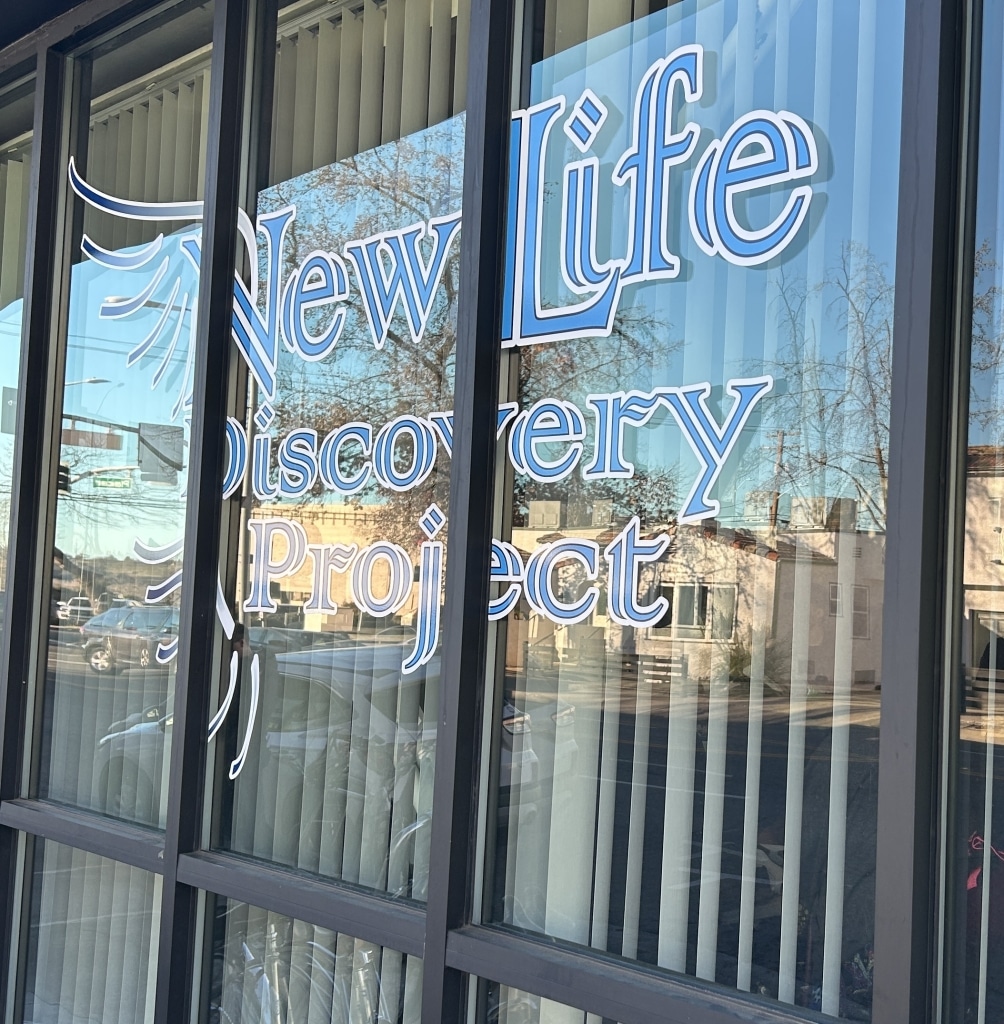
A little past 9 AM on January 22, dozens of unhoused community members began to fill New Life Discovery Project’s Placer Street location. At first they trickled in, then they began to arrive in a heavy stream — some with bikes and carts, others with canes and wheelchairs, most with bags or backpacks, and many with dogs.
With the support of staff members from about 15 different Shasta County service providers, some of the arriving local unhoused residents rifled through donated clothes, coats and shoes before moving to a makeshift dining area where they met one-on-one with staffers to participate in a brief survey for this year’s Point-in-Time Count.

The PIT Count, as it’s more frequently known, is conducted by Continuums of Care across the nation at the direction of the federal Department of Housing and Urban Development (HUD). In far northern California, the NorCal Continuum of Care comprises seven counties, including Shasta, that collaborate to provide services to individuals experiencing housing insecurity. The NorCal CoC’s focus ranges from offering resources to those currently experiencing life on the streets, to guiding people in emergency and transitional housing settings towards stable permanent housing, and all the steps in between.
Dawn Pittore, a social worker with Shasta County’s Health and Human Services Agency, was among the personnel on site at New Life Discovery Project yesterday. From behind her laptop screen, Pittore reviewed big-picture data related to submissions of online PIT Count surveys as forms were submitted by staff in real time across the seven counties of the NorCal Continuum of Care.
The bulk of those submissions as of 9 AM had come from Shasta County, which is home to the largest unhoused community of any single County within the NorCal CoC. The last PIT Count, in January 2023, documented Shasta’s total unhoused population at just over 1,000. Data revealed by the PIT Count helps to illuminate the root causes behind homelessness. For example, 14% of those surveyed in 2023 said they first became homeless after some kind of family break-up, which could include partner breakups as well as parent-child, or sibling disagreements.

During yesterday’s outreach, PIT Count team members sat at folding tables where they met with those who voluntarily agreed to respond to basic questions about their homelessness status, before grabbing breakfast, drinks, and other resources, including feminine hygiene products and gift cards from the Dollar Store. Shasta County service providers now mostly fill out client PIT Count surveys online, using an app that’s pulled up on staffers’ cell phones. The surveys start with a simple question: where did you sleep last night?
Some responses listed on the survey, such as “motel,” “jail”, “emergency shelter,” or “friend’s home,” are used to indicate the respondent is currently sheltered but not in stable housing. Other responses like “sidewalk,” “vehicle,” and “under bridge,” document the unsheltered with no access to a safe place to live, even a temporary one.
The way this data is collected leaves blindspots. Under HUD policies, communities conduct separate sheltered and unsheltered counts for the two groups, contacting sheltered individuals via known programs like the Good News Rescue Mission. This process misses many of those who lack stable permanent housing, including youth, who often find temporary shelter informally at friends’ homes. Data included in a 2017 National Law Center on Homelessness and Poverty report indicates that true homeless numbers are likely somewhere between 2.5–10 times as many as indicated by local PIT Counts.
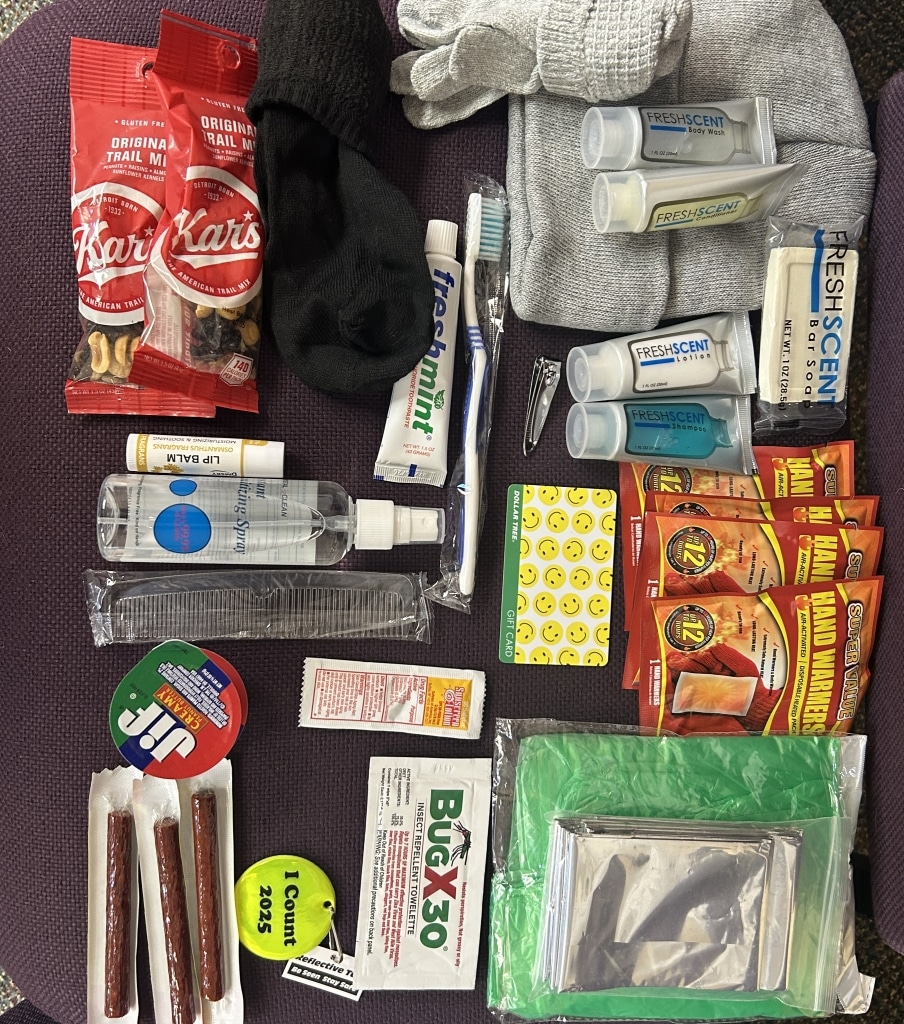
While the team at New Life Discovery Project met with homeless community members onsite, staffers from service organizations deployed out into the city to tally unhoused folks still on the streets. By noon, staffers also began fanning out across the area to approach community members living in communal, self-organized shelters known as encampments, or camps. They distributed bags of resources equipped with reflectors, hand warmers, a beanie and gloves, and snacks.
Procuring supplies and coordinating the complex logistics of the Count requires a subset of the NorCal Continuum of Care Shasta Advisory Board team to hustle for months. The three PIT Count coordinators behind this year’s effort include FaithWorks Executive Director Crystal Spencer, Pathways to Housing Executive Director Lesha Schaefer, and Megan Preller, a social worker and Host Homes Coordinator with Ready for Life. More than 80 staffers from various organizations helped conduct yesterday’s event. And that’s just in Shasta.
In the weeks leading up to the PIT Count, organizers met with members of the Redding Police Department to explain the importance of the survey, and request that police officers refrain from disrupting camps where the houseless congregate, in order to make it easier to contact hte unhoused for the survey. During a recent NorCal CoC Advisory Board meeting, Preller described RPD as curious about the PIT Count process and accommodating to the team’s requests. PIT Count organizers said they do not include RPD representatives as part of the Count itself, since many in the unhoused community associate the police with enforcement rather than resources.
Now that the data has been collected, a PIT Count team representative from each NorCal CoC County will report back to the NorCal CoC Executive Committee as the full results are submitted to HUD. None of the organizers received any additional funding for their participation. Instead, they’re motivated by the importance of providing a full count of as many of Shasta County’s unhoused population as possible. Accurately documenting the need for resources will, in time, qualify Shasta County for more federal and state funding for homeless response.
Appearing to find a little bit of reprieve from the daily challenges of living outside, community members at the New Life Discovery Project ate burritos washed down with energy drinks as they greeted old friends. Some slipped brightly-colored donated collars and leashes onto their dogs, who also relaxed, many with newly-procured rawhide bones. Participants flashed easy smiles to one another and staff members as they responded to survey questions and then stayed to talk.
Making sure they feel safe, comfortable and welcome, Spencer said, is integral to the endeavor’s success.
Do you have a correction to share? Email us: editor@shastascout.org.
Author

Comments (10)
Comments are closed.
Related Articles
Haven Humane opens disaster response center built with Zogg Fire funds
The animal welfare organization opened a new disaster response and humane education center today next to its existing facilities in Anderson. The center was built with funds from the Zogg Fire that were designated for animal care in honor of Karen King.
Redding Rancheria PAC spends $32,000 to support four city council candidates
The Tribe said it created a PAC, or political action committee, to support city council members who understand the relationship between the Tribe and the city. Those candidates haven’t received direct donations of funds; instead, the PAC has provided indirect support through media campaigns.
Power shutoffs impacting thousands of customers across Shasta County
PG&E shut off power for California residents earlier this week due to wind and dry conditions, which could lead to dangerous wildfires. Shutdowns are expected to continue until Saturday morning.
I am a Shasta county homeless person on the street type but I am also a full time college student and I was not counted this year because I had not been home that day but I was aware that they do it some time in January. I have had tobyse it many times for papers as a reference I’m majoring in psychology and iv made my focus the homeless and that is why I would really like a chance to meet some people mentioned here I have a plan that iv Bern working on for some time but I’m real nervous about it. Anyway if someone could contact me by email I can explain it better.i left my e mail in the box.
Thank you Crystal Wenzel
Hi Crystal, I empathize with your comments on being homeless and wanting help. I would just say to you to please be aware and cautious as to who may reach out to help you. If you are at Shasta College, I strongly urge you to work with the staff. They can be trusted. You may be down, but you are not out.
“City of Redding to do pointless “point in time” homeless survey”
Redding California homeless advocates prepare 2025 Point-in-Time survey, yet year after year they go to homeless camps to do a survey, then a week later Redding police raid and remove the identified camps…
Such BS
With chief Barner’s aggressive criminalization of homeless, and their constitutional rights, many homeless know this and refuse to participate in the survey, knowing homeless haters volunteer for the count, to later report their location to police.
Besides there being allegations by past RPD officers of “Breaking homeless folks legs” if they dont comply with orders
Reported homeless numbers are reported to be down, therefore reducing the amount of money available to solve the local homeless problem.
https://reddinghomeless.blogspot.com/2025/01/city-of-redding-to-do-pointless-point.html
While I appreciate the generosity of the persons from Churches, many people are not in the Judeo-Christian religion or any religion. I sure hope these vulnerable people are not feeling pressure to participate in or attend religious services. That puts them in a tough spot – sell your soul for a bed? It is cold out there but I suspect these individuals have rejected a similar offer at home or other outreach programs. If they do not wish to participate are the going to be dropped and their needs unattended to?
It’s the counties way of getting more money and none goes to help the homeless. And all the free clothes and hygiene stuff that’s given to the homeless ends up trash along the banks of the Sacramento river. And then the police have to clean it up.
How long have these accounts been going on? Are they annual? Has the homeless situation in any way been reduced since the counts have been going on? What is the mission statement of the PIT? Every program Should have a measurable outcome.
Jon: 1) The PIT Count is not a program, its a process. 2) Counting people doesn’t help them stop being homeless.3) Results of the Count help qualify NorCal CoC service providers (mostly nonprofits, many faith-based) to recieve state and federal funding via the CoC. The ways programs are measured depends on the program but most state and federal programs lack specificity and accountability in how they determine progress, imo. The NorCal CoC is actively working to increase its own internal metrics processes to make up for that deficit.
While the PIT/CoC is certainly an important effort to get a count on those without homes; the funding coming from the newly elected President and legislators and department heads will be tenuous. I suspect entities like PIT will be part of the DOGE bean counting crew. Communities may have to find inventive ways to take of their own for the next 4 years.
Hello Frank,
I appreciate your words about communities, such as ours in Shasta County, needing to find inventive ways to take care of our community members. It look forward to participating in creative conversations and creating community projects to do this important work.
I enjoyed reading this article. I am happy to see that someone actually cares about the homeless out here (even if it’s for the moment). Keep up the good work.