
New question emerges about Measure B, a local initiative that could change Shasta’s election law
A ballot initiative slated to appear before voters in June continues to face legal pushback. The initiative, if passed by voters, would change Shasta’s election laws in ways that violate current state election law. A recent legal filing alleges that Measure B never received enough signatures to appear on ballots at all.
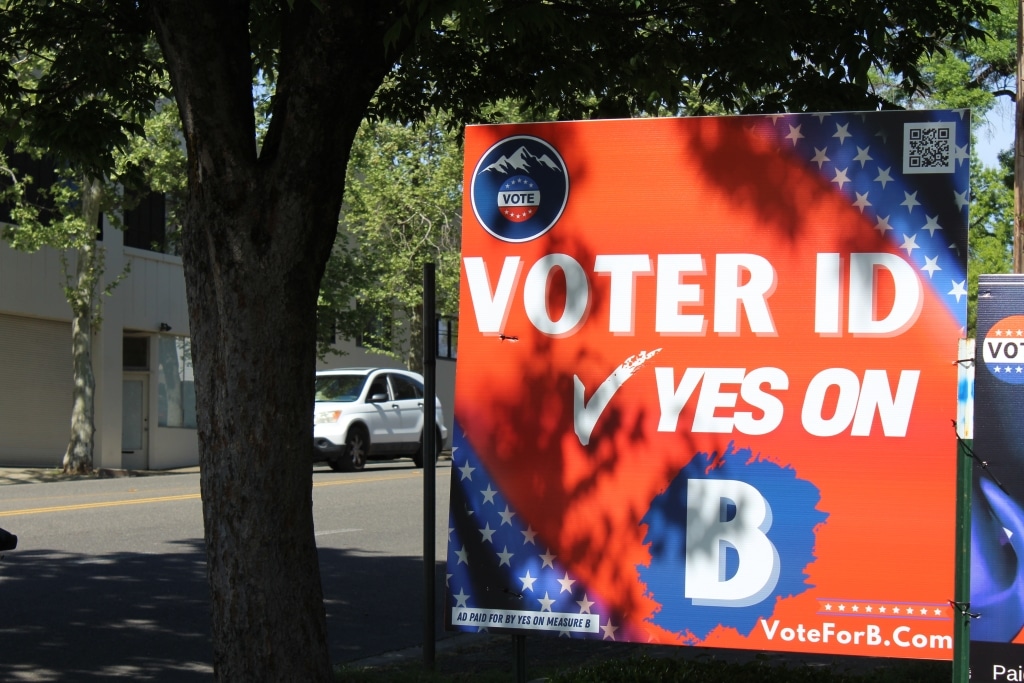
A filing submitted to the Shasta County Superior Court on March 12 raises a new question about Measure B.
The initiative, which is currently slated to appear before Shasta voters in June, would change the county’s charter law to implement local election rules including limited absentee ballots, hand counting and voter ID. All three, and other requirements of the measure — such as separating Shasta’s voter rolls from the state — would violate state laws that forbid voter ID requirements, require the use of universal mail in ballots and outlaw hand counting in jurisdictions the size of Shasta.
In February, Shasta County taxpayer Jennifer Katske filed a suit against the measure — originally under a pseudonym. She alleged that placing the initiative on ballots is a waste of taxpayer money because implementing the measure would be illegal. In the suit, she asked the court to issue a restraining order to prohibit the county from continuing to spend money to place it on the ballot. Shasta County Judge Benjamin Hanna agreed, issuing a restraining order in February that was later lifted by judges in the Third District Court after an appeal by ballot measure proponents. For now, the ballot measure is moving forward.
Measure B is a citizen-led initiative, meaning that it’s being placed on ballots because enough signatures were gathered by Shasta community members. But Katske’s latest filing in the case, submitted on March 12, alleges that the appropriate number of citizen signatures were never verified by the county elections office.
In an Oct. 23 document submitted to the county board, County Clerk and Registrar of Voters Clint Curtis said he had determined the number of signatures needed by utilizing a formula that had been provided by California’s Secretary of State. citing California Election Code 9118. He said a random sampling of submitted signatures had shown that proponents gathered more than enough valid signatures and asked supervisors to vote to place the measure on ballots, something they did.
But Katske, a nurse who’s representing herself in the case, says Curtis used the wrong formula for a charter amendment, alleging that another part of the election code referencing city or city and county charter initiatives should have been used instead.
Using emails pulled through public records requests and shared as exhibits in her filing, Katske documented that the ballot measure initially failed the signature verification process before Curtis found what he referred to in an email to ballot proponents as a “loophole” by switching to a formula provided in California Election Code 9118. That law outlines signature requirements for ballot measures more broadly without referencing charter amendments.
The Secretary of State’s Office declined to comment on the validity of the formula used by Curtis, referring to the ballot measure as a “local issue” and suggesting Shasta Scout contact the local elections office. Curtis, who heads that office, did not respond to a request for comment.
The ballot measure is being promoted by a group of five Shasta County community members including Laura Hobbs, an election activist who was hired by Curtis on Oct. 6, just weeks before the signatures for the ballot measure she championed were officially approved by his office. In February, Curtis said his decision to employ Hobbs full-time at the Shasta Elections Office doesn’t represent a conflict of interest and shouldn’t concern voters. Hobbs, who has already poured more than $2000 into the campaign for Measure B, did not respond to a request for comment.
Judge Hanna will take up the case against Measure B again on March 25 at 8:30 a.m. in Dept. 64 of the Shasta County Superior Courthouse.
4.23.2026 3:05 p.m.: We have updated the story to correct the next hearing date.
Do you have a correction to share? Email us: editor@shastascout.org
Author

Comments (1)
Leave a comment
Related Articles

After branding a man guilty on social media, three RPD officers have been named in $12 million defamation suit
When Phetakhom Tu Manivong was arrested in 2022, Redding Police officers posted on the department’s Facebook page, claiming he had committed a heinous crime. After being found not guilty by a jury of his peers, Manivong has filed a lawsuit against the city alleging that RPD’s false statement followed him for years, ruining his career and his reputation.

Neighborhood association files legal challenge over land lease for Shasta custody expansion project
In a legal filing in February, the River Ranch Neighborhood Association said Redding inappropriately bypassed state environmental law when it leased property to Shasta to build an alternative custody facility.

Redding council approves city-wide efficiency study at request of new city manager
The study is intended to “increase efficiency and accountability while reducing waste,” according to the staff report. The council allocated up to $300,000 to hire a consulting firm — chosen by the new city manager — that will conduct the study.
Measure B in Shasta County has quickly become more than a local ballot initiative—it is now a test case for the limits of county authority over election administration. At its core, the proposal seeks to fundamentally restructure how votes are cast and counted, invoking principles of local control and election transparency. Yet the measure also raises serious questions about legal preemption, administrative feasibility, and fiscal stewardship. As voters weigh its merits, they are not merely deciding policy—they are potentially setting in motion a complex and costly legal process with implications far beyond county lines.
From a legal standpoint, Measure B appears poised to collide with the California Elections Code, which establishes uniform procedures governing elections statewide. Under the doctrine of state preemption, local governments are generally prohibited from enacting ordinances that conflict with state law in areas of statewide concern—elections being a prime example. Should the measure pass, it would almost certainly invite immediate litigation seeking declaratory and injunctive relief, potentially halting implementation before any substantive changes occur. The likelihood of judicial intervention at an early stage is not speculative; it is consistent with how courts have historically treated similar conflicts.
Compounding the legal uncertainty are potential federal claims. Provisions relating to voter identification requirements and restrictions on voting methods could be challenged under the United States Constitution, particularly the Equal Protection Clause, as well as statutes like the Voting Rights Act of 1965. Such claims would open the door to parallel proceedings in federal court, adding layers of complexity and extending the timeline for final resolution. In high-stakes election litigation, it is not uncommon for cases to proceed simultaneously through state and federal systems, creating a prolonged period of legal ambiguity.
The financial implications of this trajectory deserve equal scrutiny. Even under a conservative estimate, defending Measure B through trial and initial appeals could cost between $200,000 and $750,000 in legal fees alone. A more protracted legal battle—particularly one involving appellate review by the Supreme Court of California or federal courts—could push total expenditures into the $750,000 to $2 million range. Critically, if the measure is invalidated on constitutional grounds, fee-shifting provisions may obligate the county to pay prevailing plaintiffs’ attorneys’ fees, significantly increasing total liability.
Beyond litigation costs, the operational expenses associated with implementing Measure B could prove even more consequential. Transitioning to labor-intensive processes such as full hand-counting of ballots would likely require substantial staffing, training, and infrastructure investments. Estimates for such changes can reach into the millions per election cycle, particularly when accounting for extended counting periods and compliance safeguards. Should courts later enjoin or overturn these measures after partial implementation, the county could face sunk costs with little to show in return—an outcome that raises legitimate concerns about fiscal prudence.
Ultimately, Measure B places voters at the intersection of principle and practicality. Supporters may view it as a necessary recalibration of election integrity, while opponents see it as a legally tenuous and financially risky proposition. What is clear, however, is that passage would not mark the end of the debate—it would mark the beginning of a likely multi-year legal and financial undertaking. In that sense, the most consequential vote may not be about the policy itself, but about whether the county is prepared to bear the costs—both fiscal and institutional—of defending it.