
Redding Council Approves “Guiding Framework” For Riverfront Planning
The city says all future planning for the area must be consistent with the framework. But many specifics, such as what development might actually occur at the riverfront, remain unanswered, for now.
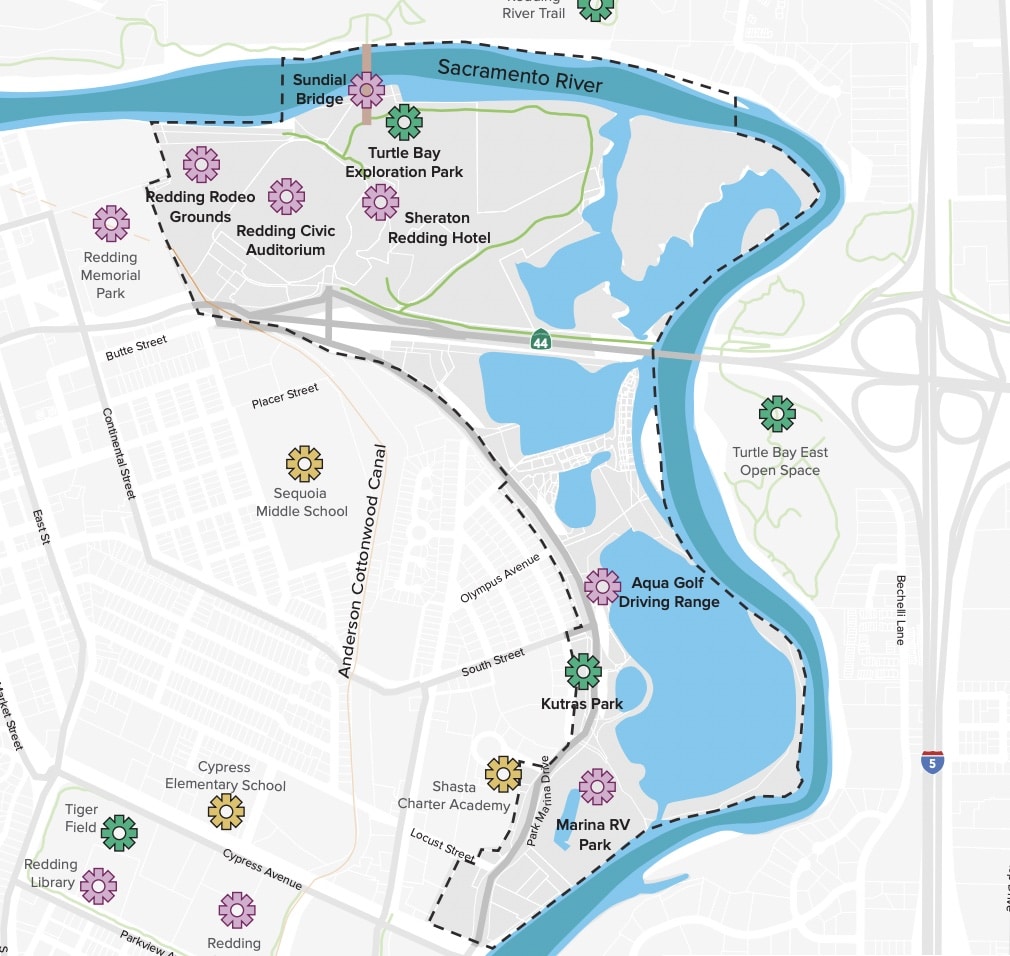
A map of the area included in the Riverfront Specific Plan area. Image from the city’s website.
Redding says it wants to use a planning process to “reintroduce” the local community to the Sacramento River.
The city is partway through a two-year process of updating the Riverfront Specific Plan, a document that establishes goals, policies and developmental standards to guide development and conservation for 380 acres of public and private land along the river in Redding. The area includes important city landmarks and locations like the Sundial Bridge, Turtle Bay Exploration Park, the Redding Rodeo Grounds, and the Redding Civic Auditorium.
Council members took an important step in the process last night, approving a framework guided by community input which includes both overarching vision themes and principles underlying each part of those vision elements.
The framework is the result of several months of meetings with community members thought open house workshops, community conversations, and public meetings of the Riverfront Community Coalition.
It’s focused on broad themes of protecting the natural environment and respecting the Indigenous community, while developing environmentally-sensitive, appropriately scaled and world-class facilities for art, culture, entertainment, and recreation.

An image from the City’s website shows the guiding vision elements that underlie a series of planning principles for the riverfront area.
The key vision elements are broken down into a series of guiding principles that, city documents indicate, must be used to guide all future planning at the riverfront.
Redding Development Services Director Jeremy Pagan used part of the city’s presentation on the framework to share extensively about Indigenous perspectives and values learned during the City’s listening session with Tribal community members. He said about fifty Native community members attended the event.
That session was one aspect of the city’s emphasis on robust community input into the planning process which began in August of 2023 with two open house workshops held at the Redding Civic Center, and continued with a series of community conversations with key individuals and groups, including property owners, riverfront tenants, and local Tribes.

Moving into the fall of 2023, the city used those themes to begin a series of public meetings with key stakeholders. The Riverfront Community Coalition included 20 community members who were chosen by the city for their roles as representatives of various stakeholder groups.

From those events, conversations, and meetings, the city developed a series of themes regarding the public’s thoughts about riverfront planning. They reveal that the public’s view of the riverfront as an asset is mostly focused on the ecosystem value of the property, including its natural beauty, riparian habitat, open spaces, and walking trails. The public’s main concerns about land use relate to environmental protection, land ownership, planning processes, and Indigenous cultural resource protection.
In summary, city staff say, they learned that the community’s vision is to protect the environment at the riverfront and establish clear guidance around riverfront land use while enhancing public access and expanding outdoor attractions and facilities.
The Coalition’s conversations resulted in the guiding vision and principles being discussed by the Redding City Council last night. Council members eventually approved the framework unanimously, but only after some discussion.
Council member Michael Dacquisto asked several times about whether housing might be built at the riverfront and if so, where. In response, Redding’s Community Development Director Jeremy Pagan, who oversees the planning process, said that it hadn’t been ruled out either on the north or the south side of the river and that specifics related to development weren’t part of the guiding framework. Redding Mayor Tenessa Audette asked about the inclusion of sports facilities at the riverfront and Pagan said that idea could be considered if the Council wanted to include it. And Council member Jack Munns spoke up briefly after the unanimous vote saying he approves the framework but is “still trying to take it all in.”
More than a dozen community members also spoke up on the topic, many of them Native community members who expressed both gratitude for the inclusion of their voices in the planning process and ongoing concern about development at the riverfront and its potential effect both on the local environment and on Native cultural ceremonies and resources.
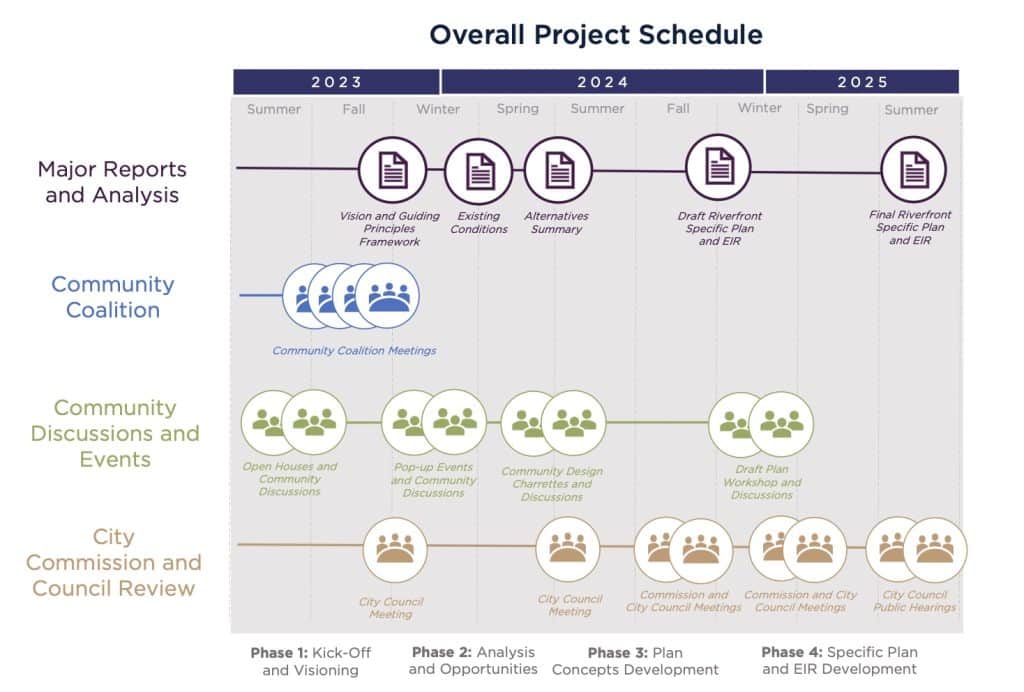
Now that the guiding vision and principles are approved, the city will move forward with additional community input as staff members begin to develop a first draft of the updated plan. Pagan says the newly-approved guiding principles should be thought of as “the first chapter in the Riverfront Specific Plan,” as all future planning for the area must be consistent with the framework.
Once completed, the Riverfront Specific Plan will provide legal guidelines that delineate potential development and conservation decisions moving forward. As always, public officials such as city council members will still have the ability to review specific development proposals as long as their decisions fall within the boundaries of city planning documents.
Do you have a correction to this story? You can submit it here. Do you have information to share? Email us: editor@shastascout.org
Author

Comments (8)
Comments are closed.
Related Articles
Democrat from Marin could represent Shasta County in Congress under new Prop. 50 district lines
As Prop. 50 lines come into play at the midterms, Shasta County will join California’s second congressional district, currently represented by Jared Huffman of San Rafael. His representation would mark an immense shift for Shasta’s conservative voters.
Redding Library to reopen following significant upgrades made with nearly $800K state grant
The library, which hasn’t been fully operational since last July, will reopen on Feb. 17 after significant upgrades made through a grant from the California State Library.
Garman withdraws from Shasta’s District 5 race, endorses Gallagher
Former Shasta supervisor Tim Garman has pulled out of the race for District 5, a seat currently held by Shasta County Board Chair Chris Kelstrom. Garman has endorsed Mike Gallagher, a current Anderson City Council member.
“Vision ” such an over used word of the local cult, Bethel, so we should know they’re guilding this plan to their best interest , as part of their 7 mountain mandate to take over the entire Northstate.
Bit of a logical leap my friend. 🙂
Why was my comment to Nick removed
It was just waiting for moderation. Just approved it. I apologize for the delay.
The south part of the plan is more or less the city telling Chris Kutrus how he may develop his property.
Development , sell, keep who cares do nothing or turns to blight. Whats he doing now?? Blight equates to city being able to do different things
The north part of the plan, north of hwy 44 will be given to K2, McConnell and Turtle Bay for a small fraction of it’s value. The Civic Auditorium is worth $30-40 million Redding taxpayers won’t realize. The economic boom we will be promised won’t materialize, think Big League Dreams. The development will be built with mostly taxpayer money but will be privately owned and the public will have to pay to get in.
Bend Oregon would be a great place for city. Planners to go check out. The only exception that I don’t much care for in Bend is that it is a city truly built on the roundabouts I guess if you get used to them enough, maybe they’re OK. I have no problem with them. I just couldn’t help but notice not many stoplights in Bend Food attractions, much of the architecture, they’re open air, amphitheater, the mill district, all of it is much like what Redding could do. Of course they have the Deschutes river, running right through the middle of their city as do we for the most part. I would also be concerned about the fishing part of the deal. Redding rates around three or four for blue ribbon trout fishing. I would hate to see this reduced because of traffic. A full and serious conservation would need to be studied and its impact.