
SCOE student board members prepare to launch countywide Shasta student council
The council is slated to bring together students from every high school in Shasta County to work on shared issues. Leaders Jacob Garcia and Deasle Delello hope to improve online safety, student engagement and opportunities for rural students.
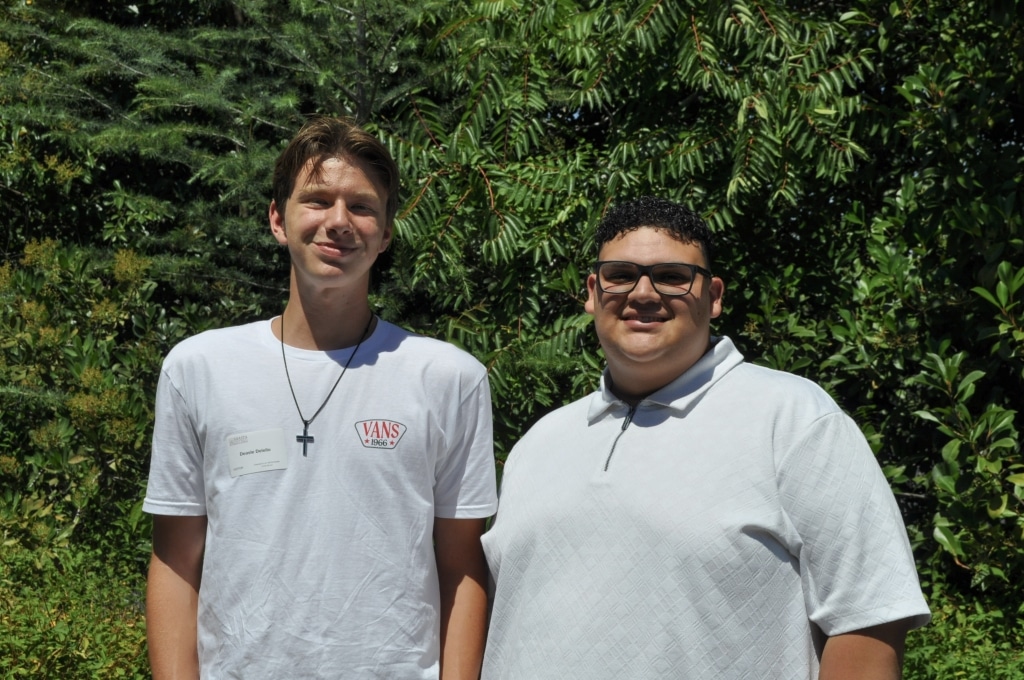
Jacob Garcia, a student board member on the Shasta County Board of Education, is from Cottonwood. Growing up there, he said, inspired his mission to ensure that students who live in more rural areas of the county have access to opportunities.
He told a reporter it was while applying to be a student board member for SCOE that he realized students who don’t have easy transportation methods, or who live far away from SCOE’s office, might be disincentivized from applying for the position.
It’s why he’s working on a new project — along with incoming student board member Deasle Delello who will join Garcia in the role next fall — to establish a county-wide student advisory board where every school can be represented.
“We can’t change the geographical setting of Shasta,” Garcia said while pitching the idea to SCOE’s board last week, but “we can change how we apply [the] student voice here.”
While the project is still getting off the ground, the council’s creation was approved by SCOE’s board during a June 23 meeting. Garcia and Delello will now spend the summer ironing out the remaining details — drafting a mission statement, outlining roles and reaching out to school administrators to inform them of the project — with the hopes of launching the council this fall.
The group is informally being referred to as the Shasta student advisory board. It’s primary goal will be to work on a single project each year, addressing one of the common issues faced by high schools across the county. Garcia has a few ideas for potential projects to start with — online safety education and student disengagement being the main ones — but the ultimate direction for the project will be voted on by the council.
Garcia also wants to use the council as a platform to educate student board members on how they can get involved with their local school districts. Meanwhile Delello, who is passionate about getting his peers involved in civics, hopes the board could be a launching pad for students to seek further opportunities in local government.
The current plan is to include one student from every high school in the county — including public, private and charter schools — who will be elected by their student bodies. Garcia also wants to include the voices of homeschooled students, and is working with SCOE’s board to develop a possible outreach strategy.
With one student from every Shasta high school, Garcia acknowledged the council will be sizable. He imagines meetings — which he plans to make public —will be held virtually so that everyone can attend. While student representatives would be able to participate openly, he and Delello would take charge in leading discussions the first year.
Garcia said he can’t take full credit for the idea of a countywide council. At a conference last November put on by the California Association of Student Councils, he met a student board member from the Folsom-Cordova district who was participating in something similar. She explained how the council worked to Garcia, who thought it sounded like something Shasta might need, too.
With only two student members sitting on SCOE’s board, Garcia said it can be challenging to represent the ideas and opinions of a whole county of students. By leading a student advisory board, he can make sure he’s “hearing everything.”
It’s not an unusual practice — many California counties host some variation of a student advisory council or panel. The North State’s own Humboldt County just launched a Superintendent’s Student Advisory Council last spring. In Sacramento County, previous student-led initiatives have focused on gender-neutral restroom accessibility and college prep opportunities.
When Garcia presented his vision to the board during last week’s meeting, he was met with unanimous support. Shasta County Office of Education Superintendent Mike Freeman appreciated that the council would focus on a specific project. He also encouraged Garcia and Delello to clarify what the elections process for student board members would look like.
Some board members suggested the two should consider having school administrators nominate students for the council, out of concern that elections at high schools districtwide might end up resembling popularity contests. Delello acknowledged this worry, but said he believes elections are still the best way to capture student will. The board ultimately voted to approve the election-based appointment system, but Garcia and Delello will have to coordinate with schools on how best to administer the election process moving forward.
Beyond the formation of the student council, Garcia and Delello are also excited about other plans for the fall term. Promoting opportunities for students is a major ambition of theirs, and Delello is working with Freeman on the possibility of setting up an internship program matching students with local government offices. Meanwhile, Garcia wants to continue exploring ways to create more opportunities for rural students.
“There’s so many students in Shasta County that are talented,” Garcia told Shasta Scout. “And I want to show off everyone’s talent here.”
Maya Nelson is a student at Brown University. She’s reporting for Shasta Scout as a 2026 summer intern with support from the Nonprofit Newsroom Internship Program — created by The Scripps Howard Fund and the Institute for Nonprofit News.
Do you have a correction to share? Email us: editor@shastascout.org.
Author

Comments (5)
Comments are closed.
Related Articles
For Shasta, collaboration needed to solve physician shortage
Political division is a barrier to improving healthcare access in Shasta County. Experts say solving the entrenched problem requires working together.
Meet Rebecca Anne Miller for Redding City Council
Three seats are up for grabs on the council this fall, and nine candidates are running. Miller is a substitute teacher with the Shasta County Office of Education and a caregiver with In-Home Supportive Services, or IHSS.

Gallery: Downtown Redding hosts fourth annual Hispanic Heritage Month celebration
Red Bluff-based entrepreneur Araceli Gutierrez collaborated with Viva Downtown to bring the celebration of Hispanic Heritage Month to Redding.
These remarkable leaders make me proud and give me comfort about the future.
Thanks for this great article. I sat on the Shasta County Board of Education for 20+ years and one of my actions I will always remember and be proud of is the changes in our process to allow the election of student board members. During the first few years we travelled, once to Florida to share the thoughts of our student board members with others, and once to the CSBA Counties Conference I have seen many wonderful projects evolved over the years by Shasta County Student/Board Members and it reflects our student population and schools.
This is a very relevant project that could train board members, and all students, how to communicate with each other in a constructive dialogue influenced by a respect for the diversity of student knowledge, language, respect for peers, and experience. Long lasting friendships should follow and confidence straightened.
We are lucky to have these two student leaders! I think this is an excellent idea for getting more young people involved. Congratulations!
These young people give me hope that thinking minds will ultimately prevail.