
Shasta supervisors discuss youth substance use prevention, strategic planning and possible new medical school
Board Chair Chris Kelstrom led an unusually collaborative meeting.
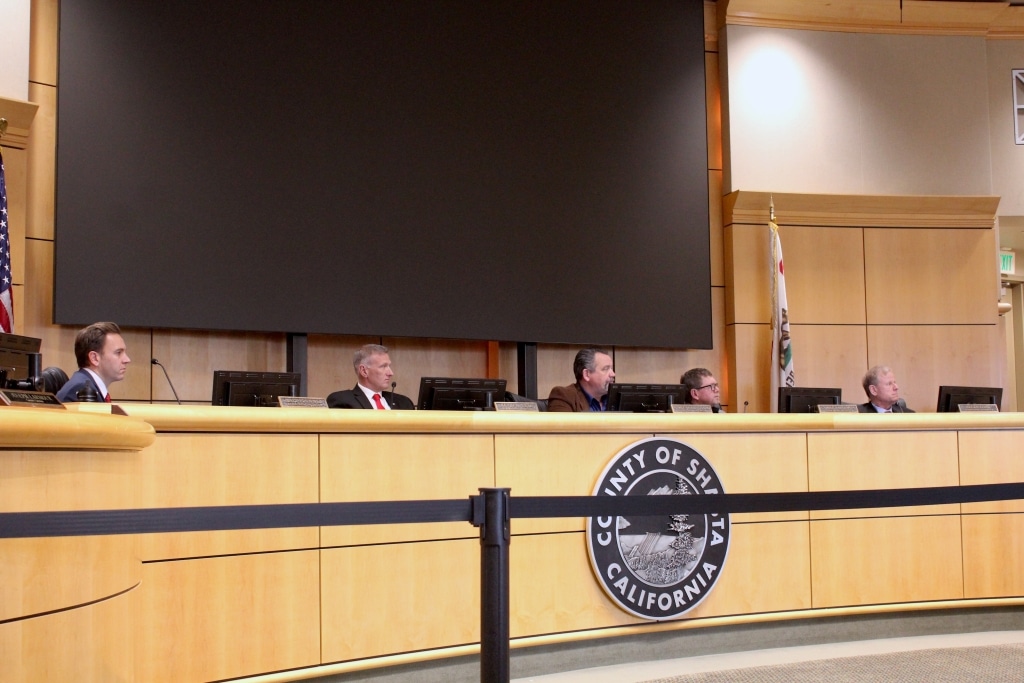
Repeat topics including substance use prevention for youth, the county’s strategic plan and local efforts to open a new medical school were all up for discussion at today’s Shasta County Board of Supervisors meeting.
CORE update
A group tasked by the county with addressing substance use prevention among Shasta County’s young people — known as Community Opioid Response and Education or CORE — gave a presentation on the progress made since last summer’s initial proposal.
The group, which includes two nonprofits, Raising Shasta and Youth Options, will receive a total of $4 million in Shasta County opioid funding for use over four years. They’re halfway through the first year of funding in which they’re working toward four goals, including finding and implementing a substance use prevention curriculum. They’re making progress on that goal but not yet there, as indicated by Raising Shasta Director Jenna Berry.
“We have been doing a ton of research around curriculum,” Berry told the board. But she said one of the research limitations is that evidence-based curriculums often don’t keep up with the pace of substance use trends among youth.
“By the time that they’re evidence based, [they] have become outdated and no longer reference current substances. And so we are in this process of looking if there’s a way to combine evidence-based programs and find a more evidence-informed model,” she said. According to researchers, evidence-based programs rely on data proving that they work while evidence-informed models are ones that have shown early promise but so far lack proof of success.
To meet another goal, the group is hoping to leverage current data to better understand local students’ attitudes toward substance use. Berry said they’ve utilized the California Healthy Kids Survey but noted her views on the limitations of that survey. For example, the number of schools and students represented varied greatly from year to year, or the questions were focused on substance use on and around school as opposed to at home, she said.
As for developing a new survey — a third goal of CORE’s first year — Berry shared that the survey is under development and is being rolled out with specific partner organizations in a “trial and error” stage of use. At this point, Berry told Shasta Scout after the meeting, the survey is not yet available for public view.
Asked after the meeting what organizations CORE is partnering with, Berry said only that some are rural. “There are a lot of nonprofits in town that do specific work around substance use prevention, but there’s also a lot of groups that do really great work around mentorship,” she said, declining to name specific groups.
CORE’s fourth goal for the first year relates to a public media campaign to share information about substance use prevention. They’ve found a partner for that project, JD Hudson, the founder of the Redding-based marketing agency Parabl, but there has not yet been roll out of a campaign.
Asked by Supervisor Allen Long about whether there’s been an increase in the number of youths served by Raising Shasta since the opioid funding was granted seven months ago, Berry said that the organization just implemented a new system in December to track numbers, and doesn’t yet know how many they’re serving as compared to previously.
CORE member Youth Options also presented, providing data on the number of juveniles who participated in programming over the last six months, but the organization did not include a comparison to the past that demonstrated either an increase or decrease in overall reach as a result of the new funding.
CORE member Clay Ross, superintendent of the Columbia School District, told the board that while superintendents around the county have shown interest in what the group is doing, referrals from local superintendents to CORE programs have been slow so far. But he said “there’s a thirst and a hunger for these kinds of programs,” explaining that the word just needs to get out so that referrals increase.
Strategic planning process moves forward
The board of supervisors also discussed the county-led strategic plan, an item that’s been in process for months and is intended to identify a set of public-centered goals for the county to focus on in the coming years. Members of an ad hoc committee that’s been working on the plan, which includes Supervisors Matt Plummer and Allen Long, came up with five proposed goals for the county’s overarching strategic plan using community feedback gathered from public meetings and a countywide survey.
Those goals, which were presented to supervisors today, include:
- Develop a corrections and rehabilitation campus
- Increase access to effective health care and behavioral health services through participation in community efforts toward the addition of a regional medical school in Shasta County
- Significantly reduce the risk of destructive wildfires in the county
- Develop a comprehensive general plan, zoning plan, code enforcement ordinance and policy updates and streamline the development process
- Increase engagement, outreach and conversation to enhance trust among Shasta residents
Plummer said county approval of the goals would be very beneficial to the community.
“We think that by the county saying this is the direction that we want to go forward,” he said, “we are more likely to be able to achieve significant milestones and momentum on these things that have been challenging to make progress on.”
The supervisors voted 5-0 to approve the five goals as presented and direct staff to develop further steps to achieve each goal. The full strategic plan, including specifics of how goals will be achieved, was originally supposed to be presented in May. Supervisor Kevin Crye requested the plan be brought back sooner to give the board more time to consider it ahead of the county’s budget hearings in June. It’ll now be brought back to discussion in early April.
Long explained that since the strategic plan is moving to the next stages, there will be sub-committees assigned to each of the goals so that they can be further developed and possible funding sources to help facilitate them can be identified.
Supervisors express support for medical school committee
Toward the end of the meeting, supervisors received a presentation from a group of local leaders working to open a new medical school in Shasta County. The group requested a letter of support from the board encouraging the establishment of the school, which supervisors approved unanimously.
During the discussion about the medical school, Long raised concerns about the use of the word “partner” in the letter’s description of the county’s role with the school, stating that the county can’t afford to financially partner with the school due to a tight budget. Crye quickly interjected, telling Long to “speak for yourself.” After County Counsel Joseph Larmour weighed in and explained that the use of the word “partner” does not oblige the county to financially support the school in any way, Long didn’t press the matter further.
The group requested the letter of support from supervisors, members of the medical school committee said, because it is required for state and federal grants, strengthens funding competitiveness and signals regional alignment and readiness.
Do you have a correction to share? Email us: editor@shastascout.org.
Comments (12)
Comments are closed.
Related Articles
Opioid settlement funds designated to build 60-bed youth behavioral health facility in Anderson
Local nonprofit Family Dynamics Resource Center asked the county board for a community match in order to receive $25 million dollars in funding from the state. The funds will be used to develop a 60-bed behavioral health campus for youth. Few details on how the program will operate were provided.

Redding airport to conduct Mass-Casualty Incident training event on Friday
The training exercise is intended to ensure airport staff and emergency personnel are trained for a mass-casualty event, like a plane crash. There will be emergency personnel, equipment and smoke in the vicinity of the airport.
Fate of Shasta’s Measure B remains uncertain
A Shasta County Superior Court judge heard arguments today on whether a measure that promises to create specialized local election laws should remain on ballots for June 2. The judge has promised to deliver a ruling later this week.
Christian Gardinier, you might look into the reputation of Simpson University’s School of Nursing before disparaging the University.
I do not agree there was collaboration apropos the very contentious medical school topic. I believe it was Crye pulling the strings and then going after Long when Long rightly expressed concern about being on the hook and spending tax payer money. Obvs, Crye doesn’t seem to give a hang about spending other people’s money (so long as he gets his fragile ego stroked and his buddy’s palms greased)
Disappointed that Matt initially left Allen hanging in the wind…
I sincerely hope the good people of District 1 will send Mr Crye packing in June. We cannot afford to feed his ego and fund his “legacy.”
June’s coming!
Robert, it sounds like you have a personal issue with Supervisor Crye. Having a medical school in Redding is a good idea and most people support that.
Paul, do you have any data to support your assertion that most people support having a medical school in Redding?
I support it. Why wouldnt you Leroy?
1) Said medical school at last report was affiliated or involved with Simpson and Simpson’s sciences programs are weak at best and Simpson graduates I have interacted with in the past through my job almost universally reject shared observable reality in favor of belief.
2)Redding does not have the population to support a medical school-we do not have enough hospital capacity to support clinical training we have one small hospital (MMC) and two entities that call themselves hospitals but are little more than glorified outpatient surgery centers( SRMC and Patients hospital)
3) Redding does not have enough practicing physicians to provide mentorship for trainees
4) We do have established residency programs but no where near the capacity to support a medical school
5) Where is the money going to come from? This area is broke as a joke
Short version-It’s a pipe dream being foisted on us by a group of grifters
Simpson College is a joke. You’re right.
So Leroy actually told you all the reason why it’s not feasible.
So do you still support the grifters who are trying to make a buck off of it?
It’s pretty hilarious to me, how so many people of Shasta County say they distrust the government and they won’t be taken advantage of.
Yet these very same people will give up everything for the grifters that tell them what they want to hear. This even after being provided solid proof and evidence that they are being grifted.
Just tell him it was Erin’s idea and he’ll support it.
I can’t speak for Robert, I think he does so very well. Nobody thinks a medical school located in the far north state would be a problem. My opposition is charlatans, like Street, Crye and Simpson University trying to grab money and power for power’s sake, using the health crisis of North State citizens as a foil.
A taxpayer medical school should not be located at Simpson University, a far-right trumpian institution, with links to the Bethel’s seven mountain mandate and direct links to the Trump administration.
Much of the healthcare crisis, and not only California but the, is exasperated by Trump’s disastrous healthcare policies. Simpson University is clearly a trumpian education center.
The healthcare collaborative is working well with UC Davis that has excellent systems already in place, doing good work.
If any Shasta County money or resources go into a” medical school” should be with a politically non-partisan organization that has a proven, well established track record.
Robert, I, too, was disappointed with Matt for “leaving Allen hanging.” First, Crye is on a trumpian power trip, thinking his hard-right extremist base will get him another term. But at least Shasta County is not committing funds to Street and Dr. Danuka!
Crye hired Mr. YMCA, an anti-democracy, staunch secessionist, and taxpayers gave Mr. YMCA $40,000 to basically copy a PowerPoint already available from the Mercy Medical Collaboration. Street, the director of Mountain Top Media, is not a member of the Shasta Health Assessment and Redesign Collaborative, the people who are doing the real work that Crye and Street want to take control of or replace with their MAGA Medical School Pipe Dream. Street’s presentation was a joke.
Also, Crye made a statement at Tuesday’s BOS meeting, praising Trump for releasing $200 million for rural health care this year and $50 billion in total to rural health programs over five years. This is less than a third of the funding rural communities are expected to lose in Medicaid cuts. 67% Shasta County citizens will see the Medicare cuts; it remains to be seen if we get any of the new trump money. Also, I don’t know at this point how many will lose or have to drop ObamaCare, but see: https://shastascout.org/shasta-health-officials-warn-of-major-medicaid-cuts for more information. Vote charlatans out in the next 2 elections. We need health care FAR more than $43 billion or more per year, what Trump is NOW demanding for the ICE war, far exceeding all previous budgets, funded by the “Big Beautiful Bill.”
You make some solid points and shine a light on Medicaid and rural funding. I am not disagreeing with what you said about that. I have a perspective that your assertation is true but other important factors may not be known or were left out. First would be the COVID pandemic in which Federal and State administrators did a financial response above all else. Enormous sums of money were sent from the Feds to the states with a huge part of that being tied to health care. Many state and municipalities used the influx of funds to problem solve their own budget issues and in very minor ways attach it to COVID releif funding and medicare funding increases that resulted. In California billions were spent on PPE supplies from China (how much of that is still sitting in warehouses or still in boxes gathering dust on shelving). Medicare funding for Medi Cal was used to expand eligibilty so that more people qualified (suspension of asset limits, exclusion of citizenship or legal residency requirements for full coverage ), how much was used for housing the homeless in local hotels and motels. How many creative designs were used to access this medical service money by attaching a clinician as being assigned to the project so it had a medical service component and justifcation. Our state government used these very temporary funds to not only address the deficit for pre covid approved spending and program expansions but they also used it for continued expansion of programs with zero dedicated long term funding. California has expanded medicare services under MediCal far beyond what federal dollars are received for. The state must pay, using nonfederal funds, for expanded services beyond what the federal programs prescribe. California did not have dedicated funding & has a massive deficit. The idea that temporary funds would be installed as permanent and federal grants received under previous “like minded” federal administrations could be used for the state approved expanded services beyond federal requirements is unsound & just another political maneuver to place blame on others for not providing ongoing taxpayer funds for services they expanded without dedicated funding for.