
Shasta’s district attorneys and public defenders will get bonuses this year. Will it be enough?
The district attorney’s and public defender’s offices asked for higher salaries and more manageable caseloads to address ongoing staff shortages. As a temporary solution, the board gave all attorneys a $10,000 retention bonus. It’s “a meaningful first step,” DA Stephanie Bridgett said — but “there’s still a long way to go.”
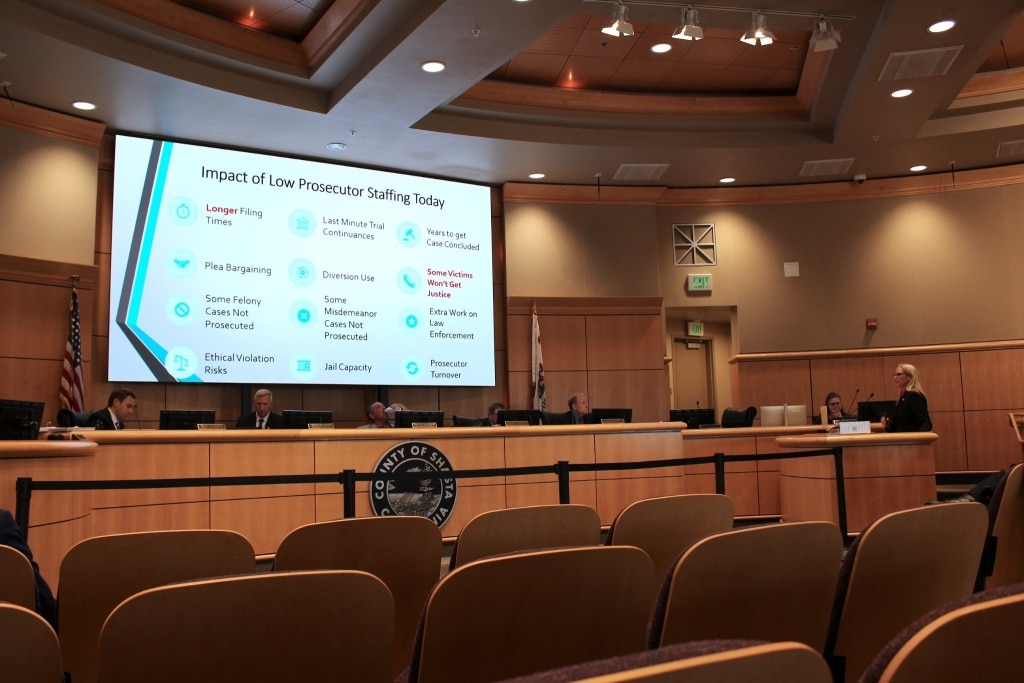
At last week’s budget hearing, the Shasta County Board of Supervisors voted for attorneys at the district attorney’s office, public defender’s office and county counsel’s office to receive a $10,000 retention bonus — an effort to combat staffing shortages in all three offices.
The decision came after pleas from both department heads detailing declining retention rates due to non-competitive salaries and high caseloads. Both District Attorney Stephanie Bridgett and Public Defender Ashley Jones asked the board to increase attorney pay rates, and give retention bonuses to currently employed attorneys to stabilize staffing numbers.
Specifically, Bridgett petitioned for a three-year plan where the board would agree to give prosecutors $10,000 bonuses each year. That’s not possible during budget hearings, Deputy County Executive Officer Erin Bertain said in response, noting that the board can’t allocate future funding beyond the one-year time frame laid out in the budget process.
The same issue impacted the board’s ability to respond to Bridgett’s plea to make salary adjustments during budget hearings, though negotiations could be approved by the board during collective bargaining agreements with union representatives in future months.
Acknowledging that the one-year bonus is only a temporary band-aid, District 2 Supervisor Allen Long spearheaded the motion to provide $10,000 retention bonuses to all attorneys, which was approved 5-0. The bonuses will be funded from existing salary savings from staffing vacancies in both offices.
The board also granted both Bridgett and Jones’ requests to purchase Axon AI extension, a $15,000 digital evidence software that assists offices in processing law enforcement body camera footage more efficiently.
In a statement to Shasta Scout after the meeting, Bridgett said these efforts “represent a meaningful first step” but emphasized that the bigger picture of compensation “must be addressed soon.” She said she hopes the board will consider extending retention bonuses for an additional two years as the broader issue of competitive pay increases is addressed through ongoing labor negotiations.
Jones has not yet responded to a request for comment sent after the meeting.
“We’re actively bleeding out”: What’s going on at the DA and PD’s offices
In her presentation to the board at last Thursday’s budget hearing, DA Bridgett outlined the struggle her office is battling. Out of 28 authorized positions, only 19 prosecutors remain. Seven prosecutors, she said, left the DA’s office this past year alone, including five over recent months.
Bridgett described the results of that shortage as a laundry list of public concerns: long case filing times, last minute trial continuances, years to get cases concluded, extra work placed on law enforcement and ultimately, many cases not being prosecuted at all.
Last year, local law enforcement agencies submitted more than 11,700 cases to the DA’s office, Bridgett said, and of those, about 6,000 were filed with the courts. If the staffing shortage continues, each deputy district attorney would need to review more than 700 cases a year at current staffing levels, she explained.
Bridgett announced last month that her office is responding to most recent the loss of attorneys by temporarily reducing the number of cases it files, prioritizing those that involve violent crime and other public safety threats.
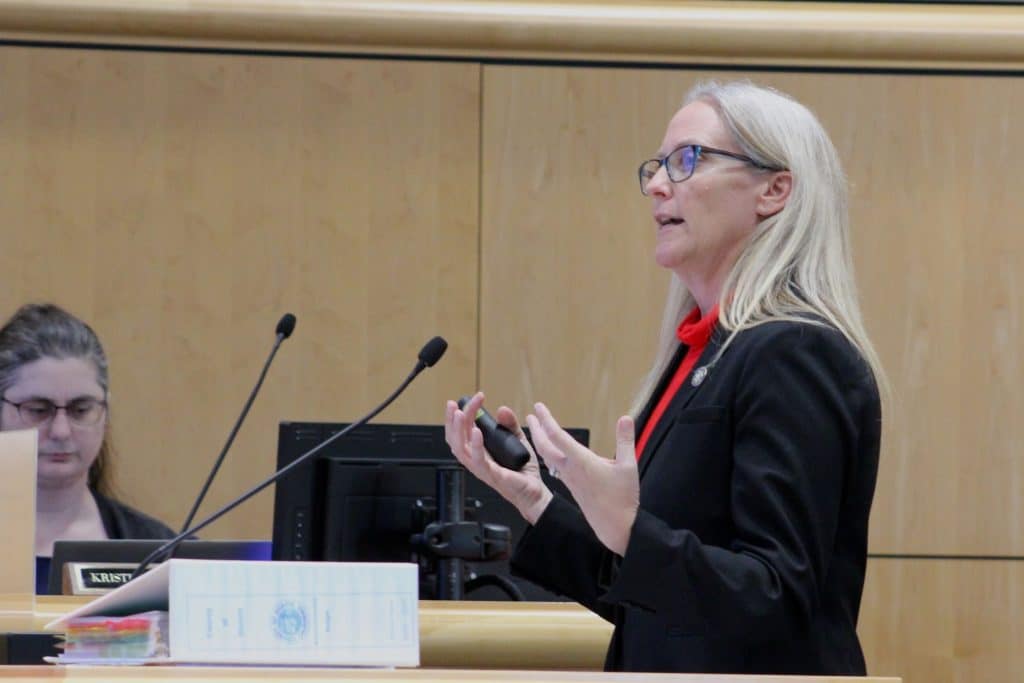
In an in-depth presentation, Bridgett compared significant differences in salaries between Shasta and Butte counties. According to Bridgett, Butte County attempted a number of strategies to find new prosecutors and keep existing ones from leaving. The county tried increasing sign-on bonuses to $30,000, but this did not result in any new hires. The only thing that worked: increasing salaries.
Within a year of doing so, the county had filled all open prosecutor positions — three of whom came from Shasta’s own DA’s office, Bridgett said. Currently, entry-level attorneys in Butte County make about $140,000 a year — $50,000 more than in Shasta — and senior attorneys make about $40,000 more than their Shasta equivalents, she added.
This is not the first time DA Bridgett has made a plea for higher salaries to the board. At last year’s budget hearing, Bridgett requested around $12.9 million — $1.8 million more than what Shasta County CEO David Rickert recommended — to expand and support staffing.
Instead, all the board approved was the addition of a single legal secretary position and a job reclassification.
Bridgett was also not the only public safety department head to make such a plea. Public Defender Jones used her budget presentation last week to explain that her office is also facing a critical staffing shortage — only 17 attorneys are currently working out of 22 total authorized positions, she said.
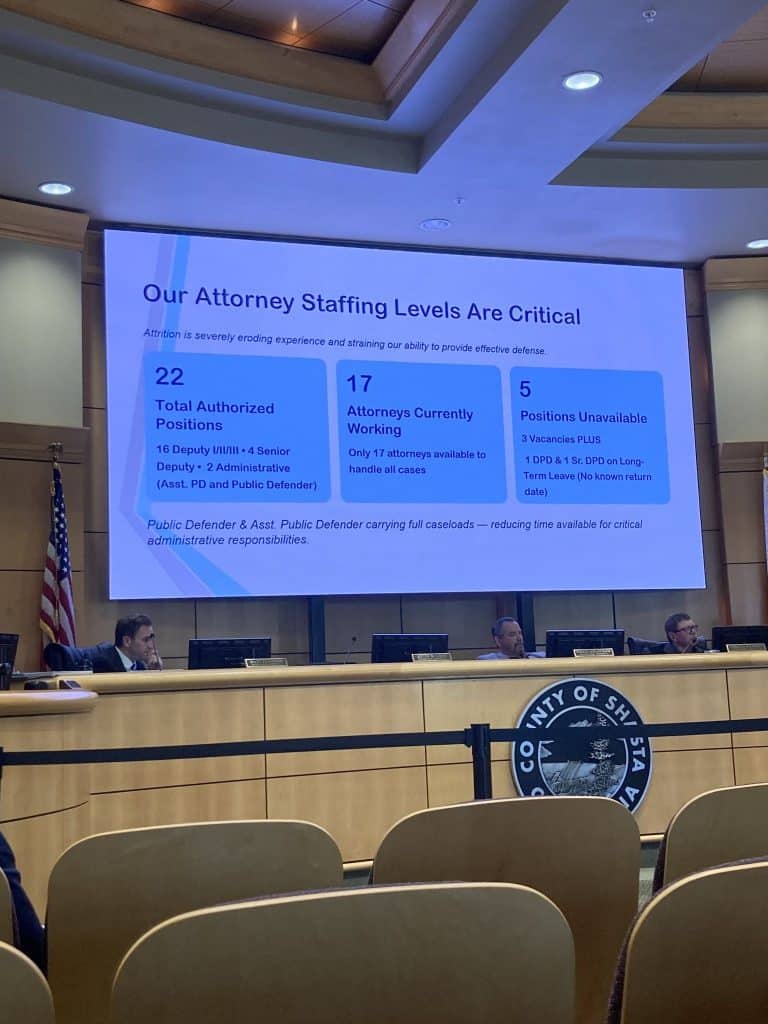
She described a lack of adequate experience among an already stretched-thin staff, saying having to hire less-experienced staffers adds training burdens and delays the resolution of more serious cases. Nearly half of Shasta’s public defense attorneys have less than three years of experience in the field, she said, a problem she attributed to non-competitive starting salaries compared with nearby counties.
Understaffed and under-resourced, Jones described how the office must balance a workload that far exceeds national standards. Some attorneys are taking on caseloads that more than double national averages, she said.
To compensate, Jones said her office has been outsourcing felony cases, costing the county more than $7 million this year alone — the highest in her department’s history.
“If our department was a medical patient,” Jones told the board, “I would say right now we’re in the ER, and we’re actively bleeding out.”
While Bridgett and Jones see the recent funding for bonuses and AI tools as a success, in the long term, both said attorney salaries must be made more competitive in order to keep up with other counties like Butte.
“There is still a long way to go,” Bridgett said in her statement to Shasta Scout. “Failure to address the long term solution of competitive pay will keep our community at risk.”
Do you have a correction to share? Email us: editor@shastascout.org.
Author

Comments (9)
Comments are closed.
Related Articles
“No Kings” rally encourages civic engagement but sees a decrease in participation
Around 1,450 people attended the No Kings Get Out The Vote Rally on Oct. 17 in Redding, according to organizers. In March, about 2000 protestors organized.
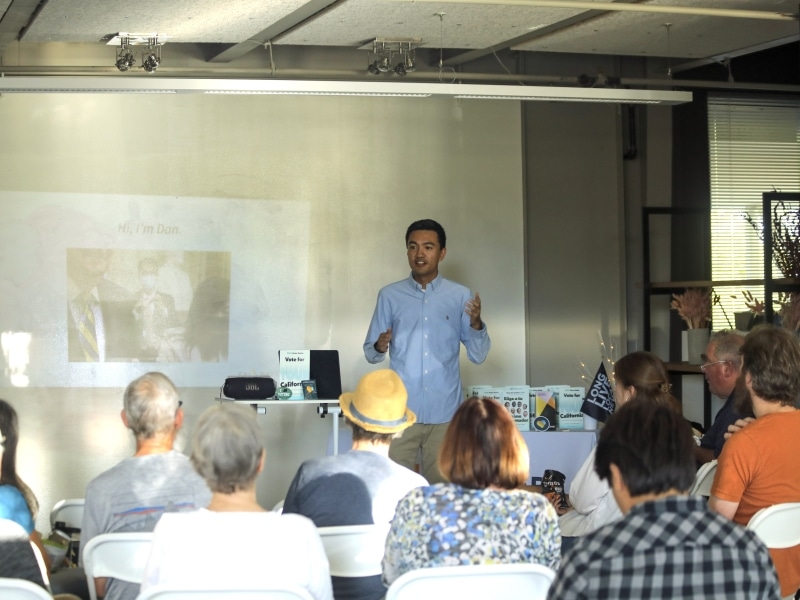
CalMatters, Shasta Scout host local voter information event ahead of midterm elections
CalMatters’ Dan Hu gave a presentation about statewide races and ballot propositions, as well as general information about CalMatters’ election tools. Shasta Scout’s Annelise Pierce presented about local ballot measures.
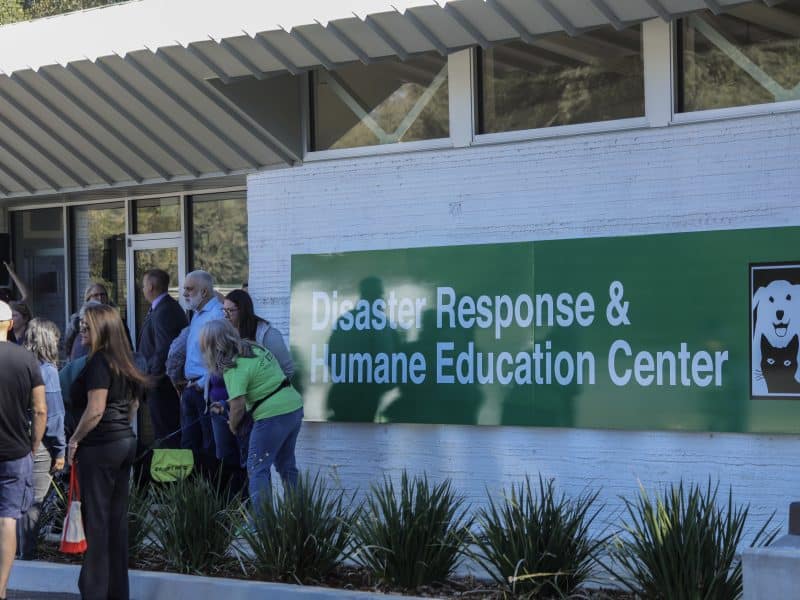
Haven Humane opens disaster response center built with Zogg Fire funds
The animal welfare organization opened a new disaster response and humane education center today next to its existing facilities in Anderson. The center was built with funds from the Zogg Fire that were designated for animal care in honor of Karen King.
The claim that the District Attorney’s office is understaffed assumes that its workload is an unavoidable consequence of crime rates and legal obligations. That assumption deserves scrutiny. If prosecutors are routinely filing cases based largely on arrest reports without conducting substantial independent review beforehand, then the size of the caseload is not simply a function of public safety needs. It is also a function of charging practices. In many cases, prosecutors are not conducting extensive pre-filing investigations, interviewing witnesses, or independently developing evidence before charges are filed. Instead, charging decisions may be based primarily on the information contained in law enforcement reports. If that is the case, then the argument that the office needs more staff because it has too many cases becomes less persuasive. The office is choosing to accept and file those cases. The question is not whether prosecutors are busy. The question is why they are busy. If a prosecutor’s first meaningful exposure to a case is shortly before arraignment, then the workload is not being driven by exhaustive case preparation prior to filing. Rather, it is being driven by the volume of cases entering the system. Every case that is filed creates hearings, motions, plea negotiations, discovery obligations, continuances, and administrative work. The office then points to that growing workload as evidence that it needs additional staffing. This creates a circular problem. Aggressive charging increases the number of active cases. The increase in active cases creates more work. The resulting workload is then cited as proof that additional prosecutors are needed. Before taxpayers are asked to fund more prosecutors, the office should first demonstrate that it is exercising meaningful discretion in deciding which cases deserve prosecution. If weak cases are being filed and maintained primarily to obtain plea agreements rather than because the evidence is likely to sustain a conviction at trial, then the resulting workload is at least partially self-created. Under that view, the problem is not understaffing. The problem is case selection. Adding more prosecutors would increase the office’s capacity to continue the same practices, but it would not address the underlying reason the caseload has become so large in the first place.
Fastest way to clear beds in the jail without releasing people is to process cases. Pleas and trials move butts from jail to prison. The convo about expanding the jail keeps coming up but that is not the only bottleneck to the current judicial backlog. Well-staffed attorney agencies and jail will move the bottleneck back to the courts.
19 positions with 10k bonus is 190k plus employer costs will cost roughly 250k, but they’re cleared for 9 more positions which is “saving” roughly 100 to 150k per unfilled position (about $1m). I don’t see why it’s not reasonable to earmark the unused salaries for a three year retention bonus plan. Gov budget mechanics not being able to plan three years out like that sounds both ridiculous and par for the course.
Comparing to those tiny little counties with relatively low crime rates and much lower stressful case loads is very disingenuous of you. I bet the County not defending Clint and the Jive 5 made you puke out a little of your breakfast pablum this morning. Better save your Milk money hun to attempt fighting the mighty State of California and overrule that Measure B lawsuit!
Hey Nic…
Speaking of Kevin Crye
Your Once…Joanna Francescut
Twice… Measure B Fail
Three times loser!
https://www.youtube.com/watch?v=B4dl6JSf-bc
Nicky, Nicky, Nicky! I’m not sure what flavor kool aid you’re drinking this week but as usual you’re facts are all wonky.
Entry-Level Deputy District Attorney Salaries for Shasta and Butte counties currently.
Butte County: Approximately $134,627 per year.
Shasta County: Approximately $90, 180-$115, 104 per year (Deputy DA 1 range).
Key Differences:
• Butte County pays roughly $19,500-$44,000 more annually for entry-level prosecutors.
• Butte County has advertised a $30,000 hiring bonus for Deputy District Attorneys.
Shasta County Salary Ranges:
Deputy DA I: Approximately $7,515-$9,592 per month.
Deputy DA Il: Approximately $8,491-$10,837 per month.
Combined advertised range for Deputy DA I/II/III positions: Approximately $90, 180-$152,028 annually.
Summary:
For a new attorney seeking employment in Northern California, Butte County currently offers significantly higher entry-level compensation than Shasta County and includes a substantial hiring
To understand the salary of entry-level prosecution attorneys in Butte County, CA, consider the following points:
Entry-level prosecution attorneys typically earn between $60,000 and $75,000 annually.
Shasta—60k to 75k
Lassen— 60k to 80k
Siskyou—60k to 70k
Tehama–60k to 75K
Trinty–60k to 80k
Humbolt –60k to 80k
Glen—60kto80k
Yolo60k to 80k
Butte 60k to 75k—humm
I got my figures off the internet, given to me by artificial intelligence, you know, the kind you got in college.
Nick: A link in our article to the Butte DA’s site itself contradicted those numbers.
my information is right off the internet—maybe you thought I made it up? Remember starting wages—-“Currently, entry-level attorneys in Butte County make about $140,000 a year — $50,000 more than in Shasta ” that’s what I reported
I reported Entry level attorneys