
She Was Killed Crossing the Street; Her Parents Say The City’s “Clean Up” At Nur Pon Contributed To Her Death
Brenda and Ryan Woods believe Redding’s ongoing “sweeps” of homeless camps cause harm to unsheltered community members like their daughter, who died last fall. Shasta Scout’s review of data and documents show the City’s Nur Pon “sweep,” which displaced an estimated seventy people from their usual shelter site last fall, lacked coordinated provision of resources for the unhoused.

Twenty-eight-year-old LeAnn Massingham had been homeless for over six years when she was killed by a car while crossing the street behind Redding’s City Hall last fall.
Eleven Redding Police Department officers responded to the vehicle/pedestrian fatality, but the subsequent investigation report includes relatively few details about what caused the accident, focusing instead on Massingham’s history of past encounters with RPD’s Crisis Intervention Response Team (CIRT).
To Massingham’s EMT mother Brenda Woods, and firefighter stepfather Ryan Woods, the report’s focus is an indication of how City officials, including law enforcement, tend to vilify the local homeless population instead of helping them.
“This is about exposing the discrepancies and the biases within the system,” Ryan Woods explained to Shasta Scout during an interview in the family’s home last week.
”I never thought I’d ever be saying that,” Ryan continued. “Because I’ve always been kind of a conservative libertarian-type person. I do believe that (the driver of the vehicle) is entitled to his constitutional rights. But I also believe that so is LeAnn. And I believe that because of who she was, and her social status, she was instantly labeled as the person at fault. And there was very little done to disprove that.”
The Woodses, who are both first responders, feel that their professional backgrounds, and their perspectives as parents of a long-term unsheltered Shasta County adult, offers them a unique vantage point.
During a series of interviews with Shasta Scout over the last several months, the Woodses shared their concerns about what they feel is a lack of appropriate care and resources provided to members of Shasta County’s unhoused community and their families.
They’re also frustrated about Redding’s ongoing use of police resources to address the complex needs of unsheltered community members like their daughter, saying what she needed to overcome homelessness was a strong and interconnected web of case work, mental health services, and supportive housing, not police confrontation.
The Woodses have been caring for Massingham’s three children since before her death. Last week, Brenda and Ryan spoke to Shasta Scout at their family home, as two of LeAnn’s children ran around the house, giggling. Her dog, Petunia, who is also in their care, intermittently barked from a crate in the living room, before being let out to socialize.
Massingham was killed while crossing Parkview Avenue at night, in dark clothing, without a crosswalk. A statement by the vehicle’s driver, included in the police report, indicate that he never saw Massingham before he hit her, without slowing or braking, while driving 30 mph.
RPD’s report on the incident, which was provided to Shasta Scout by the Woodses, includes supplemental reports from two CIRT Officers, Devin Ketel and Joanna Bland.
Both document a series of encounters the officers previously had with Massingham, unrelated to her fatal accident. In a summary section of Ketel’s report, he characterizes Massingham as “unpleasant,” and “uninterested in assistance from CIRT.”

RPD Chief Bill Schueller did not respond to multiple requests for comment on whether it is typical policy for RPD to document the deceased’s past encounters with police as part of an investigative report into traffic fatalities. But for Ryan Woods, the intent of the two supplemental CIRT Officer summaries included in the fatality investigation report seems clear.
“They’re trying to discredit LeAnn,” he said.
Redding’s Use of CIRT to Response to Homelessness
In September of 2021, Redding launched the CIRT as part of a policing-oriented approach to solving homelessness.
The City currently funds four CIRT positions at a cost of $220,000/annually per officer through a combination of state housing funds, opioid settlement funds, and support from Shasta County.
During a presentation to Redding City Council members last fall, the CIRT reported that they responded to over 1100 calls for service and provided access to shelter for about forty individuals during their first year of deployment.

In response to a subsequent records request from Shasta Scout, RPD Police Services Manager Emily Egger provided data showing that between August and December, most of the individuals who accessed shelter through CIRT were housed at the Bridgeway Inn & Suites through Redding’s contract with No Boundaries Transitional Housing.
As of December, Egger was unable to provide information on which, if any, of those individuals have remained housed since being referred, as the City does not track that data.
While CIRT supervisors declined to respond to requests for comment or interviews by Shasta Scout after CIRT’s presentation last fall, the CIRT report indicates that their homeless outreach work consists of connecting unsheltered community members with services for substance use and mental health offered by other community providers.
According to recent reporting from KRCR, CIRT distributes resource cards, which RPD Sergeant and CIRT Supervisor Aaron Hollemon said include “all the pertinent information that the homeless might need.”

Redding Also Uses Ongoing “Sweeps” to Respond to Homelessness
Brenda and Ryan Woods say the resource cards CIRT hands out are not enough to legitimize the City’s simultaneous ongoing “sweeps” of unhoused community members from public spaces.
Local outreach providers, who spoke with Shasta Scout in December but asked not to be named because of concerns that they may be retaliated against, agree.
They say the City’s continual movement of the unhoused from public space to public space, through police “sweeps” that displace the City’s most vulnerable, multiplies their trauma, exacerbates their mental health concerns, and increases their physical danger. Those sweeps also makes it harder for outreach workers to locate specific members of the unhoused community for the purposes of medical care, substance use resources, or other forms of support, they said.
Research from the National Health Care for the Homeless Council backs up these statements, indicating that while public officials are rightly concerned about encampments, which can be “unsafe, violent and unhealthy places,” responding to those issues with encampment “sweeps” is “counterproductive, costly and harmful.”
Clearing encampments without adequate alternate resources does not end homelessness, the NHCHC says; instead, it “damages health, well-being and connections to care,” “compromises personal safety and civic trust,” “undermines paths to housing and financial stability” and “creates unnecessary costs for local communities.”

The Woodses partly blame the increased trauma and risk from City sweeps, especially the Nur Pon cleanup, for their daughter’s death, which occurred after she was moved multiple times by police over the course of a few months last fall.
After Massingham was pushed out of her long-term shelter at Nur Pon in August of last year, Brenda Woods says police moved her from public spaces again three more times before she died in November.
Massingham contacted her mother each time she was displaced, often asking for her to come and advocate for her and others, which Woods frequently did.
Coordinated Housing Services At Nur Pon
When Brenda Woods showed up on August 15 to support her daughter as the police began to “clean up” Nur Pon, she found a scene she describes as chaotic.
She says she immediately confronted RPD on site because she was skeptical of claims she had read in the paper that access to housing had been offered to the community members living at Nur Pon, including her daughter.
“We’ve been at this for six years, right?” Brenda said, referring to the length of time she and Ryan have been actively advocating for her daughter’s needs while she lived on the streets. “And every time we call about accessing housing (for our daughter) it’s like ‘yeah, we don’t have housing.’”
Woods says when she asked RPD what housing was being offered, she was told no emergency housing was being made available that day.
It was a direct contrast to statements that local outreach workers and unhoused community members say had been made earlier in the week when the police told them to show up under a tree at Nur Pon on August 15th to receive emergency hotel vouchers before the “sweep” began.
Speaking to Shasta Scout in October, Redding City Manager Barry Tippin acknowledged that he had heard similar reports of emergency hotel vouchers being offered.
“I don’t have a response to that,” Tippin said, after being asked about why offers of hotel vouchers did not materialize, “I’ve heard the same thing. Our housing staff did not make that comment. I don’t know about our police staff, but they would work through our housing department. We’re not aware of who may have made that promise. But certainly we did hear that that was a failure . . .”
The City of Redding does have a housing division, which coordinates affordable housing development and housing voucher distribution. But as with many municipalities, Redding does not offer any kind of case management services to help connect the unhoused to services, relying instead on Shasta County to meet those needs.
So while City housing staff had volunteered to be on site at Nur Pon to physically help clear waste from the site, Tippin says, they were not there to offer assistance to the unhoused.
Responding to questions from Shasta Scout in late August, Supervising Shasta County Community Education Specialist Amy Koslosky said County staff was present at Nur Pon on August 15, providing information about County resources and entering people into the Homeless Management Information System for future services.
She says HHSA Community Health Advocates offered bottles of water, outreach cards, and an information number, but were unable to offer access to emergency housing other than the Good News Rescue Mission.
Distressed by how little outreach and resources were available that morning, Brenda Woods says she stood in the Nur Pon parking lot that morning, making phone calls to HHSA, the Good News Rescue Mission, and Hill Country Community Clinic.
“I said, ‘why are you guys not here?’” Brenda recalls. “And they’re like, ‘well we didn’t know about it. We weren’t invited.’”
A series of chat communications between County staff, obtained by Shasta Scout via public records request, indicate that while some HHSA community health advocates may have been on site as reported by Koslosky, members of HHSA’s leadership were unaware of what was happening at Nur Pon and were confused and concerned.
In those August 15 chat messages, HHSA Deputy Branch Director of Mental Health Laura Stapp and Shasta County’s Health and Human Services Clinical Division Chief Genell Restivo discuss the issue, saying they need to learn more about CIRT. On August 17, as RPD activity continued at Nur Pon, an unidentified user corresponded with Restivo and County-employed CIRT mental health clinician Nichole Brandon, asking urgently for more information:
“ . . . Laura told me to drop everything and get the information now . . .I know you all are extremely busy but I need it.”

In an email dated the next day, August 17, 2022, Brandon provided a report to Restivo outlining her activities with CIRT at Nur Pon over the course of the last few weeks and explaining why she hadn’t provided supervisors with more information.
“I assumed everyone knew about it,” Brandon wrote, “It’s been blasted on the news for weeks.”
Asked why the City did not ensure that Shasta County’s housing services were involved with the Nur Pon process, Tippin said the City “assumed (County staff) would talk more amongst themselves and do what they need to do.”
He also emphasized that every individual at Nur Pon was offered a place to get help.
“Ten percent take us up on those offers,” Tippin said, “and the rest do not wish to do that at this stage. That’s their choice as well. But we still have an obligation to the environment and the neighbors. We’re trying to strike a balance that assistance is here and for them to trust us.”
Koslosky, speaking for the County in August, said few emergency shelter options currently exist, and those that do include barriers like restrictive rules.
“It’s clear that there’s a growing need for affordable and safe shelter options for those experiencing life on our streets,” Koslosky wrote by email. “Each individual has their own story and their own needs, so there is not a one-size-fits-all answer. Developers, social service providers, city and county decision-makers, and the public working together with our housing-insecure neighbors to find solutions and improve health and well-being for us all.”
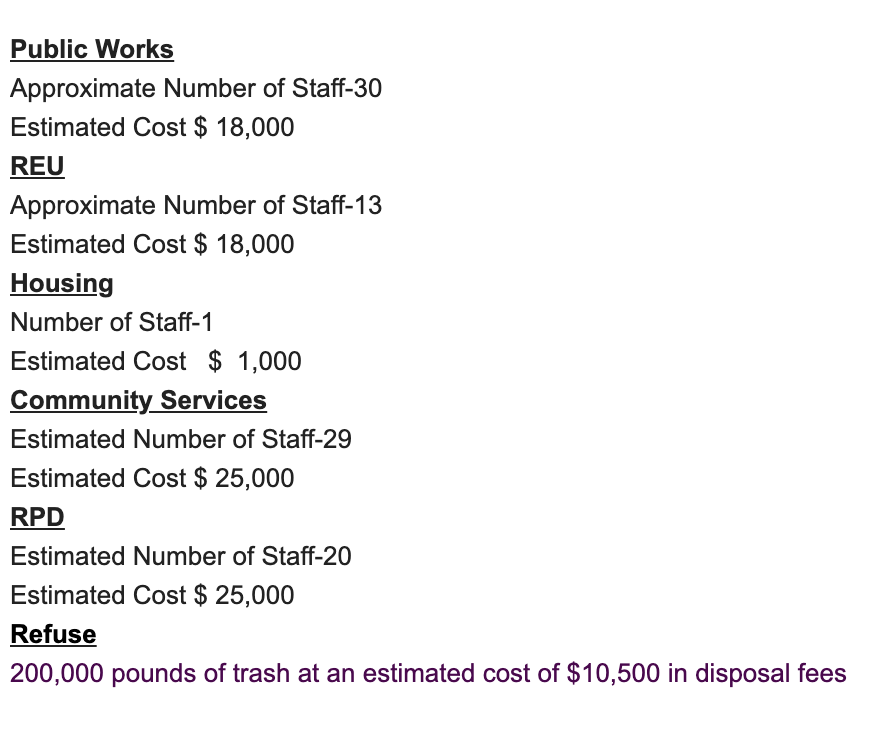
The City responded to Shasta Scout’s August records requests with estimates that Redding spent nearly $100,000 to clean up the Nur Pon open space. Tippin estimated that approximately $12,000 of that was spent on police services at the site prior to the start of the cleanup.
He said the City struggles to find a balance between responding to community members who want there to be “zero evidence of people who are homeless” and responding to the specialized needs of those who remain unsheltered, often because of complex circumstances.
“It’s not easy at all,” Tippin told Shasta Scout by phone in October, “and we don’t look at it as a black-and-white fix. We’re trying to have a balanced approach to have everyone meet their goals.”
For Ryan Woods, a balanced approach will mean reducing the police’s involvement in favor of providing more important resources to the unhoused.
“There are specific things that need to change,” he said, specifically citing the need for better in-patient and dual-diagnosis mental health services, coordinated family care, and emergency shelter, “But it’s just easier for them to turn (the homeless) into criminals and wipe them away.”
If you have a correction to this story you can submit it here. Have information to share? Email us: editor@shastascout.org
Author

Related Articles
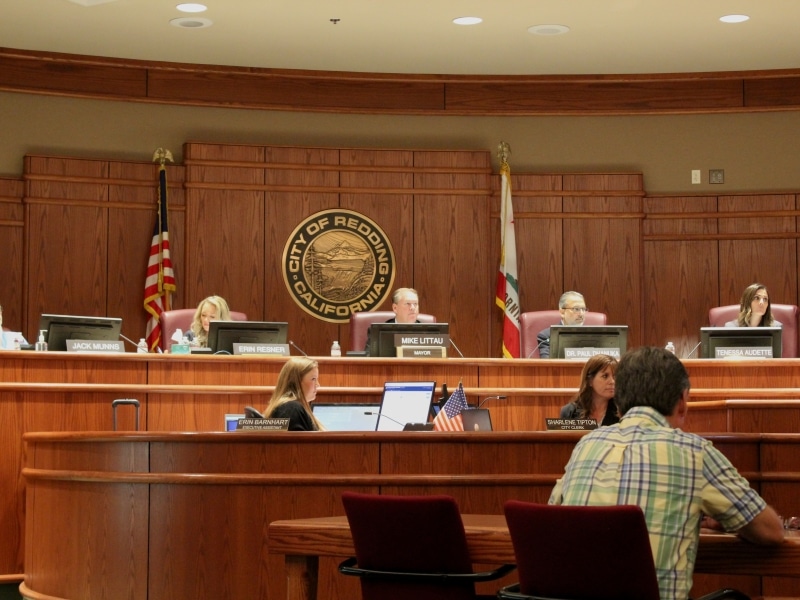
Redding efficiency study’s initial results identify $1.2 million available to return to general fund
A little over a million in funds that were designated elsewhere have been identified as available to be returned to the city’s struggling general fund. More comprehensive results and savings are expected to be presented later this month.
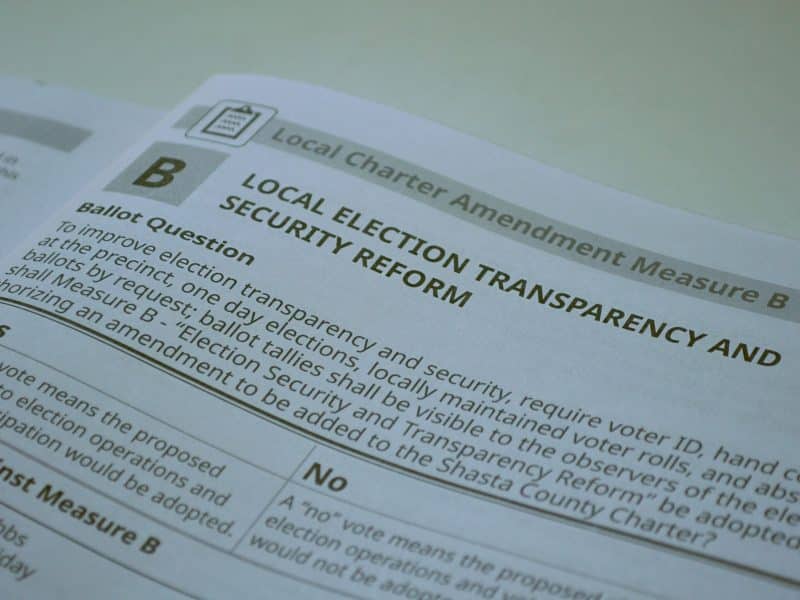
Measure B remains suspended after latest court ruling
Elections are still slated to be held as usual this fall after proponents’ most recent attempt to ensure implementation of Measure B failed in court late last week.

Shasta elections official says Tina Peters won’t be working in Shasta
It’s not clear whether any formal job offer to the former Colorado elections official was ever made.
