The Redding Police Department is No Longer Sharing Arrested Suspects’ Faces on Social Media. Here’s Why.
The decision occurred shortly after a report from Shasta Scout that documented the practice’s legal and ethical issues. Further reporting shows that California’s chief law enforcement agency had already informed RPD, along with other local agencies, that the practice is illegal.
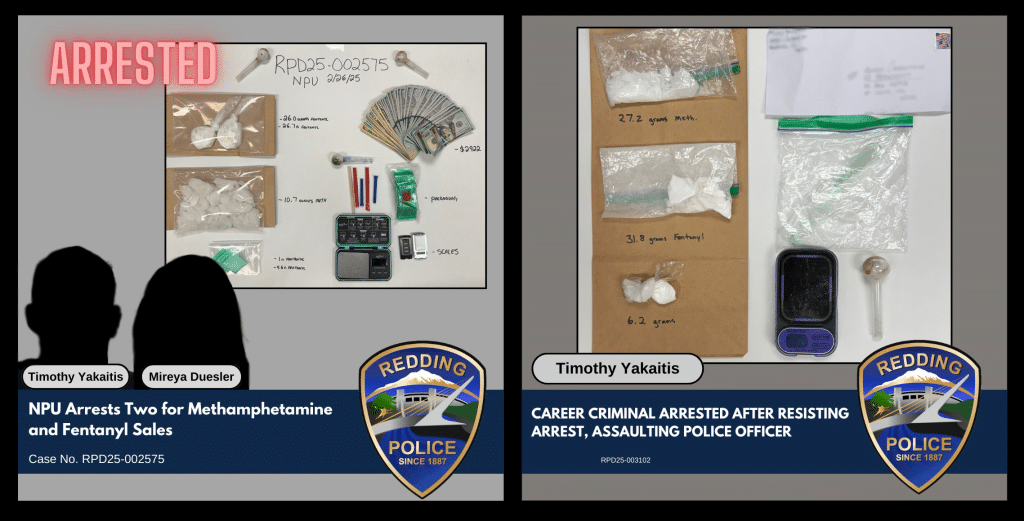
“…Where is his picture?” one Facebook user asked in the comment section of a recent Redding Police Department (RPD) “arrest story.” The social media post, which was shared on March 12, detailed the arrest of Timothy Yakaitis one day before but did not include a photo of his face.
“I was wondering the same thing… that’s the best part,” complained another social media commenter.
To the disappointment of some, RPD’s recent social media posts do not currently feature photos of suspects taken in the process of their arrests. It’s a significant departure from RPD’s habitual sharing of suspects’ faces, alongside lurid details of related RPD investigations, to the Department’s tens of thousands of social media followers.
Instead, for the last few weeks, RPD has been sharing photos of objects, ostensibly evidence, in social posts related to select arrests. In the case of the post about Yakaitis’ detention, RPD shared a picture of a singed glass pipe, ziploc bags filled with white substances labeled “meth” and “fentanyl,” and a piece of mail with what appears to be Yakaitis’ full address in plain view.
On March 14, RPD Chief Brian Barner confirmed for Shasta Scout that for the time being, his officers have been directed not to use photos of suspects on social media, as the organization awaits further legal direction from Redding City Attorney Christian Curtis.
The decision to halt the use of “arrest photos” in social media posts came after a months-long Shasta Scout investigation that identified 626 instances in which the Department posted mid-arrest photos of nonviolent suspects despite the fact that they no longer posed a demonstrable threat to the public.
According to legal scholars cited in Shasta Scout’s investigation, publicizing photos of suspects alongside allegations of their guilt before they’ve gone through the court process fundamentally undermines a core principle of the American justice system: the presumption of innocence.
Data showing the harm the practice causes is what motivated California legislators to pass AB 1475 in 2021. The bill prohibits police from indiscriminately posting booking photos of suspects arrested on nonviolent charges, except in very specific circumstances.
While Shasta Scout’s recent reporting indicated that RPD’s practice appeared only to violate the intent of the law, a “legal alert,” uncovered in the course of follow-up reporting, considerably heightens concern about RPD’s policy.
Issued by the state Department of Justice (DOJ) to all California law enforcement on October 4, 2024, the memo, entitled “Guidance on Sharing of Booking Photographs on Social Media,” provides a specific legal definition for what constitutes a “booking photo”, specifying that any photos taken in the course of an arrest or “other involvement in the criminal justice system,” fall under the purview of AB 1475.
Under that legal definition, the 626 “arrest photos” identified in Shasta Scout’s investigation go beyond violating the “intent” of AB 1475 – to outright breaking it.
In response to Shasta Scout’s inquiry about whether RPD is aware of the DOJ’s legal analysis regarding arrest photos, Barner said yes, before suggesting that the memo is merely the state’s opinion until a court case determines the parameters of the law.
“[RPD] is aware of the DOJ definition,” Barner wrote, “which is their opinion and nothing has been decided by the courts/case law. This is the frustrating part with new legislation that does not make it clear–and the courts ultimately need to decide – which takes time.”
The DOJ is the legal department of California’s executive branch, which is responsible for enforcing laws created by the legislature. It is also a statewide law enforcement agency with agents of its own. In tandem with the AG’s office, the DOJ’s mission is to enforce and apply all of California’s laws fairly and impartially. This includes “assisting district attorneys, local law enforcement and federal and international criminal justice agencies in the administration of justice.”
While RPD has halted its practice of posting arrest photos on social media for now, the Department’s written policy remains unchanged.
The temporary pause on posting photos of suspects has not stopped local media from finding alternative ways to use photos of arrestee faces in their coverage. Less than an hour after RPD’s post about Yakaitis went live on March 12, KRCR published an article that copied RPD’s post almost word-for-word, adding in photos from older RPD post that remains online.
Have you been impacted by RPD’s paused practice of posting arrest photos? We’d love to speak with you. Contact us at editor@shastascout.org.
Related Articles
Shasta County Office of Education trustee Robert Brown resigns
To fill Brown’s vacancy, SCOE is accepting qualified applicants that reside in the area he represented.
New question emerges about Measure B, a local initiative that could change Shasta’s election law
A ballot initiative slated to appear before voters in June continues to face legal pushback. The initiative, if passed by voters, would change Shasta’s election laws in ways that violate current state election law. A recent legal filing alleges that Measure B never received enough signatures to appear on ballots at all.
After branding a man guilty on social media, three RPD officers have been named in $12 million defamation suit
When Phetakhom Tu Manivong was arrested in 2022, Redding Police officers posted on the department’s Facebook page, claiming he had committed a heinous crime. After being found not guilty by a jury of his peers, Manivong has filed a lawsuit against the city alleging that RPD’s false statement followed him for years, ruining his career and his reputation.