
‘The work I do matters’: California Fish and Wildlife environmental scientists rally for telework and raises
State workers across California have rallied over the past year to protest against Newsom’s mandated RTO, or return to office. A group of environmental scientists based in Redding are part of the fight.
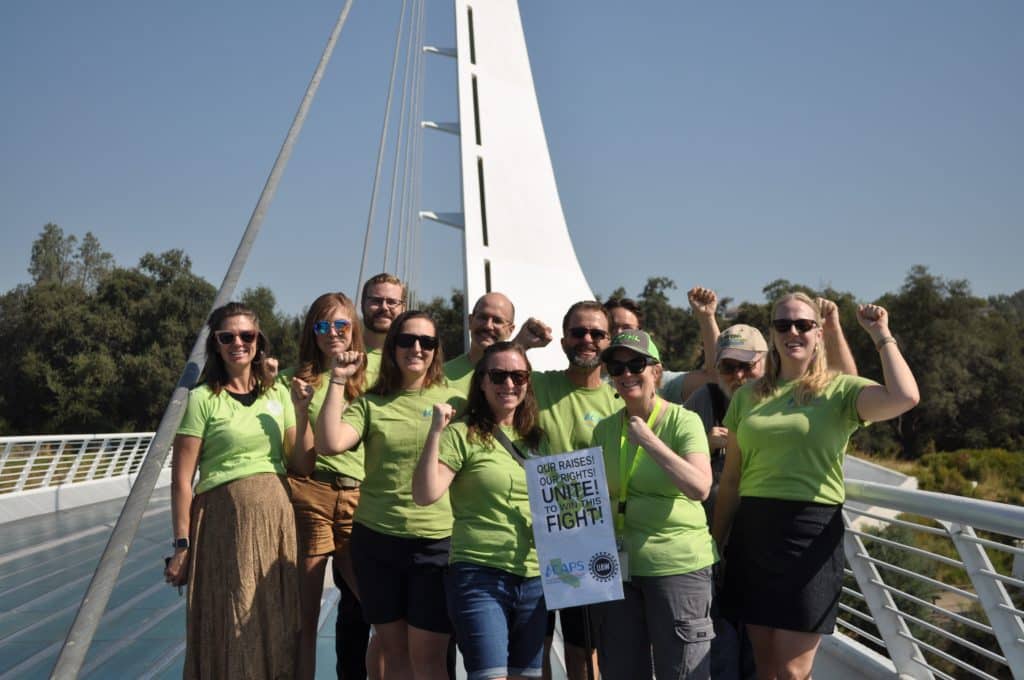
On August 5, a group of California Department of Fish and Wildlife staffers, organized by environmental scientist and union steward Dyana Judnick, stood together at the Sundial Bridge to take a photograph. The CDFW scientists, along with a union member at the Department of Cannabis Control, were gathered as part of a statewide rally organized by CAPS, UAW Local 1115, a union of scientists and researchers employed by California and working across the state in sectors such as public health and environmental protection.
In March 2025, Governor Gavin Newsom signed an executive order, mandating that California’s state employees return to in-person work.
His decision has spurred a wave of protests all over the state, with thousands of workers rallying against what they say are impacts on costs of living and productivity. Environmental scientists in Shasta, whose work protects California’s environment through the California Department of Fish and Wildlife, are no exception.
The scientists are also fighting for a pay raise, which was promised to them by the state in 2024 before being suddenly revoked this June.
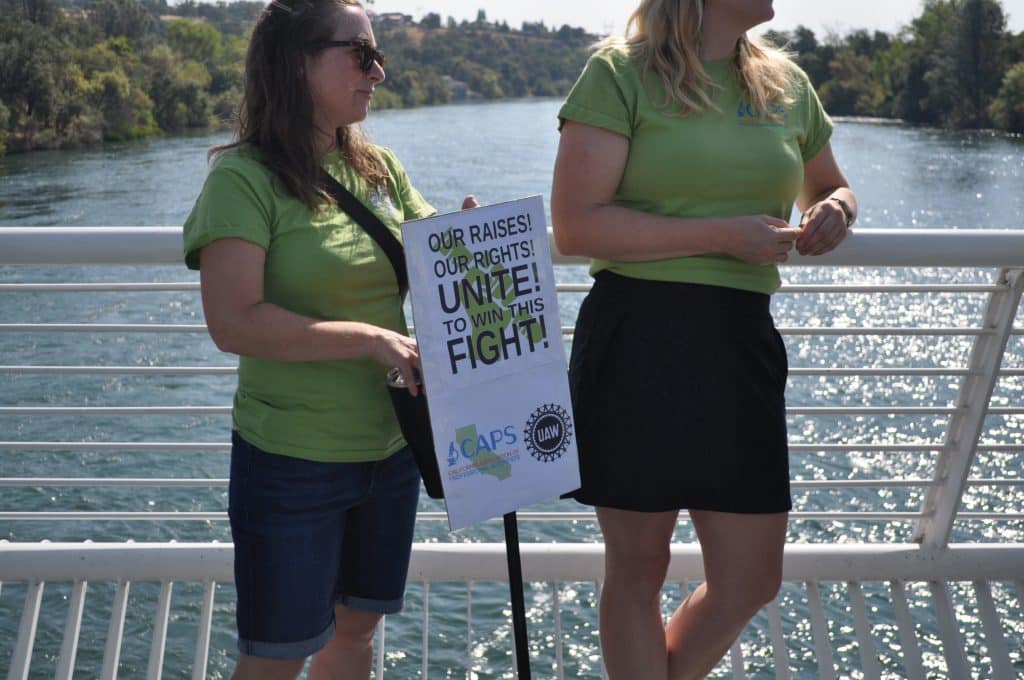
As the group gathered in front of the iconic Redding bridge a week ago, Stacey Alexander, one of the environmental scientists for CDFW, held up a sign that read “Our Raises! Our Rights! Unite! To Win This Fight!”
“I love my job, so that’s what makes all of this happening difficult,” Alexander said.
What is RTO, and how has it impacted CDFW scientists’ work?
Newsom’s demand for a return-to-office, or RTO, called for over 108,000 state workers with hybrid work options to return to work in the office at least four days a week, starting July 1. The order cited a “commitment to operational efficiency and high-quality public service,” noting that in-person work increases collaboration and accountability.
Many CDFW scientists interviewed by Shasta Scout said that the RTO has forced them into what they described as a poor work environment, making both their work and their quality of life difficult to sustain. The mandated return to office has forced workers to reverse a series of actions taken four years ago, when they were given orders to work from home.
At the time, California had issued a statewide telework guidance policy in response to COVID-19. In an email to employees from that era, CalHR noted that the administration supported telework “as a long-term strategy to decrease office space, allow more flexibility for employees, and provide resiliency in the case of future emergencies.”
Alexander, whose work involves writing expedited permits for restoration projects such as the Klamath Dam removals, said that she paid out of pocket four years ago, to establish her ability to work from her home.
“My previous state agency, the Regional Water Quality Control Board, didn’t have the equipment to have us all work from home, so I had to purchase a computer just to work from home,” she said, adding that she also had to purchase a desk when the pandemic suddenly shifted the state’s work plans. “But I was okay, because I knew it was an emergency and I cared a lot about the work I do.”
Eventually, as online work became the norm, employees adapted their work styles, and lifestyles, to telework. Judnick, whose role at CDFW involves cannabis permitting to protect local waterways, added that telework also allowed for more flexibility to accommodate long days of fieldwork, which many CDFW’s scientists conduct as a frequent part of their responsibilities
“I go out in the field probably twice a week, sometimes less. Everything else I do is very regular work, and we have Teams,” she said, referring to Microsoft’s online messaging system. “I actually feel like I collaborate more now than I did before [COVID], because we all have Teams.”
By the time the RTO was issued this year, Judnick and Alexander both say, their Redding office was ill-equipped to accommodate all employees coming back in-person. Changes made by CDFW after telework began in 2020, including a decision not to renew a building lease, meant current facilities lack space with not enough desks or meeting rooms, they said.
Dacota Huzzen, who began working for CDFW as an environmental scientist last year, added that the office also lacks sufficient air conditioning and internet connection, making it difficult to work productively — especially as much of the work is still being conducted on Teams, requiring strong connectivity.
“Now I’m stuck in a room with two other people,” Huzzen said. “While the camaraderie is nice, I don’t feel like I’m as efficient because it’s just louder, and we don’t have proper cubicles, and it’s too hot, and the internet doesn’t work properly.”
Many sources also pointed out that they’ve been communicating with coworkers and supervisors effectively online, and Microsoft Teams already tracks their productivity, meaning employee efficiency is already streamlined without in-person management.
Since labor protests against RTO have broken out, Newsom has explained his reasoning behind the mandate in several ways, including his belief that it will increase accountability, vitalize local businesses, and battle a “crisis of loneliness.” He’s also referred to the four-day mandate as a “three-day weekend,” implying that employees do not work on the one day they are permitted to telework.
In contrast to Newsom’s statements, local CDFW scientists’ claims are backed by a state audit conducted last year which concluded that telework did not negatively impact employee productivity, and could save California as much as $225 million in facility and real estate costs. The governor’s office did not respond to Shasta Scout’s questions regarding state workers’ concerns about RTO.
In addition to difficulties in their work environment, CDFW employees say that the RTO has contributed to financial challenges, particularly given increased gas prices and new parking costs in Redding. Judnick noted that RTO has also created unique financial challenges for CDFW employees who live outside of the Redding city center, explaining that long driving distances and limited public transportation contributed an added expense for those living in the North State.
Carolyn Buesch, an environmental scientist at CDFW, said that she was forced to find housing in Redding close to the office, with higher rent and fewer options, as she couldn’t afford the higher gas prices to commute from outside of town. She added that she now bikes to the office four days a week in order to avoid gas prices and associated car expenses.
“My rent would have been cheaper if I lived just outside of town,” Buesch said. “I could have saved commuting time, gas money, reduced wear and tear on my truck, and saved more money for a house down payment and retirement.”
Promised pay raises that were never delivered
On June 30, the night before they were preparing to return to office after years working from home, CDFW scientists received an email from CAPS which outlined that they also wouldn’t be receiving the pay raises that had been signed into their contract in 2024.
“This evening, hours after bargaining concluded for the day, we received notice from CalHR that the State Budget Act of 2026 does not contain funding for our 2026 special salary adjustments,” the email read.
“What it really is, is the state deciding that they won’t allocate money in the budget to fund salaries that were previously agreed to in our contract,” Eli Scott, head steward for the Northern California district of UAW 1115, explained.
Scott was referring to a contract signed by the state and ratified in 2024, which promised special salary adjustments ranging from 3% to 5% increases depending on the classification of the position. CalHR notified the union that the raises, which were to be effective this July, were not included in the finalized state budget. That budget was signed into law on June 29 with a comment stating that the budget was “balanced” with “zero deficit this year, and next,” something scientists have referred to as “balancing the budget on state workers’ backs.”
Prior to the 2024 contract that included those promised raises, Scott said, the union hadn’t had an effective contract for four full years, and the lack of pay raises only added to financial challenges and frustrations CDFW scientists faced.
During the peak of COVID-19 in 2020 and 2021, state workers took pay cuts and furlough days amid budget uncertainty. But the following year, the state recorded a record-breaking surplus of $97.5 billion, Alexander noted.
“So [given that context,] I don’t really feel like the economic uncertainty warrants us having to take pay cuts,” she said. “And then the governor saying that we have a balanced budget, and we’re not getting those raises anyway.”
Scott added that although the union has had little time to respond to the pay cuts, given that the announcement came so suddenly, he hopes the agreements can be clarified in dialogue between the union and the governor’s office.
“If not, we’re hoping to get a trailer bill as the legislature comes back into session, that would fund our raises,” he said.
CalHR responded to questions about the lack of salary adjustments and the union’s claims by saying the agency doesn’t comment on pending litigation. The governor’s office has not responded to the same questions.
What comes next?
In response to frustrations over the governor’s unilateral decision on RTO, CAPS filed an unfair labor practice charge earlier this year, which the Public Employment Relations Board accepted for expedited processing on July 10. The union’s charge alleges that the state’s change to its telework policies was in violation of prior agreements that promised negotiations regarding RTOs, as well as that CalHR refused to engage in good-faith negotiations.
In response to questions, CalHR said that the state will “review the filing by the California Association of Professional Scientists and will respond as appropriate through the PERB process.”
Meanwhile, unions are supporting AB 1729, a bill introduced this February which would require state agencies to establish structured remote policies and provide justification for in-person work. The bill came back to the Senate Appropriations Committee last week, and while the analysis by the committee has been favorable, it’s been placed in the suspense file for additional fiscal review. The bill is scheduled to return for a hearing this week, on August 13.
In the meantime, CAPS is continuing to file workplace grievances surrounding RTO, as well as continuing its statewide campaign to spread the word, Scott said.
The environmental scientists in Redding have their hopes high both for the telework bill and for the return of their promised raises, which they say would allow them to remain committed to a line of work that they love.
“I always wanted to work for the Department of Fish and Wildlife. I’m finally here, and I’m so happy,” said Jennifer VanDyke, a senior environmental scientist at CDFW who graduated with a degree in biology and went on to work in different environmental departments with the state. “I feel like the work I do matters, and that I’m actually using my degree for something that I’m invested in, like trying to restore the environment.”
Her love for the work, she said, makes her frustrations all the more disappointing.
“Just honor the contracts, and allow the flexibility we’ve been able to work with for so long. We do a lot.”
August 12, 9 am: We have updated the article to correct two CDFW scientists’ classifications, and to clarify that one member of the union who is not affiliated with CDFW was also present at the Sundial Bridge gathering.
Moe Shimizu is a student at Yale University. She’s reporting for Shasta Scout as a 2026 summer intern, with support from the Nonprofit Newsroom Internship Program — created by The Scripps Howard Fund and the Institute for Nonprofit News.
Do you have a correction to share? Email us: editor@shastascout.org.
Author

Comments (9)
Comments are closed.
Related Articles
Curtis says he won’t appear in federal court tomorrow to testify
The elections official received a subpoena earlier this month to testify before a federal grand jury and bring June election ballots with him. He said he confirmed today he won’t have to go but did not explain who had informed him he was released from testifying.
Redding council to open recruitment for a new city manager
The council is contracting Rocklin-based recruiter Ralph Anderson & Associates to run the recruitment. It’s a decision met with mixed opinions by council members, some of whom wanted to offer the role to the city’s interim manager.
Shasta school board member Jackie LaBarbera faces new legal threat
Months after the California Attorney General’s Office approved the initiation of a lawsuit against her, LaBarbera is facing another dispute. The new claim against her alleges not only that her dual school board roles are incompatible, but also that she broke state law by holding her first seat long after having moved from the district she serves.
I am sure that each and everyone who does not want to “return to work” at a or the office will have his or her resignation accepted without hesitation by the State of California. That will give each and everyone who resigns the ability to seek new opportunities. (I do not believe that they will find those new opportunities to their liking; the private sector is no place for a former State of California employee: It is too rugged.)
I have worked with various employees of CDFW on environmental issues and have found almost all of them to be dedicated to their work at protecting the environment which people in the Redding area should certainly appreciate. The only exceptions are management which are largely insulated from the public, won’t return phone calls or emails and try to avoid controversy, which is almost impossible, especially in Shasta County.
The issue of cleanups of marijuana grows is discouraging. However, these are often toxic sites that use often illegal herbicides and pesticides and leave them often in unmarked bottles. Many of the chemicals used are banned in the United States. The marijuana is then sold to various “medicinal” marijuana stores in the area. Cleanups have to be contracted out to specialists because of the hazards and CDFW does not have the funds. Readers could help by contacting Assemblymember Hadwick and state Senator Dahle to provide more funding for marijuana grow cleanups.
Here is the pay for CDFW scientist and others down to seasonal workers:
Scientist Pay Breakdown at CDFWEnvironmental Scientist (Entry/Base Range): $4,418 – $9,321 per month (New hires start at the minimum step $4,418/mo).
Senior Environmental Scientist (Specialist/Supervisor): $7,556 – $10,732 per month.
Research Scientist Series (e.g., Research Scientist I/II/III): $6,942 – $10,364+ per month depending on the specific scientific tier and specialty.
Scientific Aid (Temporary/Seasonal): $18.26 – $21.67 per hour
So with a minimum of a BS or MS and five to ten years of service employees can make $100,00 per year, which is not that high considering the addtional knowledge, training and course work they must complete over their career.
While I understand that employees can’t use their last name, it would be nice if cowards such as ReddingSkeptic would use their real name and get their facts right instead of just bar stool bloviating.
…plus ~$40,000 in benefits. And between holidays and vacations they get ~6 1/2 weeks off which is ~equivalent to an independent contractor getting $180,000.
The average scientist with a masters earns about half that ($96,000)
Gavin Newsom speaking on office morale is beyond ironic. He is a diagusting human being and poor leader.
Thanks so much to my fellow BU 10 scientists for being out there advocating for our rights. I’m a CDPH employee based in Sacramento but living in Redding and unfortunately couldn’t make it to the rally. I’ll try to make the next one.
I’m sad to say that I gave the state the benefit of the doubt on not funding our contracted raises, thinking they were left out of the budget just as an oversight. I was shocked to listen to the recording of this morning’s Senate hearing on the topic and hear from the CalHR rep’s testimony that it was absolutely intentional. Absolutely shocked that the Newsom administration would be touting balancing the budget for the next two fiscal years and yet INTENTIONALLY deciding to renege and not fund our hard fought, contracted raises. Thankfully it seems that the committee members did not agree with the administration’s decision and I trust that they will fix it.
“I like my job”, “I do a lot”, “I worked a long time to get here”, “What I do matters”, “”I’m stuck in a room….”.
A senior scientist working for the Department of Fish and Wildlife pulls in something like $100k per year with a guaranteed risk free retirement package worth millions.
There are 20 million taxpayers in California who bust their buns on a daily basis to pay taxes, purchase licenses and permits, shoulder regulations and feed their families with whatever is left over.
Maybe, just maybe… They should count their blessings that taxpayers haven’t held them to task for the 100’s of millions of tax dollars we’ve poured into restoration projects that haven’t delivered on promises, or for the 100’s of mindless regulations, or the thousands of meaningful improvements that have been blocked by “possible” harm to a habitat of a creature that doesn’t actually live there.
Bottom line, if you really can’t find the fortitude necessary to go to work at the wage offered, You should find a job elsewhere.
When you get a science degree, it means you work very, very hard to get it. Not everyone has the ability or the intelligence. The ones that do, are very committed to their work and making a positive change for the environment and humanity as a whole. It is nonsense to think that after *6 years* of teleworking, the governor doesn’t get this or wants to believe that scientists aren’t working and having “3 day weekends”. Look at the audit done by the state on productivity Newsom! The data says that people are more productive when they have the flexibility to work from home. So, this mandate is demeaning and insane. To diminish scientists in this way is exactly what our current administration wants too. I guess this ploy by Newsom has much deeper roots. He clearly doesn’t care about wasting millions of taxpayer dollars on getting scientists/state workers back to the office and thinks this will improve his chances for a future presidency. He will never have my vote.
If ca dfw environmental scientist in this article is reading this then your work related to cannabis in our county has been an abject failure. I see dfw at illegal sites take samples but nothing ever happens and no information is given to our county partners….why?, shouldn’t we all know about the toxins?
As far as remote work…it was never promised at hire and it shouldn’t be automatically granted. I’ve seen and dealt with remote workers and I dispute the productivity proffered in the article.
Duty statements at the time of hiring did in fact state “permanent telework”. All the data available contradicts your absurd claim about productivity as well. I suggest you stay silent on things you have no knowledge about….