
California requires law enforcement to track reasons behind use of Flock cameras. It’s not clear if that’s happening in Shasta
Flock camera audit logs released by the sheriff’s office do not include documentation of the reasons for why the system is being accessed, something that’s required under state law. A staff analyst claimed reasons are being logged but weren’t disclosed.
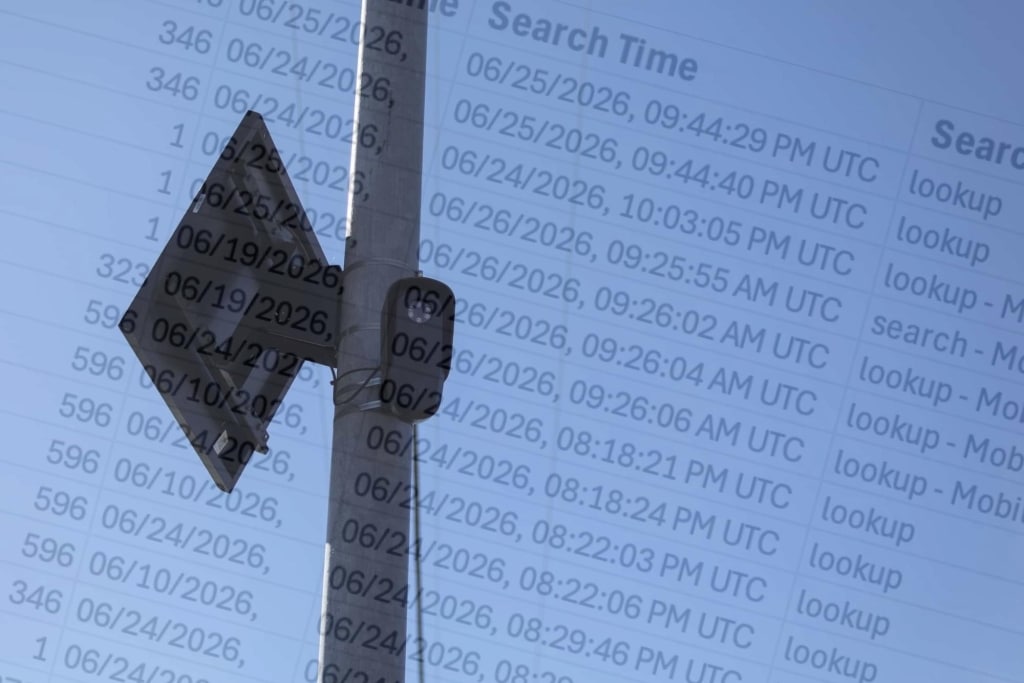
The Shasta County Sheriff’s Office may or may not have been logging the reasons Flock data is being accessed by law enforcement, a requirement under state law.
Sheriff Michael Johnson has not responded to multiple requests for comment over the last four days seeking to understand why audit logs released over the summer in response to a public records request do not include reason codes — or the reason that Flock camera data was accessed each time it was used.
It’s not clear whether the county is failing to document the reasons the data is being accessed, something that would violate California law, or failed to disclose that information on a public records response, something the state also requires.
Shasta has deployed 24 Flock cameras across the county, beginning in 2025. According to the county, the cameras are intended to assist “staff with the investigation of crimes, missing persons incidents, or other law enforcement related business.”
Since then, there’s been relatively little public debate over the cameras until a few months ago, when two local officials — Shasta County Supervisor Kevin Crye and Anderson Council member Darin Hale — began raising concerns.
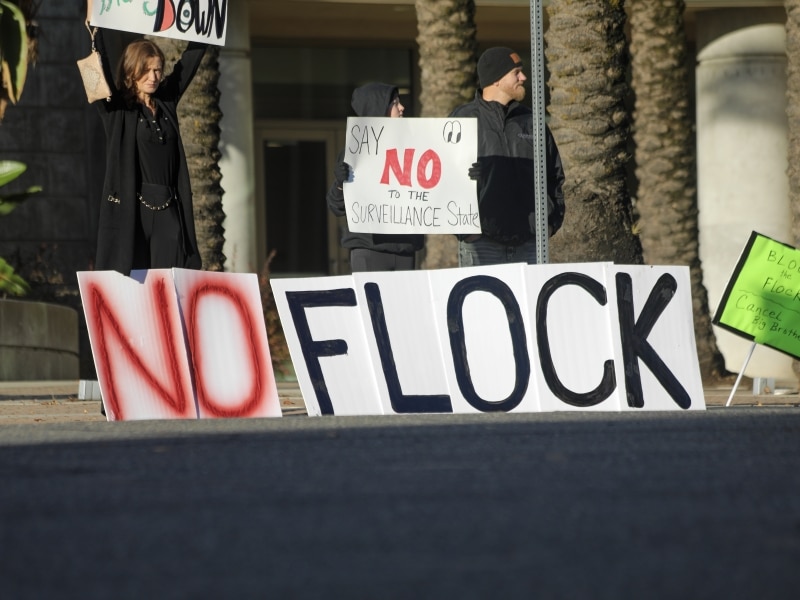
Now, a protest against Shasta County’s Flock cameras is scheduled for Tuesday morning. It will take place just before the county board meeting where Johnson is scheduled to present on the controversial technology.
Some community members want to rid the county of the cameras, which are also known as automated license plate readers, or ALPRs. Concerns focus in part on the potential for privacy violations.
Nationwide, cases have been documented where Flock cameras have been used by law enforcement to stalk or harass community members. There haven’t been claims of such harassment in Shasta, but records obtained by Shasta Scout this summer indicate that the sheriff’s current policies and practices may leave community members vulnerable and violate California law SB 34.
While Johnson has not responded to requests for comment, a staff analyst from his office wrote back today, initially saying that the county tracks the reasons for searches but doesn’t record them in audit logs. The staffer then responded a second time, stating that search reasons were recorded in audit logs but that the information wasn’t released to Shasta Scout under a government code exemption.
The only exemption cited in a response to Shasta’s records request this summer was Government Code 7922, with a note that “personal identifiable and contact information” can be withheld if “the redacted information clearly outweighs the public interest served by disclosure.”
The county did not specifically state whether such information was withheld or redacted in Flock audit records from the county. It’s also unclear how the reason for a Flock camera search query, such as “narcotics,” “larceny” or “stolen auto” would constitute personally identifiable information that would qualify for such an exemption.
Here’s what isn’t showing up on the sheriff’s Flock camera logs
California Senate Bill 34 requires law enforcement agencies to maintain “a record of access” that includes numerous pieces of information, including the “purpose for accessing the information.”
This summer, Shasta Scout submitted a Public Records Act request to the sheriff’s office, asking for information related to Flock cameras. The request asked the sheriff’s office to include “the reason for each ALPR search, if logged.”
The sheriff’s office responded with audit logs documenting the use of Flock cameras in a spreadsheet, but the logs lacked any documented reason for Flock searches. There was no mention of any information being withheld or redacted from the logs.
The information on Shasta’s logs contrast with that included on the city of Anderson’s audit logs, which cite the reason for each search query, along with the name of the individual searching the system and other key pieces of information missing from Shasta’s released documentation.
This morning, a staff services analyst from the sheriff’s office responded to a request for comment sent over the weekend, saying the sheriff’s office has “access to the underlying search reasons” but that search reasons are “not generated in the logs.”
Later, the analyst responded again saying that the information was logged in the Flock system but was not included in the released log due to being exempt from disclosure under Government Code § 7928.300.
Sheriff’s policies require logging reasons for Flock data searches
Other documents received in response to Shasta Scout’s records request this summer include both the sheriff’s policy on ALPR camera use and a November 2025 sheriff’s office training bulletin related to the use of the technology.
The training bulletin included mention of California’s legal requirement that search reasons be documented “to protect and maintain the privacy rights of the public” and said that the Flock system automatically records date, time, user, license plate searched and the reason for the search.
“You are required to properly document a case number, or sufficient information that validates your use of the system for a legitimate law enforcement purpose,” the training bulletin stated. It explained that law enforcement officers should document the nature of the crime and whether the vehicle being searched is connected to the crime or to the victim along with documenting a case number.
The bulletin also explained the reasoning behind the policy.
“While ALPR’s are an amazing investigative tool, there is a growing concern among some citizen-led groups on the privacy of citizens,” it said. “It’s important as a professional agency we properly document our ALPR use and ensure it’s being used for law enforcement purposes only.”
On Oct. 27 during the last county board discussion on Flock cameras, Supervisor Allen Long asked Johnson whether each search of the Flock camera system requires a case number be used.
“Yes,” the sheriff responded, but “we don’t actually enter that case number into the tracking system because we don’t want to make that discoverable by anybody else. But the reason is listed on there: the agency, the officer … who accessed that camera and for what reason.”
California law, personal privacy and what’s at stake
Authored in 2015 by former California State Senator Jerry Hill, SB 34 was the first of its kind to encourage local regulations of ALPR data outside of agencies like the California Highway Patrol.
Before SB 34, limited oversight for ALPRs existed, retention of data was capped at 60 days, and CHP only had baseline restrictions on data sharing. The new law filled in an accountability gap that required local law enforcement to uphold internal regulations and allow public input in order to better protect community members’ privacy.
The law outlines specific guidelines for access, including that “ALPR information only be used for the authorized purposes described in [each agency’s] ALPR privacy policy,” according to an information bulletin from the California Attorney General’s Office. According to Shasta County’s policy, neither reasonable suspicion nor probable cause is required to access database records.
Local community members posting online have expressed that the sheriff should document how he’s protecting personal privacy in order to reassure those with concerns.
“If the Sheriff’s Office maintains that the system cannot be used to improperly monitor individuals, the public deserves documentation demonstrating that appropriate safeguards are actually functioning,” said a Shasta resident in an open letter posted to Facebook two days ago.
Speaking to a reporter today, Supervisor Matt Plummer said he plans to ask the sheriff about audit logs during the board’s meeting tomorrow, both to understand what’s currently being documented and how the county can ensure that there’s sufficient oversight to abide by state law and ensure all policies are being followed.
“I don’t think that any policy should be written on the basis of trusting an individual who works in the government,” Plummer said. “I think it should be written in such a way that it provides the proper accountability and oversight to minimize the chances of being abused. And if it is abused, there’s a high likelihood that there will be the opportunity to discover it and address it appropriately.
“One thing that I am going to be recommending,” he continued, “is doing an independent, third-party audit of the logs that would potentially, to the extent necessary, go beyond what is publicly available.”
Have a correction to share? Email us: editor@shastascout.org
Authors


Comments (14)
Leave a comment
Related Articles
Shasta supervisors say voters should make decision on Flock cameras
County board members, who voted to approve Flock cameras last year, said they don’t want to be decision makers on removing the technology. Instead, they hope to let the electorate decide.
Supervisors vote to extend contract for Shasta CEO David Rickert
The extension does not come with a pay increase, but will add another four years to the CEO’s term, which was previously slated to end in December of 2028. Supervisors Crye and Kelstrom pushed through the 3-1 vote as they prepare to vacate their seats to make way for a new board majority.

Redding City Council to hold public hearing on Redding Electric Utility rate increase
REU is proposing a 6% increase for two years. The public is invited to share their thoughts during Tuesday’s public hearing.

It’s interesting, I’ve been working for almost four decades in various jobs and I can’t think of a single coworker I’ve had that has been arrested for an illegal grow operation, for rape, for DUI, grossly negligent driving, but various local LEOs have all been convicted of those in the past 12 years. And those are just the crimes that weren’t covered up. Then we have a previous sheriff running illegal background checks, a RPD officer fired for in 2021 with improperly accessing CLETS to look up information on his fiancee’s ex-husband. And y’all will fly your Gadsen flags right next to your “back the blue” sticker and are okay with them having even more surveillance technology. Interesting.
Because Flock cameras do not require a “suspicion” trigger such as the certain minimum speed that is required to start a red-light enforcement camera recording a car, truck, or motorcycle so as to have video of the vehicle, of the license plate of it, and of the driver of it and because the Flock cameras are triggered by each and every car, truck, and motorcycle that approaches the camera, what all does the Flock camera–or is it cameras like the red-light cameras–capture? It is patently more than a license plate.
This article lack the information in issue in the above question. It also lacks the next step the Shasta Scout will take if the sheriff stays with his non-disclosure position, as well as an estimate of the success of that step.
All we want is for law enforcement to follow the law. Protect personal privacy and state a reason for a search. Stating a reason doesn’t necessarily make private information public.
And my tax dollars pay their salaries.
I hope we can agree on a few things.
The Flock cameras have been shown to help solve crimes, locally and nationally.
The use of the cameras has been abused.
We need safeguards to stop or limit abuse.
Two things I believe.
24 cameras in Shasta county cannot track anyone’s every move.
The privacy issue with the cameras is vastly overstated. Anyone with a cell phone or GPS in their car can be tracked better than 24 cameras can.
I don’t think we need mob rule… whatever group can scream the loudest. We need information to make a smart decision.
Maybe the Grand Jury or a committee to review the policy and procedures of the sheriff.
It appears that the term “accountability” is something that the Sheriff’s office understands when dealing with persons it oversees but fails to understand when dealing with folks who oversee their work (the press, elected officials tasked with LEO oversight, and even the general public).
To state that the case code is a “required field” but then state that the Sherriff’s Office does not enter the actual case file number is double-peak. It is only a required field if both the software requires it to be entered (which may be the case) and the policies of the Sherriff Office require users of the system to enter that information correctly. Yet the Sherriff clearly states that their policies are specifically designed to not enter that information so that it is not discoverable. Therefore, it is not a required field in the manner in which the system is being used. I personally might understand how inclusion of that might constitute information which should NOT be made available to the general public, but raise the issue only to state how the answers from the Sherriff do not appear to be transparent and responsive.
As for Personally Identifiable Information (PIF), it is absurd to assert that having no reported reason reported in response to a legitimate freedom of information request (when such information is clearly required to be entered to assure accountability by the Sherriff’s Office) goes too far to protect the investigative powers of LEO. Using and reporting generic codes to explain why the system was access is the fundamental pillar of making the Sherif’s Office accountable to those who need to fulfill their duty for such a task. If not, then how does the Sherriff believe he is making his Office and his Officers accountable?
Finally, having a third-party audit is an expensive, and unless shown to be necessary, should not be rushed into. That being said, the Sherriff’s Office has not demonstrated to date that the reasons for access are being entered into any system (or systems), nor that it is internally enforcing its own policies for entering the reasons for access, nor that it is capable to showing that each and every access had a legitimate LEO reason for access. Until and unless these minimum accountability requirements are demonstrated then the Sheriff’s Office is not holding itself to the required accountability standards and should be required to do so ASAP if the system is be continued to be used.
What’s good for the goose is good for the gander.
Citizens are being “stalked” by SCSO and their minion posse militia. There’s the obvious reason. Good job Shasta Scout!!!
Excellent reporting, getting the facts out prior to the demonstration and Board meeting on Tuesday.
When information required by law is ignored or omitted, it begs the question “what are they trying to hide?”
Great reporting Shasta Scout. Thank you very much and I look forward to how this unfolds.
Our Sheriff won’t know who all accessed the data and for what reason. These companies are gathering data and selling it! They won’t fess up to that.
Has there been any incident of abuse or misuse in Shasta County? Or is this just a whole lot of noise about nothing?
That’s point of transparency.
How is it noise about nothing if there have been verified instances of abuse in other countries/states? Why do we have to wait for it to happen here to speak about it? What about our county would prevent abuse from happening?
Also, for every instance of abuse that’s been caught it’s almost guaranteed there were several more inappropriate uses of this technology that was never caught. Basically, just because no one has been caught abusing it in Shasta County doesn’t mean it hasn’t happened.
Robert B.
I believe the “noise” you’re referring to is called investigative reporting; you know (when done fairly) the “truth to power” thing that happens to be one of the pillars of a healthy, working Democracy. So the answer to your question is “who knows?”which is if course the entire point.