
Candidates for California’s District 1 Assembly seat spar over bipartisan collaboration in Sacramento
At a candidate forum hosted by the League of Women Voters in Redding, incumbent Assemblymember Heather Hadwick stood her ground as Anderson City Council member Darin Hale took aim at her political decision-making. Mt. Shasta-based Dianna James spoke mostly about her campaign promises.
California’s first assembly district is enormous — one of the biggest in the state. Currently represented by family farmer Heather Hadwick, the district encompasses the rural stretches of Alpine, Amador, El Dorado, Lassen, Modoc, Nevada, Placer, Plumas, Sierra, Siskiyou and Shasta Counties.
While the geography of California’s Assembly District 1 may range dramatically from dry grasslands to mountainous forests, the candidates in this race agree that across the district, advocating for the needs of rural constituents in Sacramento is an uphill battle.
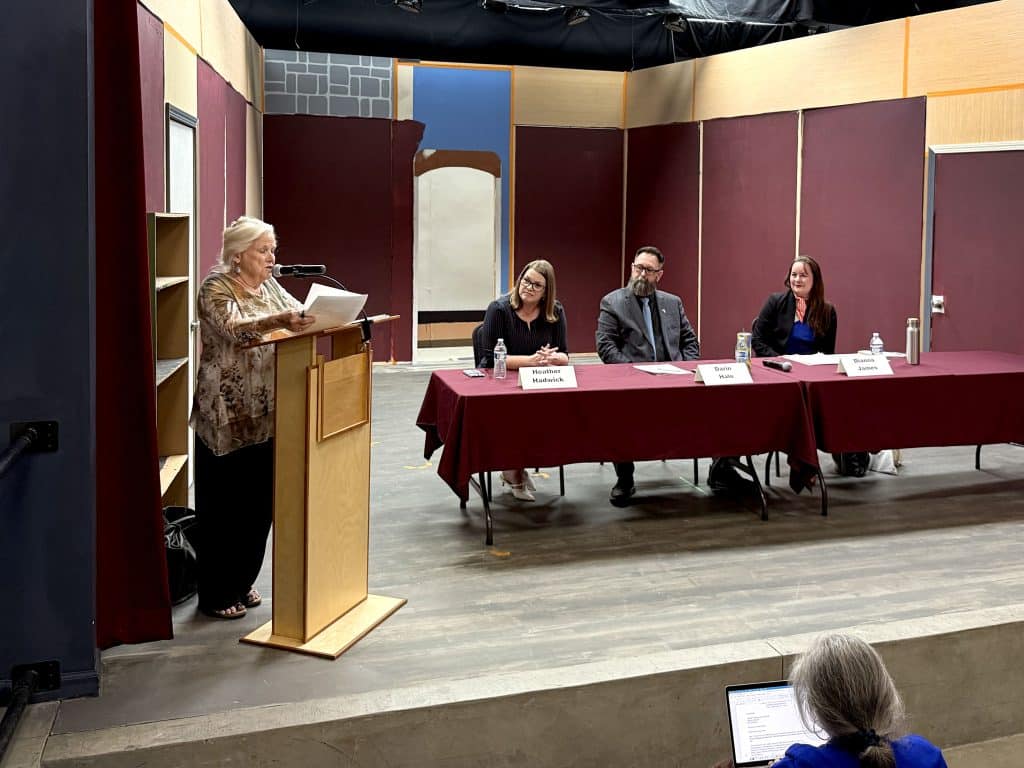
Candidates discussed such topics at a forum on the evening of May 1 at the Riverfront Playhouse in Redding. Hosted by the League of Women Voters, Hadwick, Anderson City Council member Darin Hale and former U.S. State Department Affairs Officer Dianna James shared their visions for the North State ahead of the primary election on June 2. The three speakers answered questions submitted by audience members and asked by the forum’s moderator, Susan Wilson.
Hadwick and Hale are Republicans based in Modoc and Shasta respectively, while James is a Democrat based in Mt. Shasta. The top two vote-getters in the June election will move on to the general in November, regardless of party affiliation. During last week’s forum, James and Hadwick mostly focused on specific policy-driven solutions. Hale spent a significant amount of his speaking time criticizing Hadwick’s leadership, while painting a bleak picture of how little agency Republicans have in California.
Hadwick, the only candidate with experience in the California legislature, said that working with the supermajority of Democrats was a necessary part of the job. She described how she led forestry tours for her fellow assemblymembers from urbanized parts of the state, hoping to expose them to the material needs of voters living on the edge of wilderness.
“You kind of have to decide,” Hadwick began, “are you going to yell up the Capitol steps and be angry … get the TikTok video likes and go viral? Or are you going to get things done and work across the aisle?”
In response, Hale expressed his belief that bipartisan compromise works against the interests of rural constituents, saying, “I’m not incredibly interested in reaching across the aisle in Sacramento.” He also called one gun-related bill that Hadwick pushed forward a “fake bill with a fake name.”
Meanwhile James, the lone Democrat, emphasized her goal to “lower the temperature,” and “work together to resolve these problems,” rather than remain divided along polarized lines — though she did describe the current political state in the nation as one of “democratic backsliding.” She added that she’s willing to stand up to her own party to ensure fiscal responsibility.
When it came to discussing their top priorities, each candidate listed different obstacles faced by local voters. Hadwick said she was focused on improving rural health care — later telling the story of a friend who gave birth on the side of a road because she was so far from a hospital. She also emphasized the need to keep small schools afloat and advocated for reopening the timber and logging industries.
James spoke about hiring more grantwriters to help the district secure needed funding for various projects, while pushing for financial incentives that encourage homeowners to “harden” their houses against wildfires, among other mitigation efforts.
Hale expressed concerns about local water rights, damaged infrastructure, and like Hadwick, education. But unlike Hadwick, who described a lack of teachers and funding in rural schools, Hale problematized California’s current public education system as a “Marxist-Leninist agenda being pushed on our kids and in the classrooms,” accusing Hadwick of “advocating for programs that hurt our kids.”
He said one his main motivations to run for state assembly was Hadwick’s “non-vote” on Assembly Bill 495, a law allowing immigrants to appoint a temporary guardian for their child in the event that they’re deported — something which many conservatives claimed would enable child trafficking. When the bill was first introduced, Hadwick was one of 10 Republicans who did not vote for or against it. She later voted against it, but it passed 60 to 20.
The committees that candidates plan to join also revealed a bit about how each would approach the job. James said she’d like to join the economic development committee, along with those devoted to utilities and energy and insurance. Hadwick cited some of the committees she already serves on, such as agriculture, budget and emergency management — the last of which she said was her top priority given the state’s focus on management approaches that are more suited to urban environments than rural ones.
“They try to pass bills all the time that are awful,” she said. “The ideas that work for LA do not work for us.”
Hale acknowledged that he wasn’t aware of all the committees but listed his topics of interest as education, finance and infrastructure. He added that “a token Republican has to sit on each committee, so I don’t think we get a whole lot of say.”
One question focused squarely on how the candidates were thinking about medical providers in the North State, with each candidate offering different solutions. James floated the idea of providing bonuses or housing support for doctors willing to work in rural counties for a certain number of years, and advocated for expanding telemedicine and creating a medical school loan forgiveness benefit.
Both Hale and Hadwick cited their support for establishing a medical school in Shasta, and Hale insisted broadly that health care should be further privatized, blaming state “overregulation” for a shortage of health care business and insurance incentives in California.
Also related to health care, candidates responded to a question about how recent changes in federal funding will impact rural Californians. Hadwick and James both agreed that President Donald Trump’s Big Beautiful Bill will likely disenfranchise already underfunded rural hospitals. But Hadwick said that California can afford to throw around its weight at the federal level given its massive economy, and that she has been sending letters to Washington to spare some funding for programs like Head Start.
Hale cast doubt on how significantly the withholding of federal funding would really affect local health care. “I know there’s a lot of talk on Medicare being withheld, but I haven’t seen the data,” he said, noting that he couldn’t give a fully informed answer. He then pivoted to talking about the possibility of the federal government defunding DEI and social emotional learning in schools.
He emphasized again how limited he believes rural representation to be at the state level while advocating for uncompromising ideological stances as the path forward.
“We’ve done enough compromising here in District 1,” Hale said. “We’ve compromised to where we’ve lost so much, you can barely afford to live in District 1 now.”
Do you have a correction to share? Email us: editor@shastascout.org.
Comments (3)
Comments are closed.
Related Articles

Haven Humane opens disaster response center built with Zogg Fire funds
The animal welfare organization opened a new disaster response and humane education center today next to its existing facilities in Anderson. The center was built with funds from the Zogg Fire that were designated for animal care in honor of Karen King.
Redding Rancheria PAC spends $32,000 to support four city council candidates
The Tribe said it created a PAC, or political action committee, to support city council members who understand the relationship between the Tribe and the city. Those candidates haven’t received direct donations of funds; instead, the PAC has provided indirect support through media campaigns.
Power shutoffs impacting thousands of customers across Shasta County
PG&E shut off power for California residents earlier this week due to wind and dry conditions, which could lead to dangerous wildfires. Shutdowns are expected to continue until Saturday morning.
Our nation is in tatters, we do NOT need Hadick retaining her office, nor another of her party frankly. And she is not protecting women’s rights, women’s autonomy, pro-choice etc. Get her out!
With the above people our best bet is Dianna James or another person who will actually do everything in their power to protecting people – including women, wildlife, land, affordability, safety, freedom and the pursuit of happiness!
I like that Hadwick is committed to working across the aisle. She described how she led forestry tours for her fellow assemblymembers from urbanized parts of the state, hoping to expose them to the material needs of voters living on the edge of wilderness. Good move.
Hale comes off as a gold-plated, foaming-at-the-mouth, hair-on-fire MAGA jackass. I don’t think Hadwick has to worry much about retaining her seat.
.
James, being a Democrat in Jeffersonistan, is irrelevant.