
Simpson University requests $10 million in county funds as ‘seed money’ for medical school
The school is now leading a process focused on bringing a medical school to Redding. During a presentation today, the university’s president pitched an initial request to the county for an “anchor investment” of $10 million.
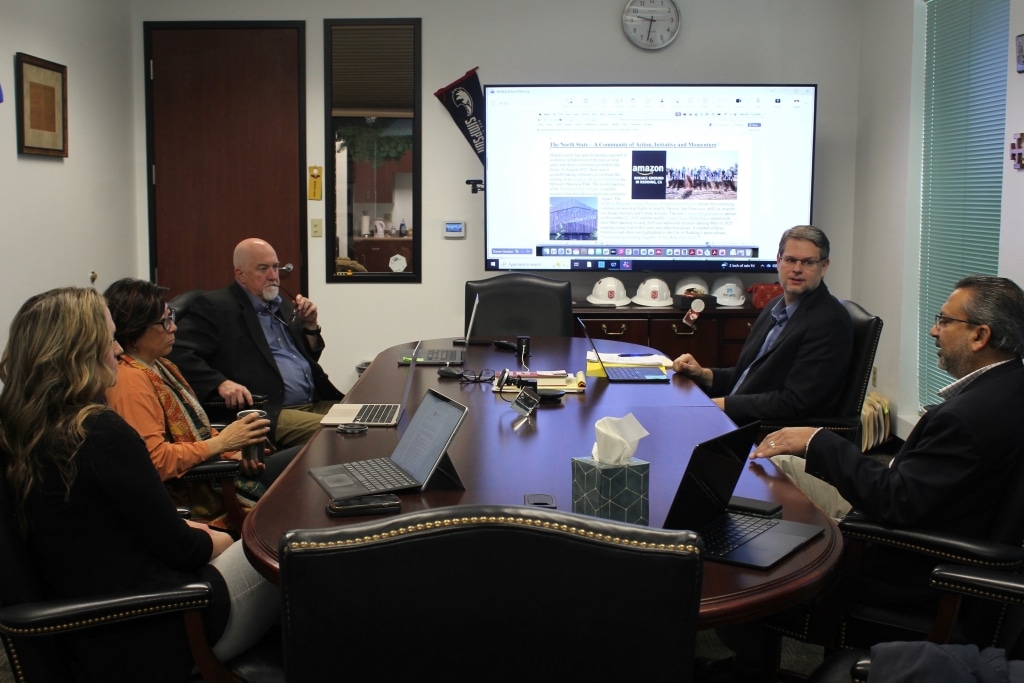
Today Simpson University President Norman Hall fielded hard questions from Supervisors Allen Long and Matt Plummer after a brief progress update into the need for a North State medical school turned into a pitch for $10 million in seed funding for Simpson to launch the project.
Hall spoke before the Shasta County Board of Supervisors during a discussion-only presentation that Supervisor Kevin Crye eventually revealed was placed on the agenda so supervisors could “do their homework” in order to be prepared to support the project during annual budget talks later this spring.
“I could have sprung this at the last second in June,” Crye said of the $10 million ask that he’s supporting, “but that’s not fair to you guys. It’s not fair to the community. It’s not fair to Simpson and all the stakeholders.
“I would just encourage you guys to do the work,” Crye continued. “And if you guys come back and make a great case of why we shouldn’t spend the $10 million … then I’d say you’re right, but that has to be proved, and you have an opportunity.”
Plummer pushed back, saying the onus isn’t on supervisors to prove why the county shouldn’t fund a private project with $10 million; instead, it’s the responsibility of those requesting the funds to present a case that is sufficiently robust to prove the project should receive the money.
His comments about steps leading up to any funding process referenced a recent decision by the board that provisionally awarded almost $2 million to a proposed behavioral health project that has now come under scrutiny. During a recent board meeting, Plummer said he believes the board needs to more fully scrutinize projects before funding them, asking supervisors to consider establishing a consistent set of metrics for doing so.
‘We don’t see the homework’
Hall told the board today that a small consortium that’s been meeting since last year to discuss opening a North State medical school wants Simpson, a private Christian university with an undergraduate enrollment of about 775, to take the lead in establishing it.
He outlined the steps Simpson has taken to look into the opportunity including working with a company called CFO Colleague that, he said, specializes in higher education initiatives. The university also developed a case study examining market demand and long-term viability, Hall explained.
“The conclusion is clear: The North State not only needs — it is uniquely positioned to support and sustain — a medical school,” Hall said. “The commission voted to focus on launching a full, fully accredited, four-year medical school in Redding through Simpson University.”
While county supervisors spent more than an hour discussing the medical school topic today, the board’s staff report for the presentation contained only minimal information, lacking information about both the case study Hall mentioned and the private partner that’s being considered as the lead investor in the medical school, noted today as Salud Education.
Instead of providing such documentation, proponents of the project paraded a number of individuals before the board to praise its potential for success and impact. Those speakers included four Simpson University trustees and staffers, along with a local medical doctor and an executive from Shasta Regional Medical Center.
Dean Germano, the founder of the Shasta Community Health Center and a member of the Shasta Assessment Redesign Collaborative, or SHARC, also spoke in support of the project.
“Simpson is doing the homework,” Germano said. “They’re pulling in the right people. We’re asking the right questions. There’s a lot of work yet to be done, but I am encouraged by these efforts.”
His statement prompted Plummer to ask where the homework was.
“I’m glad to hear Dean Germano saying that his experience is that you’ve done the homework,” Plummer said to Hall during board discussion. “We don’t see the homework, though.”
While formal documentation was scarce, Hall outlined some of the group’s work behind the scenes during his presentation, including a visit to Kentucky to learn from a medical school that’s being viewed as a model project. Based on the blueprint seen there, Hall said, Simpson has a goal of launching its first doctor of osteopathic medicine class by 2030.
“We have engaged a development partner, Salud,” Hall said, “and retained Washington, D.C. experts to pursue federal and state funding, recognizing that rural physician pipeline development is currently a national priority.”
The university president said that Simpson is willing to donate land for the project and laid out two possible financial models for launching the project, citing a cost of $100 million for start-up with a leased and renovated facility or $150 million with a newly-built one. Both models include a required reserve of $50 million to ensure that medical students aren’t left in the lurch if the start-up fails, Hall said.
Under the $150 million model, Hall explained, $50 million would come as an investment from Salud Education, $50 million from other private investors, and the last $50 million from fundraising, which he hoped would include $10 million from the board.
“If you’ve done fundraising, you know how important it is to come back to the initiating body,” Hall said, “to show the value of the project. And so the first $10 million would be very normal to ask out of this body. And it’s our responsibility to fundraise the other 40 million.”
Board Chair Chris Kelstrom said relatively little during board discussion. Supervisor Corkey Harmon worried aloud that a medical school could turn Shasta County into a “mini Silicon Valley.” But Harmon also expressed optimism, noting that a project such as this could provide local opportunities for his children and grandchildren, becoming an economic driver for the region.
It was a thought that Hall quickly reinforced.
“It actually is a significant economic engine,” Hall said, “perhaps the most economic engine you can get, dollar for dollar, because it dramatically impacts the airport, entertainment, restaurants, real estate, construction, grocery, fuel, all the way across the board. It floats all the boats.”
4.22.2026 6:52 a.m.: We have updated the story to add clarity to project’s cost estimate.
Do you have a correction to share? Email us? editor@shastascout.org.
Author

Comments (18)
Comments are closed.
Related Articles
Meet Dan Sloan for Shasta County Office of Education Trustee
Dr. Dan Sloan is running for one of four open seats on SCOE. Sloan is a Redding-born candidate who hopes to bring his multicultural and law-focused perspective to the school board.
Redding Chamber of Commerce endorses Wenham and Prosperi for City Council.
With three seats open, the Chamber has endorsed two candidates after an evaluation “measuring competence over confidence.”
Meet Russ Wenham for Redding City Council
There are nine candidates running for three seats on the council. Wenham is a civil engineer who’s focused on the city’s budget, public safety, infrastructure and job expansion.
So they took a trip to another State to see how that state was able to get a medical teaching facility started in a rural area. I dont suppose they bill Medi Cal ? I appreciate they took the trip to gain understanding of what did and what didnt work in that process. HOWEVER, California is a breed of its own and there are a myriad of differences specific to State regulations and procedures.
I have seen ZERO comments, studies nor visits to KERN county that is knee deep in the process to adding a medical school for their underserved rural population. In fact the project actually has state assembly bills pending in order to solidify its future and move the project forward. Perhaps some of the time and energy should be spent speaking with those involved in that project before $1.00 is put forth by the County much less $10,000,000.00. AB 1547- involving multiple California State University`s in creating this medical school for Kern County. https://legiscan.com/CA/text/AB1547/2025
The end goal is admirable, but an “ask” of TEN MILLION in seed money for something that is just barely beyond an idea at this point is not appropriate. I also agree that Simpson has some very talented people who do care about their community. I also agree that Simpson is faith based and their leadership will always seek to pacify and remain aligned with their supporters, contributors and allies that share the same faith principles. I sincerely doubt that if this project was led by Sikh`s instead of Simpson that KC would be so bold to say unless anyone can substantially prove why we shouldn’t hand over $10 million, it should be done. On the contrary – unless KC, CH or CK can substantially prove what County residents will be getting exactly for $10 million dollars, the defined measurable results expected from that money and actually make it a contractual requirement to meet those items for any funds provided or the funds need to be returned (in part or in full)- it should not be done. If the contract is breached, is SIMPSON going to return the money or will no one return the money because it was issued to some newly created & independent non-profit group specific for the project that later dissolves when it all falls apart.
Sigh.
At this point in the game, does anyone believe that Kevin Crye is supporting this out of the goodness of his heart, and not because he hopes to somehow have financial gain?
Two things: Until now this was presented as no cost to the county. That said, $10,000 is not unreasonable as an indication of support.
Janet: It’s $10,000,000
The federal government requires solid proposals in grant applications including written statements of need, background reports, budgets and budget justifications, project timelines, technical designs, resumes from key personnel, etc., even for small grants. Why should we be any different?
As a Democratic Socialist, I believe in taxpayer (government) support of non-secular and non-partisan education and health care. I believe Health Care and Education are the fundamental first line of defense of a Democratic Society! I also find Christian “Liberation Theology” to be closer to God than Trump. So sure, there is some merit to Supervisor Crye’s ask of 10 million for Simpson’s College medical school seeds, that is, if Simpson College and Kevin Crye also endorsed the values of secularism and non-partisanship, but they don’t.
.
Simpson College is a private right-wing secular Christian University, and the benefits are that they can openly operate in alignment with the Seven Mountain Mandate, idolize and preach the socioeconomic aspects of people like Trump’s Big Beautiful Bill and Ronald Regan, a racist who damaged education and health care in California while famously preaching “The nine most terrifying words in the English language are I’m from the government, and I’m here to help,” advocating privatization of education and health care and “shrinking government to the size where it can dragged to the bathroom and drown in the bathtub.” But before you do, please give Simpson 10 million. Thank you.
.
Supervisor Crye openly disdains California, “hates the word Democratic,” and believes the church should take over things like health care, social services, and education. After all, public health care and education is WOKE! Why? Because, like health care, public education in the United States of America is expected—and in many cases legally required—to be nonpartisan in its governance, curriculum, and in treatment provision. And speaking of economics and health care, because of the TrumPublican Party’s Big Beautiful Bill (HR-1), Shasta County is about to be hit with a series of catastrophic economic and social tsunamis, and Shasta County Supervisors have sounded the alarms.
.
Right off the bat, because HR-I, we now have roughly $10 million to $30 million per year in new fiscal health-care pressures placed on Shasta County, Government, and potentially higher in worst-case scenarios, while hitting our medical community hard, putting up to 400 to 1,200 healthcare-related jobs at risk. And remember, the secondary impact multiplier: Every hospital job supports 1 additional local community job, so we could lose 800–2,400 total jobs in total. Healthcare: 400–1,200, community ripple effects: +400–1,200, County jobs: 100–300, and Retail/food: 100–300. But, hey, maybe those unemployed folks can go to the New Simpson University Medical School or work at the Ninja Gym?
.
But here’s some good news. Did you know that Shasta County has a medical school that has trained over 300 physicians locally, likely closer to 350–400 when all its Shasta County programs are included? What? Yes, and many of these physicians stay in the region, which is one reason Redding functions as a medical hub for far Northern California. It’s likely that 150–250 physicians have stayed, working in Redding, Red Bluff, Weaverville, and other North State communities! It’s called the U.C. Davis Medical School! It’s been here for years and has given Shasta County an annual positive, non-taxpayer-subsidized, direct and indirect lifetime economic impact of up to $300M locally! Why, Gee Wize, Mr. Crye, did your anti-democratic “New California” secessionist buddy Chriss Street, whom you got $40,000 in taxpayer money to remake a Medical School PowerPoint, ever tell you that?
.
I ask the Shasta County Supervisors: Did Shasta County ever call for other educational institutions to submit 10-million-dollar seed bids? How about working with secular and public Shasta College to secure land that would most likely free up some land to help with the infrastructure needed for a U.C.D. Medical School Campus? Oh! But wait! Of course, I know why.
.
The University of California, Davis School of Medicine is required by law and policy to be secular and nonpartisan. Heaven forbid, that means WOKE! That means no Trumpian–Reaganomic–Seven Mountain Mandate, Conservative Christian dogma…
.
Darn! Looks like we, the Shasta County taxpayers, will have to spend a ton of money we don’t have to reinvent a Sleep at the Wheel Kivin Crye – Ninja Gym Christian Medical School.
Note to Editor: The first line above should read, “As a Democratic Socialist, I believe in taxpayer (government) support of secular (not non-seculer) and non-partisan education and health care.” The public funding of education in America should be, and historically has been, provided to public and secular institutions.
.
In fact, generally speaking, under the California Constitution Article IX Section 8, public funds are prohibited from being used for private sectarian (religious) schools.
Thanks for that, Christian. It’s an excellent program.
.
One quibble: The program is under UC Davis’s Accelerated Competency-based Education in Primary Care Program, which allows medical students who are looking to become primary care physicians to opt for a faster 3-year route over the usual 4-year path at medical school.
.
Locally, it’s a new program that hasn’t graduated any doctors yet—the first class was admitted in 2025. The graduates of that program will be well-trained to be general practitioners—and more of those is definitely a real need—but the program as is won’t produce any specialists. Our political leaders would be wise to lobby UCD to expand the program to include 4-year training of specialists rather than blow millions of $$ on a Simpson U Medical School pipe dream.
.
It would also be worth exploring ways to supplement direct and indirect incentives for medical experts (GPs, specialists, and nurse practitioners) to move here. Already there are programs of student loan forgiveness or repayment offered to those willing to commit to rural medicine for a fixed period of time. The loans are forgiven at the conclusion of the contract. Some of those medical practitioners end up staying put after their contracts are fulfilled.
.
Goose incentives rather than spend $150 million on a stand-alone med school run by a non-secular diploma mill that has spent time on accreditation probation due to high faculty turnover, low enrollment, program rollbacks, and other issues.
I think county money should be last not first. It makes no sense to me that we should put out taxpayer money now…if ever… when there are so many unmet needs in the county right now. I just have a hard time imaging how a private religious college with less than 800 students could take on this job. I’d rather have us go full speed ahead with UC Davis which has a proven track record
Crye: “And if you guys come back and make a great case of why we shouldn’t spend the $10 million … then I’d say you’re right, but that has to be proved, and you have an opportunity.”
.
So, in his cracked mind, the burden of proof is on others to demonstrate why giving $10 million in public money to a private religious university is not a good idea? Otherwise, he thinks it’s a done deal?
.
This professional grifter is for sure thinking of ways to get his straw into that milkshake.
I wonder if he thinks he’ll benefit from that 10 million?
Another concept of a plan requesting limited taxpayer dollars for the initial investment. Supervisor Plummer is correct in asking for data that could have and should have been part of this presentation. Looks like Crye is putting the cart before the horse once again challenging the other supervisors to just get on board. Such a large project needs to be thoughtfully reviewed for infrastructure impact along with the costs and benefits. We all want local medical care improvement but we also have to accept the reality cutting edge specialty medical care will be in the larger metropolitan areas where population base and resources are available.
That cutting-edge medical care isn’t going to emerge from a private religious college producing osteopaths seems obvious, but of course nothing is obvious to Crye other than potential sources of funding into which he might be able to jam his revenue-sucking proboscis.
.
One challenge that should be addressed before anyone invests in a medical school as a panacea for our doctor shortage: If Shastanistan is unable to attract sufficient doctors to move here owing to its various political, cultural, and financial disincentives, what does Hall think is going to make graduates of the medical school remain?
The general belief behind the medical school is that those who were raised here will attend and stay here.
It’s a nice fantasy, but there’s a saying from the movie “Bad Santa” that applies: “Wish in one hand and shit in the other; see which one fills up first.”
.
Presumably a fraction of our better high school students go off to California’s best universities (and beyond), advance to medical schools, get their medical degrees, do their hospital internships, and are eligible to move back to Redding. Why don’t they? And if the agenda is to provide pre-med and medical school educations via the current and proposed Simpson U programs, who is confident that it will retain the best and brightest local high school graduates, and that the Simpson U Med School grads will be of somewhat equal caliber to graduates of UC or Stanford medical schools?
.
I’ll answer my own question: I have zero confidence in that outcome.
.
A Simpson administrator once lobbied me to hire the graduates of one of their bachelors-degree programs. I pointed out that graduates of Simpson had less coursework in the relevant discipline in four years than UC and CSU students got in their first two years. And to put it bluntly, Simpsson’s faculty isn’t exactly impressive compared with a UC school.
.
Simpson is a diploma mill—you pay your money and you get your degree. Intelligent people who have attended their primary and secondary education programs (only show in town for many years) will tell you that many graduates of those programs are functionally illiterate. Some of them get hired by local school districts through church affiliations. I just don’t see a similar model being the solution to our medical doctor shortage.
What may be a good viewpoint to obtain is to ask some of our current physicians whose children are following in their parent’s footsteps obtaining their medical degrees -if they plan to return to Shasta county to practice. I can recall only two in the last 20 years.
Problem is most cannot afford the high tuition at Simpson University. So that narrows the field considerably. We are best off working with UC Davis to invest in programs that expand internships here in Redding.
Government money is the lazy (and wrong) way to fund this. Grants have turned into the giant easy button for funding poorly conceived, poorly planned ideas. We don’t need any more of that. When the plans for the Med school successfully communicate a compelling case for the schools viability and benefits, it won’t be hard to find private funds for implementation. (Said another way, if they can’t raise funds for the implementation, it’s a sign that something is wrong with the proposal).