
Could Shasta’s elections official actually hire Tina Peters?
The answer is complicated and would involve factors at both the county and statewide levels.
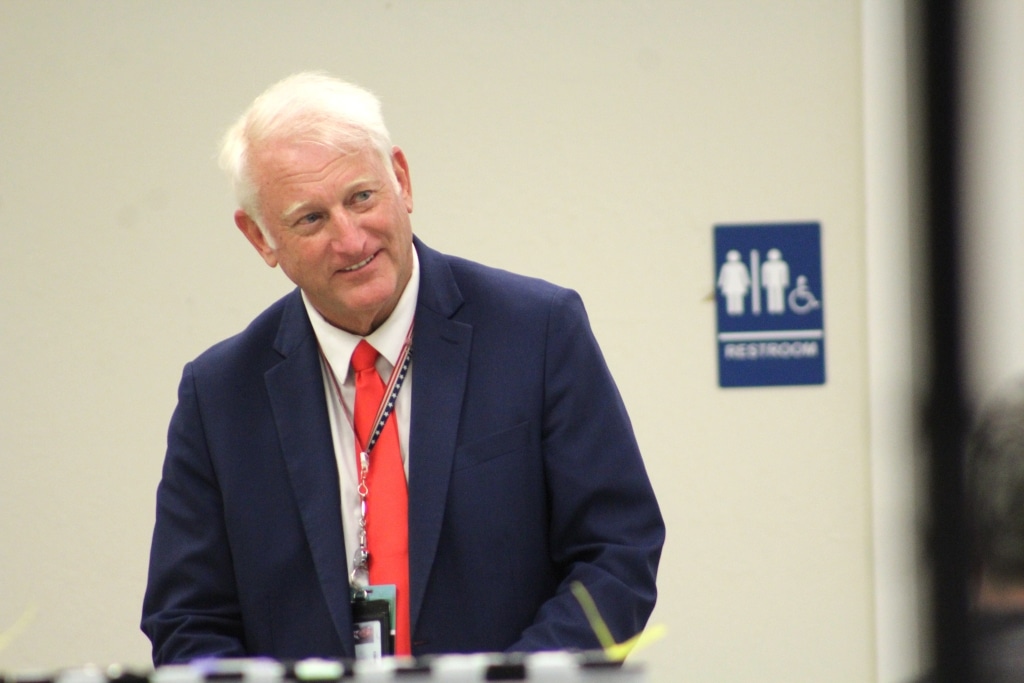
Shasta County Registrar of Voters Clint Curtis said earlier this week that he wanted to hire former Colorado elections official Tina Peters, who served time in prison for elections-related crimes. But actually going through with hiring her is more complicated than it seems.
Peters has been a prominent figure in what some refer to as the election skepticism movement, something Curtis has also been closely aligned with, as demonstrated during his time as Shasta’s top elections official this past year. She was released from prison this June after her nine-year prison sentence was commuted by Colorado’s governor following pressure from President Donald Trump. She was convicted in 2024 for tampering with voting machines in an attempt to prove the 2020 election was rigged against Trump and served less than two years.
Curtis announced his intention to hire Peters on the radio show “Jefferson State of Mine.” He told Shasta Scout over text today that she would largely be in charge of the supervision of election staff if hired, and she wouldn’t be given login credentials to operate voting machines, something she was convicted of tampering with in Colorado. She has yet to publicly accept or turn down his offer. Her attorney, Peter Ticktin, said on Monday that she’s considering the role. If she says yes, there will be major hoops for both her and Curtis to jump through.
For one, the role Curtis originally said he wanted her for isn’t actually open. Current Assistant Registrar of Voters Brent Turner told Shasta Scout for a previous story that he has no plans to step down, contradicting claims made by Curtis who had said otherwise.
The head elections official could attempt to hire Peters through a different route, as a consultant to the elections office. But unlike filling a role that’s already budgeted for, like Turner’s, hiring a new consultant would likely require approval from the county. That’s because, as Shasta Deputy CEO Stewart Buettell told Shasta Scout in an email statement, the process of hiring a consultant typically requires a contract, as outlined in county administrative policy.
Buettell confirmed that the contract would need county approval if compensation exceeds $15,000. For amounts up to $80,000, Buettell said Curtis would need CEO approval for the position. If compensation were to exceed that amount, the contract would also need to be approved by a simple majority vote of the board of supervisors. That’s unlikely, as multiple supervisors have already expressed their discontent with Curtis’ hopes to hire Peters.
Even if the contract were approved, there’s the issue of where the money would come from. The elections official may be able to pull funding from his already allotted department budget depending on the amount, but if he requests an adjustment to his budget that exceeds $75,000, he would also need a four-fifths vote of the board.
Supervisor Chris Kelstrom said in a recent interview that he wished Curtis would just focus on the upcoming November election, in which Kelstrom is a candidate, and not “all the other chaos.”
“I just want to get back to normalcy,” the chair of the county board said.
Kelstrom was one of three supervisors who voted to appoint Curtis last year, something he said he now has to own up to. In the June primary, Curtis was outvoted by former Assistant ROV Joanna Francescut, a long-term elections official with more than 16 years of experience who he fired just days after assuming office. She’ll take his seat on Jan. 4.
Kelstrom pointed out Curtis’ limited time left in office as one of the major factors of his stance on Peters’ potential hiring.
“I’m not changing a whole bunch of things up for somebody that’s only going to be here another three months,” Kelstrom said, referring to Curtis as a “lame duck.”
Supervisor Matt Plummer said in a social media post on Aug. 19 that he doesn’t think hiring Peters is a good idea either, referencing her criminal history involving elections. “You wouldn’t typically bring someone in to do something that they’ve been accused of not being honest in that particular context,” he said.
“Shasta County has endured significant election controversy, divisiveness, fighting, arguing over the last four years,” he added, “and this will only stoke that and increase it.”
Plummer also said in the post that two California-based U.S. senators had sent a letter to the board and the California secretary of state about Curtis’ hopes to hire Peters. In that letter, Senators Alex Padilla and Adam Schiff urged the secretary of state to share concerns with Curtis and the board about placing Peters “in any position of authority over elections in California.”
The senators pointed out that Peters’ criminal actions in Colorado cost Mesa County at least $1.4 million in legal fees and other impacts. “If Shasta County puts Ms. Peters in a position to again violate election laws following her convictions, county taxpayers could be burdened with unwelcomed and potentially hefty expenses,” they wrote.
The secretary of state’s office gave a reminder in an email to Shasta Scout that every person involved with California elections must comply with state law, applicable security and confidentiality requirements and maintain the integrity of California’s elections and election processes.
“The mere thought of letting someone near any part of California’s elections when that person was convicted of serious election-related crimes while serving as an election official, is simply outrageous,” Secretary of State Shirley Weber said.
“Our office is monitoring the situation and, as always, will act within our authority and work closely with law enforcement officials to ensure that all elections in our state remain transparent, safe, and fair for all eligible voters,” the email stated.
Peters’ parole terms create state-level complications
Even though Peters has been released from prison, she still has parole conditions to follow for the next three years, including a restriction from leaving the state of Colorado unless given permission to do so by her parole officer.
If she were to request to go to another state, her parole officer would review her plan to ensure it meets specific criteria designated by the Interstate Commission for Adult Offender Supervision. According to those rules, she would either need to be a resident of California or have resident family members in the state willing to assist, among other conditions and depending on the length of her stay. If she doesn’t meet that requirement, she’d have to provide other “compelling reasons and documentation as to the merit of the transfer.”
If Peters were to meet the criteria for transfer, a request would be sent to the Interstate Compact office and the state of California for investigation and determination of acceptance or rejection. This process, from application to determination, typically takes around 45 days. If Peters applied today and got accepted, she likely wouldn’t be able to come to California until the beginning of October, just one month before the November election.
A publicist for Ticktin, Peters’ attorney, said today there are no new updates on her decision at this time. Earlier this week, he told Shasta Scout that she’s considering the role, “as there most definitely has been monkey business in the way the [Shasta County] election was handled.”
Do you have a correction to share? Email us: editor@shastascout.org.
Comments (39)
Comments are closed.
Related Articles
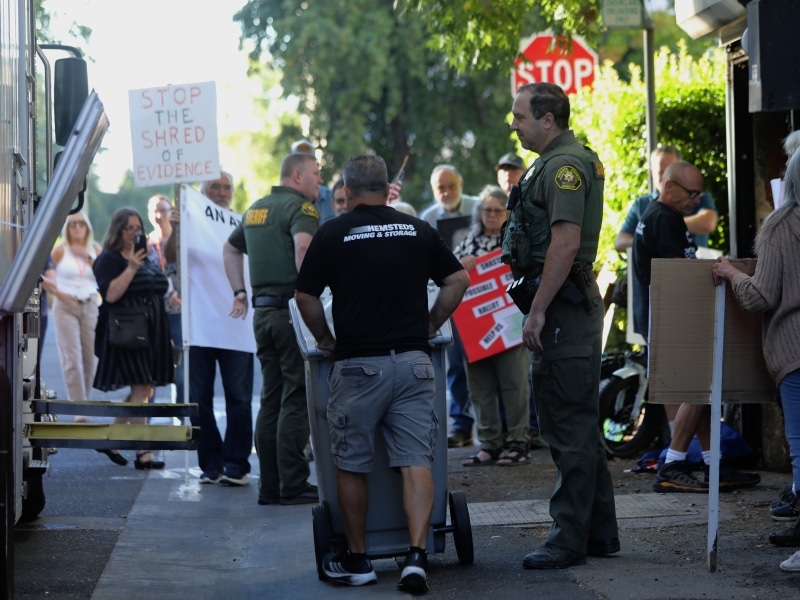
ROV Curtis oversees shredding of 2024 ballots amid activist protest
Several dozen people protested the mandatory shredding of 2024 ballots at the election office today. Amid the chaos, election official Clint Curtis supervised the proceedings with his signature cheerfulness.
Shasta County risks litigation after attempting to shield federal subpoena
The First Amendment Coalition has issued a legal demand on Shasta Scout’s behalf in an attempt to compel disclosure of a federal grand jury subpoena under public records law. A board meeting to discuss anticipated litigation is scheduled for Monday.
Meet Christina Prosperi for Redding City Council
There are nine candidates running for three seats on the council. Prosperi is a local business owner who wants to focus on the city’s budget, filling top leadership positions, collaboration within the council and staff morale.
Ringling Brothers could not have invented a better circus act.
Speaking of “nutz”…what is the purpose of the SCBOS entertaining the notion in the coming up Tuesday’s meeting of sending a partisan letter to Sacramento in favor of Trump’s “Save (white) America Act”? To accomplish what exactly. Sane Republicans”? We’ll see come Tuesday.
Purpose? This is an example of how Shasta’s far-right extremist supervisors can use all of Shasta County and avalable resorces to endorse the court-adjudicated rapist’s plan to take over the elections of the United States of America; it’s a “See, Patty? I’m not a whore!” kind of endorsement of Clint’s and Hobbs’ Measure B, which is very similar to the SAVE ACT.
.
If the SAVE ACT passes, it would cost Shasta County millions while disenfranchising thousands of Shasta’s voters, trigger a national constitutional crisis, and immediately start going through the courts, where California and 11 other states are likely to win at least an emergency injunction against Trump’s plan. Of course, the SAVE ACT is WAY out of the board’s jurisdiction, but at least some supervisors can wear the “I’M A TRUMPER, and I’M OK” badge, and yell, “WHERE’S YOURS?”
To date, courts have blocked 31 closely related SAVE ACT election-rigging requirements from taking effect in the 2026 election, making convicted 34-count criminal felon PANIC BIGGLY! And then there’s also the Supreme Court emergency ruling in Purcell v. Gonzalez.
.
Will the SAVE ACT pass? It doesn’t look good in the Senate, but who knows? But Kelstrom, Crye, and Corkey can say they tried.
Warning: bringing a Florida attorney and instantly making him a Shasta County government official was done solely for personal interest gains. What’s wrong with our County is the Personal Interest Gainers ( pig’s) in government. This merely sets the stage for their next attempt at obtaining a personal interest gain from the honest, hard-working Shasta County residence. Yes, the Florida attorney turned instant County official will file a claim for damages. It will be cheaper for the county to settle. Personal interest gain obtained. Remember this started with his request for 2.4 million dollars from the sheriffs to him (his department). Clearly, he’s sending his resume via media to the other counties in the country. Hoping to find the ancestors who created the Great American dust bowl and now call themselves “Make America great again”. Putting these pigs in jail is difficult. The Florida attorney never filed a police report alleging his election fraud allocations with Shasta County sheriff’s department. He knew he would face criminal charges of filing a false police report. He never spoke to the FBI because he knew he could be criminally charged for providing false information. When he files a claim for damages, serious consideration should be given to criminal prosecution. It’s time to put the pigs in the pin.
Lastly, to the person who offered the $50, I’ll take you up on that. One condition loser gives $100 to the Shasta high School booster club and the winner gives $50 to the Shasta high school booster club.
Comm on Shasat County! At least there’s one common denominator we all have in common: MONEY!
As Shasta County’s budget gets slammed by Trump and the Republican Party, here’s what the Corkey, Curtis, Crye, and Kelstorm ROV Clown Show has bought taxpayers so far. The Board has spent roughly 125 hours on election issues (most of which are outside the Board’s jurisdiction), including hours spent on proven-to-be-false (lies) conspiracies, across 2023–mid-2026.
.
Records show that $5 million in direct county costs were identified in replacing the voting system and developing a manual tally process. Additionally, an estimated $100,000–$125,000 has been spent on Measure B-related costs incurred to date. That does not cover the court hearing tomorrow on Aug 24, or any monies spent if the Curtis Hobbs Jones Clown Car show goes on the road to an appeals court, which is unlikely. And now we are looking to hire a convicted election-fraud criminal to work in our ROV office?
.
To protect our money, our elections, and staff, Curtis and his Clowns need to be isolated from ALL Election Activities in their own little office, as clearly the Clowns are intent on doing as much damage as they can while flushing TAXPAYERS’ MONEY down the toilet. While we might not be able to stop T. Peters’ assault on our elections, the Board can quarantine the disease to prevent further Trumpian infection.
Stupid, stupid, stupid. People of Shasta County have had enough, we are tired of our hard earned tax dollars flushed down the toilet. Harmon you need to resign, you don’t have enough brain power to even know which district you represent. Laura,Patty Bev, and who else is in your crazy ass circle need to find the closest psy ward and check yourselves in just as fast as possible, because you are out of your minds, and Curtis needs to be sent packing.
I’m pretty sure anyone in a hired position (not the elected position) can be terminated. Just like Curtis fired Joanna. Even if Tina passed background (Personnel) and the state granted her an transfer acceptance, Joanna could fire her in January.
.
More importantly, Clint’s antics are all attempts to show off and impress Trump. Including this Tina Peters stunt. He is currently working with several others to create a documentary about Shasta County elections to present to Trump. Everything he is doing and staging is literally marketing to be the cool kid in Trump’s and the MAGA club’s eyes.
.
Curtis could care less about anything but his fame and political standing with MAGA. You wouldn’t be able to convince me that he isn’t making stuff up about concerns with our County’s elections to sweeten his own narrative. And don’t think he won’t “find” more “irregularities” in November.
.
As he goes out the door he has nothing to lose by screwing over Shasta to further his MAGA celebrity.
.
Our tax money continues to circle the drain.
Curtis couldn’t unilaterally hire her for more than $15k total compensation as a consultant, and consultants have to prove they carry various types of business insurance which she won’t have. For up to $80,000 compensation, she could be hired with the approval of the County CEO, but he’s not going to do that. Above $80k, it goes to the BOS, and their approval is also a non-starter.
.
Curtis is an attention whore, and this is one of the dying gasps of the local MAGA shit-show. One final insult from this carpetbagging clown. That’s all.
Hey, Chris…these ARE your monkeys, and this IS your circus!!
PERFECT
This shuld be on campaing poster everywhere
Where is Joanna Francescut?
Isn’t she the county’s Clerk-Elect?
At this stage Mrs. Francescut HAS A SAY on this nonsensical matter, plus she should stop playing politically-correct games.
Joanna’s silence is DEAFENING and denotes some sort of cowardice or lacking the NEEDED leadership (working for 17+ years at the ROV doesn’t necessarily mean guidance).
Joanna Francescut must remember that in Shasta County, California, the County Clerk / Registrar of Voters position earns an approximate salary of $12,786 per month (about $153,432 annually) or an hourly rate of $73.77. Total annual compensation packages historically range between $145,000 and $152,000 in base wages plus benefits.
Apparently her gullible constituency never envisioned that Joanna will earn a SUMPTUOUS salary, which in many ways is a TRUE INSULT TO POVERTY in Shasta County.
Frank Frank Frank.
Tell me, when will she be sworn in ?
Until then, she is a private citizen with no authority in the ROV!
Politically correct games?? 😂
.
You mean by letting Mr Curtis, Mr Turner, and company dig themselves deeper and deeper into their own holes?
.
It is now politically correct to stand back and let incompetent people be … incompetent?
.
😂
Frank, your post is absurd.
.
Joanna has nothing to gain by getting mired in the tar pit created by the MAGA dipshits polluting our local political boards and government departments. She has no duty to take swings at Curtis, the MAGA tar baby. As ROV-elect, she has no say in the current management of that department and only risks being charged with interfering with the current ROV. (Of course, Curtis is a lying scumbag who’s going to make that claim anyway.)
.
The salary paid by Shasta County to the ROV is a red herring—bringing it up reeks of envy and unearned entitlement. If you think an upper middle-class salary paid to an accomplished person with huge responsibilities, after nearly two decades of hard work, is somehow an insult to your impoverished state, your problem is obvious.
Aaaargh!!! The DEAFENING silence! Get yourself some ear plugs Frank. You’ll feel better (probably not).
Does anyone know if somehow this moron is able to bring this woman into Shasta County can she be fired/removed once he is gone? The revenge of Reverge continues thanks to Cry, PJ and Kelstrom and the voters who put them in office.
Hire a clown, get a circus. It’s past time to take your sleaze-fest show all the way down the road, Curtis. Hobbs & Friends can hop on with you. Don’t let the “Welcome To Redding” sign hit you in the ass(es). Next stop – Earth 2.
Today, information was released by CNN that two months after her early release from prison, Tina Peters arrived in Washington and met with Trump and representatives of the Donald Trump administration. She is promoting the idea to the court-appointed rapist that he could use his emergency powers and give the court-appointed rapist unprecedented federal control over elections ahead of the November midterms. Yes, Shasta County is mentioned in the article. https://edition.cnn.com/2026/08/22/politics/tina-peters-election-denier-trump
Today, Aug 23, The Guardian and The L.A. Times report that Trump is laying the groundwork for a possible national emergency declaration involving the November 2026 elections, using court-proven lies about how the election system is rigged against MAGA, and alleged foreign interference and noncitizen voting, completely unsubstantiated. See: https://www.theguardian.com/us-news/2026/aug/23/trump-sowing-election-distrust?utm_source=chatgpt.com.
.
Yesterday, August 22, Trump’s USPS issued a plan to implement Trump’s March executive order on mail-in ballots, demanding that states must use his “approved voter” list despite losing this demand in 21 consecutive court battles involving demands for state voter-roll information and an existing court injunction preventing the unconstitutional rule from taking effect.
.
Last month, Reuters News reported White House and Trump’s intelligence officials had met to discuss the election commission’s future (which they got rid of) and proposed a national emergency and emergency powers to force changes to the use of voting machines.
.
Ticken, Curtis, Crye, Peters, Hobbs, Jones, The Shasta 5, and possibly Tinia Peters, should she become a Shasta County election official, are key local players in this conspiracy to overthrow the government of the United States of America via the Nov. 03 election. They are trying to normalize court-proven lies, fear, disparagement, conspiracies, and tons of false information, using Trumpian tools here in our county, as he is doing nationally.
.
In my opinion, Curtis and Crye could possibly be seen as negligent in their duty to protect the welfare of Shasta County laws, codes, and citizens and complicit in helping their Clown Car Circus spread court-proven lies in an attempt to disrupt the vote.
The CNN article mis-states that Curtis lost “re-election” which implies that he was elected rather than appointed.
The only good thing about Curtis’s conspiracy oriented term as ROV is the almost universal opposition to Curtis’s conduct as seen in the comments in every Shasta Scout article. This, in a very conservative community, is encouraging to this libtard.
I’m honestly a little disappointed in Plummer’s namby-pamby take. It’s not a good idea? Yeah, no shit.
.
Kelstrom’s take is miles closer to what I’d have preferred from a supervisor, which is: “Not only no, but HELL no. Over my dead body. This is a childish political stunt, and this county doesn’t need any more stupid, self-serving stunts. You lost, Clint. Stop being a jackass, if you’re capable of that.”
It is rather late for Kelstrom to be so gungho against Curtis’s plan. He was hell bent on hiring him in the first place. Wishy washy on censure and now, after this June election where he finds that he still has to run a campaign, he sees which way the wind is blowing and he wants to jump on the anti-Curtis bandwagon in hopes of keeping his job, though not a Chair.
MEDIA NOISE + POLITICAL THEATER?
The controversy is enormous in the short term, but the practical long-term consequences may be much smaller than the headlines suggest.
The real thing to watch is the exact terms of any hiring or consulting agreement Curtis enters into before leaving office. That determines whether this is merely a few months of political theater—or something that could actually constrain Francescut after January.
So much uproar for nothing.
Oh hey, it’s my buddy. I know who this is too. And of course you would say that.
.
Remember when you told people they should speak truth to power?
Before people stary freaking out… Anybody remember that sling blade looking fool Patrick Jones? Curtis is just another fart in the wind. This too will pass.
And that’s because people stood up and decided to kick him out.
Francescut to Peters, “Say When…”
I’ll wager he has no intention of hiring Tina but said that to just put a burr under your saddle. Kinda put your panties in a bunch. It worked.
Yes, Clintie the Clown isn’t a flailing, pathetic loser, he’s playing eleventy dimensional media chess to show us who’s boss. No wonder you’re a star of Flop Sweat Media, or whatever it’s called.
Selah
Yep. I agree another publicity stunt to stay in the public eye as he lives on publicity, like, Hummmmm.
So he says he has a locked room with suspicious ballots because some employee entered a locked room without using her entry card. Didn’t Peter’s do the same thing by letting someone inside her secured office without using no authorization, let alone even more.
Then he says she would be in charge of county election staff. Is that because he still can’t go near them without a babysitter? I’m pretty sure putting even a competent person in a job as staff supervisor 2 months before an election they know nothing whatsoever about would also fail.
This isn’t going to happen.
Our main Monkey is the current ROV, hopefully clear minds prevail and the Tina Peters hiring becomes dust in the wind.
Well, gee wiz, Clint, you didn’t offer the position to lying loser Mr. Pillow?
What knowledge does she have of California elections law and procedures?
If Curtis needs help in running the office then surely there are already people in CA without criminal records but who have the necessary knowledge and experience in running elections in CA to do it for a couple of months and that don’t require them to ask permission to leave the jurisdiction of another State where they are having their movements restricted by court order.
Seems more like a way to give a short term tax payer funded gig to a fellow election denier.
This will never happen, it’s a pathetic publicity stunt by a sad, soon to be irrelevant, little man.
Selah
A lot of this goes back to the secessionist group New California.
.
Surprise surprise, Ron and Patty Plumb are friends with Tina Peters and Clint Curtis.
.
For some of the local people who scream about local control, it really does seem as if we have too many outside parties interested in telling us how to run our elections.
.
Clint Curtis, Tina Peters, Brent Turner, Jeb haberbush, Mike lindell…
Then you also have Laura Hobbs who no one knows about her background and she just appeared out of nowhere.
Hobbs has a Ph.D. from UC Riverside. She was housed in the Department of Plant Pathology and Microbiology. She published circa 2006-2012, generally as a secondary author (probably a lab assistant) and a couple of papers as primary author (likely from her dissertation research). Her academic bona fides anre authentic. Lots of academics are a little loony, and some go completely off the rails (e.g., The Unabomber). She published under the name Laura L. Presley. I don’t know if that’s her birth name, or the product of a previous marriage.
.
I don’t know if her academic career ended when she found Christo-fascism, or if she converted after moving to Shastanistan.
Thank you for your careful, detailed explanation of the possible scenarios. I’ve been HOPING the press would step in and do just that. I expect Curtis tossed it out there for the headlines and attention and to keep the the Shasta County election drama ramped up. Looking forward to return of sanity and Joanna come January.
Yes, Mr. Ticktin, Curtis has been monkeying with our elections.
Shasta Scout has done the best reporting on this subject. So, maybe it goes like this?.
.
As reported, ROV Curtis sought county funding to hire Peter Ticktin as his attorney in the Measure B litigation, and Supervisor Crye voted to support Curtis’s request; the rest said nope.
.
Curtis then threatened the county, saying the B proponents might sue the county if it didn’t hire Ticktin or some other attorney to help him defend B.
.
Ticktin is also Tina Peters’ attorney, and both Ticktin and Peters (who’s a convicted election fraud felon) have communicated with the court-adjudicated rapist and are advocating he use emergency powers to impose sweeping federal election changes before the Nov elections.
.
Curtis later proposed bringing Peters into the Shasta County elections operation, and Ticktin stated that Peters is considering the proposal.
.
My 50-dollar wager that the convicted election felon won’t make it to the Shasta County ROV office still stands. Any takers?
“Supervisor Chris Kelstrom said in a recent interview that he wished Curtis would just focus on the upcoming November election, in which Kelstrom is a candidate, and not “all the other chaos.”
“I just want to get back to normalcy,” the chair of the county board said.”
Hey, Chris…these ARE your monkeys, and this IS your circus.