
Council members make clear: No plans for data center in Redding
After Circle 6 Consulting recommended the council consider a data center project in Redding, council members expressed their disapproval of such a plan. There’s little word yet on how the efficiency study Circle 6 produced will be used by the council to improve city finances.
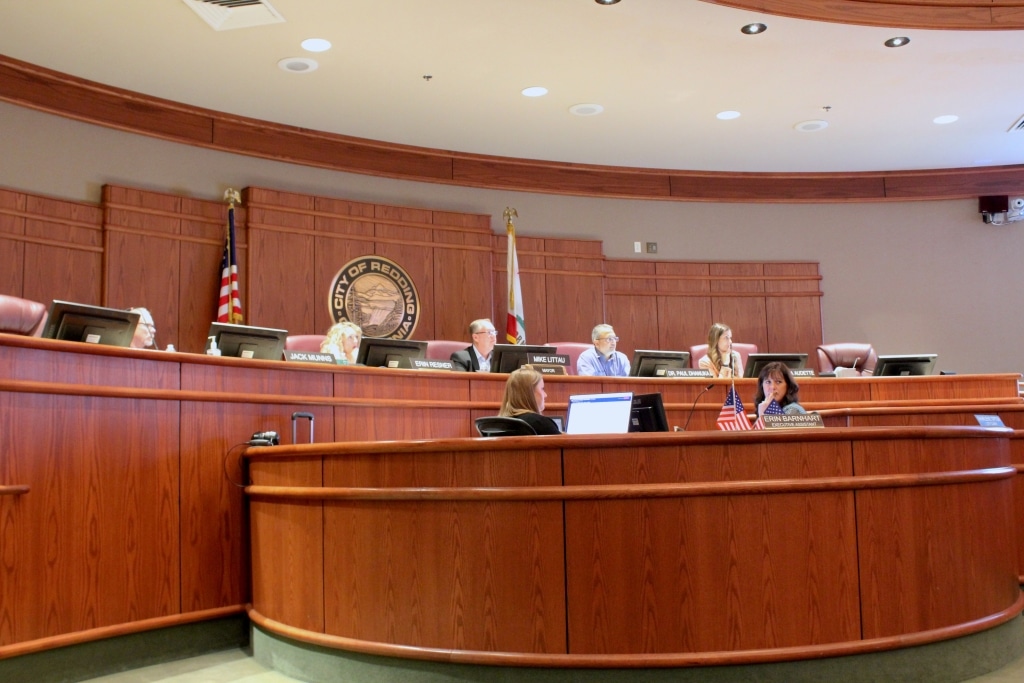
In the minutes before Tuesday’s Redding City Council meeting began, the audience of around 80 community members talked amongst themselves, many sharing the same topic of conversation: data centers.
It was revealed a few days prior that Circle 6 Consulting, the firm hired to conduct an efficiency study on the city, was recommending that the council consider a data center project in Redding, among other suggestions, to improve city finances.
During Circle 6 principal Nathan Sprague’s presentation at the council chambers last night, he breezed over the slide about the data center recommendation, clearly aware of the community’s pushback.
“[I] can hear the groans before I start talking about this one,” he said when the slide appeared. “Believe me, I’m not going to stand here and wave pom poms in the air for a data center, but there is a business case for it.
“But clearly, the business case for a data center has to be reconciled with the will of the community.”
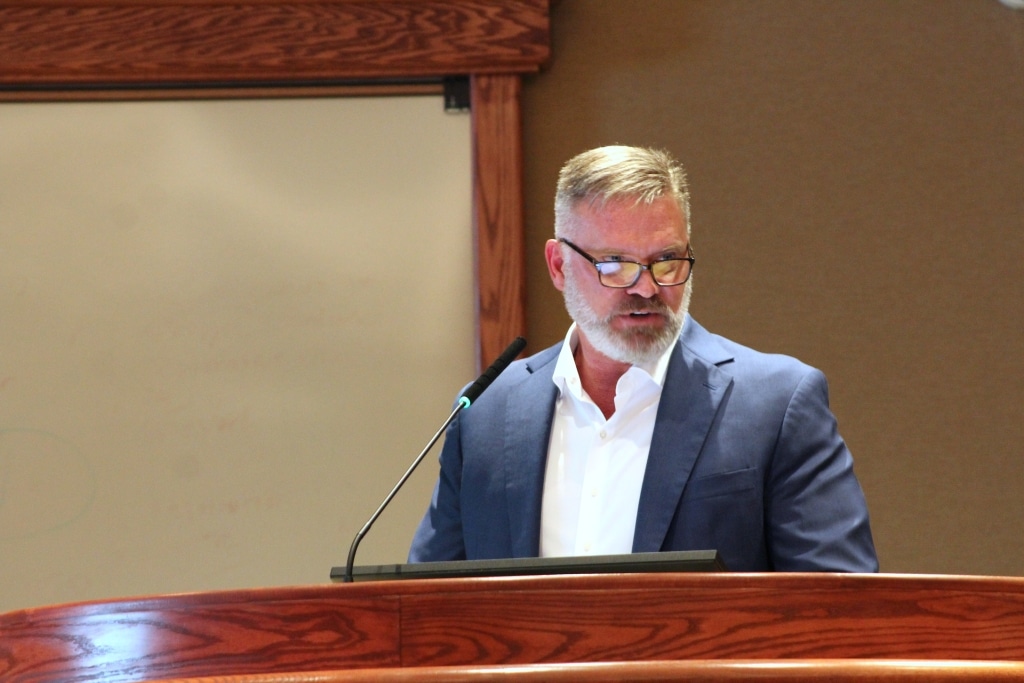
Several community members spoke after Sprague’s presentation in opposition to the idea of a data center in Redding, including Susan Weiss, who said areas like Redding are often the target of data centers because they’re rural and face financial issues.
“[It’d] be really easy to say that that’s our solution,” she said. “But trust me, our property values, our health risks, our quality of life, our environmental effects on the flora and fauna of our area, nothing’s worth it. No amount of money is worth all that.”
Multiple council members also shut down the idea of a data center in Redding, making clear after the public comment period that they did not support such a project. Council member Dr. Paul Dhanuka said he believes the city should be more focused on expanding education and health care, not data centers.
“I would rather build those infrastructure basic needs that we all have, for our people, before saying anything to support any data center for tech billionaires,” he said before the audience erupted in applause and cheers.
Mayor Mike Littau chimed in, saying he doesn’t think a data center is a viable option because it requires space the city doesn’t have, wouldn’t create jobs for the community and would use a significant amount of electricity.
“I think it’s important that we remain focused on Redding’s opportunities that really match everything about us,” he said, “as far as our land and all our resources and … what the community really wants.” He also posted on Facebook before the meeting to explain why he doesn’t see a data center to be the right fit for Redding.
Council member Erin Resner agreed with other council members, saying data centers are not a viable industry for the community for many reasons. And when it came time for the council to vote to accept Circle 6’s report, Council member Tenessa Audette accepted it, but only “sans data centers.”
Opposition to the idea of a data center coming to Redding was one that united community members across the political spectrum. Leslie Sawyer, a political activist who frequently speaks at city and county meetings, thanked Sprague for finding a way to bring locals together on something.
“All sides of the aisle hate [data centers], and nobody agrees on anything in Shasta County,” she said as the audience and council members laughed. “If you thought the alternative custody program location was bad, bring an AI data center here. You’ll see us unite, which would be great.”
Another community member, Kathy Grissom, told the council she was one of the originators of a petition to ban data centers in Shasta County, noting that it’s received more than 1,500 signatures so far.
Earlier this year, the council approved spending up to $300,000 on the efficiency study at the request of late City Manager William Tarbox. The consulting firm hired to conduct the study was intended to find ways to increase “efficiency and accountability while decreasing waste,” according to a staff report from when the study was approved.
Last night, the council followed up Sprague’s presentation with questions, including how the city would work to implement the changes and other specifics about the study’s findings. They then formally accepted Sprague’s report before agreeing to have a special meeting to discuss the study’s recommendations sometime in the coming weeks. The meeting will be intended to determine the council’s priorities and create strategic plans on how to accomplish their goals.
Do you have a correction to share? Email us: editor@shastascout.org.
Comments (9)
Leave a comment
Related Articles
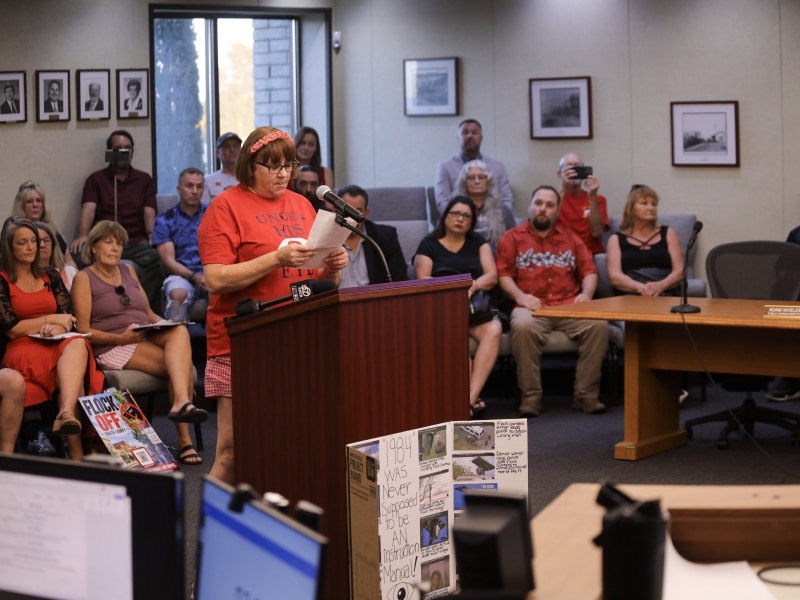
Anderson police chief tasked to respond to council questions about Flock cameras
Council members heard from more than a dozen public commenters with concerns about the cameras which have been deployed in Anderson since 2019.
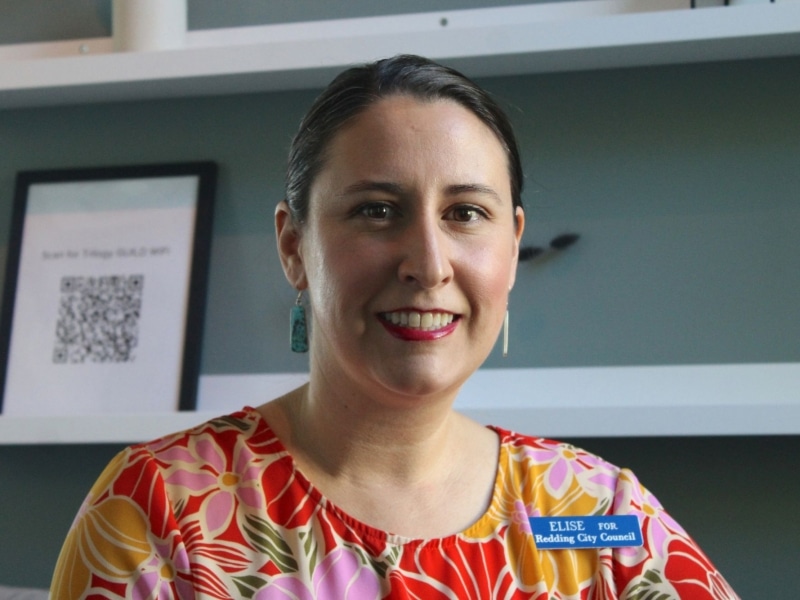
Meet Elise Ramirez Sloan for Redding City Council
Nine candidates are running for three open seats on the council. Ramirez Sloan moved to Redding two years ago, and she’s worked in the restaurant industry and in administration for Eureka High School. She now focuses on volunteering and giving back to the community.
Meet Bruce Ross for Shasta County Office of Education Trustee
Bruce Ross is running for one of four open seats on SCOE. He’s served on another local school district board for more than a decade and is a parent who hopes to bring a “focus on kids’ needs, not adults’ dramas” to the SCOE Board.
I have 2 questions for the consulting firm circle 6. How many studies have you done? Out of all those studies has there ever been one that recommended NOT putting a data center someplace??? This sounds more like a data center promoting firm than a consulting firm. What a waste of $300,000. I wonder if the gentleman who hired them got a kickback???
Meanwhile, the media reported today, September 18, 2026, that Trump’s administration is considering at least 12 or more data-center and related infrastructure projects covering about 17,600 acres of federal public land in six Western states.
.
Guess who has issued Executive Order 14318, “Accelerating Federal Permitting of Data Center Infrastructure”? Guess who controls the federal land in question? Guess who Trump appointed head of the BLM is? (I’ll just tell you: Stevan Pearce, whom E&E News/Politico described as a “fervent Trump supporter” who publicly backed the Court Ajudacated Rapist false claim that he won and fraud changed the outcome of the 2020 election.
.
Guess who analyzed BLM land in California for potential location of AI data centers and energy infrastructure? Guess who documented utility infrastructure crossing BLM land in Shasta County? Guess who controls 25,000 acres in the Chappie-Shasta OHV Area in Shasta County? Guess which county has been identified as having the BLM land, the major electrical infrastructure, and an enormous surface-water resource needed for data centers?
.
Of course, much more research is needed, and I couldn’t tell you whether Trump is specifically eyeing Shasta County or not, but we are on the map.
There’s been a lot of negative hype about data centers, but no reports from actual research by reputable companies into the actual impacts. At this point, I’m neither pro or against; I’d like to know more before closing my mind.
Tarbox’s lone contribution to Redding was wasting $300k.
We should be pursuing a city manager from towns like Coeur d’Alene, or Prescott, Arizona, or how about Huntington Beach. Do you See any large projects like $300 million medical facilities or#DATA centers in Lake Tahoe?
Watch for the Shasta County supervisors who attach themselves to large money projects, where the money is a grant from the state. They are not to be trusted, especially since they’ve never in their entire lives, run any large businesses! Or even a small one that has to be physically responsible to survive. Right now the Board of Supervisors is fat with two of these people. You know who they are. They cannot be allowed to make decisions when their district happens to be extremely small.
This just goes to show how outsiders like Circle 6 view Redding and Shasta County.
.
“You Goobers and Gomers don’t have what it takes to attract investment by businesses looking to expand. Your chaotic, MAGA/MAHA/M4L politics and uneducated workforce are widely known.
.
How about data centers? Nobody else wants data centers, so they’d be perfect for you. They’re staffed under the human-and-dog principal: The human is there to feed the dog, and the dog is there to keep the human away from the equipment. No educated workforce needed. No? Okay, how about a spent uranium disposal site. Really, it’s not as dangerous as it sounds. No? Okay, how about a medical waste disposal facility? Theoretically, the incinerator kills all the pathogens, with only a brief period of potential contaminant escape. No? You sure? We thought you people had faith in God…”
“…Earlier this year, the council approved spending up to $300,000 on the efficiency study at the request of late City Manager William Tarbox…”
Public records explaining in detail how the late City Manager William Tarbox contacted and selected this business (including criterion applied for this purpose)?
Wondering which Council members vote YES on giving a green light to the contract between Redding and Circle 6 Consulting (and how hypothetically they might have been “compensated in return” by this firm via third parties).
The office of the City Manager of Redding MUST be audited by the California State Controller’s Office (SCO).
Fair to state that $300,000 of tax payers money went to the toilet benefiting solely a private company = wasteful spending, corruption and incompetence.
If you think the worst, you won’t be far wrong; end of story.
Peter, your paranoid conspiracy theory about City Council members getting kickbacks from Circle 6 via third parties is just weird. You’re indulging in the MAGA habit of thinking that anything you might imagine is true because you imagined it. Absent any evidence in support of your paranoid theory, the Occam’s razor conclusion is: Sometimes a consultant is just a consultant.
.
In the words of Sgt. Hulka: “Lighten up, Francis.”
.
“Paranoia strikes deep in the heartland
But I think it’s all overdone
Exaggerating this, exaggerating that
They don’t have no fun”
—Paul Simon, “Have a Good Time”
Common Sense in Shasta county?
.
Who would have thunk??