
Efficiency study recommends Redding as ‘Data Center Hub’
The firm that completed the study said a data center project could attract hundreds of millions in private capital investment. The recommendation comes amid significant public pushback against data centers across the state and nation.
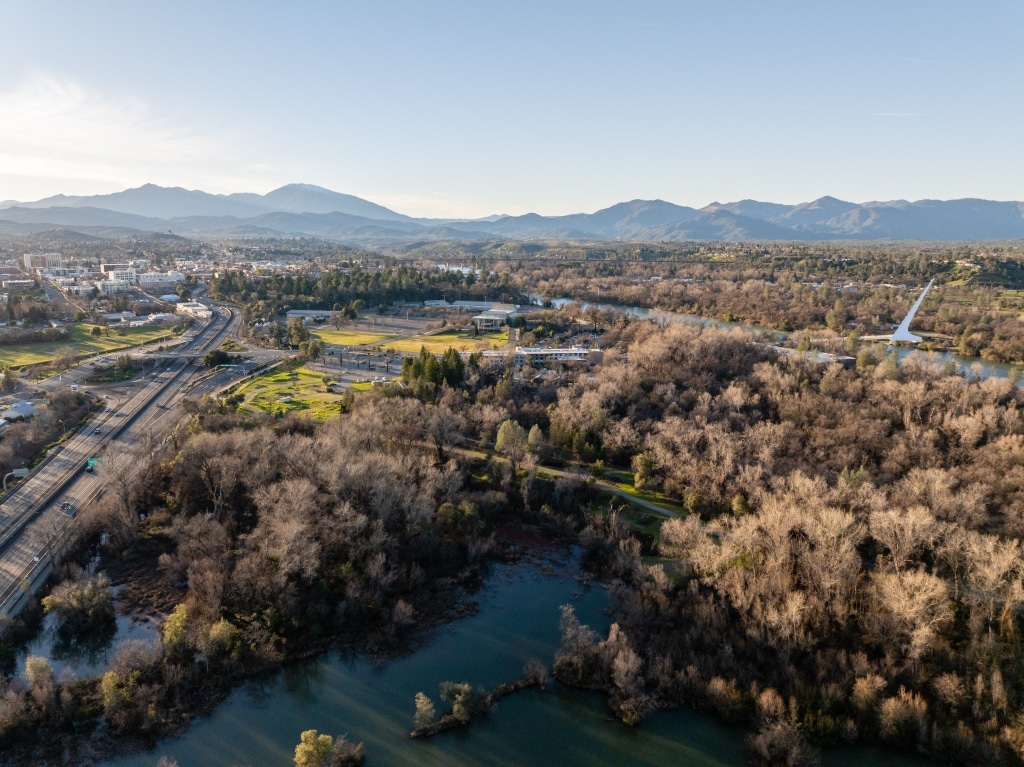
Circle 6 Consulting has completed Redding’s efficiency study, and it’s recommending, among other suggestions, that the city position itself as a “Northern California Data Center Hub.”
Doing so would capture “growing West Coast demand for AI, cloud, and high-density computing infrastructure,” the consulting firm says, and could attract hundreds of millions of dollars in private capital investment.
That’s no small number for a city that’s been facing significant budget challenges over the last two years. Those challenges are part of what motivated the Redding City Council this past spring to approve spending up to $300,000 at the request of late City Manager William Tarbox to hire consulting firm Circle 6 to analyze the city’s finances and find areas to save costs.
Staff with Circle 6 are scheduled to present the study’s findings at Tuesday’s city council meeting. Council members are not expected to take any action at the meeting aside from receiving the presentation, according to the agenda.
Circle 6’s slides explain that if the city council decides to move toward developing a data center, it could be operational within three years and provide beyond $750 million in “potential private capital investment,” depending on the scale of the project. The data center could also generate millions more in annual funding through property tax value, utility revenue and economic activity, the slides say.
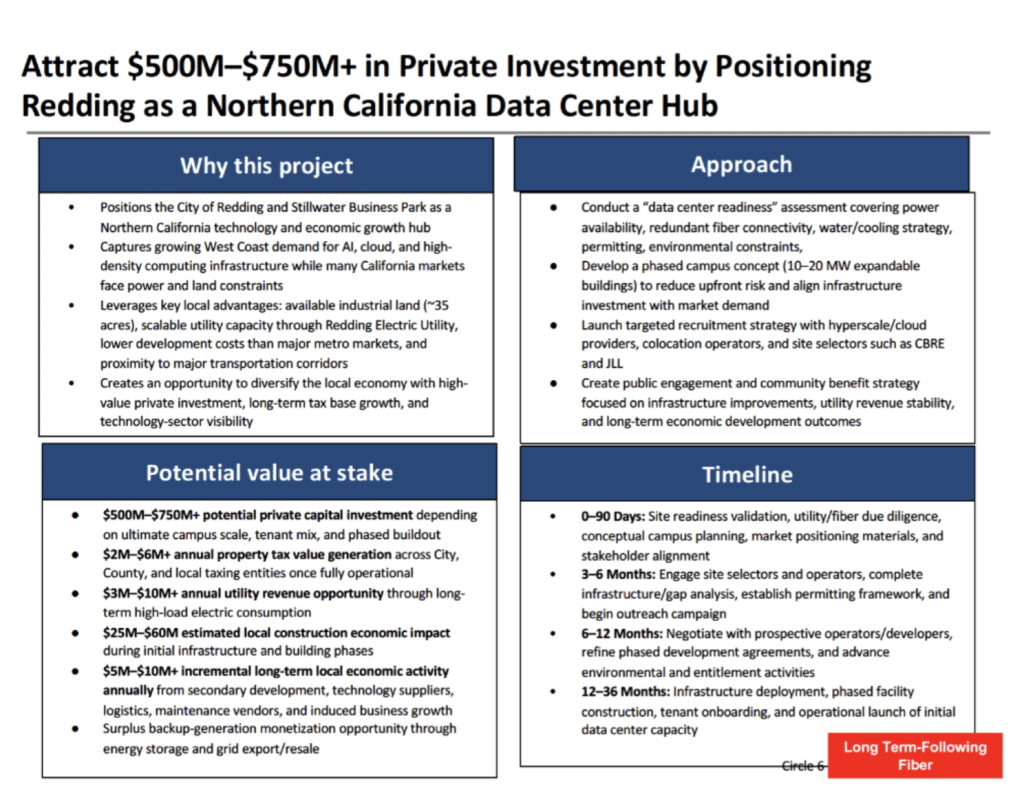
Circle 6 suggests that the data center could potentially be built on land in Stillwater Business Park, an industrial park located not far from the Redding airport. The city recently received a $7.9 million grant to make improvements to the park, which includes extending a portion to open road access to additional parcels for future development.
Implementing a data center in the city, Circle 6 says, would create “an opportunity to diversify the local economy with high-value private investment, long-term tax base growth, and technology-sector visibility.”
Data centers have sparked intense public scrutiny both locally and nationally over concerns about draining local water resources, raising utility bills and straining electrical grids. This past summer, after the city of Mount Shasta received an inquiry from a group interested in building a data center, there was significant public concern, and city staff and officials received threats over the project.
If the council chooses to develop a data center, it would likely face public pushback and could potentially be met with legal action, a growing route used by residents to combat data centers.
In recommending a data center project, the consultant’s work extends beyond what it was originally contracted to do, which was described in a March staff report as “increasing efficiency and accountability while decreasing waste.”
What else is included in Circle 6’s presentation?
The 83-slide jargon-heavy presentation by Circle 6 starts with an overview of the four phases of the study. It quickly makes clear that the firm isn’t recommending across-the-board layoffs as a solution to the city’s financial woes, instead focusing on areas where the city could cut costs and earn new revenue.
In addition to the data center recommendation, the consulting firm is recommending Redding position itself as a “strategic Northern California fiber aggregation and digital infrastructure hub,” saying the city could leverage infrastructure through Redding Electric Utility as a way to support economic development. Doing so could generate tens of millions of dollars, according to the slides, which don’t clearly define what such a hub would entail.
Circle 6 is also recommending that Redding establish an Enhanced Infrastructure Financing District for the area around the Oasis Road and I-5 interchange, saying doing so “unlocks the next major growth corridor.” The presentation slides explain that developing this economic project could enable an estimated $1.5 billion in “future buildout assessed value.”
Another recommendation is for Redding to shift its fire department dispatch from SHASCOM to CAL FIRE/Redding Emergency Command Center because CAL FIRE charges cheaper dispatch rates. The change could save hundreds of thousands of dollars, Circle 6 says.
The study also addressed what it called the “elephant in the room”: fire department overtime. The slides explain that overtime expenses are high relative to base pay, showing that labor costs in fiscal year 2025 were around $10.9 million, with overtime being $4.65 million.
According to the study, savings could also be achieved through changes to the city’s use of fire engines. The fire department currently uses two fire engines from the Office of Emergency Services, which allows OES to direct RFD to deploy the engines without reimbursing the department for equipment use. Circle 6 is recommending that the city return the engines to OES and purchase replacement engines for RFD, which cost around $750,000 each and could be paid for by fire impact fees. RFD deploying its own engines could generate more than $1 million annually, the slides say.
A controversial first responder fee could also make a comeback. Circle 6 acknowledged that the fee received public pushback before it was rescinded in August of 2025, and is recommending that an alternative fee be proposed that would omit fees for lift assists. The slides explain that a fee of $250 could produce $300,000 annually.
The firm also gives ideas for cost savings related to pensions and personnel vacancies, among other areas of proposed savings.
Circle 6 staff will present the study’s findings on Sept. 15 at 6 p.m. in the Redding City Council Chambers. The slides for the study can be found here.
Do you have a correction to share? Email us: editor@shastascout.org.
Comments (31)
Comments are closed.
Related Articles
Redding high school students call for tobacco ordinance enforcement
Students called on the Redding City Council to follow through on enforcement of a tobacco ordinance passed last year. Doing so, they said, would help address Shasta County’s high rate of teen tobacco use.
Redding declares emergency in anticipation of El Niño, makes plans to clear congested drainage ditch
The cyclical weather event is expected to bring heavy rainfall to Northern California this winter, something especially worrisome for those who experienced severe impacts from last year’s flooding.

Flock talk fizzles at Anderson council meeting
The council took no action even after Anderson Police Chief Oliver Collins’ acknowledged that the Anderson Police Department had previously granted Flock login access to employees of other agencies, something he described as “wrong.”

In addition to the recommendation for a data center, there is also a recommendation for “fiber aggregation”, stating it will serve to provide the infrastructure needed for data center, edge compute (another type data center), smart grid and so forth.
It seems a fiber company has already approached the city to sell their wares.
Yet another indication that Redding is (was) being set up for a data center. The background of Circle 6 indicates that they have worked extensively with the US government, DOD, all the branches of armed forces AND big oil and gas companies!
Their products run the generators that produce the energy for the data center.
I am suspicious of the underlying intentions of this report. Who might get a kickback?
This article states that the suggestion of perhaps a data center being built went beyond what the city requested from this study. That is curious.
I read a suggestion that data centers could earn good will by plopping themselves on top of superfund sites, cleaning them up, and going from there. Iron Mountain, anyone? Solar and wind power of course. Contaminated water can still cool and maybe get cleaned up.
It wasn’t very long ago that Shasta Lake was reduced to a stream. Driving over the bridge and seeing how dry it was was horrifying. To even consider a data center here is INSANE. I imagine the county supervisors are thinking this will be an easy solution to the finacial predicament THEY put Shasta County in.
I think Redding is probably a better location for a data center that most cities, but I fail to see how REU increasing *revenue* $3-10 million/year would be any sort of benefit to the city’s finances given that REU is a not-for-profit community-owned utility.
That is unless the city plans to raid REU for funds contrary to 2010’s Proposition 26.
Ahmad,
If REU is not for profit, why aren’t the rates lower? How much does it cost REU for workers and management?
REU has the 2nd lowest rates in the northstate:
.
Trinity PUD:
$43/month + $0.05056/kwh
$68.28 for 500kwh
.
REU
$40/month + $0.1492/kwh
($114.60 for 500kwh)
.
Shasta Lake:
$26/month + $0.17788/kwh
$114.94 for 500kwh
.
Lassen Municipal
$30/month + $0.1900/kwh
$125 for 500kwh
.
PG&E
$5.91/month + $0.32561/kwh low income
$168.72 for 500kwh
.
$23.80/month + $0.32561/kwh high income
$186.61 for 500kwh
.
.
REU rates would be even lower if the City of Redding didn’t skim $7 million/year off the top, ostensibly as a “payment in lieu of taxes” (PILOT). PG&E serves about half of Redding and pays less than $500,000 in taxes to the City, so it is hard to understand how the courts ruled Redding’s PILOT as reasonable payment since it effectively a rate 14 times higher than PG&E pays in actual taxes.
.
.
.
Why does electricity cost so much more than a few decades ago? Because in 2015 California mandated utilities switch to carbon-free electricity (60% by 2030, 100% by 2045). REU historically got most of its energy from the natural gas power plant it owns, as well as hydropower coming from Whiskeytown and Shasta. The rest came from the open market primarily from other natural gas power plants.
.
It is now having to invest in renewable alternatives and buy expensive renewable power on the open market. ~30% of its power still comes from natural gas, but about 1/3 of its electricity now comes from Wind Power transmitted all the way from Washington State.
.
.
PS Mahmoud Darwish was the Palestinian national poet who penned their Declaration of Independence. If you have ever felt oppressed by Sacramento or Washington, that oppression cannot hold a candle to what Palestine has endured
Lower than what? We pay like 1/4 what people in PG&E pay!
Perhaps, I don’t have facts to back it up, it just seems more than it used to.
A remote location I am familiar with has pge, used to be really low bills with minimum usage until they started charging for transmission and plant upkeep.
Building one of these monstrosities in an area prone to drought is madness. After the jobs created by the construction, ongoing employment is low level and minimal. A better utilization of Stillwater would be to attract renewable energy businesses to work in conjunction with REU.
Selah
Better yet, it’s the perfect place for a new jail
During today’s BoS meeting, Kelstrom stated that there are no plans for a data center in our county. He reported that he has spoken with city/county leaders, and he was confident with his statement.
Larry sez “ Who is going to be seeing the large sums of $500 – 750 Million? Other than taxes (which data centers have a history of being exempt from) after construction, very few jobs for locals.” That’s easy, the billionaire tech guys at the very top.
This is an interesting situation. Redding needs an upgrade-is this it? There are reasonable questions to answer. Personally after reading Nextdoor Neighbor I’m seeing that Redding needs professional jobs. I am in touch with one neighbor who has been job seeking for more than 2 years not being able to put their professional skill set to use. I hope we can keep an open mind and not turn this opportunity away without checking for answers to good questions.
“ In recommending a data center project, the consultant’s work extends beyond what it was originally contracted to do, which was described in a March staff report as “increasing efficiency and accountability while decreasing waste.”
Something stinks. Full stop.
Listen to Larry Roberts. Has anyone really researched this proposal? Who is Circle 6? These centers run 24/7. They illuminate a light aura 24/7. They use excessive water and electricity 24/7. Why in the world would ANYONE want one of these centers in our town? Things are so out of control now. We’ve got to stop this idea before it takes hold. It will change Redding negatively forever.
Redding is a city in distress. The majority conservative brain that runs on fear and is more comfortable being told what to do vs thinking for oneself is spiraling downward. They have hitched themselves to the “pillars” BS and it is costing their constituents in poor long term decisions and planning. The cronyism up here is rampant and blaming immigrants and homeless for all their problems is getting us nowhere. Where are the strategic forward thinking people up here that want this area to succeed. The old boys club is stifling any real progress and this town is struggling.
And to note: An AI datacenter is not the answer and I hope that putting an REU executive into the city seat is not a foretelling of such.
Yes, but . . . the only good thing about the data center issue is that hatred of big tech and data centers is a BI-PARTISAN issue within the respective political bases. Poitical leadership on the other-hand (on both sides) is sadly way behind the curve on this.
I strongly concur with Larry Robbins’ comments, particularly his concerns regarding the environmental impact. Redding’s extreme summer heat already places significant demands on our electrical grid and water resources. An AI data center—with its substantial and continuous power and cooling requirements—could place an additional and potentially unsustainable burden on these critical resources.
Before a project of this magnitude is considered, the community deserves a clear and transparent accounting of its projected water consumption, electrical demand, environmental impact, and long-term costs to local residents. Redding’s resources and quality of life should not be compromised for a project whose benefits to our community may not outweigh its lasting impacts.
Why does this feel like a nightmare? Time to put on the boxing gloves Redding!
What a wonderful recommendation to help the city and taxpayers. Stillwater is an area that has been talked about for years but under utilized. Since Redding would be part of a later stage of data center construction, we could use lessons learned in other areas. Conjured up, often close to hysteria fears are emotional rather than informed. I hope our city council is wise enough and brave enough to not let an opportunity slip away because of the loud, not in my back yard or county individuals. When I moved here, some peoole were strongly against the Sundial Bridge, which is one of our greatest tourist attractions.
I can’t tell if this is sarcasm or not. Please tell me it is 🙏
Which lessons are you speaking of and how were they implemented so as to “protect” extensive local water use, electrical grid strain and noise/light pollution? Honest question.
Data Centers are NOT tourist attractions and they are destroying the places they are built, some people get short term employment , I’m not “native” to Shasta County either but moved here long before the Sundial was built, People already are struggling here, electricity costs are high enough. Water is a resource many rely on for agriculture and have for generations, data centers use obscene amounts of it. The “sound” they create has negative impact on the health of living things around them. If bringing data centers are such an economic “Boom” why aren’t wealthy communities around the country demanding they be built there for them instead of forcing them on desperately broke rural communities ? No good has come to communities that have had these centers forced upon them, and they’ve been strong armed by big TECH using local government as if it’s just their own tool to use, likely because of the massive amounts of money they “donate” to political campaigns etc . They are predatory and think offering some short term construction jobs to the “poors” will get them in the door but many of those will likely be filled by out of town crews and any “managerial” positions are minimal and also unlikely to be filled by locals. Not every open acre of land needs to be viewed as something that needs to be filled with concrete and “utilized” and if it is to be used it needs to benefit the most of the public ,in the best way and for the longest possible duration ,not just to benefit a select upper class handful for a short time and a millionaire tech/crypto bro forever!
So let’s discourage fire fighters from making a living up here, in an area that might as well be a match box, and let’s instead build a giant, noisy, water wasting warehouse that employs maybe 2 people because the community just needs AI slop factories?? And we paid them $300k for this?
42% of payroll going to OVERTIME is absurd.
why is page 35 of Circle 6’s slide set which immediately follows the fiber and data center proposal, entirely redacted?
I wondered about that as well (redacted)
We asked about this and were told that the page was redacted for legal reasons.
There are many negative impacts to consider in locating a Data Center in Redding. The environmental damage that will be incurred though the extremely high demands for electrical power and water along with noise pollution must be considered.
The strong cautions by AI operators to limit growth in order not to have uncontrollable assaults on infrastructure necessary to human survival and growth may well be a turning point on how many data centers can be sustained.
All the AI companies except the chip maker Nvidia are operating with huge losses with no easy to see path to profitability.
I worry that allowing such a development to proceed is very dangerous. Who is going to be seeing the large sums of $500 – 750 Million? Other than taxes (which data centers have a history of being exempt from) after construction, very few jobs for locals.
The first order of business for locals is to demand to be fully informed with no NDAs hiding anything!