
How many ballots are left to count in Shasta, and where do voting results stand? Here’s what we know
As of late morning the day after Election Day, Shasta election officials had “no idea” how many ballots were left to count for the primary election. Nearly 23,000 ballots had been counted as of 3 p.m. on June 3, a number that represents only about 20% of registered voters.
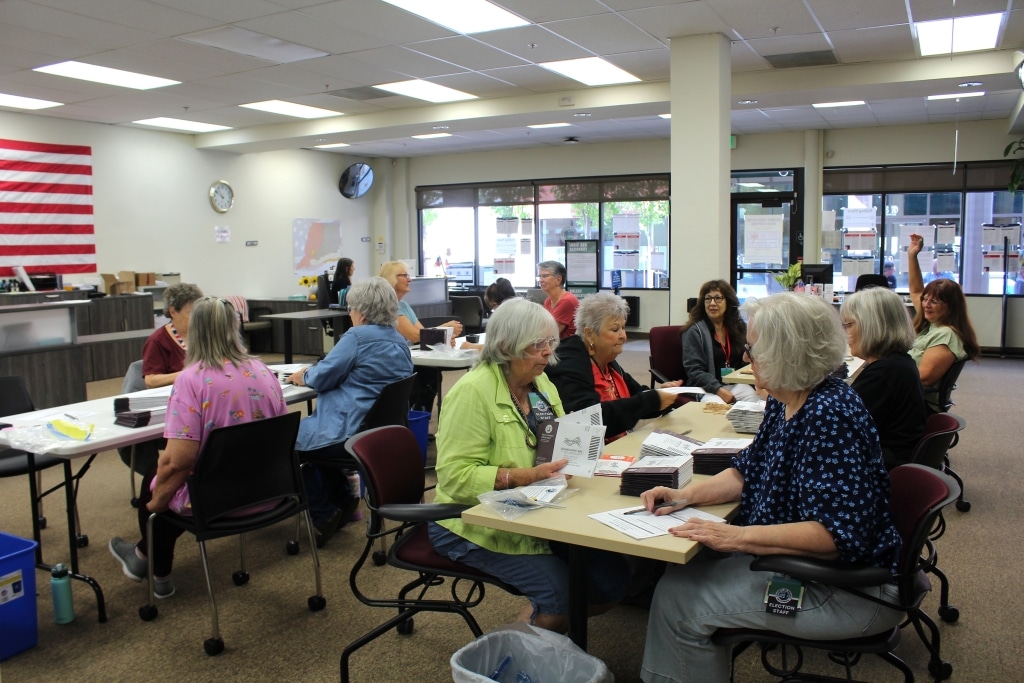
In the late morning after the June 2 primary election, staffers were hustling at the Shasta County elections office to sort ballots to be processed. A group of older women — most wearing comfy clothes or pajamas — worked as they chatted with one another.
By 3 p.m. on June 3, nearly 23,000 ballots had been counted, a number that represents only about 20% of registered voters. At a similar point in the November 2025 election, over 12,000 more votes had been counted than have so far this election. And three years before that, in November 2022, about triple the number of people voted in total, as compared to this election’s current ballot numbers.
Today, Election Manager Anna Rodriguez said that she had “no idea” how many ballots are left to count, adding that the elections office likely won’t have an update until later tonight or tomorrow.
Rodriguez said a report about ballot totals will most likely be released tomorrow. Final election results will take longer to be announced.
The speed of vote counting is a particular concern for this election. Usually, per state law, elections officials have 30 days after the election to count ballots, finalize official results and conduct a required post-election audit. Since Shasta’s primary election also included a special election to fill late Congressman Doug LaMalfa’s seat, the votes for that race need to be certified by June 11, Rodriguez said.
She said she was unsure if there would be two certification processes for this election — one for the special election and one for the primary — and deferred to Shasta Registrar of Voters Clint Curtis for that information. He did not immediately respond to reporter questions.
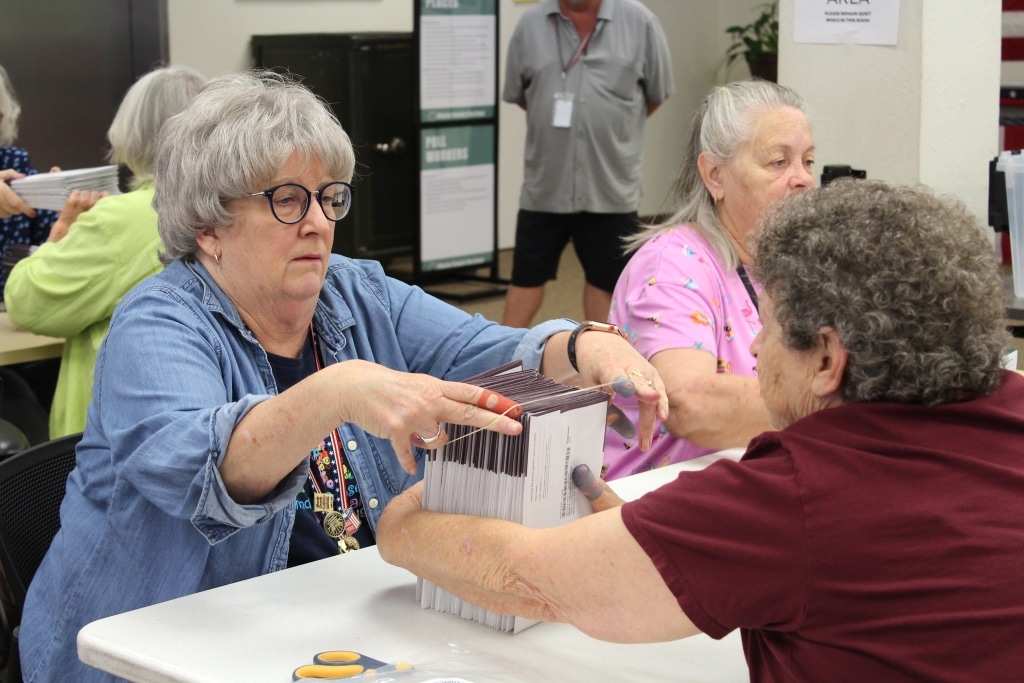
Ballot sorting, one step in ballot processing, contributes to the time-intensive process of reaching vote totals. Rodriguez said this morning that vote-by-mail ballots dropped off to polling places yesterday still need to be sorted to determine if there are any surrendered or spoiled ballots that need to be pulled out before processing.
While the arduous process of sorting ballots is not a unique challenge of this election cycle, the presence of “poll closers” has been. The new role, implemented by Curtis in an effort to expedite ballot processing, tasks poll workers with beginning the sorting process at precincts before ballots are delivered to the election office for processing.
The change was layered on top of other reforms led by Curtis, and the multiple overhauls to polling places’ previous systems seemed to slow the release of vote totals last night. Onsite reporting at polling places documented that several poll closer teams weren’t finished closing until an hour and a half to two hours after polls initially closed.
While the goal was for poll closers to relieve poll workers from certain responsibilities, Assistant ROV Brent Turner acknowledged today that the extra “moving parts” alongside training issues may have slowed down the sorting process, a cost he’s willing to absorb.
“Even if it did take a little bit longer in my mind, if it creates efficiency and or security, then it’s worth another 15 minutes in the chain,” Turner said.
While it’s unclear whether or not the incorporation of poll closers actually improved efficiency, one thing is certain: A power outage did not help.
At midnight on the night of the election, a power strip on the wall of the election office turned off, leaving voting systems still running but disabling cameras and WiFi. The power strip has a timer boxed to it that automatically shuts down at midnight every night, which also posed a problem in last November’s election cycle, according to Election Manager Rodriguez. Facilities workers brought in prior to Election Day were unable to resolve the problem in time for yesterday’s election, she said.
According to Turner, the outage was responsible for a 90-minute delay that put Shasta behind every other California county when it came to initial precinct releases. The final election update for the evening was released around 3:30 a.m., although the issue was resolved much earlier.
Turner added that while the public tends to “crave the quick result,” he believes “accuracy and appropriateness” are more important than speed. “I’m looking for transparency rather than quickness,” he said. “I think we’ve delivered both in this circumstance.”
What do the results currently show?
No new results have been released since around 3:30 a.m. on June 3. Those results show former Shasta Assistant ROV Joanna Francescut leading in the race for county clerk and registrar of voters, with about 56% of the vote. Current ROV Curtis, who’s administering this election, has almost 44% of the vote.
For the Shasta District 1 supervisor race, Redding City Council member Erin Resner is currently leading by about 54%. Trailing her lead is current Supervisor Kevin Crye, with about 39% of the vote. Commercial driver and election activist Richard Gallardo has the remaining 7% of the vote.
The race for District 5 supervisor is more narrow than the others: Anderson City Council member Mike Gallagher is leading with nearly 49% of the vote, with current Supervisor Chris Kelstrom trailing at just over 41%. Retired registered nurse Gary Oxley has only 10% of the vote.
For each of these races, candidates have to receive 50% of the vote plus one vote to win in the primary. If no candidate receives at least that much of the vote, the race will go to a run-off this fall.
Voters so far seem to be in favor of Measure B, with almost 56% voting “Yes” and about 44% voting “No.” If passed, the measure would significantly change Shasta’s local election process.
Have information or a correction to share? Email us: editor@shastascout.org.
Authors

Comments (22)
Comments are closed.
Related Articles
Mobile home residents voice concerns at town hall meeting
Residents from mobile home parks met with park owner Harmony Communities on Monday night to discuss rent increases. Supervisors are considering rent stabilization to address the issue.
“No Kings” rally encourages civic engagement but sees a decrease in participation
Around 1,450 people attended the No Kings Get Out The Vote Rally on Oct. 17 in Redding, according to organizers. In March, about 2000 protestors organized.
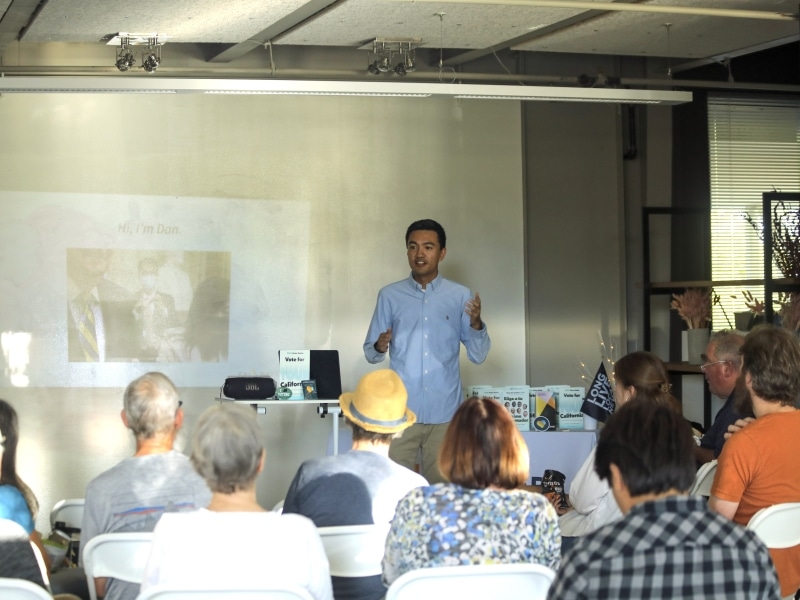
CalMatters, Shasta Scout host local voter information event ahead of midterm elections
CalMatters’ Dan Hu gave a presentation about statewide races and ballot propositions, as well as general information about CalMatters’ election tools. Shasta Scout’s Annelise Pierce presented about local ballot measures.
Observations from a Redding gal now living in Contra Costa County. I’m also a pollworker.
CCC uses pollpads linked to the central voter database with bi-directional syncing. We check in folks for in-person voting and give them their paper ballot. I assume that these are the same poll-pads that have been discontinued by Curtis? One benefit of the pollpads is that voters can vote at any precinct. Another benefit is that the check-in count is live and updated. At the end of the day we record manually the total ballots given to voters —but this info is also uploaded to the Clerk’s office. So the total number of in-person ballots is known by 9pm. We also count the mail-in ballots and provisional ballots (since those are in secure envelopes. That information is on the location report to be quickly updated to the central system.
Office Staff have rough counts available for reporting in short order. No “ We have no idea” answers.
We closed our precinct in 1/2 hr and were in the car to deliver the ballots and reports to the central drop off location.
Are there issues? Yes. Questions? Yes. Drama? Hell yes? But we are supported by a well-tested process used in most CA Counties and Voting staff well versed in law and procedure.
I’m hoping for my beloved home county that a grown-up is elected for ROV.
We used the poll pads for two maybe three elections here in Shasta County. There was a bit of a learning curve but not bad. They made the election experience better for in-person voters, poll workers and the elections office. I was disappointed to see them gone.
We had two closers at our polling site and we finished the latest I had ever finished. Closing up, no matter how organized I try to be, is always a bit chaotic. There is simply a lot to do. This is not something that we workers do every day, weekly, monthly or sometimes not even once a year (and there is always something new or different) so it can be challenging after the long day. There is all the paperwork and security measures but we also have to break everything down and leave the room the way we found it. The last few elections we had been out by 9-9:15p but Tue we didn’t get out until nearly 10 and we did not put away the tables and chairs. I was relieved when I was dropping off our ballots at the clerk’s office to see the line, which meant we were not the only ones. I still racked my brain all night trying to figure out what I could have done differently to make it more efficient. Was it the closers? Ours were very helpful. Could I have assigned the tasks differently? Maybe. Were there new required steps that took more time? Yes, but not that much more. I can’t put my finger on exactly why it took so much longer. I have to say the training was lacking. They were affable and well-intentioned, but the inexperience was apparent. I have worked many elections but as I said earlier they are not often so I always appreciate a good thorough training. Not just to learn any new protocols but also to refresh me on the old. It appears that all of this is moot and the experiment of appointing someone with no experience has failed. I will continue to serve the county as a poll worker and am very curious to see what the November election will be like. Happy 250th, America!!!
This is what happens when you have people who claim to be election integrity experts but have never administered elections. What a joke!
If Shasta County had used the same Dominion-based tabulation approach used in earlier elections, the June 06, 2026, election numbers would likely have been more complete and reported faster, according to Cal Maters.
.
Compared with Shasta County’s own recent elections, there is evidence that this election’s reporting pace is slower and less complete at the same point in time, according to Shasta Scout.
.
Also, Alpine County, Fresno County, Kings County, Tulare County, Placer County, Yolo County, San Mateo County, Stanislaus County, Sacramento County, and Imperial County seem to be ahead of us in reporting, AND all but Alpine use Dominion.
.
If there’s no hankey-pankey down at the ROV office, it’s looking reasonably good for Reasner and Joanna and very good for Measure B.
.
If passed, Measure B could be legally interesting (since it’s completely illegal) and, if the county defends it, could be very expensive for Shasta County taxpayers. That’s okay, right, Clint, Hobbs, and Jones? We’re rolling in the dough up here and can’t wait for you three to lose again.
.
Thanks to all the poll watchers, workers, and Shasta Scout for all the hard work!
Best case sceario for Measure B(ozo) is what happened to Huntington Beach Measure A. The AG and Sec of State immediately filed suit and got it shut down. HB lost an appeal for review at the CA Supreme Court. Local voter ID is a legal dead letter in California. Let’s hope we have a new BOS that refuses to waste money fighting such a lawsuit. Let our local election fabulist fruitcakes put up the money to defend it.
Selah
As much as I dislike Clint Curtis being in charge. I still think it’s fair to give new policies a chance more than just one time to see if they can improve things. Even though I disagree with how he’s handling things or even the choices he has made, I think it would be reasonable to say “ let’s see how it goes over two election cycles.” However, I also don’t think it was broken and didn’t need fixing. I think what I would like to see reported is how pre-sorting at the individual precinct is less of a security issue. How do you keep those ballots safe?
Security concerning the closers was a question many poll workers had too. The closers main “job” was to separate out any ballot that any extraneous marks on it. The machine will not accept them, so technically they were doing that sorting at the polling site instead of the office. We, poll workers, counted the ballots first and then the closers, with someone watching, did their sorting. I was also able to assign them other jobs when we were closing up the poll. In theory it should help things go quicker but it our case it did not.
This is his 2nd election; his first was the November 4, 2025 prop 50 (un)Democratic gerrymander election where he promised same night results (final results did not come until December)
A closer did not show up at my precinct. Poll staff handled very well and quickly.
As of 7:15 am on June 4 the Shasta Elections Results website has not been updated. The last report was June 3 at about 3:30 am. What’s up with that?
There’s no explanation as to why the electrical panel issue was not resolved months ago. And the shortened time frame for tallying votes was known weeks ago and should have been prepared for.
Those shortcomings are no “smear campaign.” At last, voters have fixed a huge and unforgivable mistake made by the BOS.
We now know that it is easy to tell when Brent Turner- he is speaking.
I would like to ask Madison, if Mr Turner has arm movement and wild gesticulating when he is saying the lies? You know, like Trump and Curtis?
It’s 2026; why are we reporting on (only the) women’s attire?
Exactly – very inappropriate to hear about their attire. Please people –
What’s so inappropriate about saying that they were wearing “comfy clothes”?
.
Did you find comfy clothes and pj’s offensive?
Women are still frequently judged based on their appearances in circumstances where men are not. How many times has the Scout commented on the clothing choices of men?
The only time I can recall is when a shirtless Clint Curtis was captured on CCTV moving a safe at the elections office, a description relevant to growing criticism of his unprofessionalism at work.
Perpetuating this vestigial sexism creates inherently unfair societal structures. A woman must not only do a job well, she must look good and be friendly doing it. “Com’on little lady, give us a smile!”
It’s 2026, why are you getting offended over comfy clothes and PJs? 😂
I hope the folks from the Secretary of State and AG offices are staying around to keep an eye on this circus.
Selah
That is NOT a power outage. That’s a dumbf**k completely resolvable error. IF this was an issue last election, they’ve had months to fix it, but they didn’t. Why? Clint Curtis and Brent “Call Tehama County” Turner are a waste of our tax dollars and need to go! Hopefully when Curtis loses this election, I hope he quits, immediately heads back to Florida, and the Board of Supervisors rightly appoint Joanna to complete his term. I say all this as the Shasta County Assistant ROV/County Clerk-retired. What a giant avoidable and embarrassing CF.
Based on the numbers you provided, I would describe Joanna Francescut as the apparent winner and, in ordinary political conversation, many people would likely begin referring to her as the Clerk-Elect. The legally precise status, however, remains contingent on completion of the canvass and certification process.
Isn’t it wonderful how much the Curtis regime has improved things?