
‘Little death bombs’: Illegal cannabis farms poison California’s forests. Who’s cleaning them up?
Even after legalization, illicit cannabis grows continue to pollute California’s public lands. And the contamination, new research shows, lingers.
This story was originally published by CalMatters. You can sign up for their newsletter here.
Law enforcement raided the illegal cannabis operation in Shasta-Trinity National Forest months before, but rotting potatoes still sat on the growers’ makeshift kitchen worktop, waiting to be cooked.
Ecologist Greta Wengert stared down the pockmarked hillside at a pile of pesticide sprayers left behind, long after the raid. Wild animals had gnawed through the pressurized canisters, releasing the chemicals inside.
“They’re just these little death bombs, waiting for any wildlife that is going to investigate,” said Wengert, co-founder of the Integral Ecology Research Center, a non-profit that studies the harms caused by cannabis grows on public lands. For all her stoic professionalism, she sounded a little sad.
For over a decade, Wengert and her colleagues have warned that illegal cannabis grows like this one dangerously pollute California’s public lands and pristine watersheds, with lasting consequences for ecosystems, water and wildlife.
Now, they’re sounding another alarm — that inadequate federal funding, disjointed communication, dangerous conditions and agencies stretched thin at both the state and federal level are leaving thousands of grow sites – and their trash, pesticides, fertilizers and more – to foul California’s forests.

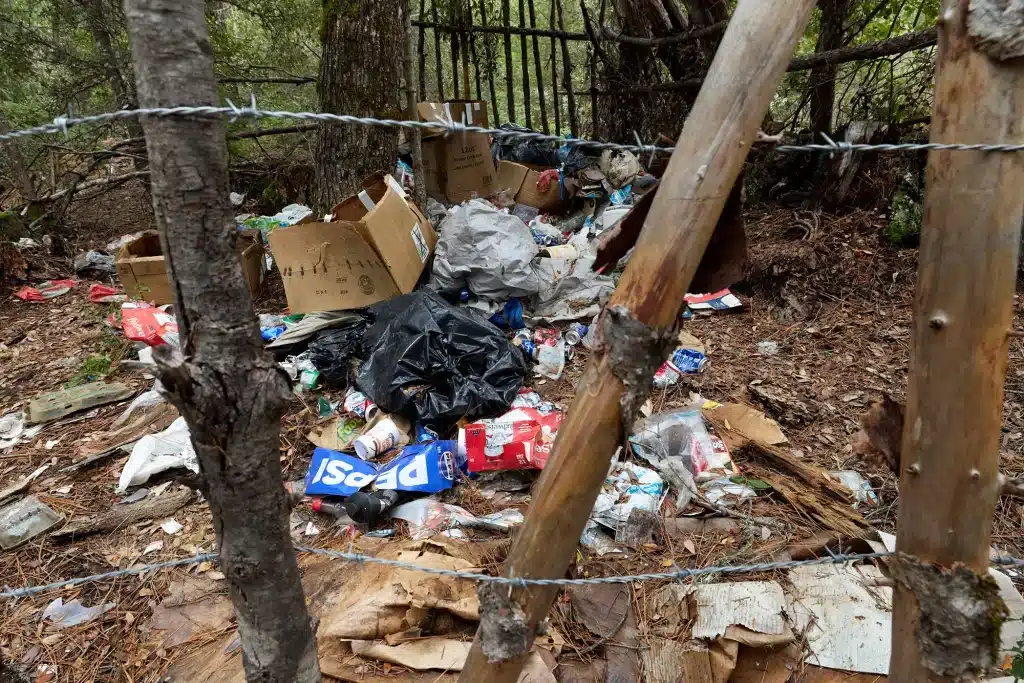
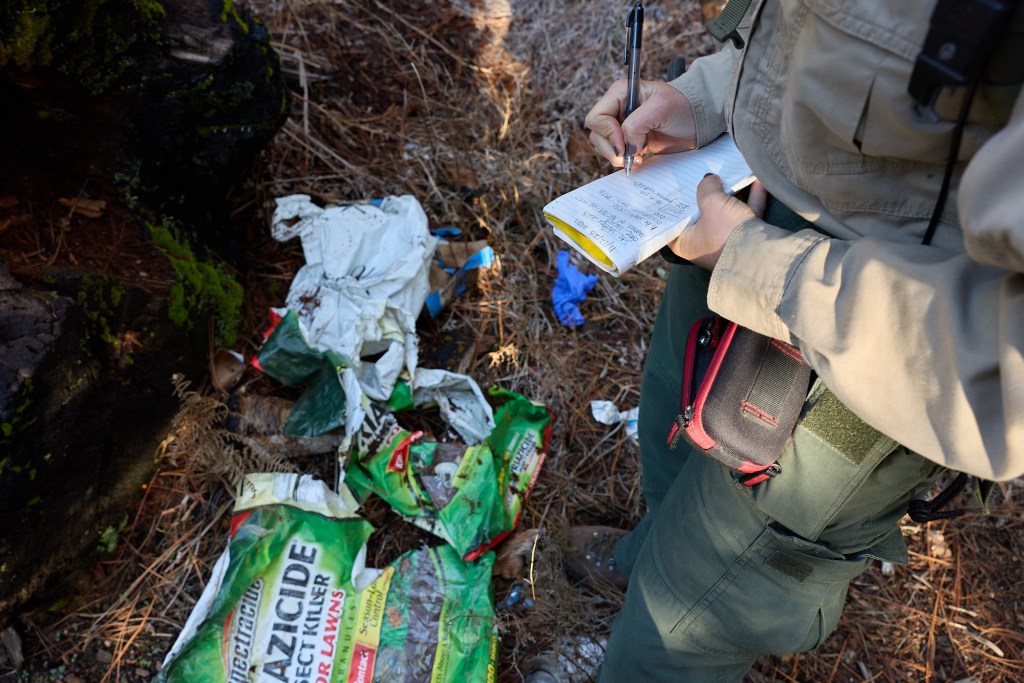
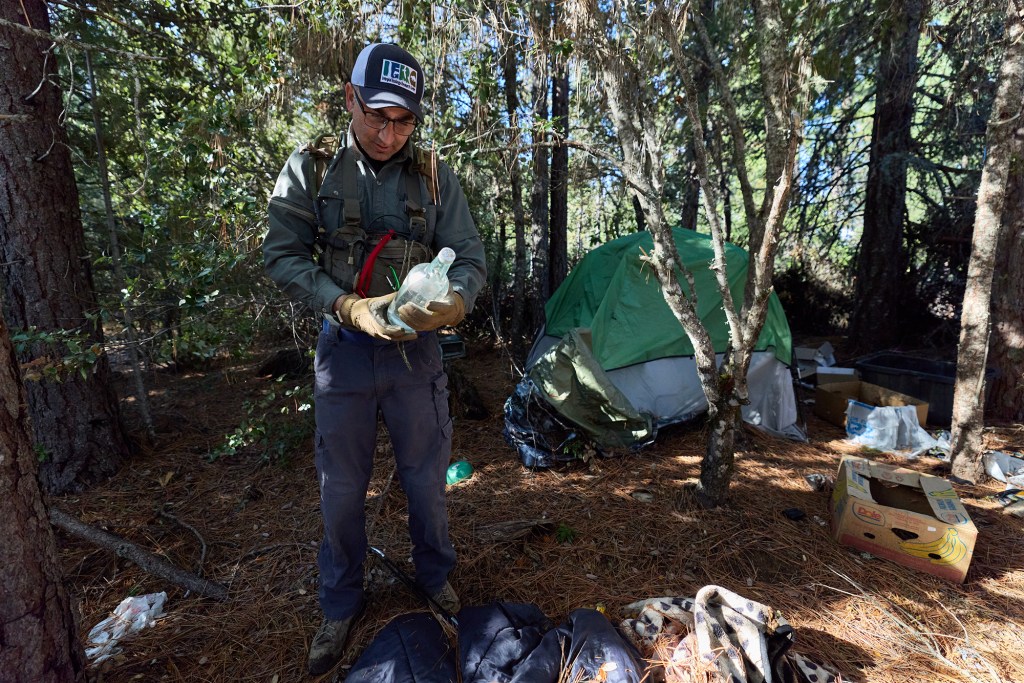
Dozens of fertilizer bags wept blue fluid onto the forest floor. Irrigation tubes snaked across the craters of empty plant holes. The cold stillness felt temporary — as if the growers would return at any moment to prop up the crumpled tents, replant their crop and fling more beer cans and dirty underwear into the woods.
Wengert has tallied nearly 7,000 abandoned sites like this one on California’s public lands. It’s almost certainly an underestimate, she said. Her team knows of only 587 that have been at least partly cleaned up.
No government agency can provide a comprehensive count; several referred CalMatters back to Wengert’s nonprofit for an unofficial tally.
Most of the sites Wengert’s team identified are in national forests, where “limited funding and a shortage of personnel trained to safely identify and remove hazardous materials” is driving a backlog in clean ups, a U.S. Forest Service spokesperson told CalMatters via an unsigned email.
The federal government, the spokesperson said, has dedicated no funding for the forest service to clean them up. And it’s leaving a mess in California.
A new playbook
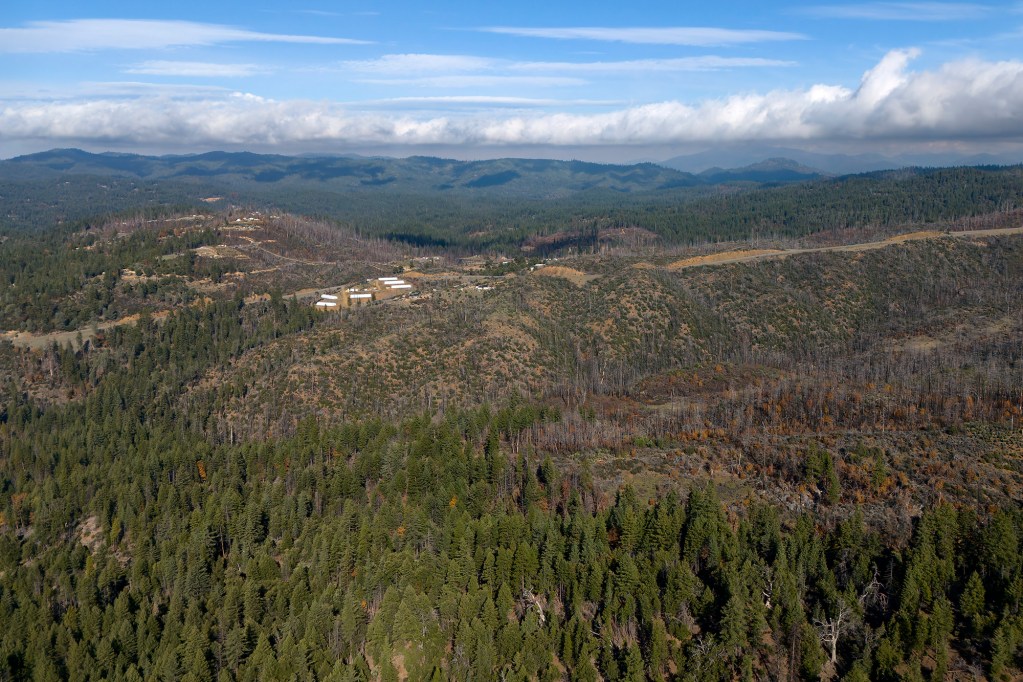
The federal government owns nearly half of the more than 100 million acres in California. But it’s California’s agencies and lawmakers taking the lead on tackling the environmental harms of illegal grows — even as the problem sprawls across state, federal and privately managed lands.
The California Department of Fish and Wildlife’s policy is to clean up all grows spotted on its 1.1 million acres of wildlife areas, ecological reserves, and other properties, officials say.
Staff assist with clean ups on federal lands “when asked,” said cannabis program director Amelia Wright — typically on California’s dime. But, she said, “That’s not our mandate.”
Fees and taxes on California’s legalized cannabis market fuel state efforts — supporting the California Department of Fish and Wildlife’s cannabis program and funding tens of millions of dollars in grants for rehabilitating places damaged by cultivation. These grants can cover clean-ups and sustainable cultivation projects, or even related efforts like fish conservation.
The department has helped remove almost 350,000 pounds of trash and more than 920 pesticide containers from grows on public lands over nearly a decade.
But former Assemblymember Jim Wood, a North Coast Democrat, said that as he prepared to leave office in 2024, progress on clean ups was still too slow.
“It doesn’t reflect what I see is the urgency to watersheds, and the water and the people that are served by them,” he said.
In 2024, lawmakers passed Wood’s bill directing the Fish and Wildlife department to conduct a study to inform a statewide cleanup strategy for cannabis grows. The law requires the department to provide regular reports to the legislature about illegal cultivation and restoration efforts on lands both public and private.
To Wright, that’s a path forward, however prospective it may be.
“It just feels like such redemption right now for many of us,” Wright said. “It’s a one of a kind program. So we didn’t have a playbook — we’re still creating it.”
But the study, which Wengert’s organization is conducting on the state’s behalf, isn’t due until next year. Meanwhile, the bloom of illicit pot grows on private land has been demanding California’s attention, a growing problem since voters legalized cannabis in 2016.
“It’s like whack a mole. They pop up in a new location, and then we have to go there — but the impacts are occurring across the landscape,” said Scott Bauer, an environmental program manager with the Department of Fish and Wildlife’s cannabis office.
The California Department of Justice told CalMatters it recently identified a “substantial increase of illicit cannabis cultivations on or adjacent to public lands.” Of the 605 sites where a multi-agency state and federal task force ripped out illicit cannabis plants, roughly 9% were on public lands — up from an average of 3 to 4%.
“Everybody thought with legalization that a lot of these problems would go away,” said Wood, the former assemblymember.
But, he added, the sites remain. “It’s a ticking environmental time bomb.”
And the contamination, new research confirms, lingers.
‘This site will sit on this landscape’
On a cold November morning, down one dirt road and up another, ecologist Mourad Gabriel led a safety briefing at the grow site in Shasta-Trinity National Forest.
Gabriel, who previously spearheaded a U.S. Forest Service effort tackling trespass grows on public lands, co-founded the research center with Wengert and now co-directs it with her. He’s also her spouse, and a foil to her calm watchfulness — dismayed by the state of the forest one moment, and bounding off to investigate an interesting mushroom or animal scat the next.
“Please don’t push the red shiny buttons, or lick the big pink things,” Gabriel joked at the mouth of a well-worn path growers had carved into the woods. (Carbofuran, a dangerous and illegal pesticide often found on grow sites, is bright pink.)
The team, Gabriel explained, wasn’t there to clean up the grow. They didn’t have the money for that. Instead, he said, shouldering his backpack and strapping on a first aid kit, they were there to document the contaminants as part of a U.S. Forest Service-funded investigation into wildlife around cultivation sites.
“This site will sit on this landscape until someone acquires some level of funding,” Gabriel said. “And no one can really push it, until we actually get that data.”
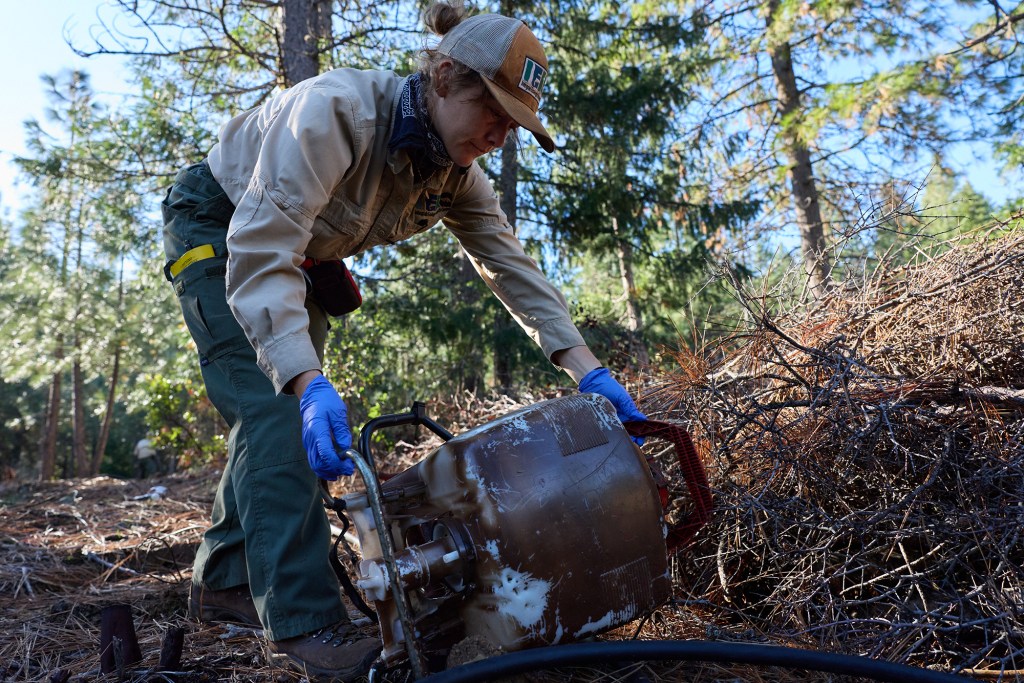
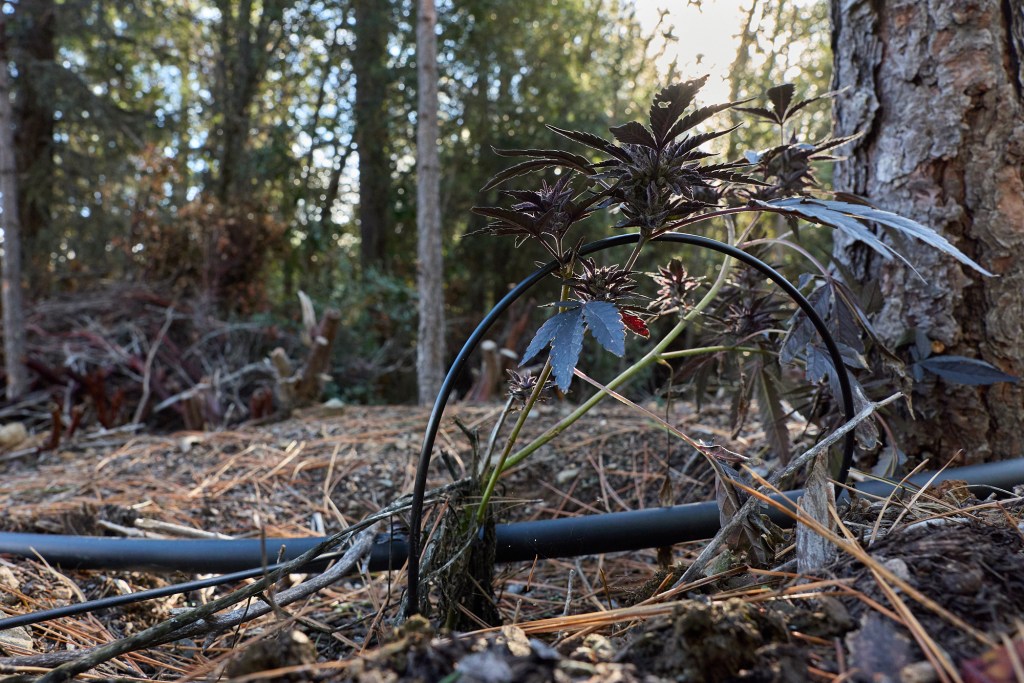
Wengert and Gabriel have spent years collecting data at grow sites like this one. They’ve found carcasses of creatures so poisoned even the flies feeding on them died, and detected dangerous pesticides in nearby creeks more than a year after raids.
In recent work they published with scientists at the U.S. Geological Survey, the team found that illegal grows pulsed pollutants from plastic, painkillers, personal care products, pot and pesticides into the soil that could be detected months or even years later. Some contaminants also showed up in nearby streams.
The pollutants diminished over time — absorbed into the landscape and washed into waterways. By the time the researchers tested for them, the concentrations had declined to levels lower than those found in agricultural soils.
But, they point out, remote habitats and sensitive headwaters are not where these chemicals are supposed to be. Past a marshy flat cratered with holes and piled with poison-green insecticide bags, Gabriel, Wengert and ecologist Ivan Medel trailed an armed U.S. Forest Service officer to a massive trash heap cordoned off by barbed wire.
Medel wedged himself through the strands and handed empty fertilizer bags dripping blue liquid out to Gabriel.
Force-feeding waterways the excess nutrients in fertilizer can upend entire ecosystems and spur algae blooms. The site is in the greater South Fork Trinity River watershed — vital, undammed habitat for protected salmon and other fish species.
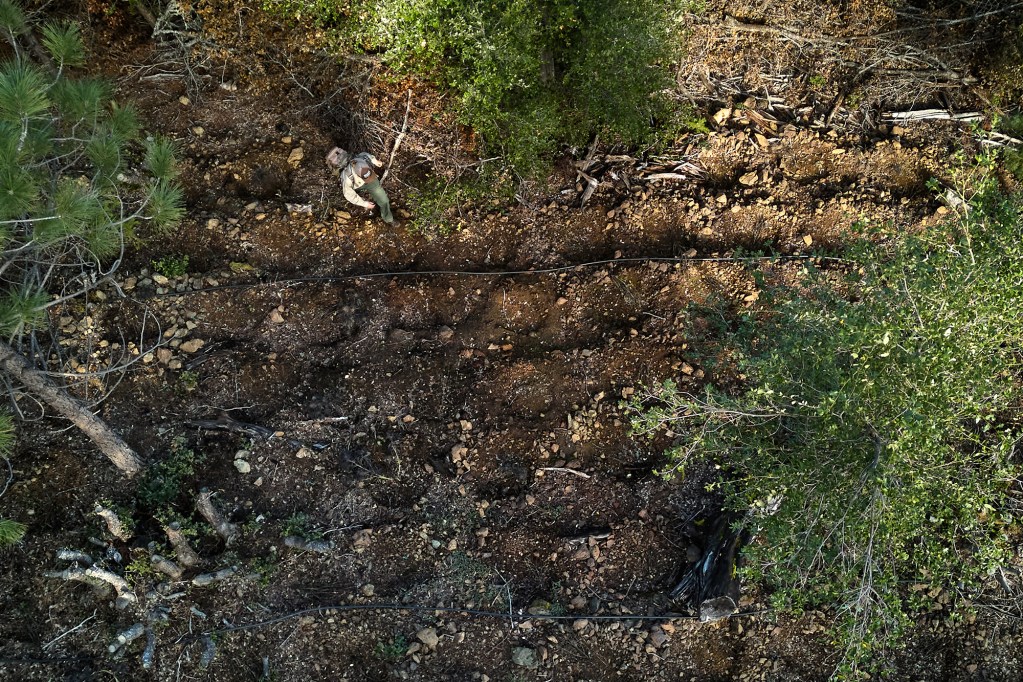
“That was pretty nasty,” Gabriel said, as one bag spilled liquid over his gloved hands. He counted up the haul. “Twelve bags right there.”
By day’s end, the team discovered enough empty bags and bottles to have held 2,150 pounds of fertilizer and more than 29 gallons of liquid concentrate. All of that, the growers had poured into the land.
A federal void
In 2018, a federal audit lambasted the U.S. Forest Service for failing to clean up — or even document — trespass grows in national forests.
The agency was finding and eradicating cannabis grows in national forests effectively. But its failure to consistently clean them up, the audit said, put “the public, wildlife, and environment at risk of contamination” and could allow growers to return more easily.
Little has changed. From 2020 through 2024, when Gabriel worked for the agency, a spokesperson said the Forest Service “prioritized reclaiming sites over investigating active grows.”
But the agency said it still has received too little funding and has too few personnel trained to work with often hazardous materials. And the backlog persists. How big it is, the Forest Service wouldn’t say. After declining an interview request and taking two months to reply to emailed inquiries, a spokesperson said CalMatters must submit a public records request.
The Forest Service now is shifting the responsibility for cleanups to individual forests. That, too, contributes to the backlog, the spokesperson said.
U.S. Rep. Jared Huffman, a California Democrat and ranking member of the House Natural Resources Committee, said he has tried repeatedly to direct more funding to cleaning up trespass grows on federal lands, but with little success in Congress.
“We have tried just about everything,” said Huffman. “It’s clearly not enough.”
Now, under the Trump administration, the Forest Service is even more understaffed. A spokesperson said while law enforcement staffing “has remained steady,” roughly 5,000 non-fire employees “have either offboarded or are in the process of doing so” through “multiple voluntary separation programs.”
Huffman put it more starkly. “They’ve been gutted,” he said. “The Forest Service right now has a sign on the door that says, ‘We’re out of the office. We’re not sure when we’ll ever be back.’”
Cleaning it up
The Shasta-Trinity grow stretched for more than 6 acres through national forest land. Trash, and the smell of pot, were everywhere.
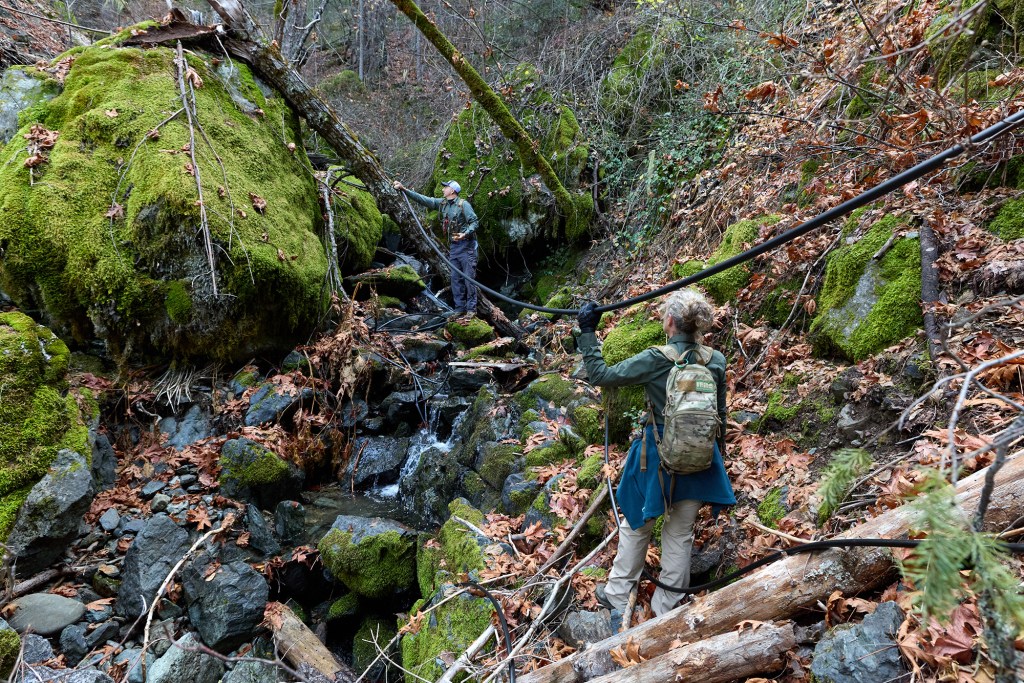
Law enforcement officers had removed the mouth of the irrigation tube diverting water from a nearby creek, but all the piping remained. It slithered over downed trees, past the craters of another abandoned grow to a waterfall where leaves and black tubing snarled in the rocks.
Gabriel clambered up the waterfall, where he discovered a sock and a plastic bottle with the top sliced off — a makeshift filter the growers used to keep the line clear of debris. He hung the bottle on a tree branch, like a ghoulish Christmas ornament.
Few organizations are qualified to do science-informed cleanups, and none work as widely as Wengert and Gabriel’s.
California’s Cannabis Restoration Grant Program is paying the team more than $5.3 million to conduct the legislatively mandated study on cleaning up grow sites, and also to train and support tribal teams and other organizations to do this work.
The study, and the training, include best practices for handling and disposing of hazardous waste, Gabriel said. More teams means more competition for the pot of state-allocated money, but he wants more allies in the fight.
“Until someone cleans it up, it stays out here,” Gabriel said from his perch in the waterfall, surrounded by a tangle of black irrigation pipes. He expected it could take years.
But that’s not what happened.
Two weeks later, the California Department of Fish and Wildlife choppered away nearly 1,500 pounds of trash, 4,000 feet of irrigation pipe and 7 pesticide containers — restoring the rugged, remote forest.
The department had offered to help out the U.S. Forest Service and take the lead on the clean up, with its own helicopter, on its own budget, according to spokesperson Sarah Sol.
Months later, when Gabriel learned about it, he was shocked — and concerned. Sol said that fish and wildlife staff did not encounter any banned or restricted pesticides, and all had masks and nitrile gloves available to them.
But Gabriel’s team found residue in the pesticide sprayers on the hillside from a class of chemicals that includes banned and dangerous carbofuran. He worried that the clean up team could have unknowingly put themselves and others at risk.
“There is a proper way to do it, and there is a cowboy way to do it,” Gabriel said.
It’s one site down — one patch of forest cleared. But thousands like it remain, littering California’s landscape.
This article was originally published on CalMatters and was republished under the Creative Commons Attribution-NonCommercial-NoDerivatives license.
Author

Comments (9)
Comments are closed.
Related Articles
Redding has eliminated more than a dozen vacant police and fire positions and will close Fire Station 3
The changes were made to increase city savings amidst a struggling budget. Council members were united on fire department changes, but two were opposed to some of the police department cuts.

Meet Madison Zimmerman for Shasta County Office of Education Trustee
Madison Zimmerman is running for one of seven seats on SCOE. She refers to herself as a proud product of Shasta County Schools and plans to bring her skills developed both inside and outside of the county to expand opportunities for students to thrive here in Shasta.
Accountability vs. micromanagement: Shasta board debates its role during wide-ranging discussion
Supervisor Matt Plummer was accused of micromanagement for asking for data in response to an assessment of fire services. Meanwhile, Supervisor Kevin Crye spent nearly thirty minutes questioning a decision by the HHSA director with no such accusation sent his way.
Let the public help! I read and re-read this article. Is there no place for trained volunteers to assist with this heart-breaking, vital work?
Ugh. Weed is such a disgusting drug.
Landowners who pollute waters of the state with their own illegal cannabis grows are held to account with enforcement actions. Find me a case analogous to illegal grows on federal lands where the state forced a sale of privately held land due to failure to clean up after an illegal grown that was unauthorized by the landowner.
Also, your analogy doesn’t account for the fact that the federal landowners in question have been effectively gutted by the Trump Administration of any ability to systematically address the issue.
Please re-read my comment. Many landowners in our community have personally experienced the fall out associated with damage done by trespassers, and who is held responsible for the cost of the clean up. It’s a very rare day that the people who do this type of damage are held responsible for cleaning up the damage they caused. With a very few exceptions, private property owners are held responsible for clean up. The same standard should be applied to all.
Please re-read my comment. I wasn’t asking if private landowner are or are not legally responsible for the toxic dumps left by trespassers. I was asking if the State actually follows through on the punishments you described that are typically applied to landowners who do the polluting themselves. I’m asking for an example of a landowner who was victimized by trespassers, left holding a toxic mess, and then strong-armed by the State into cleaning it up. Has the state gone through with threats to auction off the lands of landowners who can’t afford to do a clean-up? That’s the analogy: Federal landowners and private landowners victimized by polluting trespassers.
I’m guessing the even-handed standard already applies. I’m guessing that the State reserves its sharpest spears for landowners who were the offending growers/polluters. Prove me wrong. Let’s see links to articles demonstrating the State’s heavy hand on private landowners who were victimized by trespassing growers.
https://wildlife.ca.gov/Enforcement/CalTIP
When I served on the State Board of Forestry and Fire Protection, we tried to bring to light the environmental crisis our natural resources were being destroyed by these grows. It was not embraced by the Brown administration and still is not being funded adequately. That is why my time as a county supervisor, I pushed hard for a focus on illegal grows. The one question I have always asked is “and why are we allowing humans, especially young people, to ingest a product that has had hazardous chemicals used to encourage growth”. Aren’t we putting our youth at risk for future health problems? This is where ICE should be….eradicating these illegals grows and stopping the destruction of our watersheds and forest land.
If this happened on my property, I would be held responsible for the clean up any number of city, county, state and federal agencies. I refused, or was unable to comply, there would be notices, warnings, court orders, fees, fines and ultimately a forced sale. It’s not clear to me why the policies, rules, regulations and laws regarding this kind of situation are not applied if the owner is a government agency. If the Feds get a waver on cleaning this up because it’s expensive or inconvenient, we all should get a duff when it happens to us. Common sense would suggest the primary responsibility for cleaning this up rests on those who broke the law and left the mess. Has the court found them guilty and fined them accordingly to make restitution for the damages? Failing their ability to pay, has the court required that they clean up the mess they made? Failing their ability to clean up the mess they made, are they in jail while the owners suffer through recovering from their actions?
Exactly! The laws apply to honest taxpaying citizens, but not to the government that makes the laws or the criminals who disobey them. My brother in law was in Forest Management years ago and was told that there were certain areas to avoid by the owners of the land. They also knew what was happening, but were powerless to stop it.