
Location change for controversial corrections campus earns applause, more questions for Shasta sheriff
In a surprise announcement yesterday, Sheriff Michael Johnson pivoted on the controversial location for a proposed correctional facility. Johnson says that he is moving forward with the project at a new, undecided location, this time with more transparency. The county board has not weighed in.
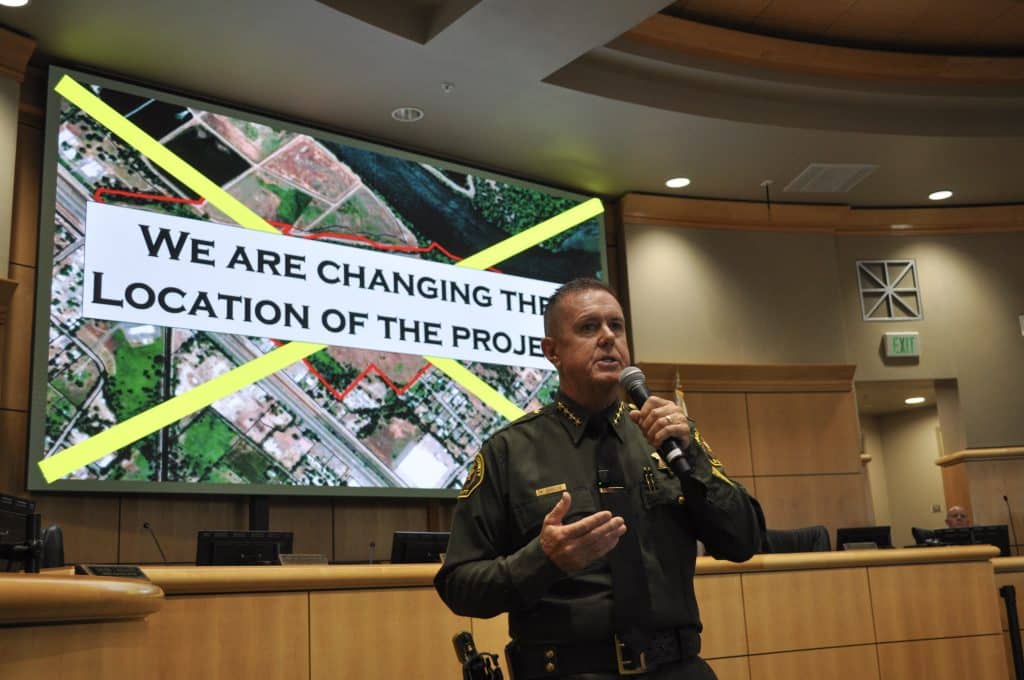
Last night, cheers erupted in the Board of Supervisors chambers as Shasta County Sheriff Michael Johnson revealed that he was unilaterally changing the location of a proposed “Corrections and Rehabilitation Campus.”
The Sheriff’s Office hosted a community meeting yesterday for Johnson to present on the proposed correctional facility, which had been slated to be built off Eastside Road in Redding. That location had garnered much pushback from community members particularly those in the River Ranch neighborhood, many of whom showed up yesterday and filled the chambers, expecting to voice their concerns.
Johnson began the meeting by screening a video outlining the three facilities that could be built as part of the proposed campus. It’s expected to include space to expand the county’s alternative custody program, along with buildings for what’s being called the Male Community Reentry Program or MCRP. Eventually, as the county acquires enough funding, the site could also be used for a full-fledged jail to replace the county’s aging infrastructure downtown.
No numbers were shared for how many might be accommodated through the expansion to alternative custody, a work program which provides diversion from incarceration for those in the criminal justice system. The MCRP is slated to hold about 100 inmates, 60 of which would be sent to Shasta from the state prison system in the final years before their release, and the other 40 of which would come from Shasta’s Jail, partially relieving space concerns at the current facility.
“We have a dilemma here in the North State,” Johnson said, explaining that the jail currently operates at maximum capacity amid an ongoing “influx of mental health type of populations.” That reality, he said, means relatively little accountability for low-level offenders, who could be housed either in newly-opened beds in the jail or as diverted to the expanded alternative custody program once the new campus is built.
“I could currently empty probably a third of my jail into these programs and make room, and have that much more room to lock up people,” Johnson added.
Together, the three phases of the facility would allow for opportunities for vocational training, skill development, and daily engagement to strengthen public safety and expand rehabilitation opportunities, Johnson’s video overview of the project noted.
In public comments, he explained that while he’s not a fan of rehabilitation for everyone, he wants to provide opportunities for those who can be rehabilitated to do so, in order to promote reintegration back into society, something he emphasized would lower recidivism and increase safety.
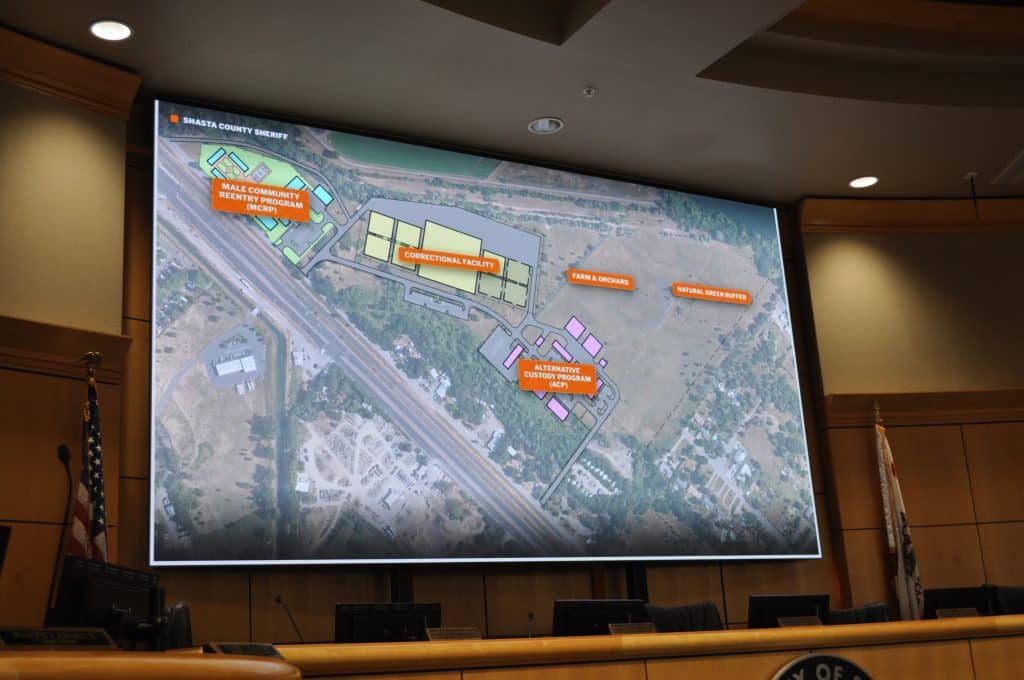
Over the past year, community members have protested against the proposed correctional campus, mostly in regards to its location. The discourse, which has included both a lawsuit and online campaigns, has been centered around concerns about public safety in a nearby neighborhood, as well as environmental impacts from the site’s proximity to the Sacramento River.
About 15 minutes into the meeting, Johnson acknowledged how thoroughly he had heard those concerns before shifting gears to make his surprise announcement.
“If this is not your favorite slide in my whole presentation, I don’t know what will be,” he said, as he switched to an image which showed the proposed campus map with a large X over it and the words, “WE ARE CHANGING THE LOCATION OF THE PROJECT.”
The announcement caused many members of the audience to burst into applause and cheers, with some even breaking into happy tears.
Johnson said strong community opposition as well as the potential for negative impacts on the River Ranch community had contributed to his decision. He also cited a preliminary field biology report he had received on possible environmental impacts to the land. Without providing specifics, the sheriff noted that his bachelor’s degree is in biology and wildlife management before saying that early environmental results had made the path forward clear and encouraged him to finalize his decision over the weekend.
“If I had to do [environmental] mitigation efforts just based on what I’ve got now, I would have to push those buildings to border your subdivision and along the riverfront, which is completely unacceptable,” he said, “which was really the straw that broke the camel’s back.”
Throughout the rest of the meeting, Johnson emphasized that the county was still pursuing the project, just not at the Eastside Road location. He said that he does not currently have a new location in mind but will be looking to acquire private land which will increase the cost of the project but will open new opportunities for where it could be placed.
Retired Sheriff’s Office Captain Jeff Foster — who was described as the campus’ project manager — also spoke, sharing additional details. Foster outlined the various treatment and vocational programs the expanded ACP would include, as well as how the MCRP would collaborate with 13 other counties to serve participants across the North State, who would be transported back to their home counties after the program.
Questions were raised by the public about what they saw as the sheriff’s lack of transparency during the project development process, as well as how such a campus might impact both surrounding communities and the environment in another location. Johnson responded by stating that he plans to be more transparent with the public moving forward.
“I had a big learning curve on this one, and as I go forward and try to identify some other properties, I’m going to do things a lot different,” he said, “and do some outreach and try to make sure that I don’t end up with the same emotionally charged situation I did.”
Shasta County Supervisor Matt Plummer, who has been deeply involved in efforts to bring the MCRP to Shasta, spoke briefly at the start of yesterday’s meeting before the surprise announcement was made. Last night, he posted a video on his social media stating that he was only informed of the location change an hour before the meeting began. In that video he said he can’t say whether he agrees with the decision, noting that he hasn’t yet seen the environmental impact report Johnson cited.
While Plummer and other county supervisors were instrumental in the process of leasing the Eastside land for the project, and approving a contract for site design, the decision to change locations for the project did not include the board’s input. The county has not yet responded to a request for comment on why the sheriff made the decision unilaterally.
Moe Shimizu is a student at Yale University. She’s reporting for Shasta Scout as a 2026 summer intern, with support from the Nonprofit Newsroom Internship Program — created by The Scripps Howard Fund and the Institute for Nonprofit News.
Do you have a correction to share? Email us: editor@shastascout.org.
Author

Comments (9)
Comments are closed.
Related Articles

For Shasta, collaboration needed to solve physician shortage
Political division is a barrier to improving healthcare access in Shasta County. Experts say solving the entrenched problem requires working together.

Meet Rebecca Anne Miller for Redding City Council
Three seats are up for grabs on the council this fall, and nine candidates are running. Miller is a substitute teacher with the Shasta County Office of Education and a caregiver with In-Home Supportive Services, or IHSS.

Gallery: Downtown Redding hosts fourth annual Hispanic Heritage Month celebration
Red Bluff-based entrepreneur Araceli Gutierrez collaborated with Viva Downtown to bring the celebration of Hispanic Heritage Month to Redding.
Does this mean we will not be building the mental health treatment center for justice involved individuals? Matt Plummer said we could easily fit a 600 bed facility on this property in addition to the jail. I understand up to 30 percent of the beds would have been set aside for Shasta and 12 other northern counties. This would have been paid for by the state; what a shame.
It’s all for a money laundering scheme. Johnson is not only blackmailed, he’s a “pipe Hitter”.
Sheriff Johnson made the right decision. I cannot imagine any recent Sheriff taking responsibility and changing course this way. He has acknowledged problems with the jail, and this facility was intended to improve jail conditions. The project was supported by the Board. It’s a good idea but the wrong location.
During a board meeting, one River Ranch resident suggested an alternative location on county owned property along Clear Creek Road. Not sure if that exists and is a viable site but the commercial/industrial businesses there would likely be more amenable to these proposed facilities than residential neighborhoods. Then there was the land west of Stillwater Creek and south of Hwy 44 that was considered in the past. Glad prime riverfront property will not be used for this.
While considering the present political climate in the immediate vacinity saving face and retirement are synonymous.
Art of War
“In that video (Plummer) said he can’t say whether he agrees with the decision, noting that he hasn’t yet seen the environmental impact report Johnson cited.”
.
I don’t think there’s been an environmental impact report (EIR) prepared for the project. Probably a biological resources report that included a constraints analysis and preliminary mitigation measures.
.
The proposed project is going to encounter NIMBYism wherever it goes. At some point the County will have to stiffen its back against that inevitable opposition, or the project won’t happen. Putting it at Stillwater Business Park might stifle efforts to attract businesses, There are brownfield parcels—abandoned industrial/timber mill sites—on the 273 corridor and elsewhere that might work. The Red Bluff campus of Shasta College was built on such a site.
Now to find a mutually agreeable location, away from neighborhoods.
It would help if the people in charge would stop importing out of county sex abusers and criminals.
This constitutes our own version of urban legend: “The people in charge are importing perverts, scofflaws, ne’er-do-wells, flops, crazies, tweakers, nodders, litterbugs, and other serial recidivists from elsewhere.”
.
No, Joe. The data show that the great majority of them are home-grown. They’re not being imported by our leaders, and they’re not coming here of their own volition because of freebies we hand out relative to other places in sunny California they could choose. They’re not here for the temperate weather, either—spend the day outside today and tell me you’d rather be living rough here than on the coast.
.
Claims that they’re outsiders is just another way for us to shirk responsibility and blame others for our failings, which are manifest.
They “recruit” those criminals purposely through “Redding Crime 2.0, “Redding Patriots and the soj51 KCNR Kent/Rapoza LLCs like Stake in Norcal and the Cottonwood Militia Clendenen, Knight, Zapata, Lane etc little girls camp crye pipe hitters and bunker lovers kkklub.