
Native community marches through Burney to raise awareness for the missing and murdered
May 5 is Missing and Murdered Indigenous Peoples Day. Yesterday, members of the Pit River Tribe and Redding Rancheria organized prayer walks in Burney and Redding to raise awareness for the systemic crisis.
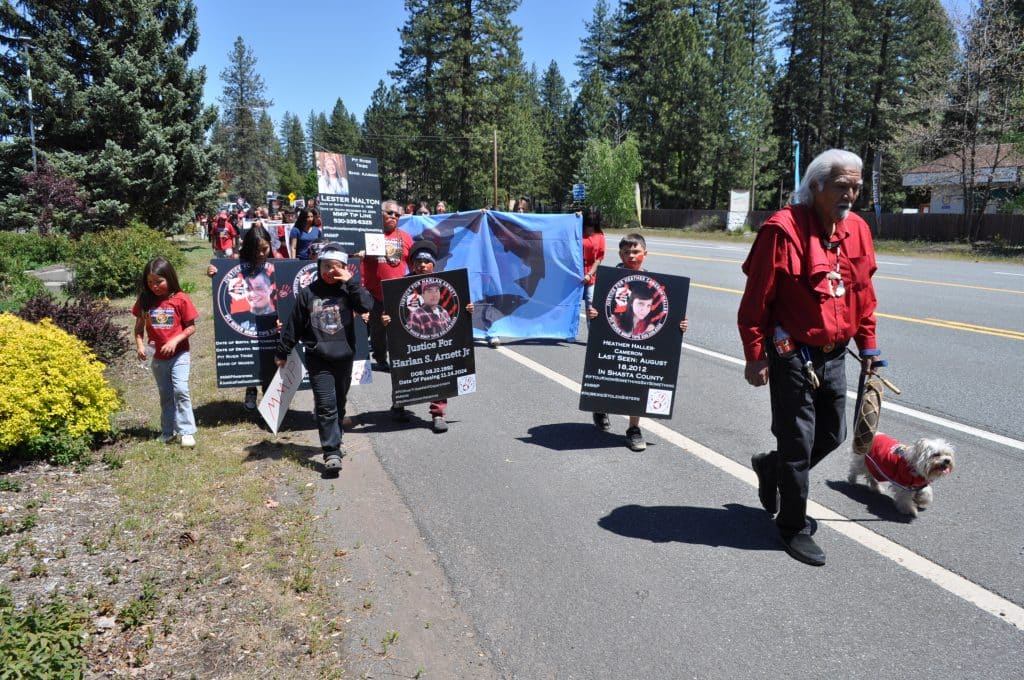
Cars, logging trucks and a tractor the size of bulldozer roared by as about 100 schoolchildren stood, corralled by their teachers, off the side of Highway 299.
The students — who were from Fall River Elementary, Burney Elementary and Burney Junior Senior Highschool — were all dressed in red, many with red paint handprints stamped across their mouths. On the backs of their matching T-shirts was the phone number for the local Missing and Murdered Indigenous People tip line: 530-335-6325.
Annually on May 5, Native communities around North America raise awareness about the disproportionate rates of murders and disappearances among Indigenous communities. MMIP walks are also used to highlight a related topic: the systemic negligence that many Native communities face at the hands of law enforcement when attempting to seek justice for their loved ones.
In Shasta County, demonstrators gathered in Burney to march through the intermountain town, demanding justice for tribal members whose murder cases remain unresolved, including Pit River Tribal member Nick Patterson, who was last seen alive just after New Year’s in 2020. Later in the evening, a similar prayer walk, led by members of the Redding Rancheria, took place at the Sundial Bridge.
According to recent data from the Centers for Disease Control and Prevention, homicide is among the leading causes of death among Native communities. Historically, research has shown that investigations into the disappearances of Indigenous women and girls in California are far less likely to be solved when compared to those of the general population.
These national statistics are felt locally. Amanda Geopfert, the MMIP coordinator of the Pit River Tribe who helped organize the prayer walk, said that “pretty much every single person here has been touched one way or another by MMIP.”
The march started near the Grocery Outlet in Burney and ended at the Pit River Casino about two miles away. Before it began, Pit River Tribal member Theodore Martinez led a prayer alongside Geopfert and another Tribal member, Renee Gemmill. Pit River leadership also shared a few words about the MMIP crisis.
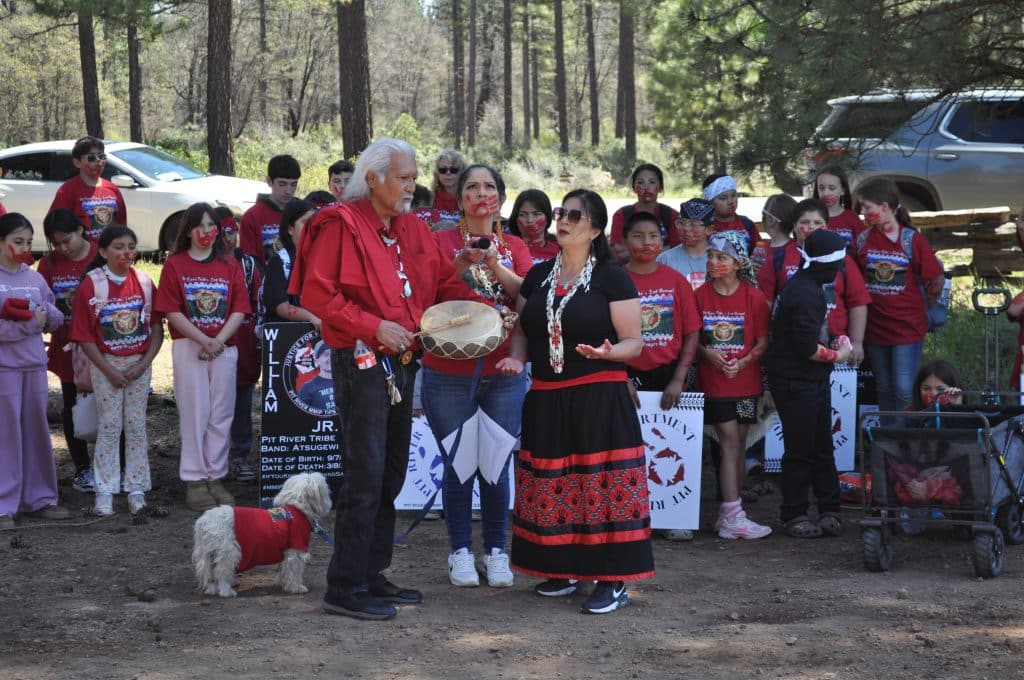
Speaking briefly, Martinez told the story of his own brother, who was murdered in 1992, his body disposed of on the railroad tracks. It’s still a cold case, Martinez said. Addressing the students directly, he advised the young crowd that it would fall upon them to continue the fight when elders like him are gone.
Pit River Chairman Yatch Bamford acknowledged how with many cold cases — or in missing person cases in which remains are never recovered — families undergo a simultaneous tragedy after the initial shock of losing a loved one.
“That silence has been as traumatic as the loss itself,” he said.
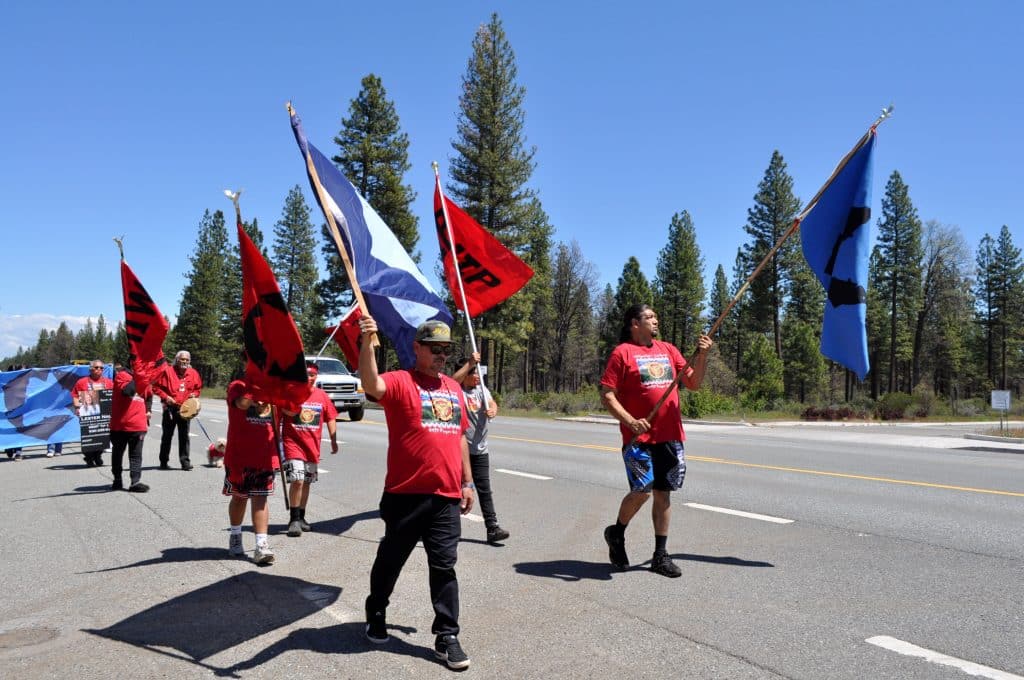
By and large, it was the students who led the march down Highway 299, Burney’s main drag, with just a handful of adults chaperoning the sea of red. They yelled call-and-response slogans like “No more stolen relatives,” and “What do we want? Justice! When do we want it? Now!” The demonstrators also held signs and banners with the faces and names of the missing and murdered as bystanders showed their support, with some honking from their cars or coming out of their homes to join the group.
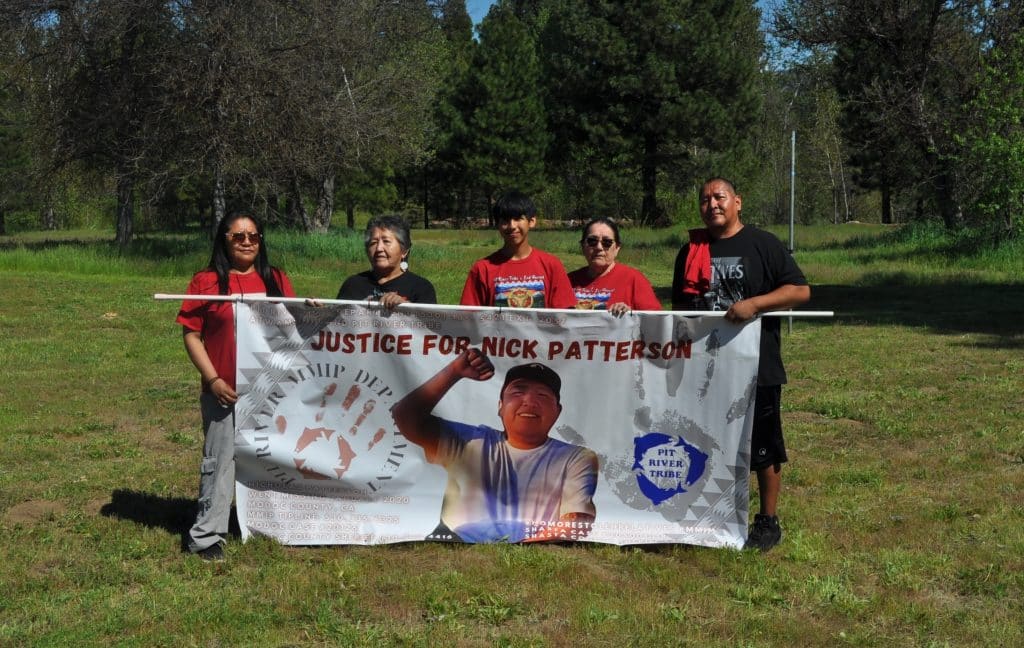
Among the demonstrators was the family of Patterson. His mother, Lynette Craig, was pivotal to the investigatory process into his disappearance, as she proactively searched for answers — seeking out and procuring her son’s DNA and dental records, which were used to identify bones discovered by a community member long after his disappearance.
The anguish of his loss was compounded by continued unanswered questions for Craig last year, when part of her son’s remains were misplaced while being transported from a forensic lab to the Modoc County Sheriff’s Office. How law enforcement both in Shasta and Modoc have handled the case has been a major politicizing event for the local Indigenous community.
Yesterday, Craig said she was grateful for the wider community’s continued support for Nick, adding that she was particularly pleased to see a number of students participating in the prayer walk.
Morning Star Gali, the founder of the grassroots organization Indigenous Justice, also attended the event. She shared her perspective on how the MMIP movement intersects with other political issues that affect her community. If the goal of MMIP advocacy is to demand that law enforcement take more initiative to solve missing persons cases and bring their relatives home, a parallel demand could be made about repatriating, or rematriating as Gali put it, the human remains of Native ancestors, whose bones are currently part of the collections of anthropology departments at universities like the University of California, Berkeley.
Gali also addressed the removal of dams in the Klamath River, saying such dams “have kept our salmon relatives incarcerated” for 100 years. Since the removal of the dams in recent years, vegetation and fish have returned to waterways that had been barren for a century. While the state has taken credit for the initiative, Gali said that like the MMIP movement, the process started with local tribal communities.
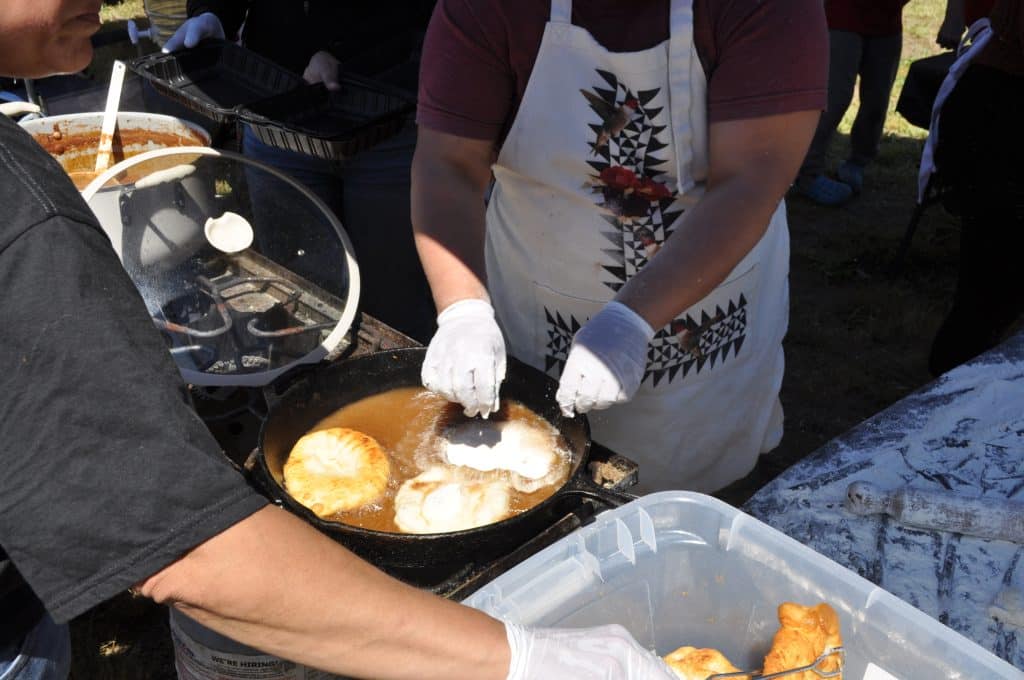
Once the group reached their destination at the Pit River Casino, piping hot fry bread used to make Indian tacos was waiting for them. As the students and community members enjoyed their lunch, MMIP coordinator Geopfert told Shasta Scout that the growing MMIP movement has helped people understand how the prevalence of missing tribal members in their own families fits into a larger pattern.
She also mentioned that the Pit River Tribe was the recipient of a $1 million MMIP grant from the California Board of State and Community Corrections. That money is being used to help expand the victim services offered to Tribal families when someone in their family is killed or disappears. The funds can be used to pay for a range of things, from legal costs to paying a family’s phone bill in their time of need, Geopfert said.
California is one of the states subject to Public Law 280, which grants local law enforcement jurisdiction over crimes committed on tribal land that would otherwise be handled federally. Because of this, Geopfert said, county sheriffs are given near-total leeway over how MMIP cases are investigated, with no real obligation to involve the Bureau of Indian Affairs or tribal authorities.
She said there have been recent efforts to improve collaboration between tribes and law enforcement in the North State, with formalized memorandums of understandings that facilitate how tribal and non-tribal authorities would work together when someone goes missing. But speaking generally, Geopfert said the relationship between Indigenous communities and local police officers remains strained.
“In a way, they don’t take us seriously,” she said. “They just don’t take us seriously as a sovereign nation.”
Do you have a correction to share? Email us: editor@shastascout.org.
Comments (4)
Comments are closed.
Related Articles
Accountability vs. micromanagement: Shasta board debates its role during wide-ranging discussion
Supervisor Matt Plummer was accused of micromanagement for asking for data in response to an assessment of fire services. Meanwhile, Supervisor Kevin Crye spent nearly thirty minutes questioning a decision by the HHSA director with no such accusation sent his way.
For Shasta, collaboration needed to solve physician shortage
Political division is a barrier to improving healthcare access in Shasta County. Experts say solving the entrenched problem requires working together.

Meet Rebecca Anne Miller for Redding City Council
Three seats are up for grabs on the council this fall, and nine candidates are running. Miller is a substitute teacher with the Shasta County Office of Education and a caregiver with In-Home Supportive Services, or IHSS.
“In a way, they don’t take us seriously,” she said. “They just don’t take us seriously as a sovereign nation.”
*
Sovereign nations most often police themselves. I grew up in Indian country where the tribes had very visible tribal police presences. This raises another issue: Violence aimed at Native Americans is a horrible thing, but who is primarily responsible for this violence? The Pit River Tribe, in particular, knows the answer.
*
We’ve also witnessed Redding Rancheria doing what some would call the bare minimum when it came to tribal member Tyler McCain being held accountable for allegedly murdering his wife, Nikki Cheng-Saelee McCain. Their excuse is that California is a Public Law 280 state, which they claim delegates criminal jurisdiction to local law enforcement for all lands within reservations and rancherias.
*
But PL 280 does not prohibit California tribes from having their own law enforcement agencies, from charging and prosecuting tribal members under tribal law, or from hiring private investigators. Many of the tribes in California that have tribal LE departments fund those departments with casino revenues, helping relieve local LE of the burden of policing tribal properties and trust lands, including casinos. Instead, Redding Rancheria has inked a ridiculously one-sided agreement with Shasta County to inadequately reimburse the County for LE services—granted, you have to mostly blame the morons on our BOS for being the Tribe’s chumps. Redding Rancheria did offer a $10,000 reward for info regarding Nikki’s disappearance (while spending millions on its new casino project).
*
Local tribes have some housekeeping to do beyond blaming local LE while taking $1 million in federal grant money to reimburse survivors of murdered tribal members (which I’m sure Nikki’s parents and sisters have no access to, though her children might).
I was one of two white people at Victor Martinez’s , younger brother of Theodore Martinez funeral. A very old Indian man sang / chanted out an ancient Wintu prayer. It was quite powerful. Last seen in a bar where the Dip is now, his body was found on the railroad tracks in downtown Redding. I seem to remember he just got paid, and of course the money was missing. I also remember the only person looking for justice for Victor was Theodore…
I’ve been involved with Native Americans my entire life. On behalf of the MMIP families, I thank you for your excellent coverage of this sad issue. Indigenous families throughout the continent have suffered from indifference to these tragedies for far too long.
Thank you for representing my son. This means allot to me. I can’t stand up to even talk about my son I am very upset with the whole scenario. I need to talk to some one. I am grieving but I am also hurt and mad and time gets pushed out