
Proponents have appealed suspension of Measure B, Shasta ROV says ‘they better hurry’
A new voter-approved measure intended to make significant changes to Shasta’s elections is currently suspended, but proponents are hoping to find a workaround before the county’s ballot order for the November election is sent out this Friday.
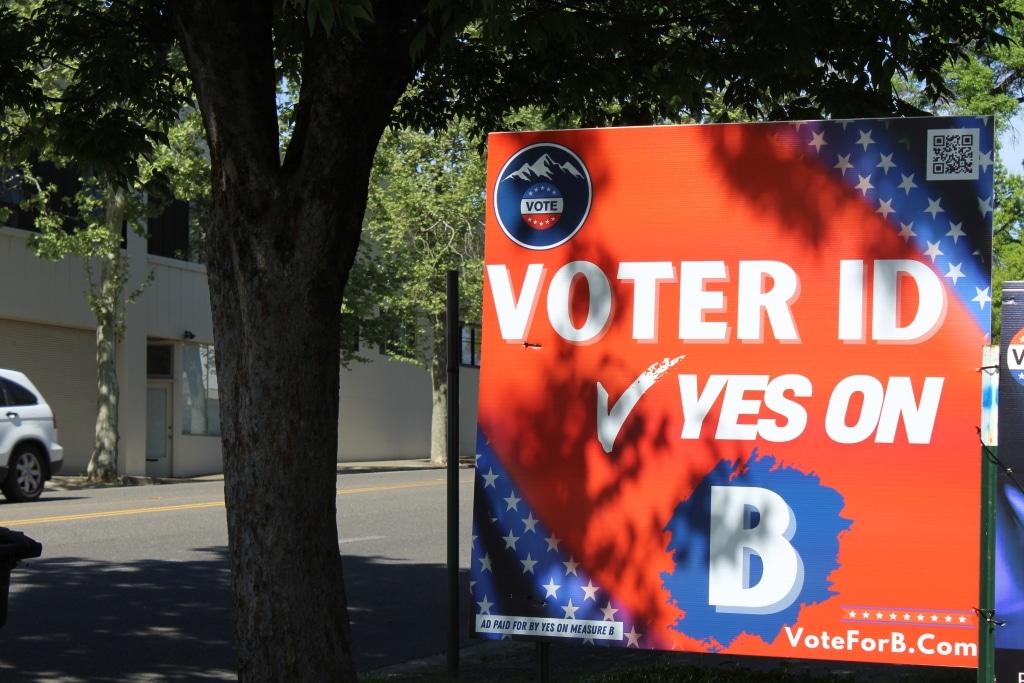
Proponents of Measure B, the initiative passed in the June primary that’s intended to make sweeping changes to Shasta County’s elections, are racing the clock to get the measure’s provisions implemented before the county’s ballot order is sent out to the printers.
Shortly after voters passed Measure B in June, California sued the county, arguing that it violates state law. The measure would implement voter ID, significantly restrict mail-in voting and require hand counting of all ballots, among other significant changes.
Earlier this month, a Shasta judge suspended the measure pending further court order, saying that leaving the measure in place while its legality is debated would likely result in voter disenfranchisement due to uncertainty and confusion.
Proponents of the measure appealed that suspension just days later in California’s Third Appellate District Court. Because the appeal process may take some time to work its way through the courts, the attorney for the proponents, Alexander Haberbush, also asked the court to act urgently to essentially unfreeze the suspension while the appeal is pending.
He requested the court do so by Aug. 27, a date previously identified by Shasta Registrar of Voters Clint Curtis as the day before he planned to send ballot material to the printers for the November election.
“They better hurry,” Curtis said over text, referring to the proponents’ legal fight to appeal the suspension of the measure so it can be implemented for the November election.
Haberbush said he appealed in part because he wants the courts to ensure the county can implement whatever parts of the measure can be legally implemented for now.
“Measure B was approved by Shasta County voters,” Haberbush wrote, “and we believe their enactment should be given effect to the fullest extent permitted by law while the courts resolve the ultimate legal issues.”
Haberbush explained that the state didn’t identify any laws that directly contradict implementing several of the measure’s provisions, including the use of paper poll books, selecting hand counters through a public lottery 60 days before the election and utilizing “a supplemental tally-sheet format.”
His argument is one that’s already been discussed in court. During the hearing earlier this month when Measure B was suspended, Shasta Judge Benjamin Hanna said in a written ruling that the unchallenged parts of the measure can’t be separated from the provisions being argued, adding that those provisions were integral parts of the measure’s enactment.
“It is simply not possible to functionally sever the provisions of Measure B without the Court turning Measure B into a statute wholly divorced from what the voters approved,” he wrote.
Yesterday, the state filed an opposition to the proponents’ requests to unfreeze the suspension. The secretary of state’s and attorney general’s offices did not respond to a request for comment on the filing or the status of the case.
Shasta County declined to comment on the case, instead referring to a press release made earlier this month following Hanna’s suspension of the measure.
“The election and voting policies described in Measure B will not be implemented for the November 3, 2026, General Election, unless further order of the court,” the release emphasized.
Measure B would significantly limit mail-in voting, a method used by about 85% of Shasta’s voters.
“Consistent with State and federal election law,” the release continued, “all Shasta County active registered voters will receive a ballot for the November 3, 2026, General Election by mail.”
The state’s battle over Shasta’s Measure B is taking place as it simultaneously fights President Donald Trump’s executive order that seeks to limit mail voting in the upcoming election. Similar to Measure B, critics have argued that implementing such sweeping changes so close to an election would cause chaos and significant uncertainty among voters.
Do you have a correction to share? Email us: editor@shastascout.org.
Comments (17)
Comments are closed.
Related Articles

Gallery: Downtown Redding hosts fourth annual Hispanic Heritage Month celebration
Red Bluff-based entrepreneur Araceli Gutierrez collaborated with Viva Downtown to bring the celebration of Hispanic Heritage Month to Redding.

Meet Jack Munns for Redding City Council
There are three council seats on the ballot this November, and nine candidates are running. Munns is a current council member and former police officer.

Meet Lisa Barry for Shasta County Office of Education Trustee
Lisa Barry is running for one of seven seats on SCOE. She has a background of service in the Intermountain area including as a community organizer with Burney Friends and Neighbors.
I heard the appeal was denied. Injunction upheld. The voter suppression measure has been lit and is about to be dropped in the burn barrel. Hallelujah!
And the Court of Appeals drops the other shoe.
https://krcrtv.com/news/local/state-appeals-court-keeps-shasta-county-measure-b-blocked-for-november-election
That didn’t take long.
Selah
So glad the local election deniers threw every debunked election fraud conspiracy theory known to man into Measure B to ensure it was doomed even if they succeeded in duping gullible MAGA types into voting for it. Focusing on ridding ourselves of Crye and Curtis and not wasting a dime or minute of time fighting Measure B was exactly the right strategy to begin righting our Shasta County ship. 86’ing Kelstrom come November will rid ourselves of the last Anselmo puppet then we can begin the process of unwinding all the damage done since 2018.
Speaking of voting, did you know hundreds of ballots were rejected in Shasta County in the June 2 primary?
616-no signature
35-signature mismatch
107-received too late <7 days
(*source, CA Sec of State website)
Elections here have been decided by 50 votes. The impact could change an election. **Make sure you sign, use the signature on your CDL, and mail early.**
If the local MAGAs get this passed, I expect many ADA enforcement law firms will jump in to sue on behalf of the disabled who will be unable to cast votes in person.
There is not even as much as a one-in-one-hundred chance that the appeal will successful.
“I consider it completely unimportant who in the party will vote, or how; but what is extraordinarily important is this—who will count the votes, and how”
Quote attributed to Joseph Stalin about voting.
A totally corrupt system where ignorant and gullible constituencies place their hopes on individuals who represent the interests of people (including institutions) who finance their campaigns, not the feebleminded voters.
Most likely, with the thoughts, hopes, prayers, and money of M-B endorsers – the local Republican Party, far-right extremists Corkey, Crye, Hobbs, Ladd, Jones, Curtis (the nut job who calls the McConnell Foundation “Antifa”), etc. – Haberbush is arguing before CA. 3d Dist. that because “Measure B was approved by Shasta County voters… (therefore) enactment should be given effect to the fullest extent permitted by law…” This is a perfect example of the costly, failed logic of our local MAGA far-right extremist. But to spell it out for them, because Measure B is illegal, therefore no “enactment.”
.
$50 says Haberbush and the Kool-Aid Clan will fail.
.
Another $50 says NO OFFICER in the local Shasta County Republican Party Central Committee will denounce the racist, misogynistic, lawless behavior of their leader; not one of them.
.
Any takers?
.
Thought so…
“Another $50 says NO OFFICER in the local Shasta County Republican Party Central Committee will denounce the racist, misogynistic, lawless behavior of their leader…”
Only a sucker would take that bet. On the bright side, SCRPCC enforces three local candidates for nonpartisan offices. Curtis and Crye lost. Kelstrom couldn’t muster a majority and is headed for a runoff that I predict he’ll lose. MAGA has shot its wad, even in Shastanistan.
…SCRPCC endorses…
.
My kingdom for an edit button.
Who will rid us of these troublesome MAGAs?
Esteban, sadly, I agree with you. I don’t think adding another 0 to the number would make a difference. I think the SCRPCC would and can ONLY endorse Republican Party members for any office, local, state, or national, whether partisan or nonpartisan; it’s more than likely in their bylaws.
.
And sadly, despite Trump’s job approval of 33 percent, the lowest of his presidency, according to Reuters, and a staggering 65 percent of Americans said they disapprove of his job as president, support for Trump among Republicans remains high, with 73% still, to some degree, approving of how he’s handling the job, with only 27% disapproving.
.
I think it’s safe to say the Cult of Trumpism is still rather popular in the SCRPCC, and because they’re Trump-Drunk and rationality is not assessable in this state, or they don’t have the fortitude to go into recovery and speak out, or are personally clear-eyed and personally sober yet harbor some racist, misogynistic, authoritarian tendencies themselves. I think it’s reasonable to ask the Republican Party for reparations and reconciliation, but I don’t see that in the near future.
.
As evidenced by people like Clint Curtis, the behaviors of candidates endorsed by the SCRPCC, and the socioeconomic cost of supporting this trumpian mindset, the risk to democracy itself is dangerous.
“It is simply not possible to functionally sever the provisions of Measure B without the Court turning Measure B into a statute wholly divorced from what the voters approved,” (Judge Hanna) wrote.
.
The above is why his decision will be upheld on appeal. As every schoolchild knows by 8th grade, it’s not the role of the judiciary to rewrite fatally flawed laws so that some parts pass muster. The election deniers will have to go back to the drawing board and craft something that isn’t unconstitutional and in direct defiance of state law. I predict they don’t have it in them. Part of their pig-ignorant fantasy is that counties reign supreme in the hierarchy of state government.
This is, slowly but surely, going the way of the Huntington Beach attempt at this. They appealed all the way to the state Supreme Court and went down in flames. This appeal is a desperate(and futile) attempt to get the camel’s nose under the tent for this election. It is doomed to fail. My question is who is financing the appeal?
Selah
Prediction: Appellate Court will uphold Judge Hanna’s ruling.
Stupix waste of time. Shasta disqualified my vote based on amateur signature comparison last election. Online secure system too tough for Calif. to pull off is pathetic.
You were given the opportunity to ‘cure’ (correct) your ballot – and thus have it counted? If not, that would appear to be yet another violation within the Curtis operation. Contact state officials ..