
Saving Lake McCumber: Community members fight to preserve a small dam in Shingletown
A beloved lake is facing an unclear future in Shingletown as PG&E prepares to pull out of the Battle Creek Hydroelectric Project, which could include removing the dam that forms McCumber reservoir. A group of local residents that hopes to save the lake will face a multitude of environmental, cultural, financial and regulatory complexities to do so.
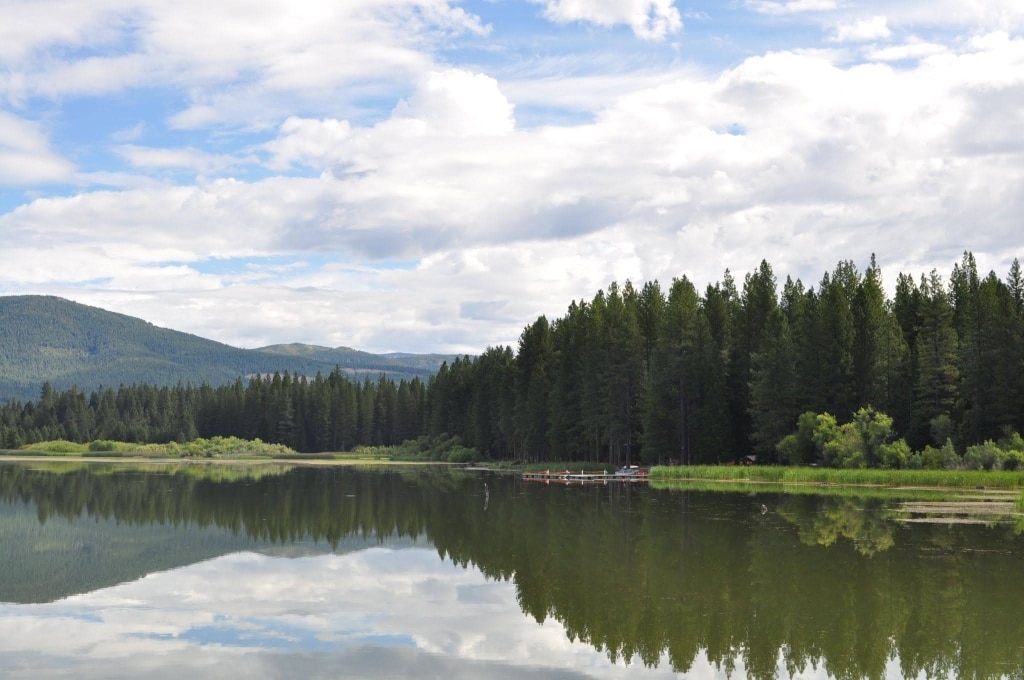
“It’s a lovely spot. The grounds are gorgeous, pristine.”
That’s what Isabel Klopchic, an attorney and Shingletown resident, said as she looked out over the water of the McCumber reservoir a few weeks ago. The lake is located in Shingletown about 45 minutes east of Redding.
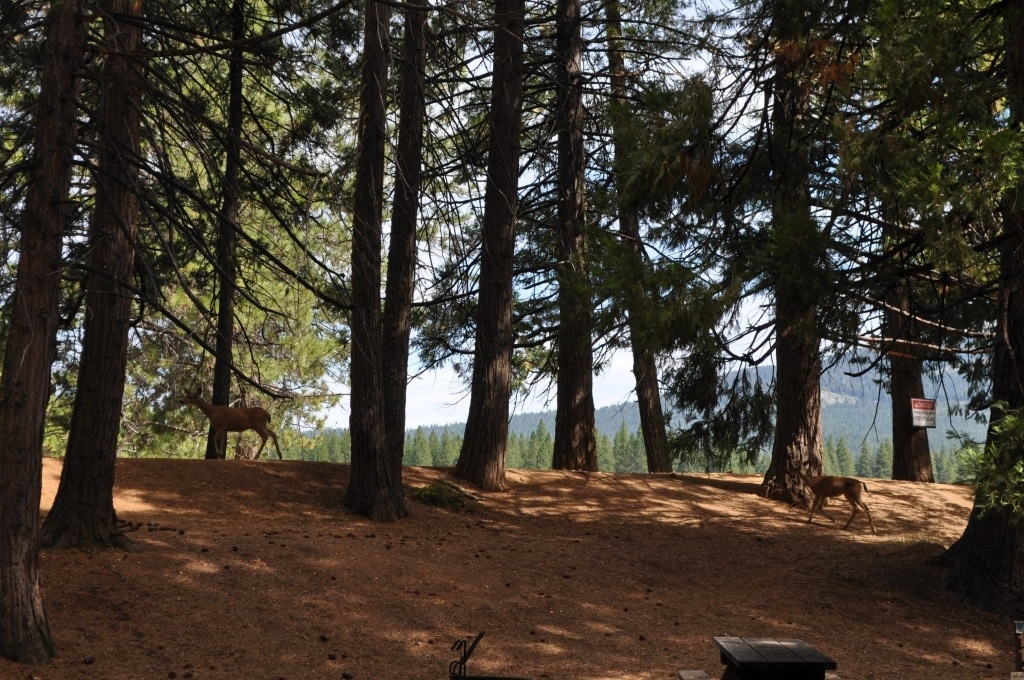
Next to Klopchic, her husband, Lassen Pines Mutual Water Company President Kim Walters, shared some of the history of the reservoir. Nearby, Shasta County Supervisor Chris Kelstrom pointed out an osprey as it dove into the deep blue water to catch a fish.
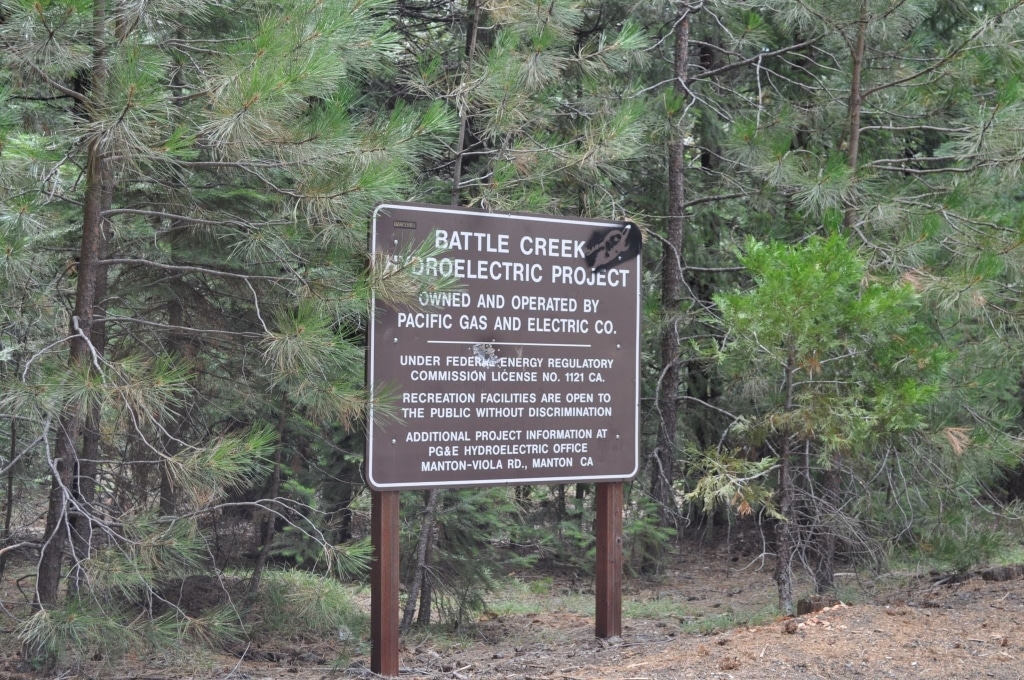
The McCumber reservoir, often called “Lake McCumber,” is a small body of water created by the McCumber Dam, which sits at the North Fork of Battle Creek in Shasta County. It’s part of the broader Battle Creek Hydroelectric Project currently owned and operated by PG&E. The lake, and the quiet forested Shingletown neighborhood that surrounds it, are located close to Lassen National Park.
PG&E’s license for the hydroelectric project, which originally generated power using dams, canals and pipes, expired this year. The company has decided not to renew its license. Since no group or entity has volunteered to take over ownership of the project, the McCumber Dam, along with the North Battle Creek Dam, could be removed in the years to come — quickly draining the existing reservoir and fundamentally changing the community that surrounds it.
Klopchic and Walters, two organizers of the grassroots project Save Lake McCumber, are trying to prevent that from happening. They hope to preserve not only the dam that holds back the water that forms the McCumber Reservoir, but also a second dam that forms the North Battle Creek Reservoir, an associated body of water within the same hydroelectric system, which sits north of McCumber.
Collaboration with a complex network of stakeholders connected to the watershed will be necessary in their quest to find new ownership for the McCumber Dam, as a means of saving the beloved lake — which they said brings significant benefits to the community.
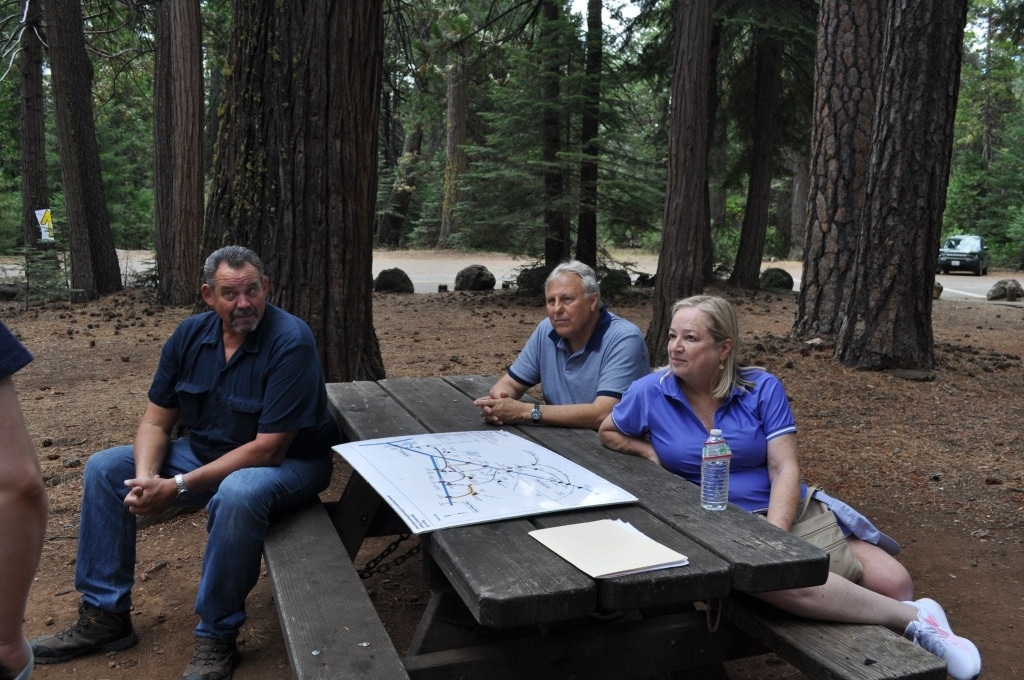
Over the last two years, Klopchic and Walters have worked with a group of around eight active committee members, as well as the broader Shingletown community, to meet regularly with stakeholders and discuss how the two dams could be preserved. While there’s not yet a clear solution or path forward, the group has been raising the alarm and gathering resources little by little to raise awareness of their cause. Many details, such as the environmental impact of maintaining the dams — and the costs to do so — remain unclear, complicating the path forward.
Their activism is how they connected with Kelstrom, a lifelong Shasta resident who has his own personal history related to reservoir preservation, which is what’s motivated him to help. During campaign interviews before the June primary, Kelstrom listed saving Lake McCumber and North Battle Creek Reservoir as a top priority for his second term in office.
In an extended conversation with Shasta Scout next to the lake last month, Klopchic and Walters — with Kelstrom listening in — said they’ve done a lot as a small group of activists but realize input and collaboration from public agencies, environmental organizations, Indigenous communities and politicians is becoming ever more crucial as they move towards next steps.
“We have to work with them for their help, not attack them,” Klopchic said about those parties, many of whom are already involved in efforts to respond to PG&E’s pulling out of the Battle Creek Hydroelectric Project.
What puts Lake McCumber at risk?
PG&E currently owns and operates the entirety of the Battle Creek Hydroelectric Project, which spans the North and South Forks of Battle Creek, including five powerhouses, 15 diversion dams, two storage reservoirs and around 20 canals and pipelines.
The McCumber reservoir, which is a storage reservoir that does not produce power, is located at the very north section of the project, below North Battle Creek Reservoir. The hydroelectric power system was originally built in the early 20th century to generate power for copper smelting operations in Redding. As is the case with many dam systems, the diversion dams and storage reservoirs do not generate electricity, but divert water in the right directions to deliver water to the powerhouses, which produce power.
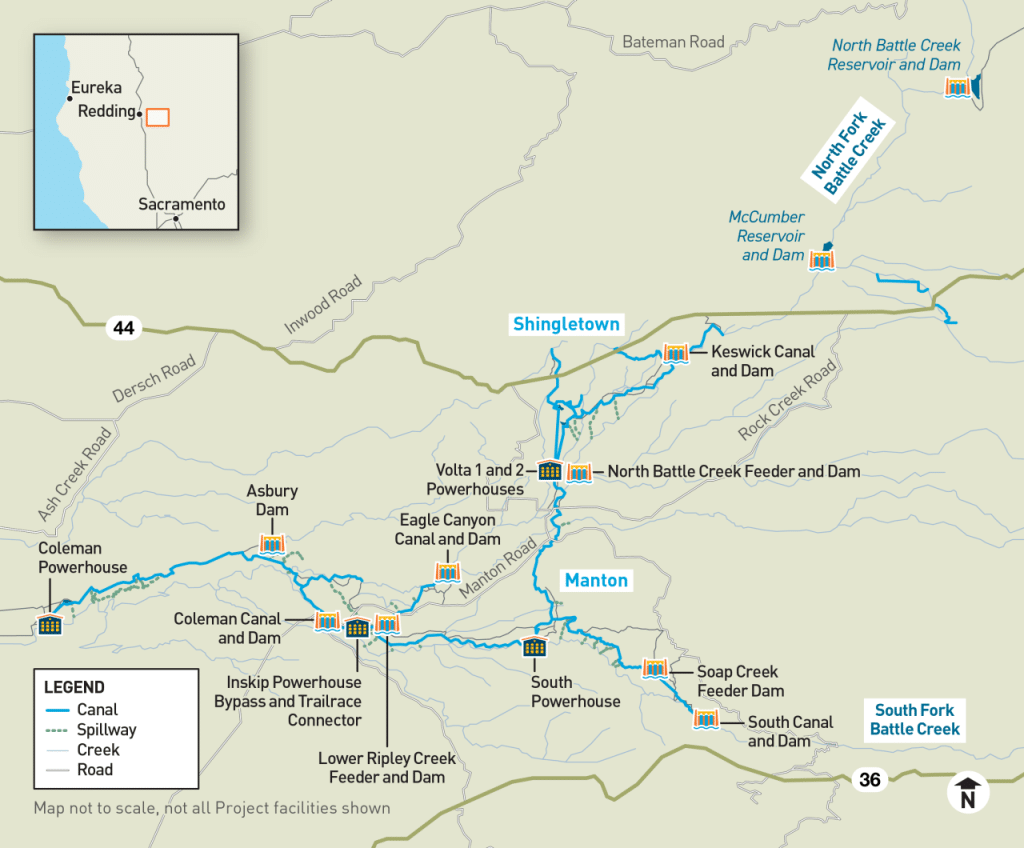
PG&E declared in 2020 that it wouldn’t be renewing its 50-year license with the Federal Energy Regulatory Commission, or FERC, to operate and maintain the project, as it was no longer profitable. That license expired just around two weeks ago, on July 31.
During 2021, there was a period where interested parties could have come forward to take over the entire hydroelectric project. When that didn’t occur, PG&E began the official preparations to decommission the project in 2022. As the first step in that process, PG&E is required by law to submit a License Surrender Application to FERC, including a proposed decommissioning plan for all associated facilities. PG&E is still in the midst of this progress, and comment from the megacorporation indicates there may still be space for a third-party intervention to take over parts of the project.
“PG&E’s goal at the end of the surrender of Battle Creek Project is to not own and operate any portion of the project,” Paul Moreno, a spokesperson for PG&E, wrote in an email to Shasta Scout. “If no qualified third party comes forward to take over a facility, PG&E will remove the facility.”
Why save Lake McCumber?
Klopchic and Walters, who used to live in Contra Costa County but often spent time in Tehama County due to Klopchic’s work as an attorney, decided to settle down in Shingletown after a chance encounter with the small forested community while on the road.
“This is our forever home,” Klopchic said.
In early 2025, at a meeting of the Battle Creek Watershed Conservancy — an organization of local residents which oversees all parts of the broader watershed — local residents including Klopchic and Walters discussed the impacts of PG&E’s decommissioning of the hydroelectric project. There, they formed an ad hoc committee and began formalized meetings for an organization to save Lake McCumber and the North Battle Creek Reservoir.
Walters noted that the Save Lake McCumber group, which includes around eight active committee members, hosts regular meetings around once or twice a month, and it reaches out regularly to local community members as well as involved organizations, politicians and stakeholders to increase support.
The group, many of whom are knowledgeable long-term residents of the area, are in support of removing most dams along the watershed, many of which block fish passage, causing environmental harm. However, they say that the McCumber and North Battle Creek Dams should be preserved because they sit above the fish migration limits and provide tangible benefits for the local Shingletown community.
Much of the group’s motivation for saving Lake McCumber is tied to the recreational experiences and sentimental value the lake provides for local residents.
Kelstrom, who is running for reelection this fall as District 5 supervisor, has made saving Lake McCumber and Battle Creek Reservoir one of his top campaign priorities, despite low recognition of the issue in the community. He said it’s because of the value such wild and beautiful spaces provide to family connection.
“My grandfather used to take me to North Battle Creek Reservoir before there was a campground, before there was any of that stuff, 50-plus years ago,” he said. “He had a jeep pick-up with a little camp trailer, and he’d pull it right through the trees, right at the edge of the water, launch the canoe, and we’d camp right there and fish right there.”
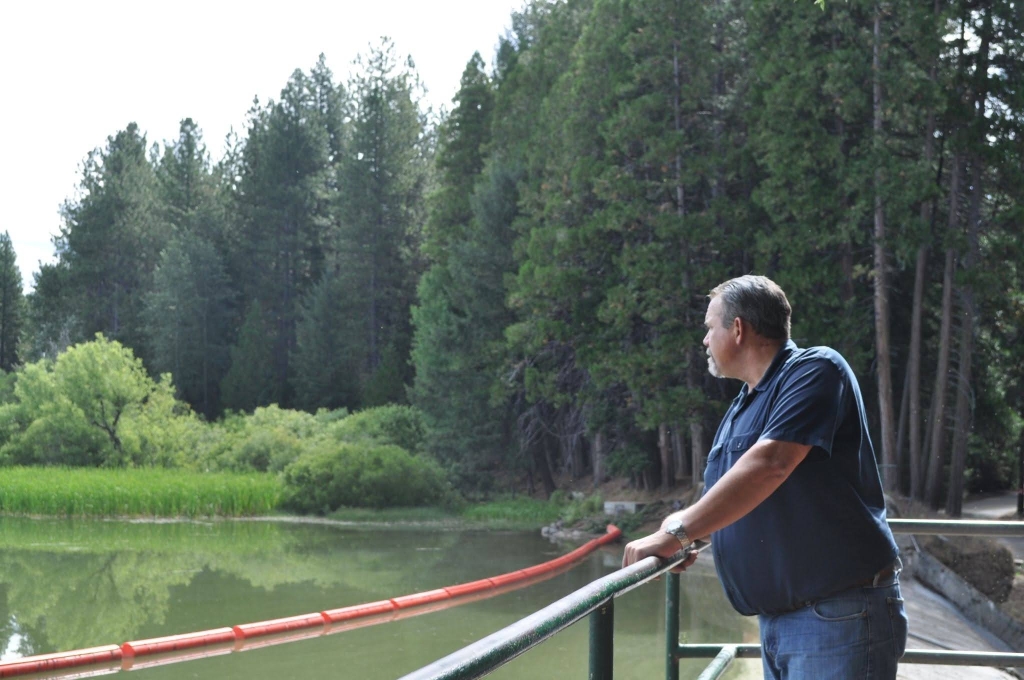
Losing a beloved body of water isn’t an unfamiliar story for residents in the region. Kilarc Reservoir, a former lake located in Shasta County, was shut down in 2019 after the Kilarc-Cow Creek Hydroelectric Project was decommissioned by PG&E in a similar manner.
“It was just the most beautiful little perfect lake in the world, but now it’s a little hole in the ground,” Kelstrom said about Kilarc, which he used to bring his children to several times a year when they were younger. “It’s just so sad.”
Many local residents’ lives have become intertwined with the Lake McCumber reservoir in a similar way. And the lake is also home to Camp McCumber, a summer camp which has hosted thousands of local children over summers for more than 65 years.
Earlier this year, Kristen Lyons, CEO of Shasta Family YMCA, issued a letter of support for Save Lake McCumber addressed to Kelstrom, saying that without the lake, “future kids won’t get to experience the same sense of adventure, connection, and growth that so many before them have had.”
What could happen if the dams were removed?
Many of Lake McCumber and North Battle Creek Reservoir’s benefits, Klopchic and Walters explained, are related to mitigating wildfires and controlling floods, particularly as a rural area that’s at high risk. While the community members involved in Save Lake McCumber do not claim to be environmental experts, they are deeply concerned about the potential environmental impacts of draining the reservoirs, including how it might affect fire risk.
“We’re the largest source of water for fire mitigation purposes between Lake Almanor and Shasta Lake,” Klopchic said, explaining that one of the major benefits of the reservoirs is that they provide a large body of water to depend on in case of wildfire.
While Kelstrom told Shasta Scout that CAL FIRE does not have a policy or regulations on specific water sources, he said the agency is able to use the McCumber reservoir to mitigate fires within a five-mile radius, in addition to the hydrants that are used to fill fire engines in the area.
Without the North Battle Creek Dam, Save Lake McCumber members are also concerned that their area will face flood concerns, particularly in years with heavy snowpack during rapid snowmelt, major rain or snow events.
“Without the dam, the floodwaters could extend well beyond Lake McCumber, potentially reaching Highway 44 and affecting the Shingletown area,” said Rima Armogida, a member of Save Lake McCumber who owns a second property in Shingletown. She referred to an inundation map by PG&E, which indicates areas that could be covered by water in the hypothetical failure of North Battle Creek Dam.
Armogida, as well as Klopchic and Walters, also referenced the fact that Lake McCumber and North Battle Creek Reservoirs provide the benefits of beaver dam analogs, or human-made structures designed to mimic the form and function of natural beaver dams. Because of this, they say that the loss of these dams could lower water tables, dry shallow wells and destroy important waterfowl and wildlife habitat.
Determining the specific extent of these concerns, Walters acknowledged, would require thorough environmental studies that would have to be conducted by PG&E.
In response to questions, PG&E spokesperson Moreno said all parts of the hydroelectric project, including impacts related to the potential removal of the McCumber Dam, will be evaluated in the company’s environmental report included in its license surrender application.
No threat to fish passage
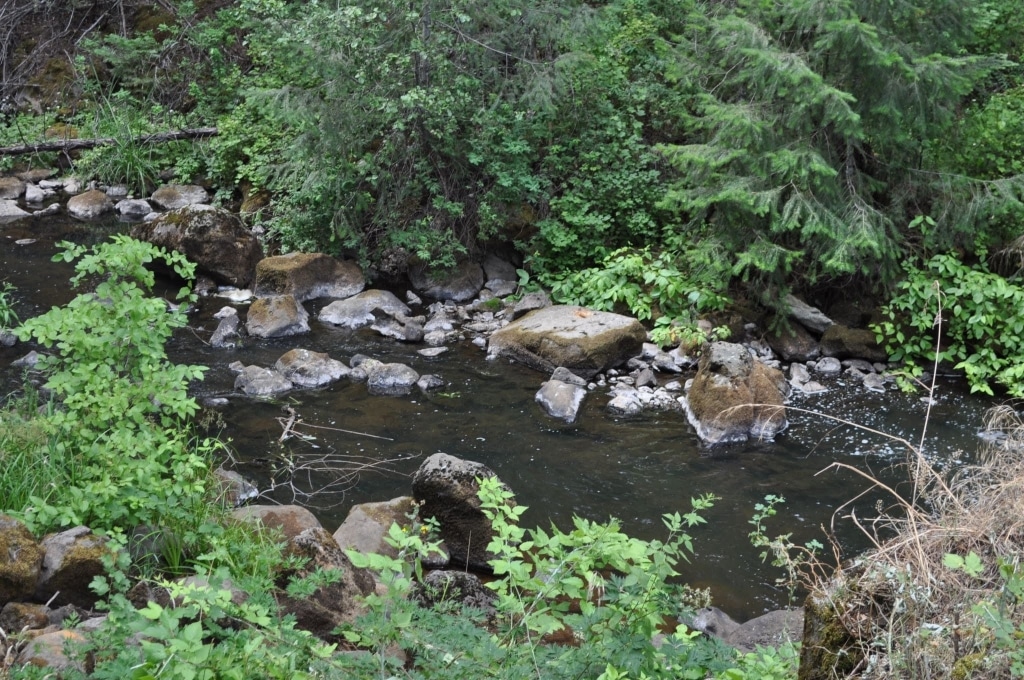
Battle Creek, which is fed primarily by volcanic springs and snowmelt from Mount Lassen, has consistently cold water year-round. It’s also one of the only watersheds which can support winter-run Chinook salmon, an endangered species, alongside Central Valley steelhead. The rare combination has caught the attention of many organizations and entities over the years, including the federal government, which began a restoration project in 1995.
CalTrout and American Whitewater, alongside other groups such as American Rivers, Trout Unlimited and California Sport Fishing Protection Alliance, usually support the removal of dams, which can block fish passage and impact water temperatures. But representatives from both CalTrout and American Whitewater agreed that McCumber and North Battle provide an exception to this typical environmental perspective, as the two dams are upstream of the natural anadromy of the fish — meaning the area where they migrate and utilize the habitat to reproduce.
As a result, both organizations said they are open to Save Lake McCumber’s vision, if the resources can be found to make it happen.
“We don’t see a problem with those dams staying in place,” Dave Steindorf, hydropower specialist emiratus at American Whitewater, told Shasta Scout in an interview. “But it’s up to PG&E and interested parties to find a way to get the resources necessary to own and operate them.”
Emily Moloney, a project manager for CalTrout, added that the organization will be completing environmental studies to inform the decommissioning process, which may reveal necessary information about the impacts of removing or maintaining the McCumber and North Battle Creek Dams.
“As long as the water quality and temperature and the operations of that facility are not impacting downstream habitat for salmon,“ Moloney said. “That would inform our stance on removal or retaining of these facilities.”
She noted that the study would include how different PG&E decommissioning scenarios could impact water temperatures and water flow on salmon habitat throughout the watershed.
What would it take to save Lake McCumber, and who would be involved?
PG&E’s surrender application, once submitted, would include plans for how to address all sections of the Battle Creek project, including feasible requests for any takeovers of the infrastructure. Should an entity reach out and indicate interest in managing any part, including the McCumber and North Battle Creek Dams, PG&E said it would be open to discussion.
“If a third party is interested and capable of taking over ownership, operation, and maintenance of a Battle Creek facility, PG&E is interested in talking with that third party about potential facility transfer,” Moreno wrote in an email to Shasta Scout.
A large hurdle for the Save Lake McCumber group would be finding an entity capable of doing so, many sources Shasta Scout spoke with agreed. In the case of a removal, PG&E would be responsible for all costs associated with removing the dam — but a takeover would require an entity with enough financial resources and technical expertise to step in instead, American Whitewater’s hydropower specialist emeritus Steindorf emphasized.
There have not been previous cases of such a transfer, particularly a takeover of the infrastructure associated with such an old dam, and one which does not generate power.
In order to actualize a takeover of the two dams, Save Lake McCumber would also have to communicate and collaborate with all interests at play, across the many different stakeholders involved in the Battle Creek watershed.
Among the sources that Shasta Scout reached out to for this story, including PG&E, elected officials, landowners, Indigenous tribes, environmental experts and NGOs, there were a variety of respective priorities on the Lake McCumber and the North Battle Creek Reservoirs.
Sierra Pacific Industries, which owns much of the land surrounding Lake McCumber, declined to provide comment on its vision for the future of the watershed following PG&E’s decommissioning.
Assemblymember Heather Hadwick also declined to provide comment on the project, but California’s District 1 Senator Megan Dahle stated that she shares the sense of affection for Lake McCumber that many residents in her district do “for its natural beauty and for fire safety.” She also noted that securing funding for the project will be a challenge.
“It’s critical that the public get solid information on the condition of the dam and long-term costs to figure out if another owner could make it work,” Dahle wrote in an email to Shasta Scout. “I expect that to come out as part of PG&E’s decommissioning studies.”
Tribal input will also be critical to next steps due to ongoing Indigenous relationships to local waterways and the fish that inhabit them.
The McCumber Reservoir falls within the ancestral lands of the Yana people, who formerly lived along the eastern tributaries of the upper Sacramento River. The interests of their descendants are represented by the Redding Rancheria, Tribal Chairman Jack Potter Jr. confirmed, declining to provide a comment on Save Lake McCumber because he is still researching the project.
Regina Chichizola, managing director of Communities United for Water Protection, pointed out that for Indigenous people it will be important to assess not only environmental concerns, but also what other negative impacts the Battle Creek dams may have on Native lifeways, including their cultural resources and sacred spaces.
“It’s important for people to realize that a lot of dams, especially in California, really did target Native people’s allotments and reservations,” she said.
The will of the water itself is another significant factor for at least some Native communities. In a previous interview with Shasta Scout, Winnemem Wintu Tribal member Michael “Pom” Preston described how his Tribe sees water as a powerful being in need of care.
“Water has memory, water reacts to human emotions, water reacts to its environment.” Preston said. “Water controls the world we’re a part of here.”
What could be next?
PG&E is currently planning and developing its surrender application, which is predicted to be completed by spring 2028. The company’s website indicates that changes to project facilities, which would come only after FERC approves the company’s surrender and decommissioning plan, are likely to begin around the mid-2030s.
PG&E is currently still in ownership of the hydroelectric project on an annual license issued by FERC until the surrender process is effectively completed. Only after the dam has been fully decommissioned, and any parts being removed fully eradicated, will PG&E no longer be responsible for any part of the project.
The company’s website notes that any third party interested in taking ownership of a Battle Creek facility should contact the company by Oct. 1 this year.
In the meantime, regular discussions are underway between Save Lake McCumber, Battle Creek Watershed Conservancy and involved organizations about the future of the watershed. Klopchic and Walters said that the next big step for the group would be commissioning a feasibility study that would address the potential outcomes of each part of the PG&E’s decommissioning process.
“It would be preservation, augmentation, the manpower needed to maintain it, repairs, and of course, how much damage and damage recovery you would need if they did blow [the dam] out,” Klopchic said, noting that the Battle Creek Conservancy would be conducting the feasibility study for the entire watershed.
Save Lake McCumber has also begun listing out entities that might be convinced to take over the dams, including federal agencies like the Bureau of Reclamation, the Bureau of Land Management or the U.S. Forest Service, as well as state agencies such as the California Department of Water Resources.
In collaboration with Kelstrom, the organization is even considering the creation of a special district in Shasta County that would facilitate the creation of a public agency whose job it would be to keep the dam and lake functioning. Such a process would require collaboration from many county agencies including county counsel, public works and the assessor’s office, as well as the broader public, which would have to vote to approve such a special district.
Pursuing any one of these ownership possibilities will require specific data on how much it might cost to maintain the dam, both annually and over the long term, what environmental impacts such a project might have and more. That’s where a feasibility study comes in.
“We need numbers. We need studies,” Walters said, “and that’s what we’re getting to.”
While the exact future of Lake McCumber remains uncertain, Walters and Klopchic agreed that collaboration across parties is the key to making their big goals a reality. They repeatedly expressed that they don’t have any particular approach they’re looking to push forward. Instead, they said they’re keeping their minds open to any win-win solution that could save the dams, and Lake McCumber, by bringing together a number of interested parties.
“We want to work with everybody,” Walters said. “Let’s all work together to get a new plan, direction.”
Moe Shimizu is a student at Yale University. She’s reporting for Shasta Scout as a 2026 summer intern, with support from the Nonprofit Newsroom Internship Program — created by The Scripps Howard Fund and the Institute for Nonprofit News.
Do you have a correction to share? Email us: editor@shastascout.org.
Author

Comments (10)
Comments are closed.
Related Articles

Redding has eliminated more than a dozen vacant police and fire positions and will close Fire Station 3
The changes were made to increase city savings amidst a struggling budget. Council members were united on fire department changes, but two were opposed to some of the police department cuts.

Meet Madison Zimmerman for Shasta County Office of Education Trustee
Madison Zimmerman is running for one of seven seats on SCOE. She refers to herself as a proud product of Shasta County Schools and plans to bring her skills developed both inside and outside of the county to expand opportunities for students to thrive here in Shasta.
Accountability vs. micromanagement: Shasta board debates its role during wide-ranging discussion
Supervisor Matt Plummer was accused of micromanagement for asking for data in response to an assessment of fire services. Meanwhile, Supervisor Kevin Crye spent nearly thirty minutes questioning a decision by the HHSA director with no such accusation sent his way.
It seems important to have included an actual foto of the dam itself?
But that’s a nice picture of Andre the Gia…oh, wait.
Well written and the research required to give this report is amazing.
This is a very well written article. Great work.
PG&E owns thousands of acres of land in Shasta County, yet they pay no property taxes on said land due to some ancient political agreement that the utilities are a public service.
If these properties are no longer going to be a public utility these properties should be sold to private investors which then would bolster Shasta Counties tax base.
Sell the lands to Serria Pacific, then Red can lock the public out. Did you know PG&E has locked up portions of their property also?
Nick Gardner
“Serria”
If you were in 3rd grade that would be cute, but you made it to 6th…right, Nick?
Jesus, dude.
Time to sell your properties.
.
Why does Shasta Scout include quotes like “water reacts to human emotions” and yet edits out long-winded bible verse from posters? Both are ridiculous. Indigenous representatives are no different than the “prophets” at Bethel— biased non-science from corporations.
Yet Shasta Scout allows your dogmatic science-worshiping to be publicly flaunted..
I bet you would have been first in line to hand out smallpox blankets, isn’t that right Mr Trucknuts?
Reach out to Elon Musk!
Uh, no. Elon would put in a data center.