
Shortage in HHSA social services fund dominates day 2 of Shasta budget discussions
The Health and Human Services Agency is facing serious financial shortages in its social services fund. Discussions during the agency’s budget proposal indicated that the county may be leaning towards extreme measures to cut costs.
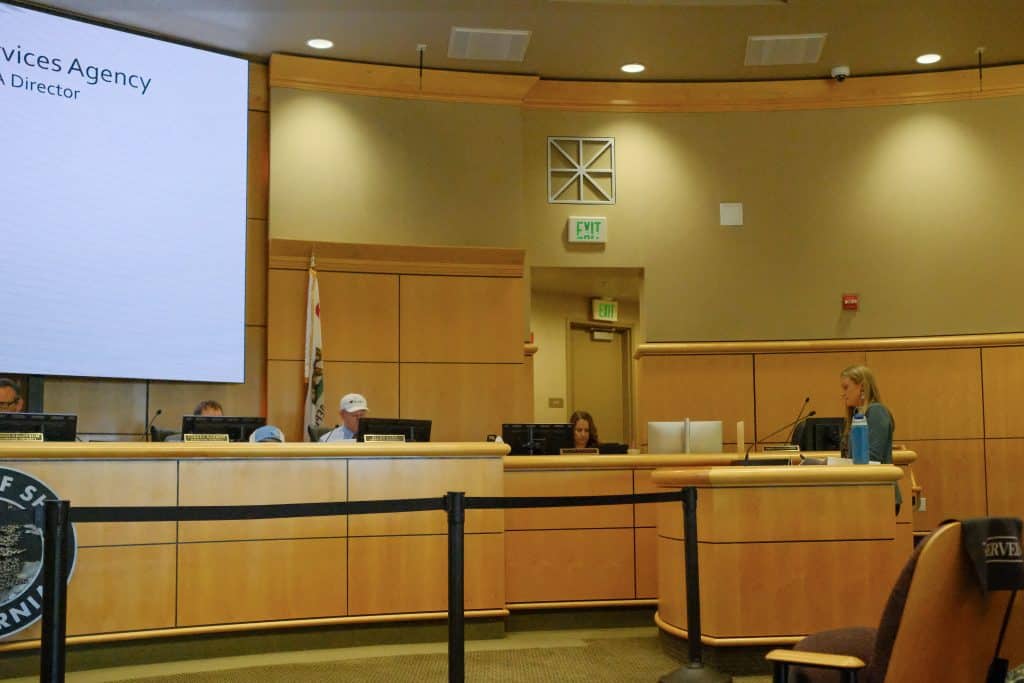
Amid ongoing financial challenges, the Health and Human Services Agency is looking for any way to trim expenses.
On the second day of Shasta County’s budget hearings, HHSA Director Christy Coleman presented the agency’s proposed budget for fiscal year 2026-27 to the board. The discussion focused primarily on the continuing crisis in the social services fund budget.
The Health and Human Services Agency accounts for around half of the county’s approximately $650 million annual budget. Despite its overall size, HHSA’s budget requests from the county are relatively small — only about 2.5% of the agency’s funds are made up of county dollars. For this coming year, Coleman said, HHSA has requested around $6.9 million from the county’s general fund, a decrease from last year. However, the majority of her concerns related to programs run using state and federal funding, which takes up most of HHSA’s $300 million budget.
Wednesday’s presentation focused heavily on the agency’s social services fund, which has faced significant cash flow challenges over recent years and is currently in the black only due to a $10 million loan from the county’s general fund.
Social services supports the bulk of essential programs in Shasta County, covering cash assistance, housing and homelessness support, adult and child protective services, medical care, and mental health programs. Many of the programs supported by the social services fund are state-mandated, meaning that the programs must be provided regardless of the county’s budget status.
Explaining the shortfall in the fund, Coleman said that HHSA’s overall costs have increased by about 27% between 2021-2025, while the amount the state provides to compensate for mandated services paid for out of the social services fund has only increased about 7%.
The Shasta County board’s discussions about the social services fund have been ongoing. In May, Coleman presented those budget concerns, alongside ideas for cost-saving measures such as mandatory furlough days and shutdowns of service locations. Coleman confirmed this week that the agency is beginning talks with unions about implementing the furlough days.
During her presentation this week, Coleman repeatedly stressed the cost-saving measures have already been implemented agency-wide, saying the agency is “saving money anywhere we can” in order to move funds into social services. Some of these measures have included hiring freezes, administrative cost cuts, and the deletion of 26 vacant positions. These efforts created savings of $7 million between October 2025 and February 2026, she said.
Coleman also cited H.R.1, also known as the One Big Beautiful Bill Act, as an initiative that could further increase the burden on individual counties to pay for programs such as Medi-Cal, CalFresh, and IHSS. She presented initial estimates for the impact of H.R.1, saying that around 6,000 CalFresh recipients and roughly 17,200 Medi-Cal beneficiaries could be impacted by policy changes, increasing workload and administrative costs for the county.
However, Coleman remained vague on the exact impacts of the bill or how much costs could shift to the county, saying that “there’s so many unknowns right now” pending finalization of the state’s budget, which may include measures to soften the blow. Coleman added that the county was actively advocating at the state-level for more support.
During discussions, the board hinted at the possibility of addressing budget shortfalls by not implementing some state-mandated programs, something some supervisors suggested could occur in collaboration with other California counties to present a united front to the state.
“We might have to look at the unfunded mandates and which ones we can start to not do,” District 2 Supervisor Allen Long said, “but we have to collectively do that, because if we stand alone, then we’re going to invite the wrath.”
Coleman clarified that “unfortunately, there’s not unfunded mandates in social services,” referring to the fact that all mandated, or required, social service programs are at least partially supported by state or federal funding. Those mandated social services include medical services, food benefits, foster care, and cash assistance for refugees, among others.
District 1 Supervisor Kevin Crye agreed that cutting mandated programs might be a necessary measure, claiming that “there’s other surrounding counties that are already cutting things.”
District 4 Supervisor Matt Plummer said that providing reduced services would be a more likely strategy than cutting programs altogether, but agreed with the general approach saying “if we can take collective action with other counties, then the state is less likely to single us out and try to punish us for this.”
Coleman noted that any decision to cut mandated programs would ultimately come down to a board decision. However, she echoed that ongoing cost-saving measures and cooperation with other counties would be necessary.
“That’s where the collaborative approach with other counties comes in to say, what are you guys doing this month, what have you seen, and what approach are you taking,” she said, “is going to be really beneficial as we get more into this.”
Do you have a correction to share? Email us: editor@shastascout.org
Author

Comments (7)
Comments are closed.
Related Articles
ROV Curtis claims scheduling issues are preventing him from complying with state law to shred November 2024 ballots
The ballots were supposed to be retained only through Sept. 5, but they still haven’t been destroyed, allegedly due to a series of scheduling missteps and delays.

As gray wolves reemerge in Shasta, humans look for ways to address threats to livestock
Long eradicated from Northern California, gray wolves are reappearing — but their new habitat also means new threats for ranchers whose livestock provide easy prey. Efforts are being made at the county, state and federal levels to find solutions that allow for coexistence between people, their livestock and wolves.

Shasta board removes Kerns as planning commissioner amid contentious debate
County Counsel Joseph Larmour said Planning Commissioner Steve Kerns was being removed without cause. Supervisors who attempted to delve into what was behind Kerns’ removal received pushback from the county’s attorney.
Let’s be honest about why Crye brought this forward: he has some personal grudges against some people who work for nonprofits, and he’s going to do his best to ‘get’ them before he leaves office.
.
Also, he struck out several times trying to get government money for his ‘for-profit’ business. He also struck out several times trying to get government money with through the use of nonprofits.
.
Make no mistake, this isn’t for the benefit of the citizens of Shasta county. This is because if he can’t have some of that government money, and he’s going to do his best to make sure that others can’t get it either.
Rules for thee but not for me.
The BOS last week placed restrictions on non-profits for administrative costs they believe to be excessive and inflated that enrich people who are tasked with providing much needed services to the community.
The same is true of any government service. So lets take a look at if administrative costs for each individual program under the HHSAA.
At the program specific budget level there are administrative costs. Charges for the managers, analysts, secretary“s etc..
At the Branch level the administrative costs are added on top as well – the Director, Deputy Director(s), their analysts & secretary`s etc…
The HHSA Administrative Branch then piles on top of the group- their HR, their, Director and Deputy Directors, their secretaries, their analysts even before you get to the top of the HHSA Administration itself which would then be added as well the HHSA Director, their Deputy Directors and their secretaries.
From there pile on the County Administrative costs for the CAO, the deputy CAO, the CAO analysts & Secretaries, the Board of Supervisors, the Clerk of the Board.
How dare non profits provide health insurance or provide cost of living increases to their employees and administrative team.
Shasta County should reap what it sows & immediately mandate that any county budget will not have more than 18% total administrative costs. This is, in the view of the board of supervisor’s recent decision, is needed to prevent waste, fraud and abuse. Too many people sucking the taxpayer dry for their own enrichment.
Just to be clear on this, the true administrative cost for county programs is closer to double the amount our BOS has deemed wasteful and abusive.
It’s pretty evident that a well-qualified person with big city experience needs to be hired and paid well for their knowledge.
Thank you, Moe and Shasat Scout, for the coverage. That said, let’s get a few things straight. The primary directive of the Shasta County Board of Supervisors is to safeguard and improve the health, safety, and welfare of county citizens. This includes not giving money to secessionist Chriss Street (a leader of New California State, which does not recognize the State of California), Simison College (a private school that promotes right-wing political and social policies), or a misguided and poorly conceived group home in Anderson, led by the far-right former supervisor and avid Trump supporter Less Baugh, a staunch conservative Republican who has consistently aligned himself with Donald Trump’s policies, rhetoric, and political movement, or paying over $150,000 to defend lawsuits brought by L. Hobbs. And we won’t even talk about Measure B or the ROV mess here!
.
Let’s do the numbers. Coleman correctly cited H.R. 1, also known as the One Big Beautiful Bill, as a reason for cuts. The California State Association of Counties estimates that H.R. 1 could impose about $10.0 billion in cuts on Health and Human Services in California counties. Shasta County has about 180,000 residents, roughly 0.45% of California’s population. According to the California State Association of Counties, that means Shasta County could eventually face roughly $30–45 million per year in combined direct and indirect impacts if statewide effects are distributed proportionally.
.
Our Republican Party and its Shasta County Supervisors like to blame California and its governor, but the supervisors got us into this mess, eyes wide open, with the board’s majority’s support for Trump’s governance and policies. California Democrats did not vote for Trump or HR-1.
.
It’s not just health care that’s about to hit the rocks as Shasta County Supervisors try to arrange the deck chairs. As Shasta County citizens fill up their vehicles, pay for food and rent, and watch inflation rise to 4.2%, the highest level in three years, remember that Trump just claimed, “I love the inflation,” and has repeatedly stated that rising oil and gas prices from the conflict with Iran make a “lot of money.”
.
And yes, according to leading economic media outlets, Trump has made well over $7.3 billion in his second term so far. Remember this when you’re voting in November.
Maybe the state should fund the programs like they are supposed to.
California taxpayers are net donors to the federal treasury. If life was fair, we would get back our pro-rata share in grants and services, etc. We don’t. Our taxes subsidize the revenue-sucking red states.
.
If it’s any consolation, the blue counties in California subsidize the revenue-parasitic red counties, including Shasta County. Alas, with Orange Jesus M.D.’s HR1 cuts, California’s milkshake shrank. But hey, we’re getting a new ballroom for a cost of just $400 million! And Der Pumpkinführer will have spent $300 million on golf trips by the time he leaves office (assuming he doesn’t choke to death on a cheeseburger before then), so that’s cool, too!
Yes let’s refuse State mandated programs so the State can sanction us. We won’t get the program funds on top of having to pay the State more sanction money. Sounds like the greatest solution to me 🙄