
The Shasta Sheriff’s Office gave information to ICE about seven inmates last year. What does that mean?
Documents obtained by Shasta Scout tell a more complex story than the sheriff’s office’s presentation to supervisors on Tuesday.
The Shasta County Sheriff’s Office gave information about seven jail inmates to Immigration and Customs Enforcement in 2025, the most that’s been shared since the agency was required to publicly announce cooperation with ICE almost a decade ago.
The information was announced during Tuesday’s board of supervisors meeting in a one-minute presentation by Undersheriff Gene Randall, where he shared that the Shasta County Jail received 33 requests from federal law enforcement agents to provide information about noncitizens incarcerated at the jail. Only seven of those individuals met the criteria for their information to be shared with ICE under state law, he said.
The presentation was required by California’s TRUTH Act, which states that law enforcement agencies must hold a public forum if they provided ICE access to an individual during the last year. Shasta County has held such forums since 2018, when the public forum provision of the law went into effect.
These points of access are usually the result of detainer requests, communications from ICE asking a law enforcement agency to either hold an individual for up to 48 hours past their release date, transfer an individual into ICE’s custody or notify ICE of the details of an individual’s release.
Last year in a similar presentation to the board, Randall shared not only that officials had notified ICE about a single individual in 2024, but also why — saying the individual was wanted under a federal warrant. On Tuesday, Randall didn’t provide any explanation for what led the sheriff’s office to decide to share information for each of the seven individuals it informed ICE about, and he refused to answer questions from a reporter after the meeting.
The Trump administration has been expanding its immigration enforcement strategies to meet the president’s deportation goals since the start of his second term. In California, the Values Act prohibits local and state law enforcement from assisting in federal immigration enforcement, though it has some exceptions that allow for limited cooperation.
Documents obtained by Shasta Scout tell a more complex story than Tuesday’s presentation, raising questions about the sheriff’s office’s practices.
How ICE detainer requests work — and what Shasta’s records show
Since the start of his second term, President Donald Trump has been implementing various strategies to expand deportation efforts, from raids and mass arrests to the 287(g) program — which the Shasta Sheriff’s Office tried to join last year — along with the detainer requests that ICE uses to request access to county inmates.
Jordan Wells, a senior staff attorney at the Lawyers’ Committee for Civil Rights of the San Francisco Bay Area, has experience with litigating cases involving detainer requests. He said these requests are yet another strategy to aid in ICE’s efforts.
“Just like the 287(g) program, detainers are a way for the federal government to accomplish more arrests than ICE can do on its own,” he said. “They’re enlisting local resources to accomplish their goal of maximizing detention and deportation.”
When someone is booked into jail, they’re fingerprinted, and that fingerprint gets entered into an FBI database. The Department of Homeland Security and ICE have access to that data, Wells said.
ICE can use that data and compare it to their own. If a person of interest is identified, ICE sends a detainer request asking a law enforcement agency to assist with providing access to an individual, whether that’s through a hold, transfer or notification request.
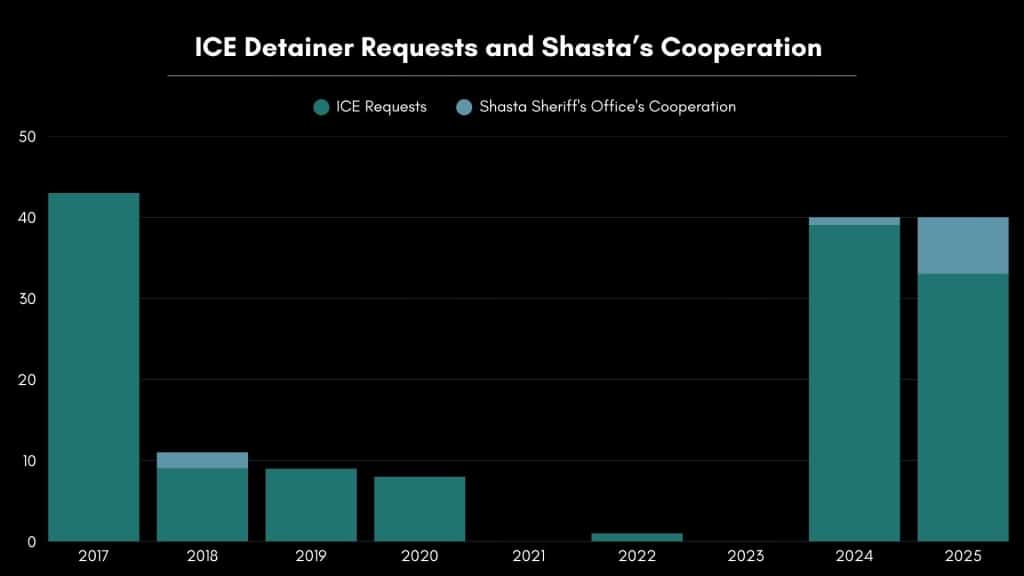
The Shasta County Jail received more than 30 of these requests in 2025, according to documents obtained from the sheriff’s office by Shasta Scout. Per the Values Act, the jail is prohibited from complying with these requests unless the inmate meets the criteria for an exception to the law, which could be that the individual has a federal warrant out for their arrest or that they have been convicted of certain crimes, such as child abuse or human trafficking.
The Values Act also prohibits law enforcement agencies from holding individuals past their release date, even if ICE made a hold request.
The records obtained from the sheriff’s office for 2025 show that it planned to comply with at least six detainer requests — for one additional request, it’s unclear if the jail planned to comply due to the way an internal form was filled out. All six requests appear to have met the criteria for a Values Act exception, allowing the sheriff’s office to comply.
Documents raise questions about data presented by the sheriff’s office compared to actual records
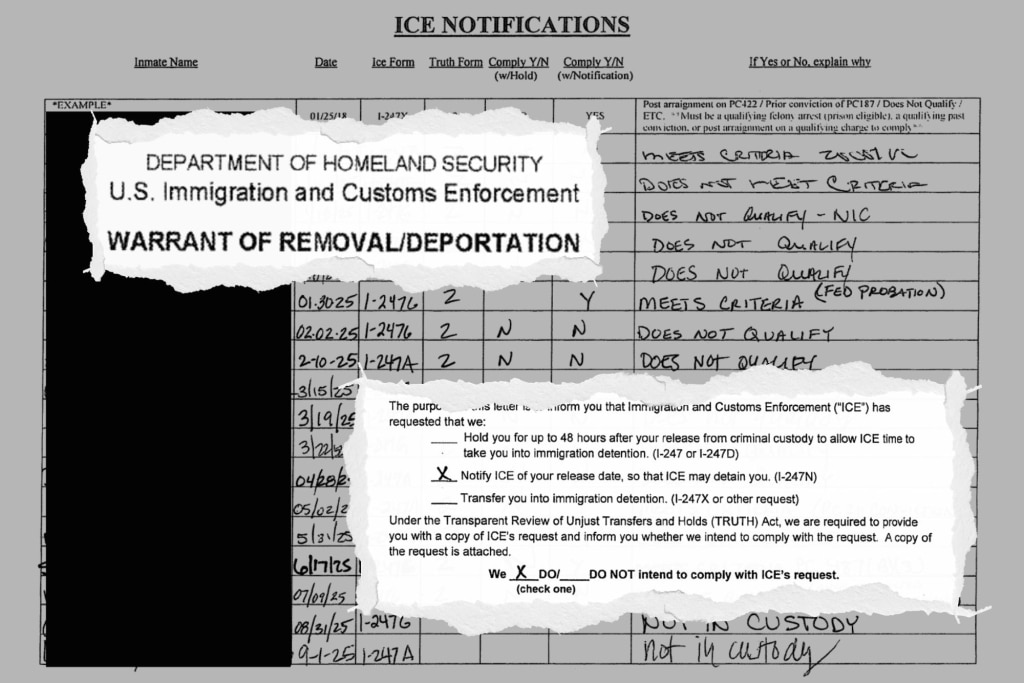
Per the TRUTH Act, if a law enforcement agency receives a detainer request and plans to comply with it, the agency must notify the subject of the request by informing the individual of the agency’s planned compliance and provide a copy of the request. Additionally, if an agency notifies ICE of the release date of an individual, the agency must provide the same notification in writing to the individual and their attorney.
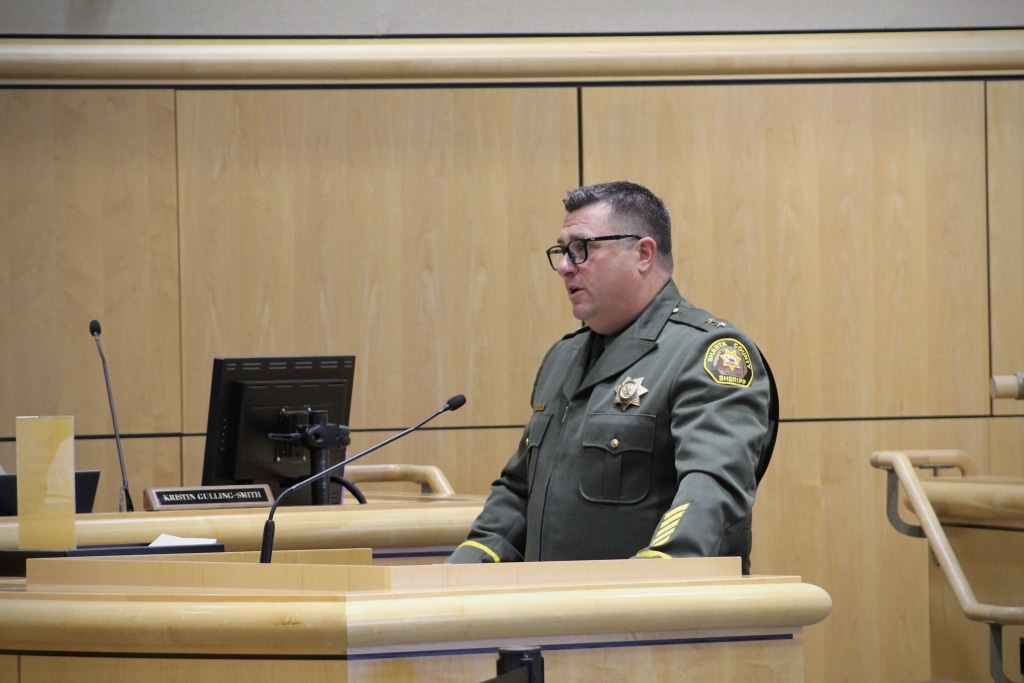
During Tuesday’s board of supervisors meeting, Undersheriff Randall said the jail gave information to ICE about seven individuals. But documents obtained by Shasta Scout show only five individuals were notified that the sheriff’s office planned to inform ICE of their release date so that ICE could detain them. It’s possible that in some cases the sheriff’s office notified ICE but didn’t inform inmates of its planned notification — though that step is required under California law. Randall declined to speak to a reporter after the meeting to address this and other questions and did not respond to a follow-up email.
Public records do not document the sheriff’s office having sent a second letter to these individuals or their attorneys telling them that ICE had officially been notified, something that should have also occurred. Shasta Scout made an additional records request to the sheriff’s office asking for the second letters, but a public records officer stated that “there is no other form that the Shasta County Sheriff’s Office provides.”
Here’s what records show happening after the sheriff’s office notifies ICE
After a law enforcement agency notifies ICE about the release date of an individual, ICE may try to coordinate with the jail to pick up the inmate. Last June, email communications showed that a deportation officer coordinated the pickup of a subject that ICE had a detainer request for, asking the Shasta Sheriff’s Office if they could arrive at the jail’s sallyport for direct transfer. The deportation officer later canceled the transfer without providing a reason.
Another email from a jail staffer obtained through document requests explained to the sheriff’s office that ICE had picked up multiple individuals from the jail lobby after they were released. The email was sent in response to a reminder from the California Department of Justice for law enforcement agencies to submit mandated reporting of any assistance they provided to ICE.
Last year holds the record for the most times in a single year that the Shasta Sheriff’s Office has publicly documented providing ICE access to, or information about, an individual since the office was mandated to publicly announce such information in 2018. That year, the sheriff’s office provided ICE access to two individuals, which was previously the most in any single year.
Critics condemn detainer requests, while ICE argues public safety
Wells, the senior staff attorney with the San Francisco civil rights nonprofit, said detainer requests are problematic for multiple reasons.
For one, he said, when a law enforcement agency complies with a detainer request, it is “prioritizing the agenda of the Trump administration over local law enforcement needs [and] local community needs” by pulling local resources away from local concerns.
Wells also said that when law enforcement agencies are known to assist ICE, it can lead to immigrants calling for police help less often out of fear they’ll be arrested and deported.
“When state and local authorities cooperate with ICE detainers,” Wells said, “then people essentially become afraid of calling the cops when they need them.”
But Jason Sweeney, a public affairs officer for ICE who’s based in Sacramento, said in an email statement that detainer requests are a matter of public safety.
He argued that detainers increase the safety of all involved “because it allows ICE to arrest these individuals in a secure and controlled custodial setting as opposed to at-large” where a noncitizen could potentially harm a community they would’ve been released in.
Sweeney also said that detainers conserve “scarce government resources” by allowing ICE to take noncitizens into custody directly rather than using resources to locate them at-large. ICE is the highest-funded law enforcement agency in the country, with a budget of $85 billion.
In February, the Department of Homeland Security called out the state of California for failing to comply with ICE detainer requests sent to incarceration facilities within the state, saying that when they’re not honored, the safety of ICE officers and the public is at risk.
“We are calling on Governor Newsom and his administration to commit to honoring the ICE arrest detainers of the more than 33,000 criminal illegal aliens in California’s custody,” former DHS Assistant Secretary Tricia McLaughlin said in the press release. “It is common sense and vital for public safety.”
Do you have information or a correction to share? Email us: editor@shastascout.org.
Comments (29)
Comments are closed.
Related Articles
ROV Curtis claims scheduling issues are preventing him from complying with state law to shred November 2024 ballots
The ballots were supposed to be retained only through Sept. 5, but they still haven’t been destroyed, allegedly due to a series of scheduling missteps and delays.

As gray wolves reemerge in Shasta, humans look for ways to address threats to livestock
Long eradicated from Northern California, gray wolves are reappearing — but their new habitat also means new threats for ranchers whose livestock provide easy prey. Efforts are being made at the county, state and federal levels to find solutions that allow for coexistence between people, their livestock and wolves.

Shasta board removes Kerns as planning commissioner amid contentious debate
County Counsel Joseph Larmour said Planning Commissioner Steve Kerns was being removed without cause. Supervisors who attempted to delve into what was behind Kerns’ removal received pushback from the county’s attorney.
I am in agreement that anyone who crosses the border without going through the legal way is breaking the law and thus a criminal. Anyone who doesn’t see a problem with crossing the border illegally is giving the big MIDDLE FINGER to those who came in legally and have patiently been waiting in line for years. To get around the Values Act i suggest that someone in the jail administration grow a pair and use a burner phone to call ICE to tell them when one of these criminals is scheduled to be released so they can take them into custody as they walk out of the jail. No local LE paperwork necessary.
The sheriff of Shasta County serves all the citizens of Shasta County with sincere dedication. I cannot find actionable fault with Sheriff Johnson within the article post by Shasta Scout. Errors in attempting to follow both “Rube Goldberg”-grade laws put forth by the Democrat Party controlled state legislature and Office of Governor of California as well as the torn-and-restitched and again mended (or amended) by the Congress of the United States and than endorsed by our not-clear-think president are common and excusable.
Matthew 25
“Then they also will answer [d]Him, saying, ‘Lord, when did we see You hungry or thirsty or a stranger or naked or sick or in prison, and did not minister to You?’ 45 Then He will answer them, saying, ‘Assuredly, I say to you, inasmuch as you did not do it to one of the least of these, you did not do it to Me.’ 46 And these will go away into everlasting punishment, but the righteous into eternal life.”
In other words, You called ICE on Jesus Christ…
Chris.. I missed the part in your Bible verse that says anything about a legal process. Everyone of the things that verse says to do is being done for these people while incarcerated. They are given drinks, food as well as medical care and cable TV. Visitors are welcome.
1. Inhumane Facility Conditions
Overcrowding: With the detention population reaching record highs in late 2025, facilities have faced severe overcrowding.
Unsanitary Environments: Reports highlight filthy living conditions, including lack of clean water and inadequate hygiene supplies.
Food and Nutrition: Complaints include the serving of contaminated, spoiled, or inadequate food.
2. Medical and Mental Health Neglect
Subpar Medical Care: Detainees report long delays in seeing doctors and denial of necessary, sometimes life-saving, treatment.
Neglect of Vulnerable Individuals: Reports suggest that people with cancer, brain tumors, and other severe conditions have faced neglect.
Mental Health Failures: ICE has been accused of failing to provide adequate mental health services and, in some cases, placing mentally ill individuals in solitary confinement.
3. Abuse and Misconduct
Sexual Assault and Harassment: Detainees have reported sexual assault, unwanted touching, and harassment by facility staff, including incidents against minors.
Excessive Force: Reports include allegations of officers using excessive force—such as choking, kicking, or beating—when not resisted.
Unlawful Detention of Citizens: There are reported cases of U.S. citizens being arrested and held by ICE without cause, sometimes for several hours or days.
4. Retaliation and Due Process Violations
Misuse of Solitary Confinement: Solitary confinement has reportedly been used as a retaliatory tool to punish individuals for filing grievances, reporting abuse, or requesting basic needs like showers.
Due Process Violations: Many complain of being subjected to “fast-track” deportations without proper hearings or being detained after appearing for scheduled court hearings.
“Disappearing” Detainees: The detainee locator system has been described as unreliable, with individuals’ whereabouts hidden from family and attorneys for days.
5. Targeting and Harassment
Indiscriminate Detention: Complaints suggest that ICE is targeting long-time residents, pregnant individuals, veterans, and people with no criminal records.
** Courthouse Arrests:** Activists have raised concerns about ICE agents arresting people at court buildings.
6. Sexual Abuse Allegations
Systemic Misconduct: Over 900 former detainees have filed complaints alleging decades of sexual abuse, including forced sexual acts and violence in detention facilities.
These allegations have been documented in reports from legal advocacy groups, the Department of Homeland Security (DHS) Office of Inspector General (OIG), and various lawsuits against the agency.
You bailed on your Sunday School lesson too fast. Jesus was born, raised, tried and executed under Roman rule, yet He never condemns what was clearly tyranny. Jesus did however have sharp and clear words for those who leverage religion for gain.
Yep, jail is a lousy place to be. The odds of avoiding jail are overwhelming good if you don’t break the law. There are millions and millions of taxpayers that have zero problems with our justice system because they adhere to that simple idea. Not breaking the laws doesn’t cost anything, aids with finding employment, reduces stress and is wildly good for your mental health. We should all give the idea a spin.
“Jesus did however have sharp and clear words for those who leverage religion for gain.”
.
Yes, and you should actually take that to heart.
Bruce, just stop.
.
The Bible says to love your neighbor as yourself. When you are rounding up people indiscriminately as is being done, then that sure isn’t love.
.
One of the worst things possible is to try and use people’s religious beliefs for political gain. And you know that is what you are doing with your propaganda.
.
Remember the parable of the Good Samaritan.
.
Good night Bruce.
Thank you, Madison, for the clear reporting.
Thank you Sheriff Johnson
We have enough domestic problems and expense with our own criminal population
Get illegal criminals out of here..as many and as quickly as is legally permissible with all the handcuffs put on you
If you’re for illegals try taking one of these criminals into your home and wake up with one of them victimizing you
Then everyone gets religion
Last year replaced my roof. Called several local roofing contractors and when I asked questions regarding their bids they basically ghosted me. How dare me to ask clarification on method or products. Let’s get this done myself. I have been a remodeling contractor for years in another county and have worked with and hired hispanic workers consistently. I did not have the local roledex here in Shasta county. I then reached out to local labor. Who shows up? Local white trash tweekers. Forget this so I hire hispanic laborers who stayed the week at my house. Ate with us and god forbid slept in my home. Hardest working people. Always have been. Appreciative for the work. Then hired a hispanic father son roofing contractor to actually install the product that I specified like rain&ice, continuous ridge vent, architectural shingles etc. Your white superiority ignorance is showing how absolutely small minded and I would presume very little traveled you are.
You’re right, let’s get criminals out of here.
.
But don’t label honest hard working men and women who only want something better for themselves and their families as criminals.
.
By the way, did you know that Jesus was considered a criminal by the Roman state?
I am continually impressed with the depth and quality of reporting by Shasta Scout reporters! Ethical investigative journalists are an essential part of a democracy that helps keep public and powerful people between the guardrails separating right from wrong. Keep up the excellent work!
The Values Act is woke legislation that reinforces California as a Sanctuary State. This article defines in detail the paperwork process of sharing fingerprint information and collaborating with the Federal Gov… to which I say thank goodness their is at least the potential for process and transfer.
.
Legislation created by the ACLU signed by retired to a multi million dollar ranch Gov. Moonbeam (who I low-key like) and promoted by Gov. “My Best Friend’s Wife (who is a “horrible person) is legislation that makes the local community less safe. Hand every illegal person who finds their way to local jail over to the federal government. Simple and cheaper for us. Bye. Litigate deportation at the next level.
.
The premis by the ACLU is that it will make local illegal immigrants less likely to call law enforcement to report crimes. That is presumptive and impossible to quantify. One can equally argue that collaborative detainment discourages immigration at the source or that there will be less crimes to report. The consequence of illegal immigration has been the slow erosion of social services and wages and the potential for terrorist activity (think bombs from latin or non latin folks making it in on foot). We need to discourage illegal immigration. ACLU lawyers doesnt get paid to discuss this.
.
Unfortunately, it seems the Sherrifs department did a great job complying with the Values Act. I wish they were worse at their job in this one case.
It must suck to be so afraid of people that are different from you.
I married one.
You married one?
.
Like as in you married one of “those” people?
.
Oblivious…
I did. I employ a few also. Real world bro. Try it.
Lol
.
A couple of days late here to respond because I actually have a life.
.
But what a savior you are…
You married one of “them” and hired some of “them”.
.
You want to talk about the real world? Maybe you should drop your superiority complex and come back down to earth.
.
Again, it must suck to be so afraid of those people who are different from you.
Marrying, hiring, firing… real world stuff. You should stop repeating yourself.
Nope.
.
Nate, I’ll repeat myself as much as I need to.
.
You know in the real world there are lots of other places on this planet besides Shasta county.
.
How many of those places have you been to?
.
In the real world you have to accept that there are people that are different from you and learn how to deal with them.
.
In the real world some people have to struggle from the very bottom until they find success. Don’t talk to me about the real world, because you will get schooled.
.
But hey man, hopefully you can expand your mind and see there’s a much bigger world than this little place that you live in.
.
Have a good night
Many illegals are gang members and narco trafficker’s. Thank you Sheriff Johnson for protecting our community,
Its worse in the cities than Shasta County. Id love to give a universal pass to all the farm workers, hotel workers, restaurant chefs, gorgeous nannies, my fellow catholics, etc etc, but how do you do that without keeping the garbage that sneaks thru that is gang related, drug related? You can’t. Enterprising immigrants can still get in thru marriage. Do it. Plenty of ugly and/or dumb Americans to choose from. I am one of them. 20 years in, still gringo robot dancing to salsa w my beautiful wife.
How would you know this information? Are you gang banging with these narco traffickers yourself? Are you cooking or just distributing to the local community? I am concerned that you know this information first hand and feel the authorities should be asking you about your firsthand knowledge.
“Many illegals are gang members and narco trafficker’s.”
Many more are simply here to pick fruit and vegetables seasonally.
Im so sick of the Trump shit using a demonic paint brush to paint entire third world countries as gang members, prison releases and narco trafficker’s.
Im so thankful for the Christian Organizations at the border…
“Numerous Christian organizations provide humanitarian aid, shelter, legal services, and advocacy for migrants and asylum seekers along the U.S.-Mexico border. Key groups include World Relief, Catholic Charities, Kino Border Initiative, and Border Servant Corps. These organizations offer water, food, clothing, shelter, and transportation assistance, often working in collaboration with local churches.”
Why because true Christians ARE COMMANDED to help
“The Quartet of the Vulnerable
The Poor: Those lacking material resources or land to support themselves.
The Widows: Women who lost their husbands and, consequently, their social and economic status.
The Orphans: Children without fathers to provide inheritance, protection, or a name.
The Stranger (Sojourner): Immigrants or displaced people living in a land not their own.”
Comments here describe a false “America First” complete and total misunderstanding of Holy Scripture, Christianity and Gods Desires!
Hurry , your going to miss Trump reading the Bible… LMAO
What an ignorant and factually inaccurate comment. Additionally, humans are not “illegal” and simply being undocumented in this country is not a crime (i.e. overstaying a visa is a civil offense). US citizens are much more likely to commit crimes than undocumented immigrants. Many undocumented immigrants pay taxes and fund social programs they will never reap the benefits of (Social Security, Medicare/Medicaid, etc.). They greatly benefit our economy and provide much needed labor as our country has a declining replacement rate. Beyond these measures of “value”, people have inherent value and a right to seek food, water, safety, and freedom and to not at least sympathize with those efforts is to lose your humanity.
Your argument is the traditional argument for assylum and allowing illegal immigration to continue. It’s less popular every year as the number grows.
Hi Tricia
Respectfully you are factually incorrect. The civil aspect of illegal entry is but one aspect of our Federal code. They just didnt parachute in, they crossed our border illegally.. unacceptable in any civilized nation in the world
Please see the crime under
8 USC 1325 as well as other sections.
Illegal entry is a crime punishable by a fine and or imprisonment
Some people like to push the narrative echoed by agenda driven news organizations or politicians vying for votes, generally from liberals and illegals themselves, that illegals are just violating civil law
It is..in fact a crime
Thank you
You are so brave to tell the community that you are so easily conned and gaslighted. I had hoped with all the Trump promises made and promises broken, community members like you would have realized how the rich and powerful couldn’t care less about your safety and finances. But no, you seem to ignore facts. But your bravado in professing your ignorance and belief in fraud is to be admired.