
Tule Lake Pilgrimage preserves a painful past in northern California
The unjust incarceration of Japanese Americans during World War II often remains forgotten, but the Tule Lake Pilgrimage protects its legacy and the lessons it has to teach. The pilgrimage, and its history, have been intertwined with local communities in Redding and other parts of northern California for decades.
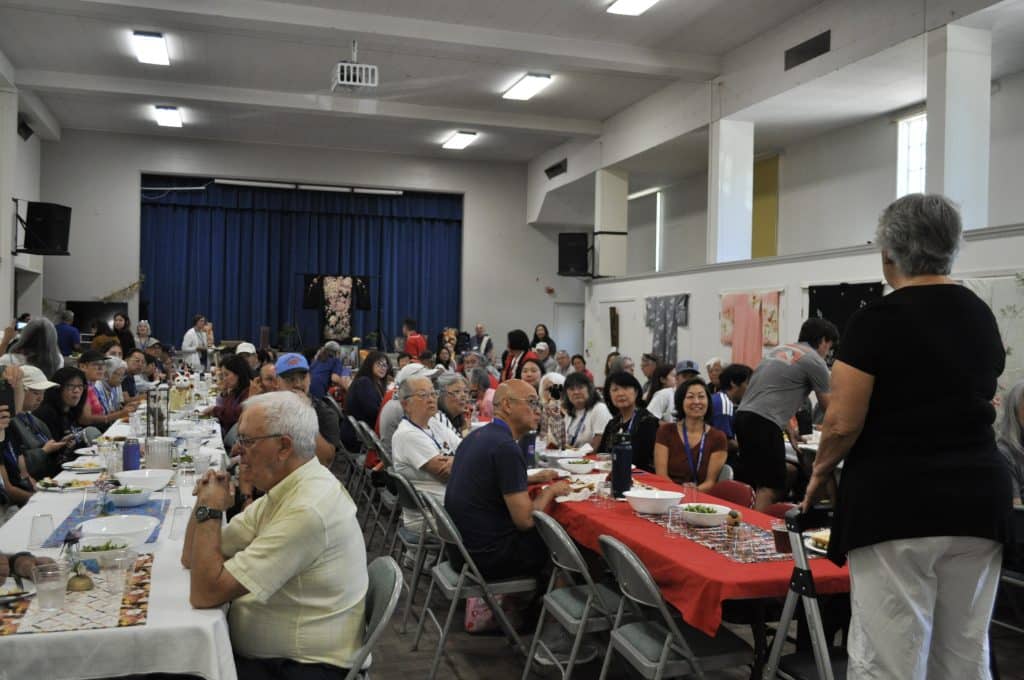
On July 3, the First United Methodist Church in Redding was crowded with families and individuals who chattered over lunch, wearing colorful lanyards that read “Tule Lake Pilgrimage.” Church members and Redding community members busily placed bowls of boiled edamame on the tables, next to the Japanese dolls and ceramics that had been laid out as decorations that morning.
The Tule Lake Pilgrimage is a biennial initiative led by the Tule Lake Committee, an organization of survivors and descendants of Japanese American families who were incarcerated by the American government in the Tule Lake prison camp and segregation center during World War II. On July 4 weekend, every two years, around 400 participants of several generations travel in five buses up to the site of incarceration at the Tule Lake National Monument, which is spread across Modoc and Siskiyou counties just southeast of Oregon.
Among those sitting at tables was 82-year-old Satsuki Ina, a psychotherapist and author who was born in the Tule Lake Segregation Center in 1944. Ina, whose parents were held at separate concentration camps during the war, said her earliest memory is of leaving the Crystal City Family Internment Camp in Texas at two-years-old.
When Ina’s parents passed, she discovered a collection of letters and haikus written by her parents to each other, inspiring her book The Poet and the Silk Girl about the trauma of Japanese American incarceration.
“It’s very powerful to be back with the community to share our stories,” Ina said, referring to the crowded room of individuals, many of whom were in conversation about family histories and their connections to shared Japanese American history.
The First United Methodist Church has hosted a lunch stop for pilgrimage travelers for over two decades now, and has since become intertwined with the work of preserving a part of northern California history that is often forgotten.
America’s dark past of unjust incarceration
Following the Pearl Harbor Attack by the Japanese Empire in December 1941, President Franklin D. Roosevelt issued Executive Order 9066, which authorized the forced removal and incarceration of any individual deemed a security threat.
The decision was driven by high anti-Japanese sentiment and suspicion, despite most Japanese Americans and individuals of Japanese descent in America having no ties to the Japanese government.
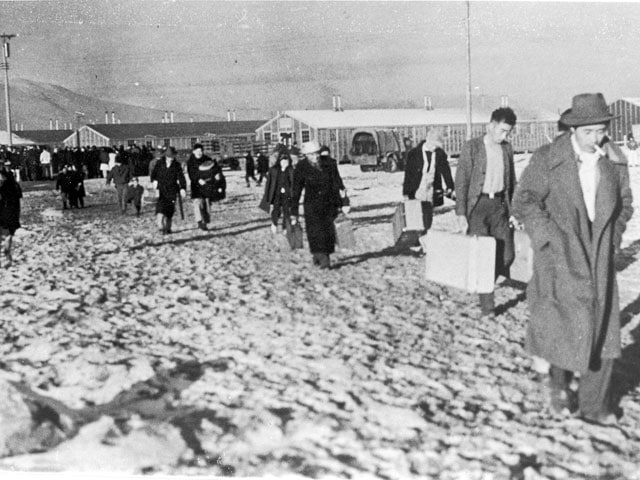
The order led to the mass incarceration of 120,000 Japanese Americans and other individuals of Japanese descent beginning in May of 1942. All persons with at least one-sixteenth Japanese blood were given less than a week to leave their homes and “relocate” to one of ten prison camps operated by the U.S. government. Many families were separated without notice of where they were being sent or when they would be let out.
About two-thirds of those incarcerated were full U.S. citizens, born and raised on American land. None were provided legal basis or due process for their incarceration.
The incident is often referred to as Japanese American “internment,” but incarceration is a more accurate term as “internment” refers to legally permissible detention of “enemy aliens,” or non-citizens. While the U.S. government referred to the camps as “relocation centers,” Tule Lake and others were more accurately prison camps, or concentration camps.
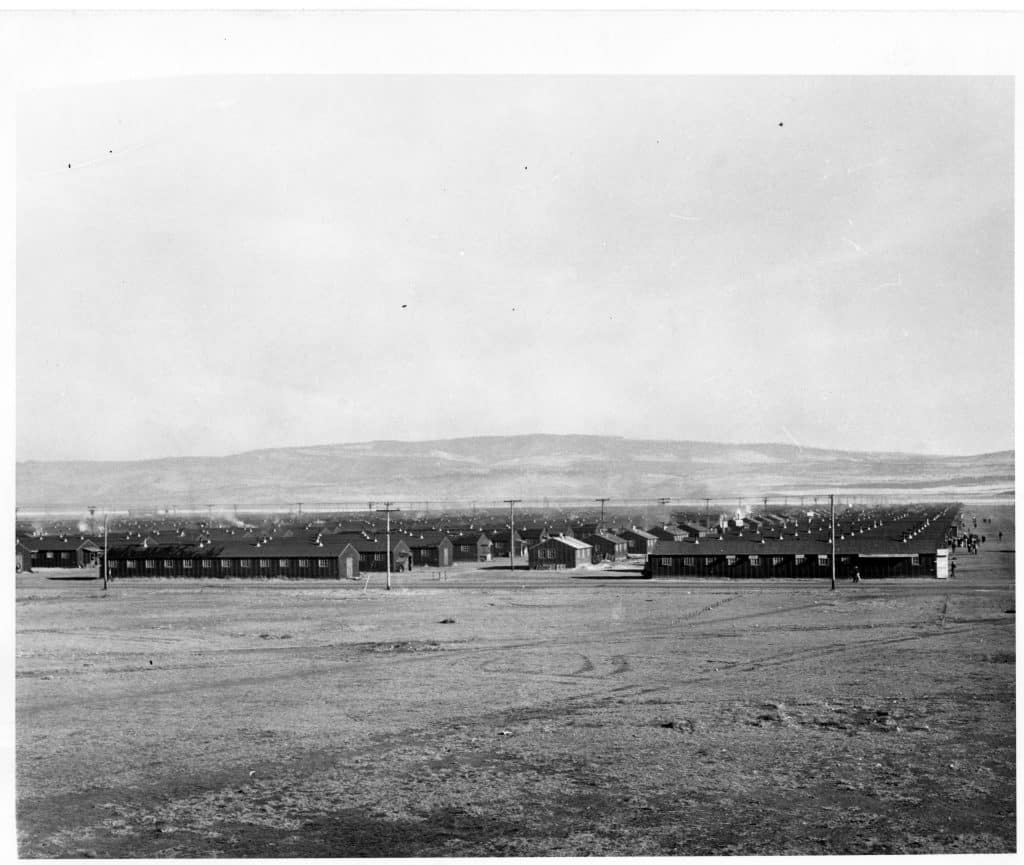
Ina, and some of the others who stopped in Redding as part of the Tule Lake pilgrimage this year, were among those incarcerated at the Tule Lake site. It was the largest of the ten concentration camps, with a total of 29,840 incarcerated over the course of four years. The site is now preserved as a national monument, and on a clear day, Mount Shasta is visible from the camp remains.
In February 1943, one year after Japanese Americans were first put in camps, the American government issued a “loyalty” questionnaire to those incarcerated in all ten camps. It included two questions: one which asked if they would be willing to serve in or volunteer for the armed forces of the United States, and another asking if they would swear “unqualified allegiance” to the United States of America and “foreswear any form of allegiance or obedience to the Japanese emperor.”
Anyone who had answered “no” to either question, or refused to answer, was sent to be incarcerated at the Tule Lake camp, which had been converted into the high-security Tule Lake Segregation Center. It included guard towers, fences, and a large military police presence.
The Tule Lake Segregation Center became known as the site for “disloyal” prisoners, or those who had resisted, and were highly stigmatized within the Japanese American community. Young men who had answered “no” to both questions, in particular, became known as “no-no boys.”
Tule Lake closed in May 1946, seven months after the end of World War II and four years after it was opened.
Hiroshi Shimizu, chair of the Tule Lake Committee, was born in the Topaz Internment Camp and later moved to the Tule Lake Segregation Center. Shimizu, who is now 83, said that the majority of those who participate in the pilgrimage have had family incarcerated in the concentration camps.
Shimizu himself said he doesn’t recall much from his experience, but could recall certain moments from his childhood, and the way the prison camps impacted his family.
“I do remember once my mother taking me to this fence, and she was trying to point out my father, who was walking to somewhere from the stockade,” Shimizu said. “She was trying to point him out, but I couldn’t focus in on him, and didn’t actually find him, and I think I remember that because of the great disappointment of not being able to spot him.” In reflection, Shimizu said, he was likely not even one-year-old at the time of the memory.
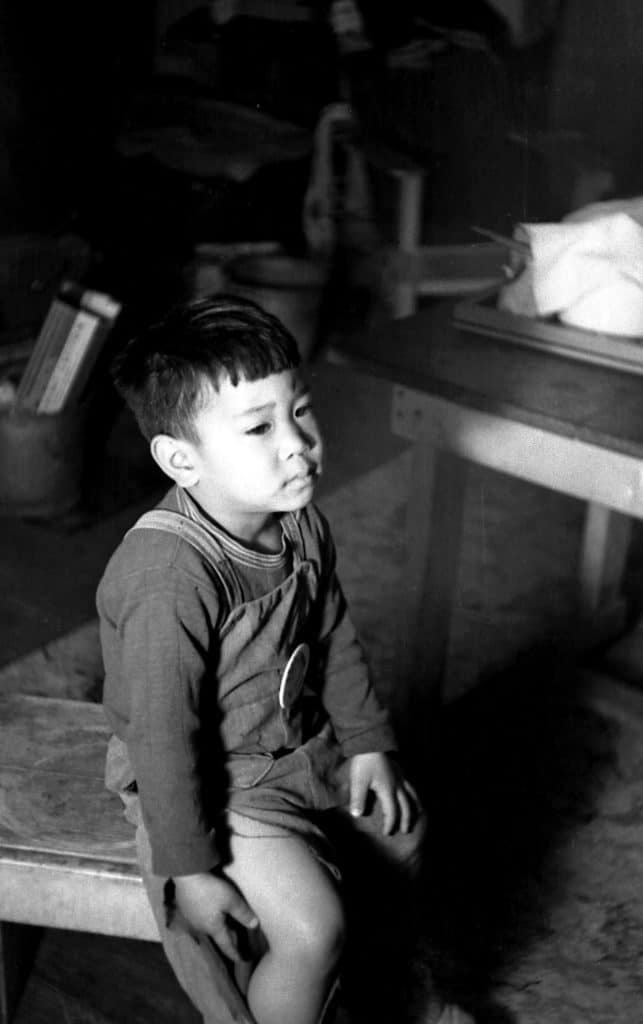
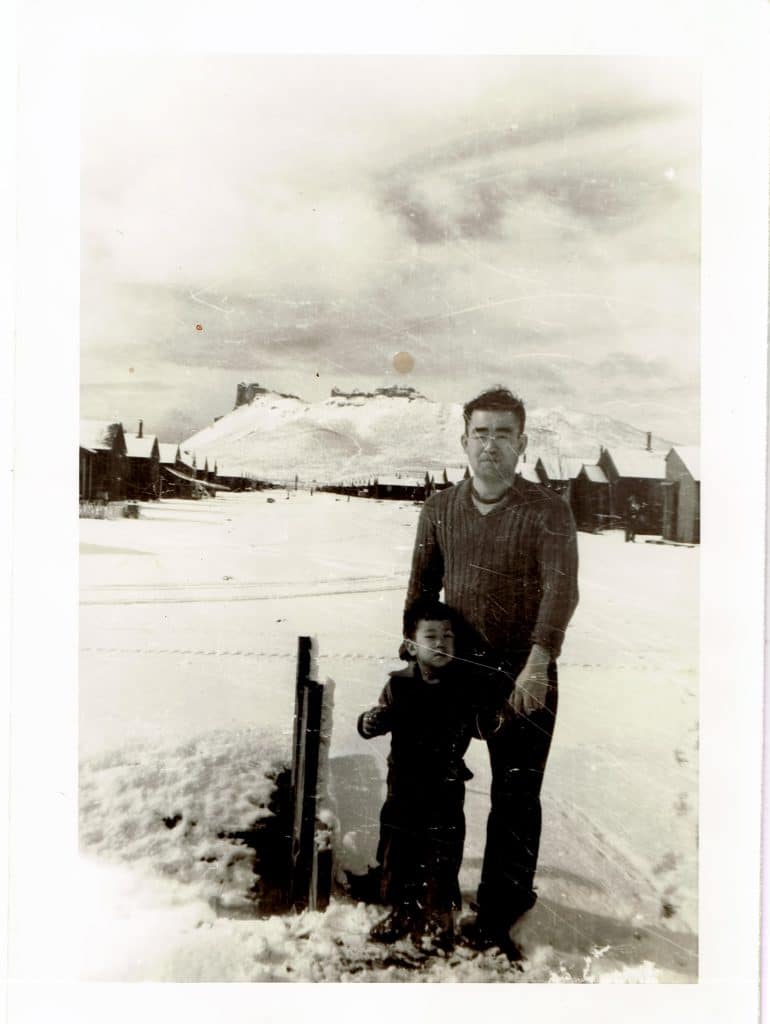
Hiroshi Shimizu at the Tule Lake Segregation Center at around three-years-old and standing with his father Iwao Shimizu at Castle Rock around 1946. Photos courtesy of Hiroshi Shimizu
“It had a lasting effect on the family, and on me, to this day,” Shimizu said of the incarceration, recalling his father, who returned to San Francisco after his release as an editor and reporter for local Japanese-language newspapers.
“Because of the incarceration and the war, he retreated back into the Japanese world in America, whereas before the war, he was more expansive in his ambitions and his ideas of what he wanted to do here.”
How the pilgrimage came to Redding
The Redding First Methodist Church has sponsored a lunch for the pilgrimage since the 1990s, when Lee Macy and Don Yost, local Redding residents and members of the First United Methodist Church, participated in the pilgrimage themselves.
Macy recalled that she first learned about Japanese American incarceration from a photograph exhibition featuring concentration camps. As a local middle school teacher, she began teaching about Japanese American history in the classroom, and eventually decided to go on the Tule Lake pilgrimage herself.
In 1992, when she first participated, the pilgrimage was making its Redding lunch stop in a shopping mall. “That wasn’t a very welcoming experience,” Macy noted, and reached out to church member Ted Klaseen, who helped organize a lunch and welcome the pilgrimage members at the next occurrence.
Since then, church members Ann and Damon Cropsey have led the organization of the lunches, gathering volunteers to set up, cook, and provide hospitality as around 400 pilgrimage members pass through the church at staggered times throughout the day.
“The connections between the church and the pilgrims have been fantastic,” Damon Cropsey said.
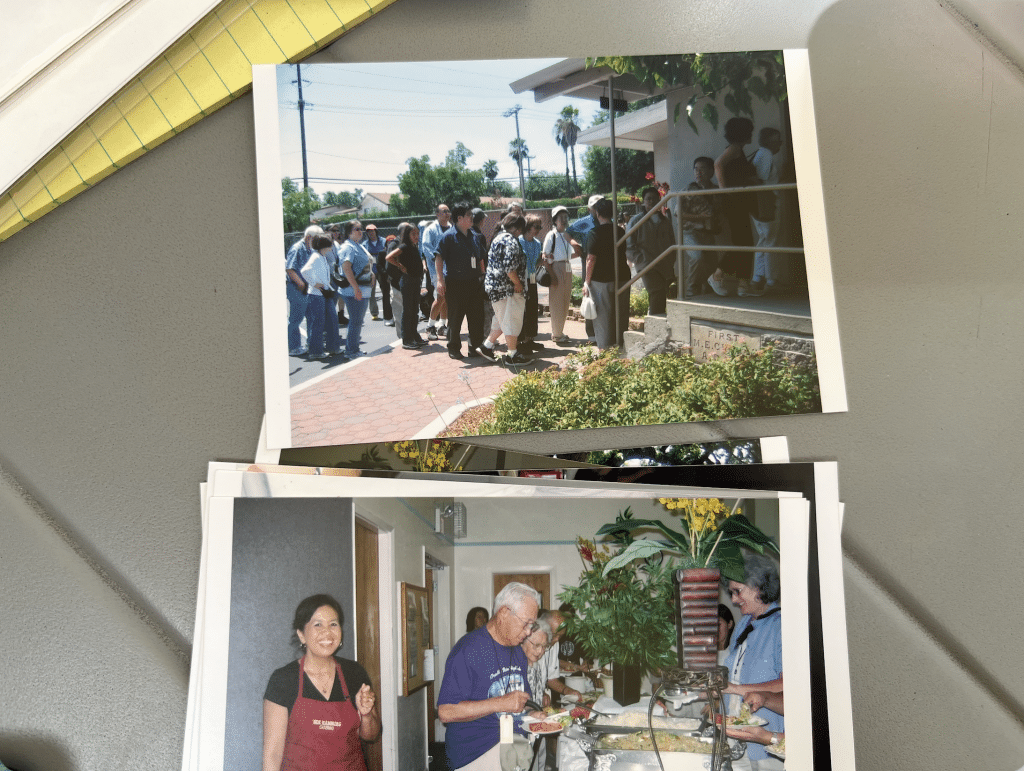
Vicki Ono, a local community leader and retired teacher in Redding, took over the task of organizing the lunch this year. Ono’s own aunt, Joanne Iritani, had been incarcerated as a Japanese American and later worked with Ono’s uncle, Frank Iritani, in organizing pilgrimages in the 1990s. Though she herself has never been on the pilgrimage, Ono was determined to make others feel welcome.
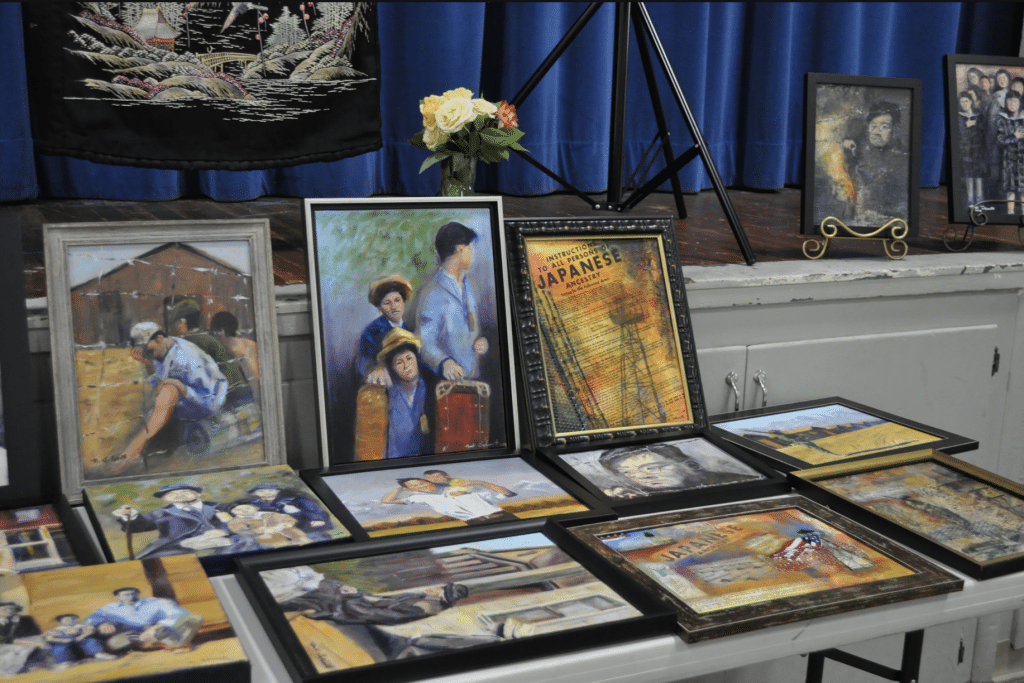
For this year’s event, Ono gathered local members of the Japanese community as well as church volunteers, and decorated the room with kimonos and Japanese dolls. The lunch also featured artwork from Michi Takemoto, a local Redding artist born in the Topaz Internment Camp, whose paintings highlight Japanese American incarceration.
“It’s been a wonderful thing. They really go out of their way to be great hosts,” Shimizu said about the church members.
What the pilgrimage means for participants
Few survivors of Japanese American concentration camps are alive today, but some who are travel with the Tule Lake pilgrimage to tell their stories, and have done so since the pilgrimage unofficially began in 1969.
Mits Yamamoto was the oldest participant of the pilgrimage this year, at 100-years-old.
Yamamoto was incarcerated at Jerome War Relocation Center in Arkansas when he was 16, spending part of his teenage years behind barbed wire. He recalled that while he had a relatively positive experience around peers of similar ages in the concentration camp, many others, like the ‘no-no boys,’ had far more negative experiences.
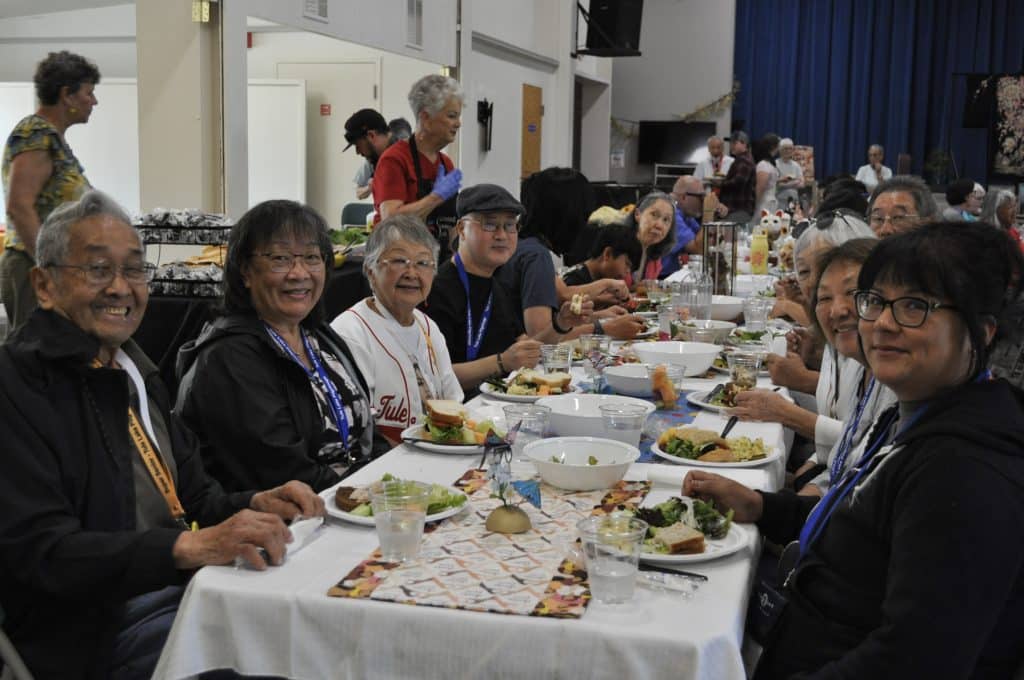
The pilgrimage’s programming includes first-hand accounts from survivors like Yamamoto, as well as lectures and discussion sessions to learn in-depth about what happened at Tule Lake.
Many Japanese American families suffered racism and stigma following their release from the concentration camps, and the experience of being at the prison camps was often intertwined with shame. Many who were incarcerated never discussed their experience.
Tess Sakuma-Dunlap, a local Redding resident who volunteered at the lunch and whose father was incarcerated at Tule Lake, recalled that despite both her parents having been incarcerated, they never mentioned it and maintained their American patriotism.
“I didn’t hear anything about it until I was in high school, and it really surprised me,” she remembered. “They never said anything bad about the government, and they put up the flag during all the holidays.”
For many similar descendants of Japanese American survivors who don’t have first-hand experiences or accounts, the pilgrimage provides an opportunity to learn and understand their own family’s histories.
Mitch Higa, who is a Sansei, or third-generation Japanese American, and whose parents were both incarcerated in their youth, said he was raised in southern California, where his parents mentioned their experiences in the camps only very casually. His first Tule Lake pilgrimage in 2002 was “mind-blowing,” he said, as he realized how little his parents had spoken of the darker parts of the camp’s history.
“I think it started to dawn on me at that point what a segregation center was, and the stigma from the Japanese American community who were not held in Tule Lake,” he said, describing witnessing the jail where “disloyal” Japanese Americans had been incarcerated. “That just started to make me want to learn more.”
Higa noted that to him, the pilgrimage is about honoring his family’s legacy, as well as being in community with others in order to make sense of a darker side of Japanese American history.
“I’ve been to about ten pilgrimages in the past 24 years, and I know going in that we all have a shared history,” he said. “It’s really rare for me to be immediately vulnerable and open to talk about my family history, but that setting is really great.”
Remembering as a way to protect others
Alongside the pilgrimage, the Tule Lake Committee also works to preserve the site of Tule Lake, which was named one of 11 most endangered historic places by the National Trust for Historic Preservation this March. The designation comes as the Federal Aviation Authority and Modoc County are attempting to construct a security fence around the Tulelake Municipal Airport, an airfield within the former concentration camp.
Committee leaders have spoken out against the plan, noting that the site needs to be preserved as it is to protect the legacy of the injustice that Japanese Americans endured.
The committee is also deeply involved in activism against present-day incarceration of immigrant children and families, many of whom are provided no due process, including some who are imprisoned under a rhetoric of “security risks” and “economic threats” that echo Japanese American history.
This year’s pilgrimage, which was titled “Resistance and Solidarity,” featured a protest to raise connections between the history of resistance at Tule Lake and present-day events, alongside a statement issued by the Tule Lake Committee calling for action to protect those unjustly removed, separated, or incarcerated with no due process.
Satsuki Ina, who is an avid activist with Tsuru for Solidarity, speaks out against unjust deportation and detention of children and others in racial communities. She said that traveling on the pilgrimage holds a special weight amid ongoing ICE raids and discriminatory detentions.
“The current situation highlights for people that our history is being repeated again, and we identify with the children that are being imprisoned today,” she said, noting that many Japanese American survivors who are now in their 80s or 90s were also children at the time of incarceration. “And we’re going to stand up for them.”
Moe Shimizu is a student at Yale University. She’s reporting for Shasta Scout as a 2026 summer intern, with support from the Nonprofit Newsroom Internship Program — created by The Scripps Howard Fund and the Institute for Nonprofit News.
Do you have a correction to share? Email us: editor@shastascout.org.
Author

Comments (34)
Comments are closed.
Related Articles
Anderson police chief tasked to respond to council questions about Flock cameras
Council members heard from more than a dozen public commenters with concerns about the cameras which have been deployed in Anderson since 2019.
Meet Elise Ramirez Sloan for Redding City Council
Nine candidates are running for three open seats on the council. Ramirez Sloan moved to Redding two years ago, and she’s worked in the restaurant industry and in administration for Eureka High School. She now focuses on volunteering and giving back to the community.
Meet Bruce Ross for Shasta County Office of Education Trustee
Bruce Ross is running for one of four open seats on SCOE. He’s served on another local school district board for more than a decade and is a parent who hopes to bring a “focus on kids’ needs, not adults’ dramas” to the SCOE Board.
Speaking of detention camps;
see the US government building detention centers for ‘immigrants’ …
the numbers they provide are far larger than our estimated immigrant population presently
Remember Jade Helm??
except this is happening for real today in our ‘democracy’
As of early 2026 the current administration was aiming for a total ICE detention capacity of ~110,000 *illegal* immigrants.
There are over 50 million immigrants in the US, 10-15 million of which are here illegally.
Leaders are forced to make tough decisions in a crisis. It was a WORLD WAR people. They weren’t thrown into ovens in Tule Lake. Grow up whiners.
Yes absolutely true. They were not thrown into ovens. All that really happened to them is that they had their homes taken away, their livelihoods eliminated, their dignity trashed and o yeah, their freedom taken away.
What’s the problem?
Wonderful, and informative writing. Thank you Moe and Shasta Scout.
The parents of my best friend in high school were incarcerated at Tule Lake. The family had owned a strawberry farm near Watsonville prior to the war, which they lost (I don’t recall if it was confiscated or auctioned for inability to pay taxes during their absence). After the war they settled in Sacramento where the dad worked in canneries and later as a barber. The parents were paid $20,000 each in reparations during the Reagan administration—obviously not enough to repurchase prime farmland near Monterrey Bay.
.
“No payment can make up for those lost years, so what is most important in this bill has less to do with property than with honor for here we admit a wrong.”
—Ronald Reagan, signing the Civil Liberties Act of 1988 (reparations law)
I saw/toured the Tule Lake camp in 1951, as a six-year-old: Dad, a veteran of the Okinawa landings, had just taken the job of Asst. Supt. of Modoc Co. Schools, and wanted we boys to see the terrible phenomenon. It looked pretty awful; I particularly recall the tall, crude guard towers emplaced at the camp corners — plus, on a huge butte nearby, there was what appeared to be one further one. And barbed-wire. It wasn’t there much longer, as the buildings were slowly sold and move to nearby communities, farms, etc. My future wife lived in on flimsy unit when her family first moved to Alturas, about 1959; hot in summer and cold (!) in winter! Later, our family owned a huge metal Quonset Hut building that had been for a while the local Chrysler-Plymouth dealer, later used a furniture storage, and much later dismantled and moved to Surprise Valley as a barn.
We went to school with a family who had been interned there, the Y——s, who ran the local dry-cleaners/laundry service, and had the Sac BEE franchise for our corner of the state. Nice folks; 13 kids, very socially involved esp in sports events. During the famous ‘baby boom’ Dad facilitated a new elem. school in Newell (the actual site of the camp) but it was shuttered long ago when the student population dried up largely; makes me very sad to see it all boarded up and graffitied, if they haven’t torn it down already.
Incredibly racist action by a ‘liberal’ Dem — but the Pacific War was racist from the start, from both sides, never doubt it! The Imperial Japanese were just as prejudiced as we Americans at the time; hopefully we’ve learned…??
US Vet, retired male Kindergarten teacher, Chico since ’66
A field trip to the Tule Lake Internment/Concentration Camp should be required for north state high school students. This a dark part of America’s history that doesn’t get enough attention, and it’s in our backyard.
Also, I didn’t realize that the camps closed SEVEN months after the end of the war?
That should never be required.
I agree! Definitely teach about it and learn from past mistakes. The MAGA impulse to edit parts of history they don’t like is willful ignorance and inappropriate racial censorship. Our descendants deserve to have the entire reality of this country’s history available to them. To learn more find the podcast BURN ORDER. A fascinating history of Japanese Internment and the attempted coverup.
There are many Japanese American citizens living in Redding/Shasta County that have to live with this nightmare on a daily basis. Thanks to the Methodist Church, its volunteers in putting this on every 2 years. Camp internees and their families came from LA, San Jose, SF, Sacramento and other areas of CA. It was very emotional to be part of this pilgrimage.
I was not aware of the“loyalty” questionnaire. I wonder why so many answered no to either question? I would like to have heard more about why they would have answered that way.
Japanese Americans have been excellent citizens of this country and I have great respect for Japan and their culture.
The same cannot be said for all cultures and all immigrants. It is neither intolerant, nor racist or anti immigrant to have standards that are strictly followed.
Would you want to wage war on your parents, grandparents, and extended family? You couldn’t say “I’ll fight in Europe, but not Japan…”
And remember that contrary to our propaganda, the US engaged in warfare against Japan first (freezing Japanese funds July 26, 1941 and enacting a blockade/oil embargo on August 1, 1941 – more than 4 months before the counterattack on Pearl Harbor on December 7, 1941).
For background, Japan and China had been at war since 1937 but China was an important trading partner of the USA. When Japan began a blockade/embargo of goods into China by invading/controlling French Indochina, the US decided to intervene on behalf of China.
Oh, so Pearl Harbor was our fault? Copy that. They should not have poked the bear.
I’m saying when you wage war playing (White) World Police you shouldn’t be surprised by retaliation from (minority) countries you mistreat.
Unfortunately we have to.
Switzerland, famous for its international neutrality, has had a total of 50 domestic deaths from international conflict and/or terrorism over the last 100 years, 49 of which were targeted at citizens of other countries by citizens of other countries.
Switzerland is a joke.
The US is increasingly the joke, or rather international villain.
You see this more and more on plotlines of foreign allies’ books, shows, and movies. And these are our allies!
2 examples:
The Silent Service, a 1986 Japanese manga recently revived into movie form where the present-day US navy is the villain for subjugating Japan and the rest of the world.
The Capture, a 2019-2026 BBC thriller series where the US corrupts British intelligence into going along with fabricating CCTV footage to convict suspected terrorists (killing innocent Brits to keep the secret)
Great article! Thanks very much! You have a bright career ahead!
There is another internment camp in the area. Close to the Klamath Refuge headquarters are the remains of a CCC camp that was converted to wartime internment. Several of the buildings have been restored and are managed by the National Park Service. For awhile, this was used as maximum security. People from other camps in the western US were brought here if they resisted internment. This camp was about ten miles west of the much larger Tule Lake camp.
Excellent article about the history behind the concentration camps and the ongoing rememberances. Congratulations to Don Yost and Lee Macy for starting the luncheons to welcome visitors at the First United Methodist Church. This sordid part of United States history is just behind the genocide of Native Americans and the enslavement of Black people.
While America has changed for the better, the inhumane treatment of black and brown refugess and migrants is not as bad, however it is in ways similar. Black, Hispanic and Muslim immigrants are particulary targeted, not because of any criminal history, but because of their color and ethnic background regardless of whether they have lived a productive life in the United States. This is directed by a president who retorically asked why can’t we get immigrants from Norway or Sweden instead of these “s…thole” countries. (Ones predominatly non-white) and welcomes White Afrikaners from South Africa.
While we do have an immigration problem in the United States that needs to be fixed, the way the Trump administration is carrying it out is purposely cruel and almost completely race based and deporting people regardless of how long they have lived productive and crime free lives in the US.
Why aren’t the megachurches in Redding speaking out about the cruelty and racism? Is it because their leaders and there members support this. Hopefully they will send comments to this article.
“Black, Hispanic and Muslim immigrants are particulary targeted, not because of any criminal history, but because of their color and ethnic background regardless of whether they have lived a productive life in the United States. This is directed by a president who retorically asked why can’t we get immigrants from Norway or Sweden instead of these “s…thole” countries. (Ones predominatly non-white) and welcomes White Afrikaners from South Africa. ”
Trump’s truthful statement was about new illegal immigrants, not those who have lived a productive life in the United States. The White Afrikaners from South Africa are true refuges, not illegal invaders
“The White Afrikaners from South Africa are true refuges”
Lol! I’m not going to argue whether they are “true refugees” or not, but regardless, there are many “true refugees” from around the world who are being denied the ability to come to the US. However, of the peoples that the Trump admin has allowed in, 95%+ are white. Hmmmm . . . its almost like racism is an outsized facet of how Trump is determining who gets to come here. But that can’t be . . . I mean Trump and his inner circle are made up of only the most ethically and morally upright people.
This is kinda like when Trump and Steven Miller say they have a baseline of 1 million deportations a year. Do the math: There is no way to actually do that unless your goal is to just start removing all non-whote people from the US, citizen or otherwise–which is their actual long-term goal. They aren’t hiding anything, they are telling you the kind of people they are pretty clearly.
““The White Afrikaners from South Africa are true refuges”
Lol! I’m not going to argue whether they are “true refugees” or not, but regardless, there are many “true refugees” from around the world who are being denied the ability to come to the US”—The blacks in S’ Africa are killing the whites and taking their land, that makes them refugees.
“there are many “true refugees” from around the world who are being denied the ability to come to the US.” Yes, there are requirements to come here and a limit as to how many are let in. Just because they are “true Refugees” doesn’t give them the right to immigrate to our country let alone crash our borders.
“The unjust incarceration of Japanese Americans”
What about German & Italian Americans?
The U.S. government did intern approximately 11,500 people of German and 3,000 of Italian ancestry.
During War Times constitutional rights CEASE TO EXIST and the Executive branch governs by decree: Korematsu v. United States is a landmark 1944 Supreme Court case in which the Court ruled in a 6-3 decision that the forced relocation and internment of over 120,000 Japanese Americans during World War II was a CONSTITUTIONAL EXERCISE OF MILITARY AUTHORITY.
Additionally, Executive Order 9066 was officially rescinded on February 19, 1976, by President Gerald Ford through Proclamation 4417.
The US incarcerated 0.1% of German and Italian Americans, virtually all of whom were born in Germany or Italy. The only US citizens were the US-born children of those white immigrants.
In contrast, the US incarcerated 95% of Japanese-Americans, over 2/3 of whom were US citizens.
In 1944, SCOTUS ruled blanket detainment of US citizens was unconstitutional. That case involved Mitsuye Endo, a US citizen and Sacramento DMV clerk forcibly incarcerated at Tule Lake.
Most excellent article. I grew up in the general area and we were taught about the Tulelake Camp, but you have provided even more information. Thank you Mo.
Thank you, Moe and Shasta Scout, for this very good article. This could – should be required reading in all California 10th – 11th grades as part of modern American history. It is great reporting by the media and Shasta Scout that will help America stay free from totalitarianism.
.
The WW 2 incarceration of Japanese under F.D.R.’s Executive Order 9066 shows how complex politics can be. F.D.R. is one of the Progressive Democrats’ heroes, and yet, F.D.R. was a racist in many ways, and this act was a stain on America’s history that borders on white nationalism.
.
Meanwhile, an overwhelming majority of Americans believe the MAGA movement and Trump are actively trying to change, erase, and rewrite American history, and they might even call this article “WOKE” unpatriotic. See: https://www.youtube.com/watch?v=QZgM_o0hYfY. In fact, Trump removed interpretive materials and signage at the Tule Lake National Monument. However, a federal judge ordered the administration to restore the exhibits, ruling the removals were censorship to fit Trump’s preferred narrative.
.
I think most Americans understand the concept: “Those who cannot remember the past are condemned to repeat it,” philosopher George Santayana, 1905, and “Those who fail to learn from history are doomed to repeat it,” Winston Churchill, 1948.
“Meanwhile, an overwhelming majority of Americans believe the MAGA movement and Trump are actively trying to change, erase, and rewrite American history”—Kinda like the 1619 project?
Genocide was committed on indigenous Americans and their land and resources were stolen. Africans were enslaved and their labor was stolen and their culture was all but eradicated. Those are stone cold historical facts, no matter how much you and your pumpkin colored hero don’t like to hear it.
Selah
Reading this article is a big surprise to my life, born in New Jersey, March, 1943. This aspect of WWII was not spoken of in our family, or our High School, Class of ‘61. Going into the military started the expansion of my world and reading histories of these areas. Now living in Redding, these events recall how close these bizarre war events had come to me, thinking that the exterminations in Europe wouldn’t affect me, and how my military and civilian travel had brought me right to it… Definitely a small world, and we must pay attention to our immediate surroundings with both ears and eyes!
Great job Moe!
Moe, you really dug into the history of Tule Lake, the Japanese and the First United Methodist Church. My college degree was in journalism, and I commend you for the excellent reportage. Your photos enhanced the story, and your writing was well-organized. It was a pleasure to have met you at the event, and I wish you all the best as you continue your education. Natalie Larson