
After opposing bipartisan collaboration, conservative candidate Darin Hale trails in race for California Assembly
Hale, who currently sits on the Anderson City Council, ran for state assembly with a promise to be a hardliner when it comes to the needs of rural Californians, accusing incumbent Assembly member Heather Hadwick of making too many concessions to Democrats.
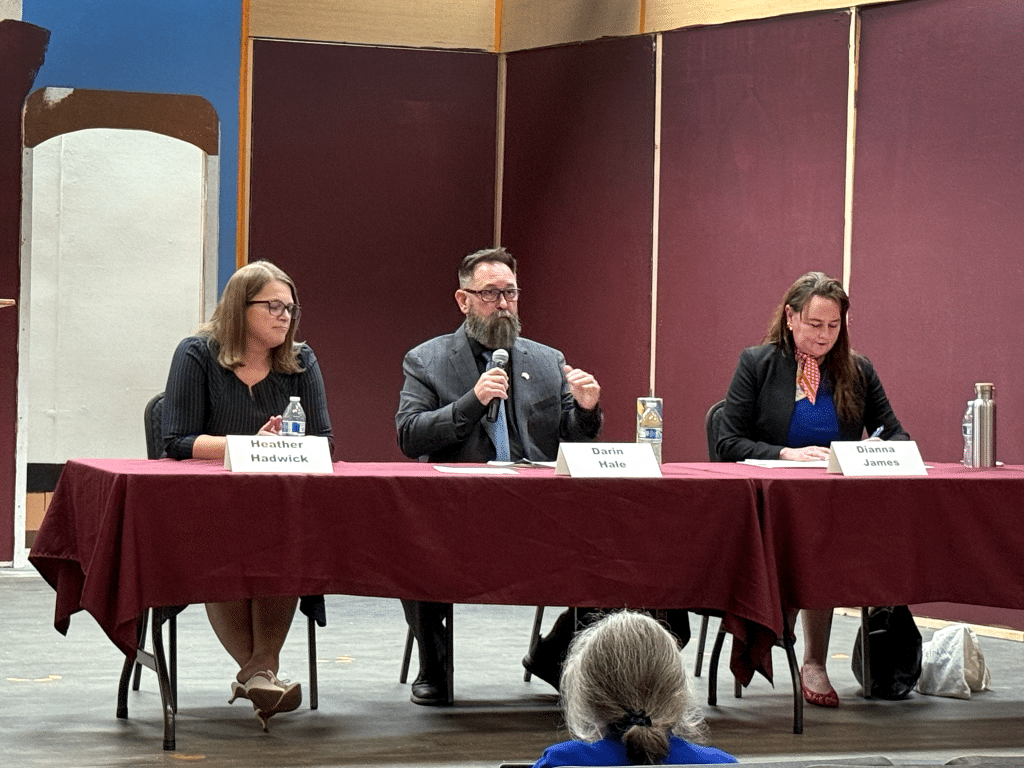
When it comes to state politics, Darin Hale says, compromise is not the answer.
It was one of the central messages for his campaign for California State Assembly, the lower house of California’s legislative branch, and one of the bodies responsible for passing new state laws. At a local candidate forum in the lead-up to the primary, Hale made his opposition to cross-party partnership clear, as he blasted the incumbent, Heather Hadwick, for “reaching across the aisle,” at the expense, he expressed, of rural constituents.
His message does not appear to have resonated with voters. Hale is currently firmly in last place as both local and state election results continue to come in.
District-wide, Hadwick is leading with 50% of the vote. With just 13%, Hale is trailing far behind both Hadwick and Democrat Diane James, who secured 37%. The results are similar in Shasta.
In what is known as California’s “jungle primary” system, the top two vote getters for statewide offices, regardless of party, move onto the general election in November. This morning, Hale made a public statement conceding the election and congratulating both Hadwick and James for their success.
“To Heather Hadwick and Dianna James, congratulations,” he wrote on social media. “I look forward to seeing you two mix it up on the campaign trail in the coming months.”
Hadwick, a Modoc rancher, agrees with Hale that rural and conservative voters are at a structural disadvantage when it comes to advocating for themselves — especially in a house overwhelmingly controlled by a Democratic supermajority, many of whom represent urban areas. Where she parts with Hale is on the question of collaboration. She believes strongly in partnering with blue assembly members to push through bipartisan legislation, something she says is a matter of strategy.
“I am in the super-minority,” Hadwick explained at that same speaking event with Hale last month. “I need 21 people to vote with me every time — I’m going to work across the aisle. I will never apologize for that.”
Locally, Hale’s campaign has had its moments of controversy. In the week leading up to the election, he posted an AI-generated video of himself assaulting a teacher as a campaign ad, eliciting a polarized reaction from the public. Redding Mayor Mike Littau responded to Hale’s post, saying “if your politics are making you wish harm on people who think or look differently, you are on the wrong path.”
Despite the outrage, Hale stood firm behind his video, saying it represented his frustration with a “war on kids” being waged against students by California’s current public school system.
A recurring theme: how to address structural disempowerment
When it comes to the debate over whether bipartisan collaboration is productive or futile, the theme extends beyond Hale and Hadwick’s campaigns. A similar dynamic is at the root of multiple political movements in the North State that hope, by whichever means, to separate from the state of California entirely.
In the wake of Prop 50, Assembly member James Gallagher — who’s poised to replace the deceased Doug LaMalfa for the remainder of his term this year — presented a proposal at the state capitol in 2025. He advocated for bisecting California into coastal and inland parts, framing the idea as a move toward rural Californian’s right to “self determination.”
Meanwhile, other state-building movements that share the same central premise, that California’s supermajority is incapable of prioritizing the needs of rural constituents, have taken a different approach in their strategy for separation. New California State, a political group with local ties that aims to carve out a state from California’s rural interior, does not believe in working within the system as a means to fight its way out of it.
“This is a rogue government,” Paul Preston, the founder of NCS said last year in reference to California’s government, and its leader, Governor Gavin Newsom, who he’s referred to as an insurrectionist.
Preston also showed disdain for Gallagher, calling his proposed map of two Californias a “laughing stock.” But Preston did acknowledge that he and Gallagher have somewhat of a shared goal, saying they’re both aware of fatal flaws in state government.
“I think Gallagher is kind of reaching — out of desperation,” Preston said, “because the system is failing entirely. He sees that. He understands that.”
In some parts of the North State, Gallagher appeared in two places on voters’ ballots, where according to the latest results, he appears to have won both races.
He gained 63% of the vote, in his successful attempt to fill LaMalfa’s term, which ends in six months. Gallagher also ran to hold on to that congressional seat in the next election cycle, alongside other regularly-scheduled congressional races across the state. He’s currently leading in the polls for that race as well, with 47% of the votes, district-wide. Democrat State Senator Mike McGuire is in second with 38%.
As the heir apparent to California’s newly redistricted District 1, Gallagher’s longer-term role will not include Shasta County. Shasta’s now part of District 2 where incumbent Democrat Jared Huffman has soared far above his seven competitors with 50% of the vote.
Do you have a correction to share? Email us: editor@shastascout.org.
Comments (2)
Comments are closed.
Related Articles
Supervisors eye replacing Steve Kerns as planning commissioner
The agenda item was brought forward by Supervisor Corkey Harmon, who hopes to replace Kerns with civil engineer Kevin Butler. Kerns said the first he heard about his replacement was from a community member who read the board’s agenda. Harmon disagrees.
Redding’s fire chief has retired. The announcement came Friday, which was also his last day
After serving as chief for six years, Vanlandingham’s sudden departure is part of a wave of turnover among Redding’s leadership in recent months.
Could Shasta’s elections official actually hire Tina Peters?
The answer is complicated and would involve factors at both the county and statewide levels.
I will echo others in decrying Hale as an utter embarrassment to the community as a whole. To characterize this man as a loose cannon and a wild eyed extremist – is gross understatement. It shames us all that he holds any kind of elected or leadership position.
Hale is an embarrassment to all of Northern California.