
Shasta ROV Clint Curtis addresses federal subpoena, says he wants to hand off ballots for transport to court
Curtis has been instructed to bring voted ballots from the June election to a federal grand jury in Sacramento. Discussing how complex that will be, Curtis said he’d be happy to hand off the ballots to federal law enforcement or state election officials instead. Doing so would violate the law, some experts say.

Shasta’s top elections official, Clint Curtis, confirmed today that he’s received a federal subpoena to appear in court in Sacramento later this month.
He said he’s excited to meet with the grand jury to share whatever information he can, adding that he believes they’ll ask him about what he referred to as “counterfeit ballots” from the June election. He also noted that he’s been trying to get a one-on-one meeting with President Donald Trump about his concerns but has not yet been successful.
Over recent months, Curtis has claimed that ballots from the June primary, which he has already certified, don’t “look, feel” or “smell” right. He said today that testifying in federal court will give him a chance to make things right with the election he ran earlier this year.
“This could solve the problem,” Curtis said, of the grand jury process.
As part of the subpoena, Curtis was told by the court to carry tens of thousands of voted ballots to Sacramento where he’ll meet with the grand jury. Curtis noted the complexity of such a process, saying he’d rather hand the ballots off to someone else for transport, if possible.
“They wanted everything.” Curtis said. “I don’t know if they have a concept of how big that is. It’s probably 50 boxes, 100 boxes, I don’t know.”
Curtis suggested he’d have to “rent a U-Haul or something” before adding that maybe the Secretary of State’s Office would be willing to transport the ballots, or federal law enforcement officials could.
“Please come get it,” Curtis said of ballot materials. “Lock it away. Do what you’re supposed to do with it. Don’t make me drag 100 boxes down, load a truck and drive it to Sacramento. That just seems excessive.”
Handing ballots over to either state or federal officials appears illegal under a new California law passed earlier this year, which forbids elections officials from handing off voted ballots. Shasta County Deputy CEO Stewart Buettell also provided an April memo from the Secretary of State’s Office today, emphasizing a longer-standing state law that says ballots shall be kept by the local elections official “unopened and unaltered” after they’re counted. The official said that Shasta County has no comment on Curtis’ plans for ballot transportation.
Curtis said he’d still want to hand the ballots off for transport and would also consider leaving them with the federal court itself after transporting them there. Asked if he’d sought legal advice from Shasta County Counsel Joseph Larmour, Curtis said he’d provided the subpoena to him before referring to Larmour as “a horrible attorney.”
The California Secretary of State’s Office has not responded to a request for comment on the appropriate chain of custody for transporting the ballots in compliance with the law. And a spokesperson for California’s Department of Justice said only that the agency is “monitoring the situation closely,” adding that there is no additional comment at this time.
But an attorney with the UCLA Voting Rights Project, Legal Director Chad Dunn, weighed in this afternoon. Dunn’s organization has been involved with legal action by the state against Riverside County Sheriff Chad Bianco over his seizure of ballots earlier this year in response to unproven claims by local activists of election fraud.
When it comes to the instructions given in Curtis’ federal subpoena, Dunn said, the elections official appears to have a clear path to transport ballots legally, as long as the documents remain in his custody throughout the process.
“As long as the materials aren’t disturbed, and the chain of custody and other protections are in place,” Dunn explained, “the grand jury being able to inspect these records as part of their questioning of the elections administrator seems to be within the bounds of the law.
“But under no circumstances should federal law enforcement be taking custody of ballots,” Dunn emphasized. “They have to be handled by the local election official.”
He noted the work of Justin Levitt, a constitutional law scholar and professor at Loyola Law School. Levitt did not respond to a request for comment today, but his recent writing about Bianco’s seizure of ballots referenced federal law that appears to require elections officials to retain exclusive custody in most cases.
“The law is designed to ensure that the records stay in one identifiable place,” Levitt wrote for Lawfare, “where everyone knows they can be found. Government officials with legitimate needs can inspect the records and take copies, but nobody other than the registrar gets exclusive custody, so nobody has to work through a wild goose chase if there’s a need for access.”
Reflecting on the unique circumstances in Shasta right now, Dunn said that believes the public should be “concerned but cautious.”
“If the situation is that federal law enforcement wants to inspect election records, and if they do so while they remain under the custody of the elections official in a way that doesn’t disrupt their chain of custody and organization, then this is a proper exercise,” Dunn said.
“If they are removing the ballots from the elections office or breaking the chain of custody, that’s something about which the public should be deeply disturbed.”
Madison Holcomb contributed reporting for this story.
9.11.2026 5:11 p.m.: We have updated the story to include comment from the DOJ.
Do you have a correction to share? Email us: editor@shastascout.org.
Author

Comments (33)
Leave a comment
Related Articles
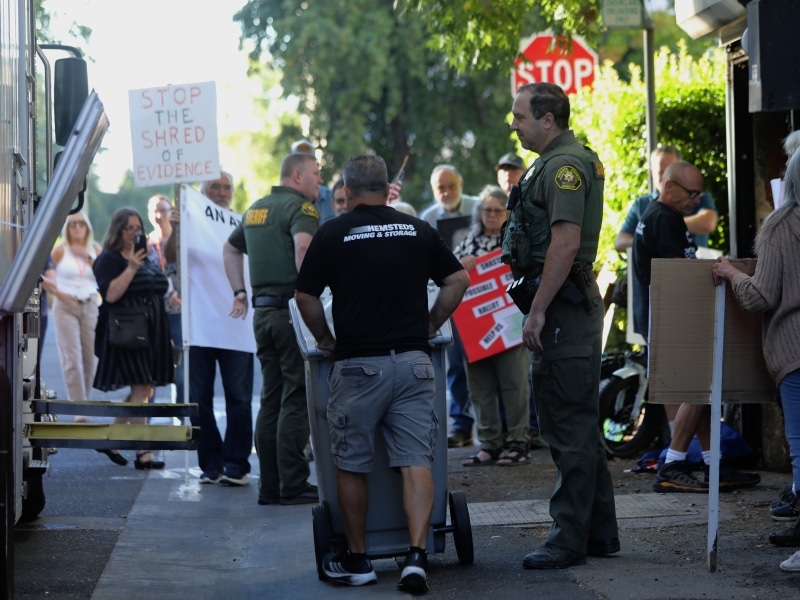
ROV Curtis oversees shredding of 2024 ballots amid activist protest
Several dozen people protested the mandatory shredding of 2024 ballots at the election office today. Amid the chaos, election official Clint Curtis supervised the proceedings with his signature cheerfulness.
Shasta County risks litigation after attempting to shield federal subpoena
The First Amendment Coalition has issued a legal demand on Shasta Scout’s behalf in an attempt to compel disclosure of a federal grand jury subpoena under public records law. A board meeting to discuss anticipated litigation is scheduled for Monday.
Meet Christina Prosperi for Redding City Council
There are nine candidates running for three seats on the council. Prosperi is a local business owner who wants to focus on the city’s budget, filling top leadership positions, collaboration within the council and staff morale.
I hope someone from the CAO’s office will be accompanying Mr. Curtis with his truckload of smelly ballots. He’s used to having babysitters monitor his behavior.
Clint will obviously have his wife load the (enter exaggerated number) boxes on a Saturday into a Lindell paid for rent-a-van driven by Hobbs while he tans himself under florescent bulbs. The ballots will be locked securely in a linnen closet in Mar-a-loco until at which time they can be properly sniffed for accuracy by the Q-anon shaman.
Justice will be severed.
I’m wondering where the Easter Bunny is in all this BS. What about Santa Clause? We should start a new holiday called Thieving Clowns Day… swear to God.
With only limited exceptions that have been established by Federal statutory law and/or Federal case law, California restrictions established by California statutory or California case law as to the possession of cast ballots as they relate to ballots with Federal elections on them are not in play.
The result that our registrar of voters may and might get from the Federal grand jury may and might be the opposite of the result that he is seeking. We should know much more by September 25th.
The Federal grand jury operates in secret. The FBI and department of Justice operation is shielded for secrecy.
On September 25th, the only thing we’re going to find out is that nobody can speak or make public anything pertaining to the election investigations.
I hope I’m wrong. Will soon know.
The secrecy requirement is not applicable to witnesses as to their testimony without an uncommon federal district court order. There is no reasonable expectation that such and order would be issued in the matter in question. Our registrar of voters suffers form Trump Syndrome: He cannot stop talking about what he does. We will know more on the 25th.
Only 3-1/2 more month and this endless charade will come to a screeching halt.
Why did he certify the vote when he thought it was “off”?
Exactly!
My thoughts XXctly.
We’re missing the point. Nothing will happen to Curtis. The county will do nothing and is hoping he’ll just fade away into the sunset come January. Unless, that is he sues us, as he has multiple times. Here’s what I think we’re all missing.
.
1. Clint, who says there’s voter fraud in Shasta County, has been in consistent contact with FBI and the DOJ, and he’s tried and tried to get a meeting with Trump, but the court adjudicator rapist ain’t picking up the phone.
.
2. The FBI and the DOJ are under trump’s control; they will do what he wants. And right now, that means using the FBI, DOJ, and USPS as his attack dogs to assault the voters of the United States. The adjudicated rapist is doing his best to use tools from the dictator’s playbook: a cult of personality, censorship, state-sponsored propaganda, lies, control of the justice system (DOJ), a private army called I.C.E., lawsuits in the Supreme Court, to name a few, and, of course, electoral manipulation! The would-be dictator knows his goose will be cooked if his party, the Republican Party, loses control of Congress in November 03. The fool is even trying to bribe the vote with $5,000.00 if they vote for the “Trump Platform.”
.
3. Clint is just a pimple on the rash on the gluteus maximus (butt…) of American neo-fascism. Really, all he has is lies and propaganda to build distrust in democracy and distrust in voting. (Which is funny, as much of the country is in the cult of trump anyway).
.
Since the wannabe dictator won’t pick up the phone or grant him a meeting, as he does for Clint’s pals, Tina Petters and Mr. Pellow, Curtis’s second-best option is to get the F.B.I. and D.O.J. to seize the ballots. But in this case, since this is California, he can only get the ballots taken by a subpoena, hoping the Eastern District of California grand jury and U.S. Attorney Grant (recently appointed by Trump’s Attorney Pam Bondi) will do what he has been dreaming of: call the ballots rigged and spread lies and propaganda for trump.
.
No, the U.S. Attorney, who works for Trump’s DOJ, is not after Curtis. Curtis is just a pathetic propaganda tool working for trump and the republican Party in hopes of discrediting our vote and elections, the very backbone of American Democracy.
Does Shasta Scout really need a law suit! Allowing people to constantly refer to the President as a rapist and pedophile is becoming common slander and I believe that the correct prescription under the law is about to descend upon all involved!
Can’t Wait
The word you are looking for is libel-slander is spoken, libel is written.
Does your reasoning apply to the president who publicly and continually calls Democrats “Sick Communists”? I’m a Democrat, should I sue? Ridiculous sounding, right? “McCarthyism” is alive and well in this president’s administration (and apparently here in Shasta County with some folks). It’s supposed to be the “People’s House”, the “People’s Government” and that includes the “People’s Voices”. Supporting those things is called PATRIOTISM (not partisan hack cronyism).
Accept it isn’t libel or “slander” when it’s 100% true and proven in court.
Get Whackenbush right on it there, Elmer J.
Truth is an absolute defense against libel/slander. The judge in the E. Jean Carrol case stated that what Pumpkin Palpatine did was tantamount to rape. There are credible assertions that he abused a 13 yr old girl and liked to go into dressing rooms when he ran beauty pageants. He is a creep, a pervert and a traitor. Stop embarassing yourself.
Selah
Listen at the 45 minute mark of the September 12 show, hour two… as both a reminder, and or maybe it’s new news to y’all… https://www.freedominactionradio.us/blog-news
Henry. Do you mean the Freedom in America Radio, a full-on Trump-aligned media operation? Sorry, but I would listen to any pimps for the white nationalist, sexist, racist court ajudacated rapoist – convicted 34-count felon.
While I appreciate the Scouts information but is it necessary to have a huge picture of this clown above every article? Consider that you are giving him exactly what he wants: Attention and the chance to preen before the cameras. Please continue the updated information but without the pics.
Why the taking of the ballots? If so suspect, the FBI sould be on site. I think that the failed ROV is suspect.
They have you cornered Curtis… your charlatan days are numbered.
Mr. Curtis doesn’t appear to know the law or how many boxes of ballots he is being asked to transport, preserve and protect to allow a Grand Jury to inspect them. And because, although he certified, he’s not sure why he certified them. He wants the President of the United States (who is responsible for currently managing a conflict, and looking for somewhere to dig up $5,000 per person to get voters to elect Republicans to Congress in the upcoming election) to help him figure out why something is bothering him about his job.
Hang on Mr. Curtis, someone who knows the job will be taking over for you. Next time, dont sign up for something you arent qualified for and dont want the responsibility it presents.
Well, Curtis sure enough possesses all the qualities which Trump appreciates; lying being top of the list. Also, Curtis seems to believe he can pick and choose which laws he follows without impunity; works for the US president, why not him? In regard to Curtis, I’ll be happy the day I can safely say, “See ya later, bloviator”. Same goes for Trump but on that day I’ll say, “See ya later Traitor”.
*with (impunity)
This guy needs to go!! More fake election crap!!! Thank Kevin Crye we need you and Corkey gone as well!! Shasta County would start serving the people, not your egos
Now Curtis can load a truck with our ballots and drive his ass to Sacramento. I doubt he realized that he had to be in a starring role for his election pandering. He will reek of his “stinky” ballots when he arrives. He should have to live with those ballots for the entirety of the grand jury inquest.
Curtis appears to be attempting to create a “scapegoat scenario” so he can blame the other guys… in this case federal agents.
That itchy feeling be the rope you placed around your own neck, Clint.
The State of California apparently doesn’t like the noises you make.
Neither does the majority public.
Infamy awaits your next move son.
Maybe it would be easier to transport the federal grand jury to Shasta County to insoect the ballots.
Janet’s suggestion is the only secure way for the Federal Grand Jury to inspect these ballots. It is not uncommon for juries to travel to a site to inspect evidence. Curtis says he has secured them all in a locked, sealed room, adding (and showing to the media) that he deliberately broke the lock for greater security.
The security of this evidence can hardly be assured if Curtis has to load “fifty boxes…maybe 100 boxes” (he claims not to know the actual count) into a U-Haul and transport it to the Federal Court in Sacramento “later this month” to present to the Federal Grand Jury.
Heads up! The Florida attorney turned instant Shasta County government official solely for personal interest gain (pig) has a few influential friends. The pig is already squealing about somebody making the subpoena transparent to the people of Shasta. Federal grand juries, the department of Justice and the FBI have a shield of secrecy regarding their investigations. Release what happens in a a Federal grand jury and you could find yourself in jail. Secrecy will now protect the Florida attorney and his forthcoming claim for damages. (Personal Interest gain obtained).
Undisputably, we will be left with some thinking the elections we’re corrupt and others believing they were honest with others unsure what to believe. Why wasn’t this resolved:
1. The Florida attorney turned instant Shasta County official failed to perform his duties. He had an obligation to provide leadership in seek criminal responsibility for those who wronged the election process. Clearly, he chose media and verbal conversations.
2. The Shasta County board of supervisors failed to performed their duties. They did nothing.
3. The Shasta County district attorney’s office failed to perform their duty. This is excusable due to the County supervisors defunding the department. It doesn’t have the funds or resources period. The defunding is so severe Violent criminals soon may not be prosecuted. (How much money is the supervisors spending on election integrity?)
4. Our local city governments officials failed to do their duty. Face with allegations of corrupt election process by a Shasta County official. The city of Redding, Anderson and the others local elected leaders chose to take no action.
5. Are great government of the State of California failed to do their duty and protect election integrity. They knew Time was of the the essence and still dragged their foot. Now with the federal government taking possession of the evidence while remaining in the custody of the Florida attorney turned instant Shasta County official they’re screwed.
We need to stay focused on crime prevention with a strong district attorney’s office and sheriff’s department. We need to stay focused on fire preparedness. And we need to stay focused on highway improvements that are important for everyone safety and benefit. How election integrity emerged to number one position shows a sad State of affairs for us all.
Thanks, Shasta Scout, for the in-depth reporting on this circus. Hopefully the CA. Attorney General and Secretary of State will get on this asap!
.
Yesterday, at the Republican midterm spectacle in Dallas, the court-adjudicated rapist – and convicted 34-count felon – didn’t merely say he would “cheat like hell”; he demanded that the audience raise their right hands and repeat a pledge to vote even if they were not registered and to “try and cheat like hell” in this Nov. 03 election. Then he stated that if they (Democrats) win, they would “get my friends, my family…” Well… one can only hope!
.
Fulton County, Georgia — Maricopa County, Arizona — Wayne County, Michigan — Riverside County, California — and now, Shasta County, California.
.
The Eastern District of California is led by U.S. Attorney Grant, recently appointed by Trump’s Attorney Pam Bondi, and started on August 11, 2025. Grant clerked for Justice Clarence Thomas during the Supreme Court’s 1994 term. I can hear the phone call now…
.
As reported by Shasta Scout, Curtis publicly raised his concerns about the ballots in July, saying he wanted federal intervention. “They don’t smell right…” Curtis also told Shasta Scout that he has been trying to get a one-on-one meeting with President Trump about his election concerns but has not succeeded. Wow, just wow… Now, the ballots are headed to the Eastern District of California court.
I wonder if the Hobbs crew will be in the truck with Curtis? That seems totally illegal unless the Sheriff or some county authority is involved in transporting the ballots…
.
Yeah, something doesn’t smell right at all.
Anyone aiding and abetting the vote thief clown becomes a vote thief clown at this point hence the process. It’s not necessarily the votes that are of concern obviously. Every clown has his and or her day. XX
Mr Curtis…I thought you wanted an investigation.
.
Don’t get cold feet now.
.
Prove your case once and for all!!