
A coalition of state and local advocacy groups are backing California’s suit against Measure B
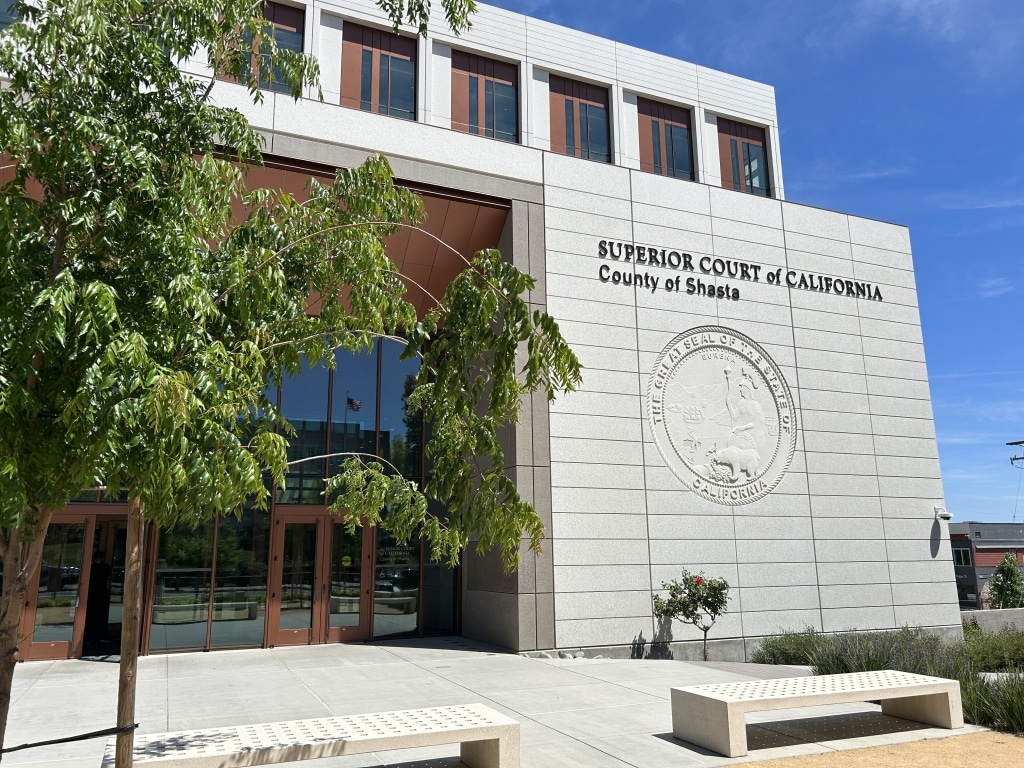
A legal document in support of California’s lawsuit against Measure B was filed last week. Advocates say implementation of Shasta’s new election law would disenfranchise voters.
“Local governments don’t get to write their own voter ID laws. The courts and the legislature have already settled this question.”
That’s a quote from Grace Zelphin, a senior attorney at the ACLU of Northern California. She’s referring to Measure B, a ballot initiative passed in Shasta this June that amended the county’s charter to implement voter ID, limited absentee voting and hand counting. The new election law is also slated to separate Shasta’s voter rolls from those of the state.
Along with the law firm Cooley LLP, legal representatives for ACLU branches in both northern and southern California filed the motion for a proposed amicus brief late last week. They’re representing a larger coalition of advocacy groups seeking to add support to a June lawsuit filed by California Attorney General Rob Bonta and Secretary of State Shirley Weber.
Other groups named in the ACLU’s legal filing include Asian Americans Advancing Justice Southern California, Asian Law Caucus, Disability Rights California, the League of Women Voters of California Education Fund and the League of Women Voters of the Redding Area.
The state’s lawsuit hopes to strike down Measure B on the grounds that it would be illegal to implement under state law. Advocates argued in the filing last week that Shasta’s new charter law would also unfairly disenfranchise voters.
The filing says that while laws like Measure B are ostensibly passed to protect election security, their “draconian changes” have the impact of suppressing voter turnout. Those changes, advocates said, will “uniquely burden voting rights among low-income voters, voters of color, voters with disabilities, and senior voters.”
In a press release about the legal filing today, the ACLU of Northern California focused on concerns that implementing Measure B would strip away voting rights by eliminating the way that more than 85% of Shasta voters currently vote: by mail. While current California law allows for universal voting by mail, Measure B’s language significantly limits who can vote by mail to include only the “infirm, military members, and U.S. citizens overseas.” That change would have a particular impact on seniors and voters with disabilities, the press release said, along with rural residents who live farther from polling places and people who can’t take time off work.
The ACLU’s press release also took a partisan framing, accusing Measure B of being “straight out of the same un-democratic playbook” as President Donald Trump’s recent attempt to seize California voting records.
The state’s suit against Measure B was originally filed in an appellate court, which sent the case back to the local trial court level for a first hearing. That preliminary hearing is scheduled for tomorrow, July 14 at 8:30 a.m. in the Shasta County Superior Court, Dept. 63.
July 14, 2026 12:52 p.m.: We have corrected the hearing date.
Do you have a correction to share? Email us: editor@shastascout.org.
Author

Comments (21)
Comments are closed.
Related Articles
Grief as a community bridge during Día de los Muertos event in Siskiyou
Leaders from two grassroots groups, Latino Outdoors and Seeds of Ancestral Renewal, came together last Friday with the help of Siskiyou County Arts Council for the second annual community celebration of Día de los Muertos.
Community members speak out during tense mental health advisory board meeting
Those impacted by the withdrawal of Kings View services shared concerns during a mental health advisory board meeting last week, saying the closure of a local mental health drop-in center had left gaps in care. Board members also navigated a number of other tense moments during the meeting.
Redding high school students call for tobacco ordinance enforcement
Students called on the Redding City Council to follow through on enforcement of a tobacco ordinance passed last year. Doing so, they said, would help address Shasta County’s high rate of teen tobacco use.


Is the last line correct or is the hearing on the 14th?
Constance: My apologies. The date was incorrect. We have corrected it with a correction notice at bottom.
It’s clear Measure B attacks our voting rights. How the proponents see it as a protection of our rights makes no sense. Even the Heritage Foundation -a conservative organization has published stats showing insignificant voter fraud over time. To deny voters the ability to vote by mail, ballot box, early voting and the other restrictions in the measure is unconstitutional breaking current state and federal law. I hope this gets settled quickly so we have no issues in November.
KD. I hear the claim that requiring voter ID is unconstitutional. Do you agree that our election laws mandate that you must be a US citizen to vote in a federal election? Do you agree that it’s reasonable to have a system that ensures that the opportunity to vote in federal elections is granted to US citizens and, after considering exceptions granted by federal law, denied to non-citizens?
If you agree with me about those two points, then the question becomes how should such a system be implemented? Measure B uses a heavy handed brute force approach, but gets the job done. Do you have a suggestion for a better process that ensures all votes are cast by eligible voters?
As for the fraud. Heritage is tracking court cases, instances where illegal activity has been proven in a court of law, with all the associated requirements of litigation. I’m outraged by the legal fraud, the kind of fraud that is obviously intended the thwart my right of representation via the vote. In my opinion, calculating district boundaries for the expressed purpose of guaranteeing an election outcome is an example of something both legal and fraudulent (Don’t care which party does it). I feel the same about ballot harvesting, drop boxes and the like.
Oh Bruce
There is nothing wrong with the current system. Widespread voter fraud is a right wing fever dream.
Selah
I suggest we use the voter’s signature to verify the validity of the person casting a ballot. Then have specially trained election office staff compare the ballot signature to the signature they have on record for that voter. Oh wait, that’s what we do now. Voter fraud is rare and easily detected. If you want to advocate for a law that requires all voters suspected of voter fraud be prosecuted, no exceptions, with differ penalties including possibly losing their right to vote permanently, I’m with you on that. Lastly, you may want to read the fine print on the back of the ID most of us have, a driver’s license, and get back to me before suggesting it should be used to determine voter eligibility.
You should have to show an ID to vote. It’s one million percent obvs babe.
Stop living in fear of stuff that’s not actually happening. Do you actually know what the process is before a person can become an active registered voter??
.
If you did then you would realize why it’s a trillion percent unnecessary to do what you want, honey.
Bruce, if only we had some safeguards to prevent illegal aliens from voting in the first place…
.
Oh wait… we do.
.
That must be the reason why it has been shown time and time again that there is not a mass army of illegal aliens voting in our elections…or any other type of mass election fraud.
.
But the fact of the matter is that you want to suppress some people’s legitimate votes because they don’t help your party to win.
Love me some Asian Americans Advancing Justice Southern California!
NC must stand for No Clue. Tell me you’re a racist without saying “I am a racist”.
Selah
Measure B scares democrats because it would make their lazy base have to work harder. It passed with a majority here. Remember that.
Measure B(ozo) is the product of the fever dreams of our local election fabulists. It is illegal, it was tried in Huntington Beach and went down in flames. MAGAts fear free elections because they can’t convince enough voters to support their insane policies, such as they are. Remember that.
Selah
Gotta show an ID. It’s coming.
Cringe comment…
Measure B, clearly illegal, is the local MAGA and a few statewide (Hi Mr. Haberbush) MAGA-backed last attempt to Trump-itize Shasta County elections.
.
MAGA is worried because they know they are polling with approval numbers underwater and in the toilet, just like their leader, a white nationalist wannabe dictator, war monger, conman, court-adjudicated rapist, convicted 34-court felon. So, as local MAGA has done in Shasta County for the last 4 years, and like the adjudicated rapist is demanding from Congress as we speak, local MAGA are once again in Shasta County court today.
.
Local MAGA knows that if the midterms were tomorrow, they would lose, about as badly as L. Hobbs, P. Jones, K. Crye, and C. Curtis did in Shasta County elections. So MAGA will try anything, including this L. Hobbs, P. Jones, C. Curtis stunt, to put voting under their control so they can manipulate the vote to stay in power. And they will lose “badly” in Shasta County, the California Appeals and Supreme Courts, hoping they can push their case to a higher court, of course, all at the expense of almost bankrupt Shasta County.
.
Meanwhile, because of the adjudicated rapist’s and his Republican Party’s economic policies, Shasta County taxpayers are barely able to buy groceries, gas, pay the rent, and obtain healthcare for their families.
.
Remember, there are 112 days until the November 3, 2026, General Election! Be sure to register and vote this MAGA nightmare out of office, like we did Jones, Curtis, and Crye, while you still can.
Ironic that the backers of Measure B are the County employees staffing our county Registrar of Voters office, put there by Kevin Crye and Chris Kelstrom. VOTE THEM OUT.
CLINT CURTIS: RESIGN NOW
oh no not partisan framing against a would-be dictator
Love me some ACLU!
To bad they have not done a dam thing defending local violations of homeless civil and constitutional rights…. Ever