
Open Notebook: Justice for the Dead
Our Open Notebook series offers readers a behind-the-scenes look at how our journalists work. In this notebook entry, California Local News Fellow Nevin Kallepalli shares why he reports on the dead, as well as the living.
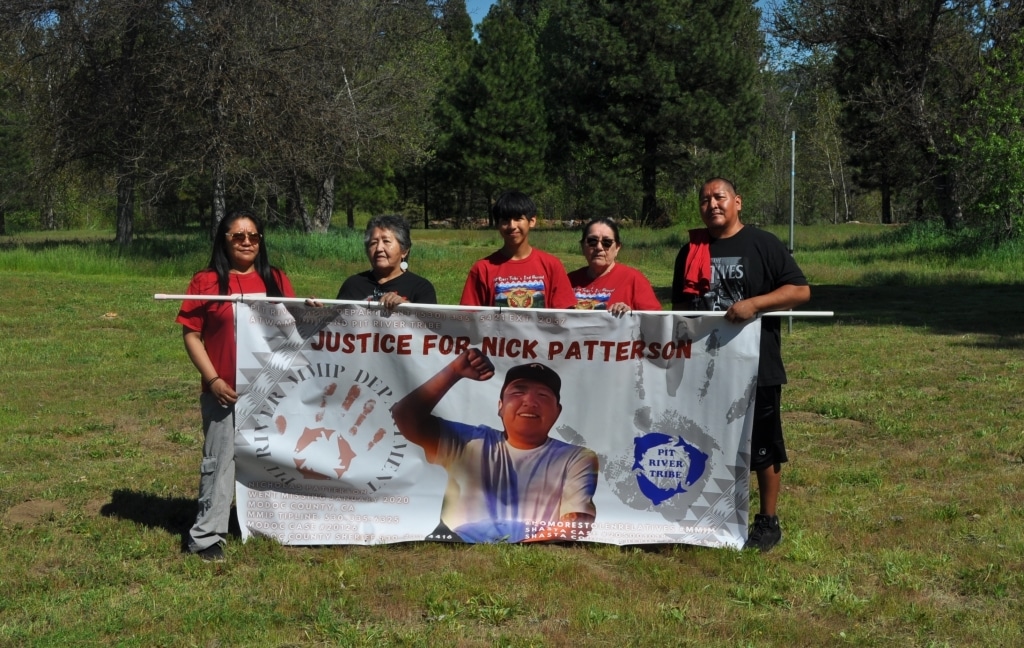
Last summer, about a year into my reporting fellowship with Shasta Scout, reporter Madison Holcomb and I visited Burney, California, for the first time. It was there that I met Lynette Craig at the Pit River Tribal office, where we sat for hours as she told us the story of her son Nick who went missing in 2020 and whose partial remains weren’t discovered until four years after he was last seen alive.
Madison and I patiently followed Lynette as her storytelling meandered through the fog of grief; the timeline of her narrative collapsed in on itself, her words fractal and circular at the same time. Particularly distressing to Lynette was how Nick’s skeletal remains had been handled by law enforcement after being found. When she recalled how long her son’s unidentified bones had been left sitting “alone” in a box in a cold evidence room, she said she had this feeling that Nick had been left “stuck” between realms. From her standpoint, part of Nick will always remain stuck: a portion of his spine was lost forever while he was being transported by mail from a DNA lab in Chico to the Modoc County Sheriff’s Office.
What resonated with me during this interview was Lynette’s focus on the trauma of having lost parts of Nick’s body — a literal second disappearance of her son — which she described as a comparable kind of pain to the first time he went missing. While clearly unintentional, the mishandling of Nick’s remains was an injustice and, for his bereaved community, should be understood as a violation of their right to mourn. It occurred to me that part of the Pit River Tribe’s mission of seeking justice for Nick was not just about revealing the exact circumstances of his death, but demanding accountability for the fact he was deprived of the opportunity to be laid to rest properly. To me this right is sacred.
I’ve come to learn intimately over my nascent career as a reporter that while the dead are the most defenseless, they are no less worthy than the living. Parts of Lynette’s story echoed international reporting on mothers that I have done in the West Bank and Kashmir. Sadly, her recounting also foreshadowed future stories of tragedy from mothers that would emerge over the second year of my fellowship in Shasta County. These testimonies were not just about a catastrophe as it happens in the immediate, they were also about the harmful reverberations that come after such tragedy and the state’s complicity at times in prolonging that harm rather than assuming its responsibility to mitigate it. At best, the state’s failures in cases like Nicks are negligent, and at worst, they are cruel.
From this reporting experience, I’ve learned that stories that outline the rights of someone after they die are often overshadowed by the stories of what killed them to begin with. Both matter. Lynette’s story and the others I’ve covered since reminded me of what I’ve previously observed with other bereaved families — that across the world, mourning an unresolved death can become a powerful political force.
In 2023 I interviewed Palestinian families whose loved ones’ corpses were seized by the Israeli army after being killed. The practice, known as postmortem detention, violates international law — regardless if the decedent was a combatant or civilian. One middle-aged man told me how “his life froze” the day his brother was shot dead by the occupation forces, after which the body was contained in a morgue in Israel across the heavily armed separation wall. It’s a boundary which those living under military rule in the West Bank, like the dead man’s brother, cannot access under any circumstance.
In covering separate guerilla uprisings in both Indian-administered Kashmir and the state of Punjab, each straddling the border between India and Pakistan, I heard stories about how tens of thousands of youths were forcibly disappeared by state paramilitaries, their mothers subjected to a very particular kind of collective punishment: never truly knowing if their child is dead or alive with no body to confirm.
We all read stories of war; headlines that amount to this many dead and that many wounded. And for Western audiences who may have never been exposed to armed conflict, the dignity of the dead may come as an afterthought in comparison to the conflict itself. But for affected families, it is at the forefront of their minds, and the state-enforced lack of closure is the catalyst that pushes them forward as they tirelessly demand answers from the government. After all, a family’s right to mourn and, by proxy, ensure dignity for their dead are not abstract concepts; they are codified explicitly by the Geneva Convention.
I was not expecting to encounter this dynamic again when I took a job with Shasta Scout in rural Northern California. But while stories like Lynette’s occurred in a totally different context, much of her circumstances, and her anguish, felt eerily familiar.
For example, California has laid out specific procedures for how correctional officers are to notify next of kin after an in-custody death. But even with these laws in place, my reporting has shown how difficult it is for bereaved families to obtain basic answers from the county after someone perishes behind bars. The family of John Adena, who died while incarcerated at the Shasta County Jail in 2019, had to issue a legal demand just to get his autopsy from the county, his sister told me, and she and her relatives were forced to bury him without knowing his cause of death. And the sister of Juan Moreno described how incredulous she was that she never even got to identify her brother’s body after his death in jail. These indignities leave families with no sense of control over how to process what has happened to them while continuing to vest near-total control in law enforcement, the very power which failed to keep their loved ones safe.
People’s stories do not end when they die, nor do their rights. Violence can be and is inflicted upon the dead when national forces, or correctional bodies at the state and county level, do not take accountability, or even extend basic decency to mourning families. But neither the dead nor their families are to be discarded, and this is why I do the work I do.
Today, I’ll leave Shasta Scout as my two-year fellowship ends. But when I’m gone, my former colleagues will continue to exhume these stories, buried in redacted public records like bodies hid in unmarked graves.
Do you have a correction to share? Email us: editor@shastascout.org.
Comments (14)
Comments are closed.
Related Articles
Open Notebook: The intersection of mental health and criminal justice
Our Open Notebook series offers readers a behind-the-scenes look at how our journalists work. In this notebook entry, reporter Madison Holcomb shares insights into the considerations she makes as she reports on criminal justice stories, especially where mental health plays a major role.
Open Notebook: As journalists, we too are threads in the fabric of our stories
Our Open Notebook series offers readers a behind-the-scenes look at how our journalists work. In this notebook entry, reporter Maya Nelson reflects on what it means to build relationships with sources and the public, and how those relationships play an integral role in shaping stories.
Open Notebook: Learning the relationship between caring and reporting
Our Open Notebook series offers readers a behind-the-scenes look at how our journalists work. In this notebook entry, summer reporting intern Moe Shimizu shares what she’s learned about the ways that care can inform meaningful reporting.
The bodies of dead prisoners and terrorists are often evidence of their crimes. If it takes some extra time and effort for their families to get remains and answers so be it.
.
Happy trails Nevin and best of luck!
Attempting to offend people is obviously your only joy in life.
A coward by definition.
Nevin, I will miss your sensibilities, compassion, honesty and clarity which you have given to your reporting here in Shasta Co. Wishing you good fortune wherever you go.
O/T:
Former Mesa County, Colorado elections clerk Tina Peters turned down a job offer to oversee elections in a conservative California county north of Sacramento, the Los Angeles Times reported Tuesday.
“She declined the offer because she’s running around the country right now trying to secure the elections,” Shasta County, Ca. registrar of voters Clint Curtis told the outlet.
Joanna Francescut must remain silent on this matter regardless of this recent development – her inaction and lack of leadership are a clear symptom that nothing will change at the county’s ROV starting January 2027.
Anything Mrs. Francescut says about the Tina Peters saga from this moment will reflect a true hypocrisy on her side.
Maybe you could keep your political junk off an article dealing with the disrespected dead!
What are you prattling on about? Why would Joanna have anything to say about Tina Peters?
.
I’m confident Joanna will keep her head down until she takes office in January, and then focus on doing the job. Running the ROV’s office like a three-ring circus isn’t on her agenda.
We will all miss your reporting. I appreciate all that you have done for us in Shasta County. I look forward to seeing your name on journalism awards and being able to say, “ I knew him when…”
Beautifully written, as always. Thank you for being with us these last two years.
Tremendous reporting – full of compassion and clarity.
Your writings have been tremendous and I thank you for giving your time to Shasta Scout.
I wish you all good.
Echoing everything said so far. Will miss your reporting. You are on your way to a distinguished career.
Thank you for your contributions to Shasta Scout, Nevin.
.
My own values don’t dovetail with those who believe that the remains of the disappeared are equal in value to justice for the disappeared. If I were close to a disappeared person, I’d want to know the circumstances of their death far more than the circumstances of some of their remains subsequently being lost, particularly if foul play is suspected in the disappearance. But closure is in the eye of the grieving beholder.
Thank you for all you’ve done for our community these last two years. I have made a point to read any article when I see you’re the aurhor. Best of luck in your future endeavors, keep up the great work! We need more journalists like you.
Consider the incredible effort the US military takes to recover even the slightest personal remains of those killed overseas, no matter how far in the past. The need to know and to hold should be honored, for all peoples. Excellent reporting the last two years Nevin.
Amen Brother.