
Open Notebook: The intersection of mental health and criminal justice
Our Open Notebook series offers readers a behind-the-scenes look at how our journalists work. In this notebook entry, reporter Madison Holcomb shares insights into the considerations she makes as she reports on criminal justice stories, especially where mental health plays a major role.

On Monday, a sentencing hearing was held for Robert Milton, a local man who killed his neighbor two years ago. Just moments before a judge announced the sentencing, the family of the man he murdered, William Dressler, had the chance to give victim impact statements. A couple of family members spoke in the jury box, standing behind large picture frames filled with photos of Dressler, who went by Bill.
His daughter tearfully recalled some of her favorite memories with him, including going to the park together and dancing to his favorite music as a child. She described her struggles from the past two years of battling grief while learning how to be a mother, and she emphasized the impact her father’s death will have on the rest of her life.
Bill’s ex-wife also wrote a speech, and it was read by a family member or friend. She said he was her best friend despite them no longer being married, and that his death has left a hole in the hearts of her and their family.
She mentioned the story I wrote almost two months ago about how the Shasta County Jail had suspended in-person visitations for nearly a year and how Robert’s mother, Missy McArthur, wasn’t able to visit him during that time.
“At least you can still see your son,” Bill’s ex-wife said, directed at Missy, who was sitting in the front row of the gallery just a few feet behind Robert. “We can never see our loved one again.”
It was a point I grappled with a lot as I was reporting on and writing the story about the prolonged suspension of jail visitations. While I was highlighting the well-documented costs of a lack of visitation — not only to incarcerated individuals and their families but to the entire community — I was inevitably brought back to Bill’s family, the grief they were facing and how they might react to the story I was writing.
It made me realize how complex reporting on murder through the lens of justice is, especially when a journalist is tasked with making the central subject of their reporting the one who committed the crime rather than focusing on the victim.
During Robert’s trial, I went to several of the court proceedings while reporting on the jail visitation story. There was usually at least one member of Bill’s family in the gallery, and I could often see the grief his family was carrying as they sat in the same courtroom as the person who ended his life.
They, like the jurors, saw Robert as a killer. But I had the chance to see him in a different light: as a son, a husband and a father.
When he was growing up, Rob, as Missy called him, was just a normal, hyper kid, she explained to me. He loved his dog, Spot, and playing board games. He got a bachelor’s degree in civil engineering, got married and had three children. He was on track to lead a productive life, she described, until at some point, mental illness took hold.
On Aug. 29, 2024, the day Rob became a murderer, he believed Bill was part of the Mexican Mafia or a cyborg, something later revealed during the jury trial. It was a day that Rob’s identity shifted to that of a killer, a new identity that he wasn’t viewed as for the far majority of his life.
At Missy’s house during a photoshoot for my story a few months ago, I noticed pictures on her walls of Rob. I remember feeling surprised at what I saw. I had never seen photos of him aside from the ones shown by the court and the media shortly before and after the time of his arrest, when he was in the throes of what appeared to be psychosis. I had expected his appearance to match how he’d been portrayed on local TV, as “Crazy Rob.”
But in Missy’s photos, Rob seemed so normal. I looked through pictures of him with his childhood dog, family portraits and photos of him during vacations through the years, both as a child and an adult, a son and a dad, sporting a wide grin in almost every picture. I saw something most of the Shasta County community likely hasn’t seen in him: humanity.
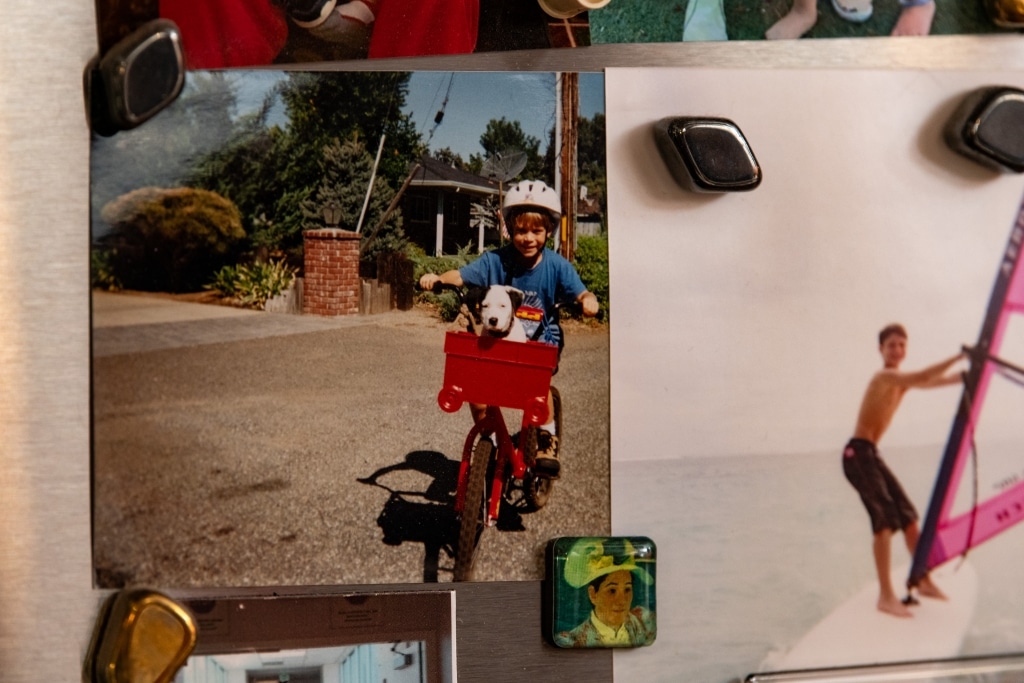
The illness that festered inside Rob’s mind practically erased the person he used to be, leading him to commit an atrocious and fatal act of violence, one that caused catastrophic impacts on Bill and his family, on Rob’s family — and on himself.
During the sentencing hearing on Monday, Judge Kathryn Barton referenced arguments made by the prosecutor that yes, there were signs showing that Rob’s mental wellbeing was dwindling in the time leading up to his crime. But having a messy house and posting conspiratorial videos about the Mexican Mafia aren’t direct tells that someone is going to commit a homicide, she said, acknowledging that this was a spontaneous and unforeseen event caused by paranoia and untreated mental illness.
“This case highlights mental health,” she said to the courtroom. “The insidious nature of mental illness.”
She sentenced Rob to 50 years to life in prison, knowing he won’t receive the help he would in a psychiatric institution, as the jury found him sane at the time of the killing.
For both Judge Barton and I, mental health was an unavoidable part of the entire story.
While I covered parts of the trial because I was reporting on jail visitations, the fact that Rob murdered Bill doesn’t really have anything to do with Shasta County suspending visitations of incarcerated people for almost a year. But I quickly learned through reporting this story that the mental health aspect was something that couldn’t be ignored, whether it was regarding the mental impacts of jail visitations or the mental illness that led Rob to commit his crime.
Also, as a reporter in a community that isn’t often sympathetic to incarcerated people, I knew I had to consider all parts of this story when reporting on and writing it whether they related to jail visitations or not, especially since Rob’s case was particularly high profile in Shasta. At Shasta Scout, we care about victims as well as those incarcerated, so it’s important to us that we don’t divorce the two.
Bill was close in age to my own grandfather, someone who I’m incredibly close with and would be devastated if anything happened to him. As I was writing my story, I kept thinking back to Bill’s family and how I would feel if I lost my Gumpas in this way. How would I react to a story that focuses on the injustice felt by the mother who couldn’t visit her son if he was a killer who had taken away someone I loved?
Though I could also understand Missy’s side. I know my mom would still want to see me no matter what situation I was in, and I’m sure many other parents would feel the same about their children.
While I tried to keep in mind these perspectives as I was writing the story to maintain fairness and nuance, I understood that sometimes, stories like these will never be received favorably by certain audiences for a variety of reasons. Partly, I knew that some people, especially some in Shasta County, only really see a criminal as their crime and not deserving of basic human rights.
But I wanted to at least attempt to broaden readers’ perspectives on incarcerated people and help them understand how things like visitation can have positive effects on entire communities. The heart of our mental health reporting at Shasta Scout is to protect our community from the very kinds of devastating crime Rob committed. We feel it’s our role to shine a light on the connection between policies that affect mental health, like jail visitation, and their known impacts, such as lower suicide and recidivism rates.
I started reporting the jail visitation story after Missy came to me months ago saying the Shasta jail had suspended visitations indefinitely, and that she just wanted to see her son. I had only expected to focus my reporting on holding the jail accountable for violating what experts saw as the rights of those incarcerated, initially a pretty straightforward story.
While the story didn’t require me to consider aspects like Rob’s impacts on Bill’s family, I felt it was important to carry these complexities with me as I wrote the story — for one, I didn’t feel that it would be morally right on my part to disregard the harm caused to Bill’s family when I was so heavily focused on Rob’s. And two, because that would likely be something on some readers’ minds, and I didn’t want to completely ignore the “other side” of Rob’s story.
My hope through writing this Open Notebook entry is to help people understand that many aspects of criminal justice reporting are incredibly complex, and that the people behind these stories — incarcerated individuals, their families, victims, judges, etc. — are more than how they’re defined in the public eye. They’re part of an elaborate system that contains shortcomings, prejudice and despair, one where people rarely walk away unscathed. Many people never get the chance to see past the surface, and my goal through writing these stories is to ensure that they’re depicted fairly and accurately.
The style of reporting I used for the jail visitation story, one where I was constantly empathizing with the individuals involved, isn’t exactly the neutrality journalists are expected to uphold in their daily work. One could argue that the act of putting myself into the shoes of these individuals brings bias into the reporting process.
But journalists are not bystanders. This approach is what I feel made the story more well balanced and complete. I didn’t remove my humanity and empathy because that’s what allowed me to report with compassion and complexity. The resulting story still remained objective, but it had more depth than if I had never considered the multifaceted layers of this overall subject.
Taking so much time to think about the damages caused to both Bill’s and Rob’s families was mentally taxing, and I often left court hearings and interviews with tears in the back of my eyes. In reporting about stories involving mental illness, I’m reminded how they affect my own mental health and likely that of many other journalists who do this type of work every day. Hearing about the devastations caused to families by mental illness from the families themselves while watching them express their grief is no easy feat.
This reporting was a mental battle in itself, but one I led with heart.
Do you have a correction to share? Email us: editor@shastascout.org.
Comments (22)
Leave a comment
Related Articles
Open Notebook: Justice for the Dead
Our Open Notebook series offers readers a behind-the-scenes look at how our journalists work. In this notebook entry, California Local News Fellow Nevin Kallepalli shares why he reports on the dead, as well as the living.
Open Notebook: As journalists, we too are threads in the fabric of our stories
Our Open Notebook series offers readers a behind-the-scenes look at how our journalists work. In this notebook entry, reporter Maya Nelson reflects on what it means to build relationships with sources and the public, and how those relationships play an integral role in shaping stories.
Open Notebook: Learning the relationship between caring and reporting
Our Open Notebook series offers readers a behind-the-scenes look at how our journalists work. In this notebook entry, summer reporting intern Moe Shimizu shares what she’s learned about the ways that care can inform meaningful reporting.
Compassion in XX… it brings the HATE into the wide open for everyone to see.
My humble opinion, some comments warrant censorship.
some comments warrant censorship.–some comments already are—-why are you afraid to use your name?
Ask Steven King if he’s afraid.
who is he?
I agree; some of the comments attack Rob’ upbringing. Basically, political attacks against his mother. Also, this article was not a news report. The facts of the crime and the conviction have already been covered. This article presents the human cost to to the reporter who tried to understand more than the basic facts.
News and compassion are not mutually exclusive. Both contribute to a better understanding. Beautifully written, as usual, Madison. Thank you.
Madison, your reporting is from the heart and provides us with interesting, if not vital, information and paths to understanding needed to do our part in a representative democracy. Not everything in life is “just the facts,” and callous reporting is just rip-and-read; if it bleeds, it leads. Just a sidebar, my first assignment as a failed Journalism Major was to read Capote’s In Cold Blood and do a 5-page report on it!
.
I can see how a criminal justice reporter, over time, can be like being a “war correspondent.” Both writers are sometimes exposed to sad and often insidious parts of humanity that don’t have clear answers or solutions, and that can take a real toll on the reporter. In this particular Robert Milton story, there seem to be as many questions, if not more, than answers.
.
As I’m sure you are aware, repetitive exposure to trauma can lead to PTSD. That said, if you’re going to do this kind of reporting, make sure you have a strong support system and healthy self-care practices. Also, I would think reporting on all the good stuff out there- and there’s lots, not just the bad and sad stories- is necessary. You seem to have a great working environment at Shasta Scout, and you’re fortunate. And our community is fortunate to have great reporting! Thank you.
I’ll be happy and interested to follow this series. More then ever we are all following our algorithms and losing nuance in our critical thinking.
There’s still a lingering belief that only monsters do bad things – never “good”, righteous citizens like ourselves. But there’s a pipeline from that to becoming unbalanced, and if there no intervention, to pathology and then a potentially worse fate.
It’s an uncomfortable reminder that all of us hold onto mental health by a thread. Our own intellect and humanity can be stripped away, or bolstered, by what we consume. So, thank you!
Madison – Being a 20 year crackhead is not a temporary mental disorder. That is a lifestyle choice. Giving them all hugs won’t make it better.
well said
Has anyone noticed that the murder/ mayhem rate went up significantly since this little XX Uprising? Do the math Trump fans and turn the National News channel off. Oligarch and those they dupe is frustrating to tolerate for the majority of citizens.
When he was growing up, Rob, as Missy called him, was just a normal, hyper kid, she explained to me. He loved his dog, Spot, and playing board games. He got a bachelor’s degree in civil engineering, got married and had three children. He was on track to lead a productive life, she described, until at some point, mental illness took hold.
It should read ” at some point drug addition took hold”—-methamphetamine took hold! If Missy didn’t know he was in danger of committing a rape or killing, she was the only one. I dare say Rob had a drug problem the last 20 years and Missy damn well knew it. Disappointingly this is what happens when you don’t have a functioning parent in the house. I saw Rob when he was 15, he had a lot of potential but no one to guide/discipline him.
Bingo: another meth head does violence.
And yet many people in this county actively support a court adjudicated rapist – who’s also a convicted 34 cout felon as president of the United States. Does trump do meth?
President Trump.
Lock him up for a million years without visitation. You wouldn’t make interesting biographical notes for a crazy child molester, so why for an insane grandpa killer? Human interest pieces need human interest. You can have that one for free.
It sure takes some chutzpah to swoop in from one of the nation’s murder capitals, with a homicide rate 10 times higher than Shasta County, and lecture us back country rubes on our need for a broader perspective of empathy towards a unrepentant murderer who you insinuate suddenly/temporarily became violent despite a much longer history that included assaulting his children’s principal, police officers, and his wife.
Well said.
Where do you get your information? Do you actually know these people or do you make shit up as you go?
Sources:
KRCR July 10, 2025 and March 12, 2026 (Perp’s violent history towards police, neighbors, children’s principal.)
.
ActionsNewsNow March 12, 2026 (Perp’s violent history towards his then-wife)
.
NPR Illinois (The author’s Chicago Metropolitan area origins)
.
CWB Chicago (Chicago being the homicide capital 13 years in a row)
You have mucho heart Gfriend.
Thank you for your ability to show the whole picture, and your kind heart to see and feel all aspects of this tragedy for all of our families.