
In the North State, changes driven by redistricting loom. Some fear a loss of representation, others see opportunity
Proposition 50, passed by voters last year, redrew part of the North State into a new district, one likely to elect a Democratic representative this November. Sources are divided on what that will mean for the North State.
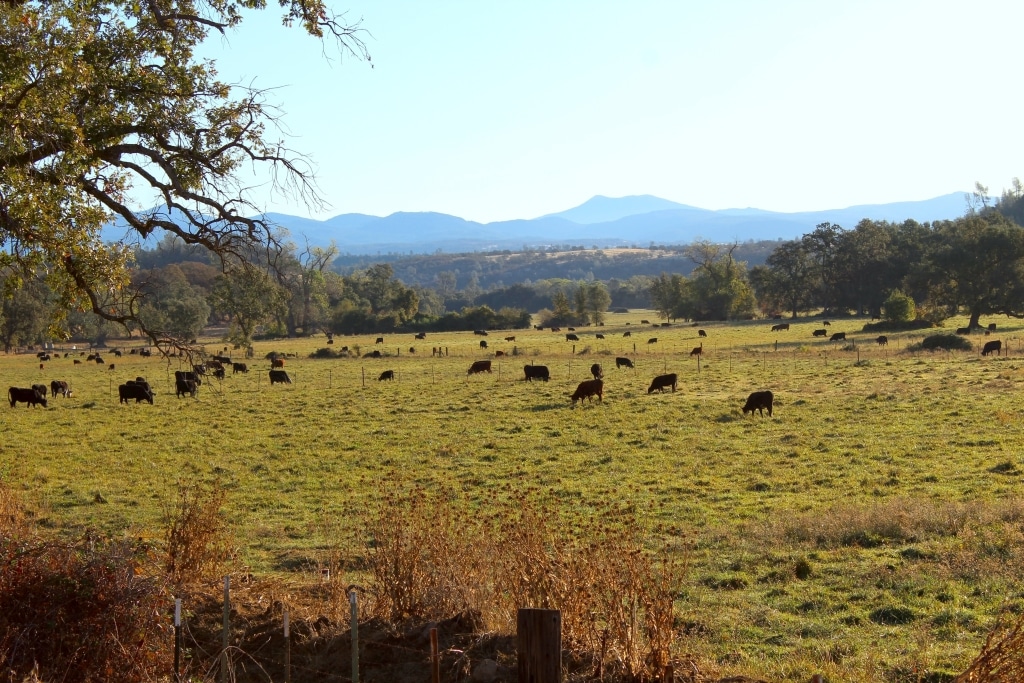
Brian Stephenson is a fifth-generation cattle rancher, and his family’s property in Bella Vista was established in the mid-1800s after his ancestors immigrated from Germany. For the past year, an unlikely subject has weighed on his mind: California’s Proposition 50.
The measure, passed by voters last November, partitioned Shasta County and other parts of the North State from District 1, which was represented for years by Congressman Doug LaMalfa before his unexpected death in January. Under Prop. 50, the region now lies within the heavily Democratic District 2, a coastal region mostly populated by the cities just north of San Francisco.
At a time when Stephenson is encountering problems new to his family ranch, including affordability issues in the agricultural industry and the incursion of wolves into Shasta, he’s worried the concerns of the North State — which he trusted LaMalfa to understand and advocate for — will be significantly outweighed by those of the liberal, urban and affluent North Bay.
“The biggest concern is we just become the kid in the back of the class nobody pays attention to,” he said, “and we don’t have a voice.”
With the midterm election just days away, Stephenson is one of many conservatives in the North State fearing the impacts of a loss in congressional representation after the passage of Prop. 50. Given the political demographics of the redistricted lines, District 2 Rep. Jared Huffman, a Democrat, is all but certain to defeat opponent Robin Littau to represent parts of California’s far north, including Shasta County.
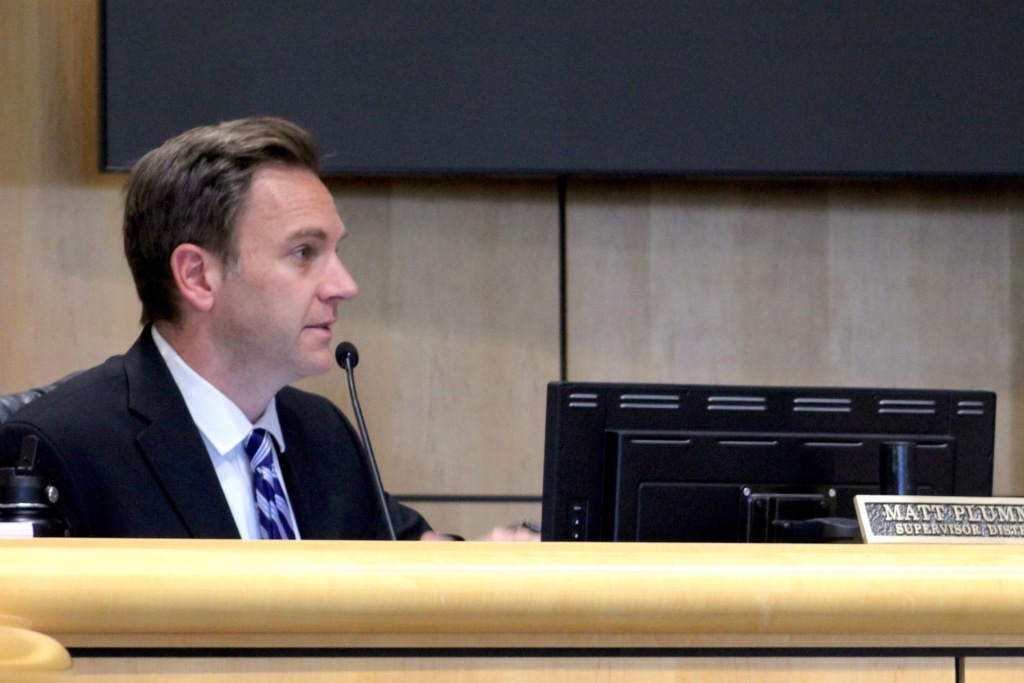
But not everyone is sure the impacts will be significant and widespread. Shasta Supervisor Matt Plummer, a Republican, said he thinks the impact of a change in representation on the North State will be less dramatic than people think.
“Could the average Shasta County resident point to one thing that LaMalfa did that specifically helped Shasta County?” he asked. “Could they point to three? I think that just goes to show you that [there is] probably not going to be a huge impact.”
One thing is certain: Prop. 50’s redistricting shift will prove a historic moment for the North State, one that is just a piece of a nationwide conflict between the Democratic and Republican parties.
What is Prop. 50, and how does it fit into the national redistricting fight?
Geographically, the North State is defined by its vast forested, mountainous and agricultural land. Those who live there often identify strongly with the rural lifestyle, and the area’s deeply conservative politics fuel resentment with the state of California and its major cities, driving secession movements like the State of Jefferson.
Before Prop. 50 was passed by voters last year, California redistricted using the independent and nonpartisan Citizens Redistricting Commission. Prop. 50 took redistricting from the hands of the commission and placed it back with the California State Legislature. The new measure will sunset in a few years, when the commission resumes drawing maps following the 2030 census.
President Donald Trump’s call for redistricting in Texas, an effort to garner more Republicans in the U.S. House of Representatives, led Gov. Gavin Newsom to launch Prop. 50 to try to add more Democrats. In the North State, the measure redrew congressional district lines to move Shasta, Modoc and Siskiyou counties from District 1 to District 2, which also includes Del Norte, Humboldt, Marin, Mendocino, Sonoma and Trinity counties.
The majority of the North State voted against Prop. 50, but those votes held little weight compared to the state’s urban population, as the measure passed by 64% across all of California. In the new District 2, Democrats within the coastal counties largely outweigh all of the registered voters in the North State.
Benjamin Schneer, an associate professor of public policy at the Harvard Kennedy School, researches political representation. He said he views Republicans across California, including those in the North State, as “collateral damage” from the national redistricting fight spurred by Texas legislators. He noted that what California, Texas and other states have done is known as gerrymandering, which is when districts are redrawn to give a political party or group a partisan advantage.
Whether in California or Texas, Schneer said he sees gerrymandering as a “significant problem for democracy,” saying it goes against the purpose of the House of Representatives: to provide a voice for people with different views that live in different localities within a state. He’s especially concerned about how states are using gerrymandering as a political tool to advance a majority party and said he wouldn’t be surprised to see it continue in the future.
“I think the ethical concern has to be that it’s contributing to a practice that is making democracy or political representation work less well, that it is harming the representation of real people like the folks in Shasta County,” he said.
The new map for District 2 sprawls from San Rafael to Crescent City and east to the Nevada border, encapsulating a large swath of the North State. It would take more than 15 hours to hit most of the population centers of the new district, and multiple sources pointed out that a single congressional representative may struggle to show up for constituents across such a vast geographical landscape.
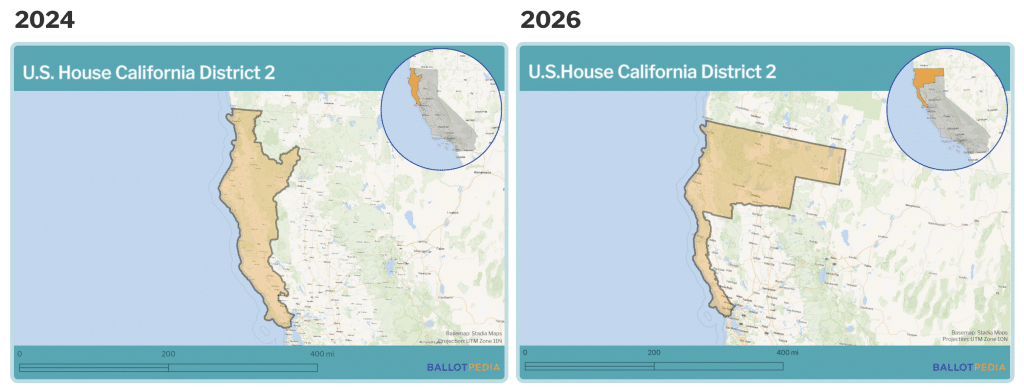
Schneer said he expects Rep. Huffman — if he wins — to face a major learning curve when it comes to representing the expanded region, which includes areas that are starkly contrasting in geography, politics and lifestyle.
From wolves to healthcare: Where the North State’s priorities lie
Congressional representatives like Huffman play a variety of roles at both the regional and federal levels. At the local level, one of their main responsibilities pertains to constituent services, where they assist residents in their district with federally connected matters like social services and immigration. Federally, they help shape national policies and direct funding.
Mary Rickert, a Republican and former Shasta County supervisor, said she hopes the new District 2 representative will focus on the wolf issue in the North State. She owns a large cattle ranch in Siskiyou County and said she has lost at least 23 cattle to wolves in the past four years, a major financial hit.
Aware that Huffman is likely to represent the North State, she said they’ve already met, and she’s been educating him and his team about top-of-mind issues in the region. When it comes to wolves, she hopes they can eventually be delisted from their endangered species status federally and statewide.
“It’s really a helpless, hopeless feeling as we try to navigate this,” she said, referring to the issue of cattle being killed by wolves in the North State.
Stephenson, the fifth-generation rancher, has similar ideas. He said he hopes his new representative will help navigate uncertainty around what he can or can’t do if a wolf enters his property. He feels the government should consider adopting delisting zones in California, something that’s been done in parts of Oregon. He also said he wants roads in the North State to be improved and for the government to require country-of-origin labeling on beef.
Stephenson hopes Huffman will meet with the Shasta County Cattlemen’s Association, which he is the president of, along with other agricultural-focused groups to learn about and address their concerns.
“Shasta County’s had a long agricultural history,” he said, “and there’s people that would still like to see it continue and not just get paved over.”
The North State is also facing major challenges when it comes to healthcare, which is top of mind for other community members as they consider congressional representation. Former Shasta Health and Human Services Agency Director Donnell Ewert, who currently serves as a board director of The California Endowment, said Congress should provide incentives for physicians to work in underserved regions like the North State, such as through a loan forgiveness program, to help address physician shortages.
Shasta County is also facing high suicide and substance abuse rates, and Ewert said a new representative should tackle the root causes by focusing on increasing education and workforce training opportunities, which could help people have hope for their future.
Ewert himself is a Democrat, and while he has mixed feelings about Prop. 50’s gerrymandering, he said this may be the first time he feels good about who his congressman is. He feels confident that a Democrat could help the North State with its issues, he explained, including ones related to not only public health but also wildfires and wolves.
“I hope people give him a chance,” Ewert said of Huffman. “Let’s try to engage with him about the things that people up here care about before making a judgment about whether he’s a good or bad representative.”
Shasta Board of Supervisors Chair Chris Kelstrom, who faces reelection in November, said he hopes the winning District 2 representative will focus on environmental issues he cares deeply about, including safeguarding bodies of water created by aging dams like the Battle Creek Reservoir.
Kelstrom, a conservative figure in the community, thinks losing Republican representation will be detrimental to the North State. But he’s trying to stay optimistic about the change in leadership and look for the possibilities even as he mourns the impacts he sees as likely given the new district lines.
“People are going to realize that we really lost representation that we took for granted, didn’t even know we had,” he said of LaMalfa’s leadership. “We’ll see. [Huffman] could prove me wrong.”
For much of the North State, LaMalfa’s most important asset seems to be how he physically showed up and the identity he shared with many of the region’s residents.
But LaMalfa also sponsored three federal bills that became law during his 13-year tenure and co-sponsored another 135 while serving as a consistent supporter of water storage in California.
As congressional leadership shifts into a new era, Supervisor Plummer has gotten a head start at forming a working relationship with Huffman. He met with the congressman in June in Washington, D.C., to discuss what he sees as the county’s priorities, which include behavioral health, housing development and criminal justice. Plummer explained that while he’s different from Huffman politically, they’re actually aligned on many local and regional issues.
“Unfortunately, what tends to happen is that when people are considering voting, they focus a lot on ideology,” Plummer said. “But at the local level, that’s less important. What tends to get not focused on is competency, and are [elected officials] able to deliver results to their locality or the district that they represent?”
Huffman’s plans for the North State
Huffman, who lives in Marin County, said he’s against California’s decision to gerrymander while also calling it a “necessary, temporary evil” to counter Trump’s push for redistricting in Texas.
“My job is to try to make the best of it and to try to give the area that has been drawn into the second district the best possible representation I can,” he said, adding that once the independent redistricting process is reinstated, Shasta, Modoc and Siskiyou counties will likely “go back to something that looked a lot like the previous district.”
To prepare to potentially start representing the North State, Huffman said he’s already driven through the area multiple times, from meeting with ranchers in Siskiyou to touring biomass plants, talking to Republicans and Democrats alike.
He acknowledged that trust is earned and said that if he wins, he’ll need to continue to show up for North State residents in order to overcome assumptions that a Democrat from the North Bay can’t understand them. To do so, he plans to open a fully staffed office in Redding. “It’s one thing to show up on the campaign trail,” Huffman noted, “but if you just disappear after that, it doesn’t mean a lot.”
While North State counties are different from the coastal counties, “it’s not like they’re different planets,” he said, adding that he has experience representing rural communities in parts of the district he’s served for more than a dozen years.
“I will work hard for people regardless of their political party, and many of them will be very surprised at how hard we work to do things for them,” he said. “But if there’s an expectation that … I’m going to vote like a Republican, people are going to be upset.”
Huffman hopes to begin his new term with a focus on the cost of living, which he said is felt across the rural-urban divide even if it shows up in different ways. For him, that includes pushing for an end to the war in Iran and halting trade wars, which he said are impacting areas like the beef industry.
Environmental issues will be another area of priority, Huffman said. He’s currently on the Natural Resources Committee in Congress, which includes the Water, Wildlife, and Fisheries Subcommittee.
In terms of his impact, so far two of Huffman’s sponsored bills have become law, including the Coastal Habitat Conservation Act of 2023 and a bill that allows “the Department of Agriculture to collect and spend fees for a marina in the Shasta-Trinity National Forest.” More than 120 bills he’s co-sponsored have become law.
Can a Marin Democrat speak for the North State?
Littau, the Republican candidate for District 2, knows predictions show she has only a 2% chance of winning. But she said she has “a 99.9% chance with God, and I just think I’m going to win.” If she does, she wants to focus on issues concerning water storage, wildfires, wolves and the affordability crisis.
While many of Littau’s priorities overlap with Huffman’s, she argues that the seasoned politician doesn’t have the life experience to represent the agricultural community in the North State, an area she said she’s well-versed in.
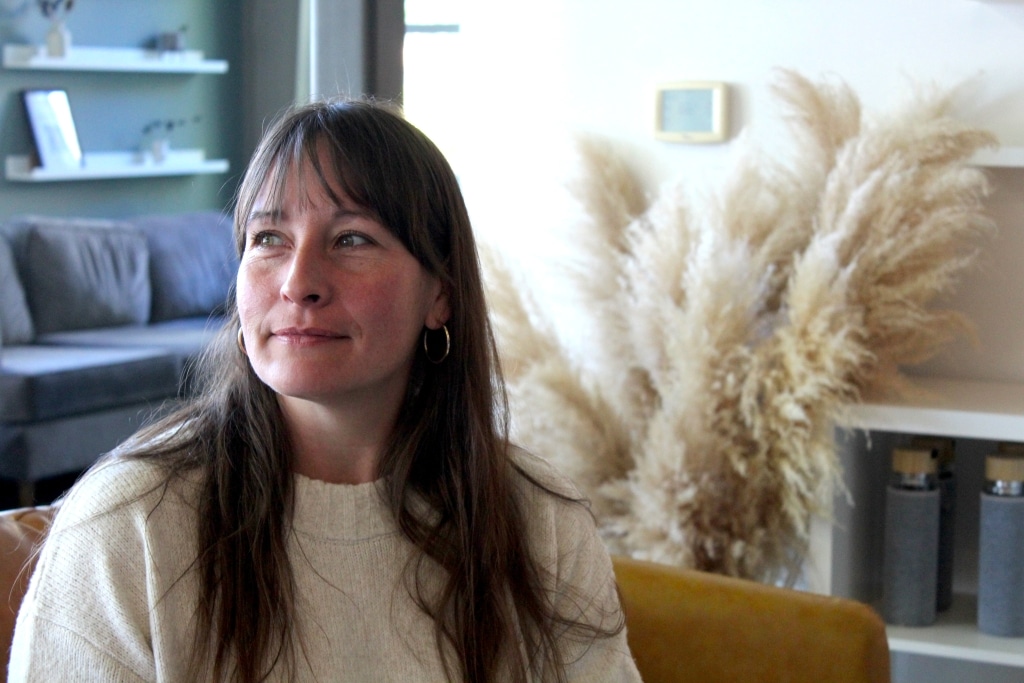
She also warned that a win by Huffman might enrage Republicans in the North State, comparing electing the Democratic congressman to represent people in Shasta and other parts of the region to “poking a bear that’s asleep.”
“I’m concerned at what that’s gonna look like when they don’t feel represented or heard,” she said, adding that the next step is “pure anger.”
Littau said gerrymandering only increases the kind of polarization that encourages California conservatives’ long-time push to secede and form a new state. It’s a sentiment that Lisa Pruitt, a rural law professor at the University of California, Davis, agreed with, saying Prop. 50 “fuels the fire.”
“These communities already feel unseen and unrecognized and unappreciated,” Pruitt said, “and so it’s just another way of depriving them of what they see as how little they have.”
Pruitt recently wrote a research paper that critiques California’s response to Texas’ redistricting, saying it undermines rural representation by tying North State counties to the urban North Bay. Her paper highlighted the concept of rural resentment, a phenomenon where rural residents feel overlooked or disrespected by urban areas and political decision makers, deepening the rural-urban divide.
She also discussed how district lines should be redrawn in the future to better consider communities of interest, or areas that have commonalities amongst their populations, saying that’s one way to affirm “that rural lives and livelihoods are critical parts of the democratic project, not merely peripheral to it.”
The North State is distinctive in terms of its shared commonalities, Pruitt wrote, “shaped by remoteness, scale, livelihood, and service deficits.” She said that nuance was absent from Prop. 50’s “ham-handed cutting and pasting chunks of far northern California.”
Now, she explained, “different parts of old CA-01 are tethered to the Bay Area in ways that shift the new districts’ centers of gravity to cities—and thus to urban concerns, along with urban attitudes and values.”
While Stephenson, the rancher with family property in Bella Vista, worries that Pruitt’s prediction of urban interests outweighing rural ones will come true, he affirmed that he and his community don’t plan to give up.
“In the ag-cattlemen-ranchers world, do we feel like we’re a losing voice? Yes,” he said. “Will it stop us from doing what we’ve always done, reaching out to our representatives and congresspeople, senators and other things? No.”
Have a correction to share? Email us: editor@shastascout.org
Comments (1)
Leave a comment
Related Articles
What to Know About Shasta County Ballot Measures E, F, and C
Measure E would prevent the county from using eminent domain to transfer property from one private owner to another, while Measure F would give the Board of Supervisors another way to fill vacancies when elected officials leave their positions early. Versions of both were rejected by voters in 2024.

In race for four open SCOE Board seats, Gorman has almost five times the donations of his closest competitor
With nearly $44,000 in campaign earnings, Gorman leads the pack among a pool of 10 candidates. He’s promoting a slate he hopes will win three of the open seats.
Shasta elections chief says he doesn’t plan to set aside ballots of individuals flagged by Trump administration
The U.S. Department of Justice attempted to sue California in an effort to force election officials statewide to set aside roughly 20,000 ballots it claims belong to noncitizens. The attempt failed in court, and Shasta’s Clint Curtis said he’ll obey the court’s ruling.


I am happy to see La mal fa left behind, no matter what else he did he was a toady for trump and a full blown maga, and his farm sucked hard on the government tit.
I look forward to Huffman being my representative..